Entity · Language
Hebrew
A reference page linking a name, group, or concept to the materials that discuss it.
A Northwest Semitic language of the Canaanite group, attested in inscriptions, manuscripts and diverse literary traditions from the Iron Age through Modern Hebrew; its stages, scripts and forms of transmission must be distinguished.
Estimated reading time: 8 min Published Last reviewed:
Share article
Text
Introduction
How can we identify ancient Hebrew, and what connects an inscription on a potsherd, a biblical text, a pointed manuscript and the Hebrew spoken today? Hebrew has a long history; it did not remain unchanged for three thousand years. This entry examines its Semitic relatives, dated evidence, writing and transmission, then considers the implications for reading divine designations in ancient texts.
In scholarship, “Hebrew” describes different historical stages, speech communities and literary registers. We must therefore identify the date and type of a witness before drawing conclusions about the meaning or pronunciation of a word. A manuscript copied in the tenth century CE is not an artefact written in the Iron Age.
Hebrew within the Semitic family
Hebrew is a Northwest Semitic languageSemitic languagesA branch of the Afroasiatic language family, including Akkadian, Ugaritic, Hebrew, Aramaic, Arabic, Ethio-Semitic and South Arabian languages; a linguistic, not racial or religious, classification.Glossary · Click to read the explanation, classified in the Canaanite group alongside Phoenician and several closely related varieties. This group is distinct from AramaicAramaicNorthwest Semitic language varieties documented since the early first millennium BCE, including Old and Imperial Aramaic, Syriac, Jewish dialects, and living Neo-Aramaic forms.Glossary · Click to read the explanation, although the languages share many roots and structural features. One comparative diagnostic is the “Canaanite shift”: Hebrew ṭōb, “good”, corresponds to Aramaic ṭāb. This sound correspondence is one piece of a larger linguistic argument, not a sufficient test for classifying every inscription. [1]
“Canaanite” is not interchangeable with “Hebrew” in every period. The term may refer to linguistic diversity in second-millennium BCE CanaanCanaanRegional name in the Mediterranean Levant, associated with Canaanite cities and cultures in the second millennium BCE and with Abraham’s family’s destination in Genesis.Glossary · Click to read the explanation, or more specifically to a language subgroup distinguishable in the first millennium. UgariticUgaritic languageAncient Semitic language preserved in Ugarit’s tablets on the Syrian coast, from the fourteenth–twelfth centuries BCE, written in a cuneiform alphabet.Glossary · Click to read the explanation, spoken at UgaritUgaritAncient city and kingdom at Ras Shamra on the Syrian coast, flourishing between the fourteenth and early twelfth centuries BCE and preserving multilingual archives.Glossary · Click to read the explanation in the Late Bronze AgeLate Bronze AgeAn archaeological period around 1600–1200 BCE in much of the Near East, with international diplomacy, exchange and religious diversity; its endpoints vary by region.Glossary · Click to read the explanation, provides valuable comparative evidence, but its exact placement within Northwest Semitic has itself been discussed and debated. [2]
From Canaanite evidence to early Hebrew
Canaanite features occur in Bronze Age correspondence written in AkkadianAkkadianAn ancient East Semitic language written in cuneiform from the third millennium BCE; its varieties include Babylonian and Assyrian, and it served in international diplomacy.Glossary · Click to read the explanation, including local glosses inserted by scribes. Such evidence illuminates the linguistic environment preceding clearly identifiable Hebrew inscriptions; it should not automatically be described as texts in Hebrew. Some of the earliest inscriptions assignable to Hebrew belong to the opening centuries of the first millennium BCE, while the epigraphic record becomes much denser from the eighth century BCE. The language of several earlier alphabetic texts remains disputed. [3]
Later evidence reveals dialect differences between the northern kingdom and the southern kingdom of JudahKingdom of JudahJudah was an ancient southern Levantine kingdom centered on Jerusalem in the Iron AgeGlossary · Click to read the explanation. Inscriptions can be compared with biblical prose, but dating one inscription does not thereby date the composition of an entire biblical book. Poems may retain archaic linguistic forms without fixing the date at which their surviving written form was edited. [3]
What do inscriptions tell us beyond the Bible?
The Lachish letters, written in ink on pottery shortly before the fall of Judah in the sixth century BCE, document Hebrew used for correspondence rather than solely for ritualRitualAn organised or distinguished practice meaningful to a community; it may leave traces, but its form alone does not reveal an associated doctrine.Glossary · Click to read the explanation and narrative. The British Museum, for example, holds the sherd known as Lachish Letter I, inventory number 125701; its catalogue identifies the inscription as Hebrew and the findspot as Lachish. That is a specific material witness, whereas reconstructing the wider political situation requires reading it alongside other letters. [4]
Other witnesses include ostraca from Samaria and Arad and the Siloam inscription, each with its own date, medium and purpose. Inscriptions document administrative and everyday writing as well as letter forms; they do not necessarily represent every speaker or social group. A securely identified artefact is a firmer starting point than a general claim about “what ancient Hebrew was like” based on one text. [5]
Biblical Hebrew is not a single moment in time
“Biblical Hebrew” denotes the language of much of the Hebrew Bible. Scholars distinguish archaic, standard or classical, and later features by considering vocabulary, verbal forms and syntax, among other evidence. A single work may also contain materials with different histories of composition, editing and transmission. These period labels aid linguistic analysis; they cannot automatically assign a definitive date to every verse. [6]
The text available to a modern reader usually comes from manuscripts copied long after the periods reflected in its earliest units. Its history also includes oral reading traditions and variant written copies. Comparisons must distinguish the language of the transmitted text, proposed dates for individual compositions, and the physical date of the manuscript containing them. [6]
Ancient scripts and ways of marking vowels
Iron Age Hebrew inscriptions use a consonantal alphabet generally called paleo-Hebrew. Forms derived from Aramaic writing gradually came into use, eventually giving rise to the square script familiar from later Jewish manuscripts. A change of script need not imply a change of language: Hebrew can be written in different graphic traditions, and Aramaic can be recorded using letter shapes very similar to those used for Hebrew. [7]
Early writing was not entirely silent about vowels. Certain letters, including waw, yod and he, could serve as matres lectionis, indicating some long vowels. Systematic systems of vowel pointing and cantillation, notably the Tiberian tradition, developed much later than the earliest inscriptions. Their value as evidence for pronunciation is substantial, but one should not simply project the entire medieval Masoretic reading onto every Iron Age dialect. [8]
An actual page of the Aleppo Codex
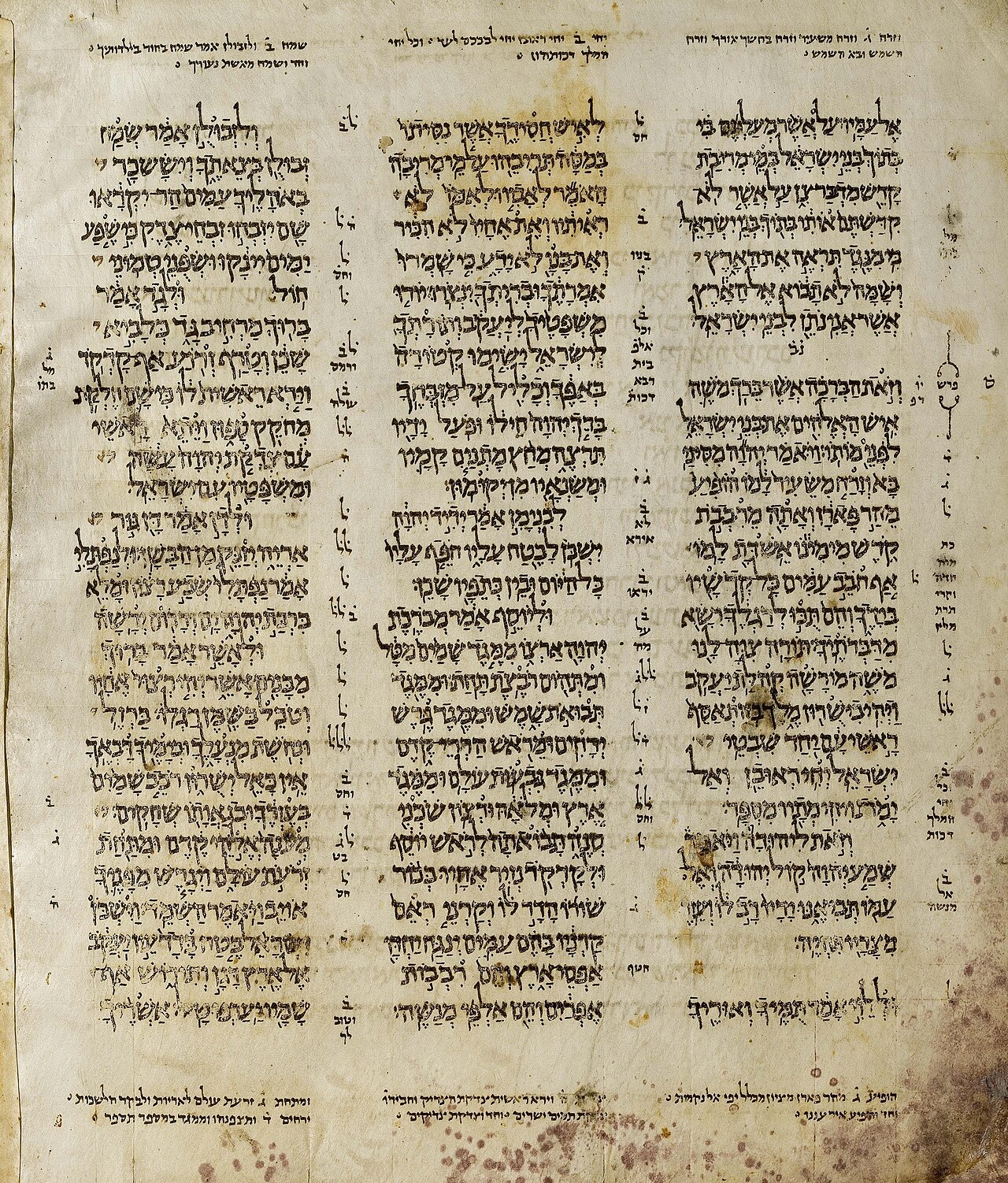
The cover shows a page of Deuteronomy from the Aleppo Codex, a tenth-century CE Hebrew biblical manuscript associated with the Masoretic tradition. Its consonantal text is attributed to the scribe Shlomo ben Buya'a, and its pointing and Masora to Aaron ben Asher according to the codex's tradition. The columns, vowel and cantillation marks, and marginal annotations can be seen in the image. It documents the preservation and reading of the Masoretic TextMasoretic TextThe Hebrew Bible’s transmission tradition combining its consonantal text, transmitted vocalization and accentuation, and Masorah notes. The consonantal text has ancient roots; surviving codices that bring these layers together in their Masoretic form are medieval.Glossary · Click to read the explanation, not the date at which Deuteronomy was composed. [9]
The Dead Sea Scrolls and textual plurality
Most of the manuscripts found around QumranQumranArchaeological site northwest of the Dead Sea near manuscript caves; its settlement and the groups who deposited the scrolls are studied together but not assumed identical. It is not synonymous with all Dead Sea Scrolls.Glossary · Click to read the explanation date from the last centuries BCE and the first century CE. The Dead Sea ScrollsDead Sea ScrollsManuscript collections from the Judaean Desert, best known through Qumran: diverse works, languages and textual forms, with copying distinguished from composition.Glossary · Click to read the explanation contain Hebrew, Aramaic and Greek texts. Even the Hebrew documents vary in spelling and script: most use square letters, but others preserve paleo-Hebrew. They include biblical and other literary compositions as well as documents; neither a single manuscript nor a single language describes the collection adequately. [10]
Some biblical scrolls closely resemble the later Masoretic tradition, whereas others show differences in spelling, readings or textual arrangement. The Samaritan PentateuchSamaritan PentateuchSamaritan Hebrew five-book tradition sharing an older textual history, with linguistic and theological variants, including readings involving Mount Gerizim.Glossary · Click to read the explanation represents another Hebrew textual and reading tradition with a distinct script. Such variation does not mean textual stability was impossible; it means that the older evidence cannot be reduced to one late manuscript tradition without examination. [11]
Spoken Hebrew, Aramaic and Rabbinic Hebrew
AramaicAramaicNorthwest Semitic language varieties documented since the early first millennium BCE, including Old and Imperial Aramaic, Syriac, Jewish dialects, and living Neo-Aramaic forms.Glossary · Click to read the explanation spread through administration and communication in much of the region, while Greek became prominent in Hellenistic and Roman cities. Hebrew nevertheless did not simply cease being used at the Babylonian exileBabylonian exileJudean deportations to Babylonia and the kingdom’s collapse in the early sixth century BCE; several phases, not everyone removed or returned at once.Glossary · Click to read the explanation. Documents from the first centuries CE, notably correspondence associated with the Bar Kokhba revolt, attest a form of Hebrew distinct in various respects from biblical prose. Multiple languages coexisted and were used by overlapping communities. [12]
The MishnahMishnahThe Mishnah is a rabbinic compilation assembled around 200 CE, organizing teachings and discussions by topic.Glossary · Click to read the explanation, compiled around 200 CE, is a major witness to the register conventionally termed “Rabbinic Hebrew”, with vocabulary and structures that differ from Biblical Hebrew. Scholars examine its connection with everyday speech and its long contact with Aramaic. The simple narrative of a “dead biblical language” suddenly revived in modern times therefore obscures many centuries of liturgical and literary continuity and changing spoken usage. [12]
El, Eloah and Elohim: what grammar can establish
The word ElSemitic ilAn ancient Semitic word meaning “god,” with cognates across several languages. It may function as a common noun or a proper name according to context; it is not always Ugaritic El.Glossary · Click to read the explanation (אֵל) can denote a god in Hebrew and appears in personal names and titles; verbal similarity alone does not establish that each occurrence denotes the deity ElElEl is a senior deity in Late Bronze Age Ugaritic texts, portrayed as father of the divine family and a council authority, alongside his consort Athirat. This entry does not cover every linguistic use of El.Glossary · Click to read the explanation known from Ugaritic texts. Forms such as EloahEloahEloah (אֱלוֹהַּ) is a singular Hebrew noun meaning “a god” or “God,” common in Job but also used for other gods. It is not the proper name of a separate deity.Glossary · Click to read the explanation (אֱלוֹהַּ) and ElohimElohimA Hebrew word with plural morphology, used for “gods” or for a singular deity according to context.Glossary · Click to read the explanation (אֱלֹהִים) also have context-dependent uses. Recognizing a word's form is only a beginning: its referent depends on the clause, literary setting and historical context. [13]
In Genesis 1:1, Elohim has a formally plural ending but takes the singular verb baraʾ (בָּרָא, “created”), so the expression has a singular referent in this clause. This does not settle every other use of the word or definitively explain its earlier morphology. Genesis 2:4 combines the name YahwehYahwehThe proper name of Israel’s deity, written יהוה (YHWH), the Tetragrammaton. Its exact ancient pronunciation is not directly preserved; texts and inscriptions witness its history.Glossary · Click to read the explanation with Elohim. The relationship between divine-name traditions and the literary history of the biblical books requires textual investigation, not a conclusion drawn solely from similar word forms. [14]
From medieval to Modern Hebrew
As Hebrew receded from general everyday conversation, it continued to be used for prayer, study, poetry, composition and translation in widely dispersed Jewish communities. Contact with Aramaic, Arabic and other languages shaped its vocabulary and written expression, while medieval grammarians and lexicographers developed systematic approaches to it. Continuity in literary use does not mean linguistic immobility or guarantee that a modern word had an identical ancient pronunciation and sense. [15]
The expansion of spoken Hebrew in the nineteenth and twentieth centuries drew on families, schools, writers and language institutions. Eliezer Ben-Yehuda was an important contributor, not its sole architect. The Academy of the Hebrew Language was established in 1953 after decades of work by an earlier Language Committee. Modern Hebrew inherits well-documented traditions, but it is also the language of a contemporary society, with sounds, usage and vocabulary that differ from the language preserved in ancient inscriptions and books. [16]
How to read a Hebrew word responsibly
Four questions guide interpretation: what kind of witness is involved (inscription, manuscript or printed edition), when it dates from, which stage of the language it represents, and how the word functions in its sentence and textual setting. One can then compare readings and related languages, keeping the surviving letters distinct from an editor's reconstruction or a scholar's hypothesis. Hebrew's history thus becomes a way of understanding texts rather than a label that erases centuries of variation.
References and notes (16)
- Dennis Pardee, “Canaanite Dialects,” in Roger D. Woodard (ed.), The Ancient Languages of Syria-Palestine and Arabia (Cambridge University Press, 2008). Complete chapter, pp. 103–107; especially the two uses of “Canaanite” and its distinction from Aramaic. Read in an openly accessible PDF and checked against the publisher entry. Return to the text ↑
- Dennis Pardee, “Canaanite Dialects,” and P. Kyle McCarter, “Hebrew,” both in Woodard (ed.), The Ancient Languages of Syria-Palestine and Arabia (2008). Pardee, pp. 103–107 in full; McCarter, pp. 36–38 only. Language classification is distinguished from geographical naming; Ugaritic classification is not settled by this reference alone. Return to the text ↑
- P. Kyle McCarter, “Hebrew,” in Roger D. Woodard (ed.), The Ancient Languages of Syria-Palestine and Arabia (Cambridge University Press, 2008). Opening section only, pp. 36–38, on historical setting, early evidence and dialect variation. The complete chapter was not consulted. Return to the text ↑
- British Museum, catalogue object “Lachish Ostracon I (Lachish Letter I),” museum no. 125701, registration 1959,0711.1. Indexed catalogue fields only: object, Hebrew inscription, provenance and accession; the complete museum page was blocked (HTTP 403). No claim to have read the full inscription. Return to the text ↑
- Academy of the Hebrew Language, “Hebrew through the Ages,” institutional historical overview. Read relevant sections on inscriptions, ancient Hebrew and stages of the language; a general overview, not a critical edition of any inscription. Return to the text ↑
- P. Kyle McCarter, “Hebrew,” The Ancient Languages of Syria-Palestine and Arabia (2008). Only pp. 36–38, read alongside the Hebrew Academy’s Biblical Hebrew overview. Chronological labels are analytical, not firm composition dates for individual texts. Return to the text ↑
- P. Kyle McCarter, “Hebrew,” in Woodard (ed.), The Ancient Languages of Syria-Palestine and Arabia (2008). Only pp. 38–39 on paleo-Hebrew and later Aramaic-derived scripts; pages beyond 40 were not read. Return to the text ↑
- P. Kyle McCarter, “Hebrew,” in Woodard (ed.), The Ancient Languages of Syria-Palestine and Arabia (2008). Only pp. 39–40, relevant to vowel letters and later notation; the whole chapter was not consulted. Return to the text ↑
- Wikimedia Commons, file description “Aleppo Codex (Deut).jpg,” c. 920 CE, manuscript authorship and licensing record. File summary, licensing section and file history read. The page both marks the scan public-domain and attributes a ©2007 photographic credit: the tension is recorded in the rights report. Return to the text ↑
- Israel Antiquities Authority, Leon Levy Dead Sea Scrolls Digital Library, “Languages and Scripts.” The Hebrew, Aramaic, Greek and script sections were read on the institutional page; collection-level evidence should not be projected onto each fragment. Return to the text ↑
- Israel Antiquities Authority, Dead Sea Scrolls Digital Library, “Introduction”; Ingrid Hjelm, “The Samaritan and Jewish Versions of the Pentateuch: A Survey,” Religions 11 (2020): 85. IAA introduction and textual-diversity sections read; Hjelm: academic abstract only (full article unavailable), not claimed as a complete reading of Samaritan witnesses. Return to the text ↑
- Academy of the Hebrew Language, “Hebrew through the Ages,” sections on Mishnaic and later Hebrew. Institutional sections read; continuous literary use is distinguished from the debated degree and geographic distribution of spoken Hebrew. Return to the text ↑
- Francis Brown, S. R. Driver and Charles Briggs, Hebrew and English Lexicon (BDB), headwords ʾēl (410), ʾĕlōhîm (430), and ʾĕlōah (433), as reproduced by Bible Hub. Online lexical entries for ʾēl and ʾĕlōhîm read, with the headword display for ʾĕlōah. Lexical categories do not settle etymological or historical controversies. Return to the text ↑
- Genesis 1:1 and 2:4, pointed Hebrew text as hosted by Mechon-Mamre. Both verses opened in Hebrew; singular bārāʾ with ʾĕlōhîm in 1:1 and the combined divine names in 2:4. This is grammatical observation, not a definitive theory of textual sources. Return to the text ↑
- Academy of the Hebrew Language, “Hebrew through the Ages,” medieval-stage overview. Relevant full section on liturgy, writing, learning and contacts with other languages; this is an overview, not a comprehensive sociolinguistic corpus. Return to the text ↑
- Academy of the Hebrew Language, “Our History,” and “Hebrew through the Ages,” Modern Hebrew section. Institutional history read concerning the Language Committee, language practices and the Academy’s 1953 founding; does not establish a single-person explanation for spoken revival. Return to the text ↑
Suggest a correction · Suggest a source for this record
Cite this record
IL Archive, «Hebrew», https://ilarchive.com/en/entities/hebrew
Continue reading