Entity · Language
Aramaic
A reference page linking a name, group, or concept to the materials that discuss it.
A diverse Northwest Semitic language family traced through early Levantine inscriptions, Achaemenid correspondence, Elephantine papyri, Biblical Aramaic, Syriac and living Neo-Aramaic varieties.
Estimated reading time: 8 min Published Last reviewed:
Share article
Text
Introduction
Aramaic names a family of related Northwest Semitic varieties, not a single language that remained unchanged from antiquity. Royal inscriptions, administrative letters, and religious manuscripts trace a language whose uses spread well beyond the communities first called Aramean and connected different societies across the Near East.
This article follows its early evidence, wider circulation, scripts, religious writings, and living descendants. It also asks how a word such as ʾĕlāh (“god”) should be read in context rather than used on its own to reconstruct an entire community's beliefs. [1] [2]
What is Aramaic, and how is it related to other languages?
Aramaic belongs to the Northwest Semitic branch, close to HebrewHebrewA Northwest Semitic language of the Canaanite group, encompassing Iron Age epigraphy, Biblical, Rabbinic, medieval and Modern Hebrew; its scripts and pronunciations changed over time.Glossary · Click to read the explanation and Canaanite, while sharing a more distant Semitic relationship with Arabic. The designation covers several dialects and writing practices with differences in pronunciation, grammar, and vocabulary. Texts separated by many centuries should not be treated as specimens of an unchanging language. The earliest securely attested inscriptions belong to the early first millennium BCE; references to Aramean groups in cuneiformCuneiformWriting with wedge-shaped signs, developed from Mesopotamian recording traditions and used for several languages from the third millennium BCE.Glossary · Click to read the explanation records are older than those surviving inscriptions. [3]
Some varieties were spoken in everyday life, while others served chancelleries and formal documents. Consequently, the history of Aramaic-speaking peoples and the history of surviving Aramaic texts are not interchangeable: the language used at home may be largely invisible behind a local official written standard.
Early inscriptions: kings, treaties, and divine names
The stele of King Zakkur, discovered at Tell Afis in Syria, is a witness to Old Aramaic. The Louvre catalogues it as a royal commemorative monument with an Old Aramaic alphabetic inscription, inventory AO 8185. This one object cannot tell the history of a whole language, but it shows the use of Aramaic in royal representation and monumental writing. [4]
The statue from Tell Fekherye, in the Khabur region, offers a particularly revealing comparison: a dedicatory inscription in Assyrian AkkadianAkkadianAn ancient East Semitic language written in cuneiform from the third millennium BCE; its varieties include Babylonian and Assyrian, and it served in international diplomacy.Glossary · Click to read the explanation written in cuneiform accompanies an Aramaic inscription in alphabetic characters. The scholar Frederick Mario Fales examined the relationship between their wording and identified the two texts as evidence of a shared cultural environment in the ninth century BCE. Parallel texts need not be verbally identical, and the presence of two written languages does not mean that all local inhabitants spoke the same tongue. The Sefire treaty inscriptions add evidence for the language of loyalty, oaths, and divine sanctions in Old Aramaic. [5]
From local kingdoms to a widely used language
Aramaic spread in stages through Aramean polities and through empires ruling linguistically diverse populations. In the Neo-Assyrian and Babylonian periods, its practical use expanded even as cuneiform writingCuneiformWriting with wedge-shaped signs, developed from Mesopotamian recording traditions and used for several languages from the third millennium BCE.Glossary · Click to read the explanation and other languages remained important. The Persian Achaemenid administration subsequently made extensive use of a widely shared written form, known to scholars as Official or Imperial Aramaic, for communications between distant provinces. [6]
An administrative language was not necessarily everyone's home language. A clerk might write Aramaic while speaking another language with family or neighbors. The relative uniformity of official texts likewise need not reflect the range of spoken dialects, which are often difficult to recover from administrative archives alone.
Elephantine: documents of work, family, and worship
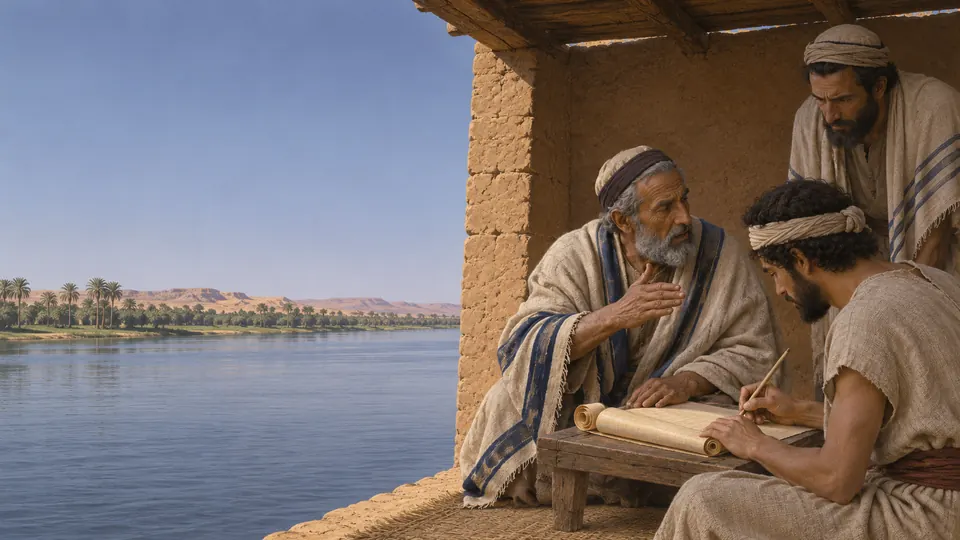
The papyri of ElephantineElephantine / YebElephantine / Yeb, near Aswan at the Nile’s First Cataract, preserves a long-lived Egyptian town, temples of Khnum and Satet, and Persian-period garrisons. Aramaic papyri document several communities, including Judeans and Yaho’s temple, whose rebuilding was sought in 407 BCE; claims and archaeological interpretations must be distinguished.Glossary · Click to read the explanation, an island in the Nile near present-day Aswan, demonstrate Aramaic usage in fifth-century BCE Egypt. The records of a Jewish military community under Persian rule contain sales, marriage documents, letters, and matters concerning a sanctuary of the god Yaho. The petition for the temple's rebuildingElephantine temple-rebuilding petitionBerlin Aramaic papyrus P.13495 (TAD A4.7), dated 25 November 407 BCE. Jedaniah and Elephantine’s priests petitioned to rebuild Yaho’s temple. The article distinguishes the reported destruction, a later memorandum restricting offerings to grain and incense, and indirect evidence from 402 BCE that may suggest rebuilding.Glossary · Click to read the explanation is one appeal to contemporary authorities; it must not be mistaken for the entire surviving correspondence and its responses. [7]
These texts preserve a language of transactions, personal names, and religious expression—not just a remote imperial bureaucracy. They also include parts of the story of AhiqarAhiqar the wise figureAhiqar is a wise figure in ancient Aramaic traditions.Glossary · Click to read the explanation the sage in the Elephantine Ahiqar papyrusElephantine Ahiqar PapyrusA fragmentary Aramaic witness, probably from the later fifth century BCE, preserving Ahiqar’s tale and sayings with gaps and editorial restorations.Glossary · Click to read the explanation, evidence that wisdom literature circulated well outside the setting in which a story was situated.
The Aramaic alphabet is not the language itself
Aramaic was written with an alphabet normally running from right to left, whose forms changed by period and region. Aramaic writing traditions played a role in the development of the square Hebrew script and other graphic systems; one of the better-known lines of development passes through Nabataean letterforms before the emergence of Arabic script. Yet shared script ancestry does not make Hebrew or Arabic dialects of Aramaic. The history of a spoken language and that of the symbols used to write it are distinct questions. [8]
To decipher a particular inscription, its date and scribal convention are crucial. Not every letter shape or abbreviation can be interpreted by applying later SyriacSyriacAn Aramaic literary language rooted in Edessa, first attested in non-Christian inscriptions and later prominent in Christian writing, scholarship, translation and liturgy.Glossary · Click to read the explanation spelling habits, and resemblance between two signs does not by itself establish identical pronunciation in separate dialects.
Different varieties and conventional periods
Scholars use categories such as Old, Imperial, Middle, Late, and Modern Aramaic to arrange the evidence. These are working periodizations, not moments of sudden collective linguistic change. Local witnesses include Palmyrene, Nabataean, and Hatran Aramaic, while Jewish traditions preserve Palestinian and Babylonian varieties, and the Mandaeans maintain their own Aramaic tradition. Political and geographical frontiers do not perfectly map onto linguistic divisions. [9]
The Comprehensive Aramaic Lexicon at Hebrew Union College emphasizes the importance of locating a word within its own dialect and textual context. That principle is especially useful when comparing words in manuscripts written centuries apart.
Aramaic within the Hebrew Bible
The books of the Hebrew Bible do not all use one language. Extended Aramaic sections survive in the Book of DanielBook of DanielA book combining court tales of wisdom and deliverance with visions of kingdoms and the future, formed in stages.Glossary · Click to read the explanation (2:4b–7:28) and in Ezra (4:8–6:18 and 7:12–26), together with Jeremiah 10:11 and an Aramaic expression in Genesis 31:47. These are identifiable passages, unlike inferences about the language of an entire book from a loanword. [10]
The letters and decrees narrated in Ezra evoke Persian administration, but an administrative register appearing in a biblical narrative does not independently authenticate a document or date a chapter's composition. Such issues demand comparison of language, manuscript evidence, and historical setting; a later editor may also have adapted earlier materials.
Religious speech, stories, and interpretation
Aramaic carried several religious traditions. Ancient inscriptions invoke deities and kings; Jewish writings preserve prayer, scriptural interpretation, and legal debate; Christian and Mandaean communities later developed extensive literature in Aramaic varieties. Alongside written texts there were oral interpretive traditions and Aramaic renderings of Hebrew scripture, many known as targums. No single translation or inscription speaks for all these communities. [11]
When a historical figure is said to have spoken Aramaic, it is important to distinguish a plausible language of their setting from the actual language of the later text that preserves the saying. An ancient translation documents the reception and transmission of words, not a recording of the original voice.
Syriac: a literary branch with its own chronology
Written SyriacSyriacAn Aramaic literary language rooted in Edessa, first attested in non-Christian inscriptions and later prominent in Christian writing, scholarship, translation and liturgy.Glossary · Click to read the explanation emerged from the Aramaic of the Edessa region, ancient Urhay, now in southeastern TurkeyTurkeyTurkey is a modern country including Anatolia and territory in southeastern EuropeGlossary · Click to read the explanation. Early inscriptions and legal documents show that this variety did not begin solely as a Christian language: pre-Christian Edessan texts also served administrative and funerary purposes. Syriac subsequently developed, especially in the early centuries CE, into a major language of Christian literature, translation, philosophy, and medicine. [12]
Thus Syriac is historically a form of Aramaic, but not all Aramaic is Syriac, nor are all Aramaic witnesses products of Christian communities. Beth Mardutho's history of Syriac follows early inscriptions, the formation of its literature, and its later translation traditions—developments distinct from the earlier history of Imperial Aramaic. [1]
ʾĔlāh and divine names: word meaning versus belief
Related forms built on ʾlh occur across Aramaic traditions, including ʾĕlāh and ʾĕlāhā, with different orthographies and the general meaning “god.” The Comprehensive Aramaic Lexicon documents their use for the God of Israel in some biblical and documentary contexts, and for other gods in inscriptions from Sefire, Zakkur, Tell Fekherye, and Egyptian papyri. This is a common nounCommon nounA noun referring to a member of a class, such as “city” or “god”, unlike a proper name designating a particular entity. Semitic il/El may fulfill either function in context.Glossary · Click to read the explanation whose referent depends on context: its presence alone neither determines how many deities were worshipped nor identifies the deity in question. [2]
Its relationship to Hebrew ʾĕlōah/ʾĕlōhîm and Arabic ilāh belongs to a wider Semitic network of cognate vocabulary. Lexical kinship does not by itself establish a direct route for religious transmission or one proper divine name shared by all the communities concerned. The sentence, document, and historical context must be considered together.
Aramaic as a living language
Not all varieties died when the ancient empires disappeared. Neo-Aramaic speech survives among communities in different regions and diasporas, including diverse eastern varieties and Modern Western Aramaic in parts of Syria's Qalamun mountains. Some speakers also preserve a Syriac literary or liturgical inheritance; that tradition is not identical to the everyday grammar of every modern variety. [13]
Migration and the interruption of intergenerational language transmission place several communities under pressure. A 2022 study of speech in Maaloula describes the documentation of recorded narratives and their transformation into a searchable linguistic corpus. The number of recordings in a corpus is not a count of today's speakers, and figures for distinct dialects should not be combined without checking how and when they were measured. [14]
The image as evidence: a Palmyrene funerary inscription
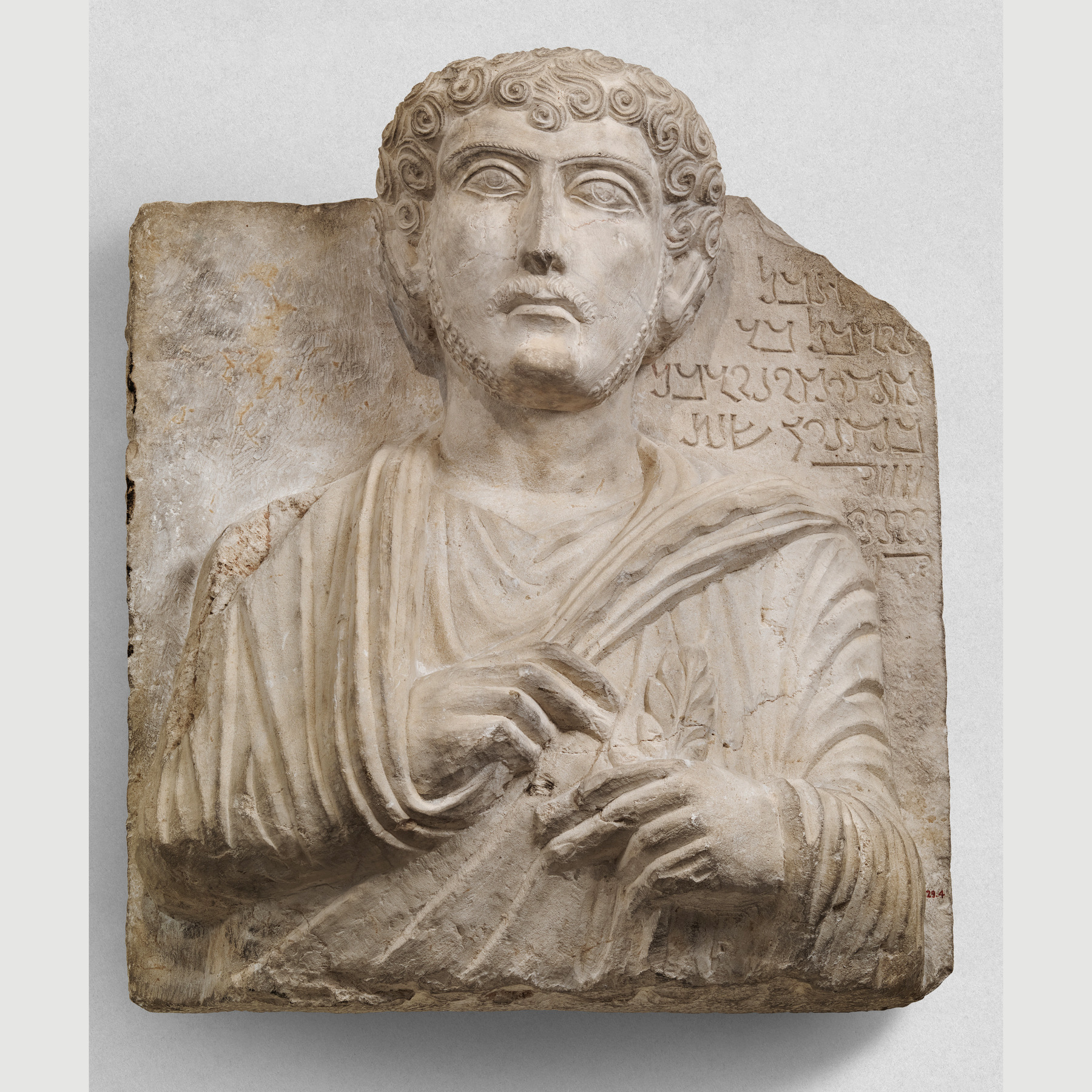
The cover image shows one context of Aramaic use in Roman-period Palmyra, Syria, rather than the history of every Aramaic dialect. The Metropolitan Museum of Art's limestone funerary relief, object 02.29.4, dates to about 181 CE. It depicts a man with Palmyrene Aramaic writing to the right of his head. The museum reads a lament, the name “Nurbel,” his descent from “Mokimu” and a grandfather also named “Nurbel,” followed by the month and year of death according to the Seleucid era. That information follows the museum's catalogue; the Archive has not newly deciphered the carved letters. [15]
A personal inscription on a tomb marker makes language part of family commemoration in a commercially connected city. It is direct evidence of one regional variety and writing practice in the second century CE, not a universal image of Aramaic through all periods.
Reading an Aramaic witness critically
First identify the place, date, document type, dialect, and writing convention. Then ask whether a scholarly translation reproduces the particular surviving object or a text reconstructed from several witnesses. A dedicatory inscription, marriage deed, official letter, and later religious commentary answer different questions, even when they share the word ʾĕlāh. Read in this way, Aramaic emerges as a long and diverse history of administration, literature, ritualRitualAn organised or distinguished practice meaningful to a community; it may leave traces, but its form alone does not reveal an associated doctrine.Glossary · Click to read the explanation, and ordinary life—rather than the language of one religion or era alone.
References and notes (15)
- Beth Mardutho, History of Syriac Origins and early literature: Christian heritage and early non-Christian attestations. Return to the text ↑
- Comprehensive Aramaic Lexicon, Hebrew Union College: ʾlh / ʾlhʾ Lexical entry and attestations; Aramaic and Syriac varieties and contexts must be distinguished. Return to the text ↑
- Franz Rosenthal, “Aramaic i. General,” Encyclopaedia Iranica, 1986 (web entry updated 2016). Introduction and “Early history”: earliest attestations and linguistic context. Return to the text ↑
- Musée du Louvre, collection record “Stèle de Zakkur,” AO 8185 / KAI 202. Catalogue fields for identification, findspot, script, language, type, and date. Return to the text ↑
- Frederick Mario Fales, “Le double bilinguisme de la statue de Tell Fekhery,” Syria 60 (1983): 233–250. Digitized opening on printed p. 233 only: introduction to the Assyrian and Aramaic inscriptions; full article not read. Return to the text ↑
- Franz Rosenthal, “Aramaic i. General,” Encyclopaedia Iranica, section “Aramaic in the Achaemenid empire.” Achaemenid administration section: official writing and provincial correspondence, including Aršāma. Return to the text ↑
- Edda Bresciani, “Elephantine,” Encyclopaedia Iranica, section on the Jewish military community and papyri. Paragraphs on contracts, letters, temple petition, and literature; checked against Rosenthal; original papyri not collated. Return to the text ↑
- Franz Rosenthal, “Aramaic i. General,” Encyclopaedia Iranica, sections on Nabataean and Aramaic-derived scripts. “Nabataean” under later dialects and “Aramaic and Iranian writing”: graphic transmission, not direct linguistic descent. Return to the text ↑
- Hebrew Union College, Comprehensive Aramaic Lexicon (CAL), project introduction, accessed 18 October 2026. Database scope, dialect coverage, and the explicit statement that the lexicon remains a work in progress. Return to the text ↑
- Massimiliano Marrazza, “L’aramaico del Libro di Ezra: storia degli studi e nuove prospettive,” Materia Giudaica 9 (2006): 391–403. University repository abstract only: biblical passage ranges and debate on the character of Ezra documents; full article not read. Return to the text ↑
- Franz Rosenthal, “Aramaic i. General,” Encyclopaedia Iranica, “Later dialects” and religious literatures. Paragraphs on Jewish, Christian, and Mandaean traditions and targums; no inference from one text to all communities. Return to the text ↑
- John F. Healey, “The Edessan Milieu and the Birth of Syriac,” Hugoye 10 (2007). Online article, numbered paragraphs 1–16 and 23–30: early inscriptions, Edessa, and literary emergence. Return to the text ↑
- Gernot L. Windfuhr, “Iran vii. Non-Iranian Languages (10). Aramaic,” Encyclopaedia Iranica (2006). Periodization overview and modern continuations; conventional, approximate boundaries. Return to the text ↑
- Ghattas Eid, Esther Seyffarth, and Ingo Plag, “The Maaloula Aramaic Speech Corpus (MASC),” LREC (2022): 6513–6520. Abstract and bibliographic record only: recorded-speech corpus and access formats, not the full study or database. Return to the text ↑
- The Metropolitan Museum of Art, “Funerary relief,” object 02.29.4, ca. 181 CE; catalogue, inscription and Public Domain mark. Full object description including museum reading of inscription lines 1–7, date and public-domain image notice; no independent decipherment. Return to the text ↑
Suggest a correction · Suggest a source for this record
Cite this record
IL Archive, «Aramaic», https://ilarchive.com/en/entities/aramaic
Continue reading
Related readings