Artifact · Document
Elephantine “Passover Letter”
An object record bringing together its image, metadata, rights, and context.
- Timeline
- From 419 BCE to 418 BCE
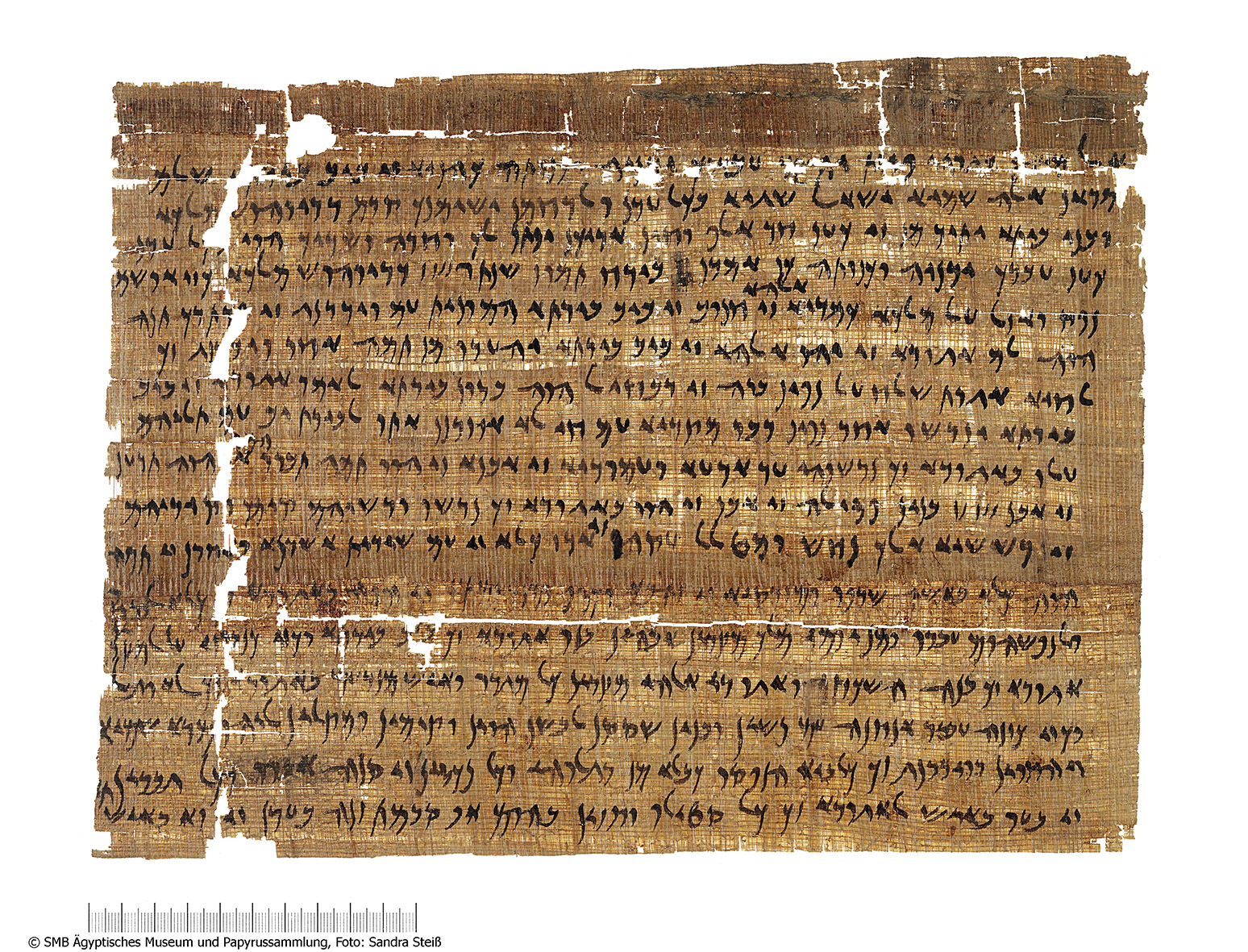
Fragmentary Aramaic letter from Elephantine (Berlin P.13464), 419/418 BCE, referring to 15–21 Nisan, purity and leaven. “Passover” is a restoration, not a surviving word; its purpose is debated.
Estimated reading time: 5 min Published Last reviewed:
Share article

Illustration — not a photograph of the original object
Conceptual AI-generated cover commissioned for IL Archive, 2026 · CC0 1.0 · not an artifact photograph
Modern AI-generated conceptual cover: imagined papyrus fragments over a symbolic Nile landscape. It does not depict the actual P.13464, its script or a documented findspot
LicenseObject details
- Title
- Elephantine “Passover Letter”
- Timeline
- From 419 BCE to 418 BCE
- Rights
- CC0
Text
Introduction
Why is a torn Aramaic papyrus from ElephantineElephantine / YebElephantine / Yeb, near Aswan at the Nile’s First Cataract, preserves a long-lived Egyptian town, temples of Khnum and Satet, and Persian-period garrisons. Aramaic papyri document several communities, including Judeans and Yaho’s temple, whose rebuilding was sought in 407 BCE; claims and archaeological interpretations must be distinguished.Glossary · Click to read the explanation known as the “Passover Letter”? It is a genuine Persian-period correspondence concerning particular days of Nisan and matters of purity and leaven. Yet the name “Passover,” like several detailed instructions commonly attributed to the letter, enters through editors’ reconstructions of lost text. This entry examines the object, its surviving words, the competing reconstructions, and the limits of what it proves.[1][2]
Identification and archaeological setting
The letter is P. Berlin 13464, held by the Egyptian Museum and Papyrus Collection in Berlin, and published as TAD A4.1 and Cowley 21. It comes from Elephantine (Yeb)Elephantine / YebElephantine / Yeb, near Aswan at the Nile’s First Cataract, preserves a long-lived Egyptian town, temples of Khnum and Satet, and Persian-period garrisons. Aramaic papyri document several communities, including Judeans and Yaho’s temple, whose rebuilding was sought in 407 BCE; claims and archaeological interpretations must be distinguished.Glossary · Click to read the explanation, a Nile island near Aswan, and was excavated under Otto Rubensohn in the early twentieth century. Written in AramaicAramaicNorthwest Semitic language varieties documented since the early first millennium BCE, including Old and Imperial Aramaic, Syriac, Jewish dialects, and living Neo-Aramaic forms.Glossary · Click to read the explanation on both sides of papyrus, it is neither a biblical manuscript nor a royal inscription. The surviving object measures approximately 10.3 × 21 cm; much of its writing surface has been lost.[1][3]
Hananiah and the garrison
The broken address identifies Hananiah as sender and JedaniahJedaniah, priest at ElephantineAn Elephantine priest named with his colleagues in the temple-rebuilding petition of 407 BCE.Glossary · Click to read the explanation and his colleagues in the Judean garrison as recipients, with parts of the address supplied by editors. The text belongs to the fifth year of Darius II, approximately 419/418 BCE; Berlin's collection catalogue dates the object to 419 BCE. There is a mention of a communication from the king to Arsames, the Persian authority in Egypt, but the substance of that royal communication is missing. It is therefore unjustified to claim that the surviving letter tells us exactly what Darius ordered, or that its Hananiah can be identified with a similarly named biblical figure.[2][3]
What can actually be read?
The Ohio State DEAPS edition retains the addressees, the regnal date, the king and Arsames, and an incomplete clause that could concern counting or appointing. The numerals 15 and 21 survive in a calendrical context; portions of Nisan are reconstructed around surviving letters. There is also an exhortation to be pure and vigilant, along with incomplete expressions involving work, drinking, and something leavened. The verso apparently concerns placing something in chambers or storage areas and sealing them. Because so much is absent, these scraps cannot be joined into a fully certain schedule of commands.[2]
Surviving letters versus editorial restoration
In critical editions, square brackets indicate letters or expressions supplied by the editor, not legible words on the papyrus. The conventional title “Passover Letter” is consequently a scholarly shorthand, not the quotation of a preserved occurrence of “Passover.” The fourteenth of Nisan, a paschal sacrifice, and an explicit seven-day instruction to eat unleavened bread are found in influential restorations based on comparison with biblical regulations, rather than in securely extant passages. Such reconstruction can be historically suggestive without being direct epigraphic evidence.[2][3][4]
Leaven, drinking, and labour
Aramaic words relating to leaven or fermentation, drinking, and work do occur, but the relevant verbs and negative particles are damaged or disputed. Traditional reconstructions turn them into prohibitions on drinking fermented beverages, eating leaven, and working; storage chambers are then interpreted as places in which leaven was sealed away. The newer DEAPS transcription instead considers a verb meaning to bind up or pack away something leavened at the end of recto line 6, in place of the older restored “do not eat.” Gad Barnea separately challenges whether clear prohibitions of these activities survive at all. Presenting the traditional rules as a secure word-for-word translation would therefore be misleading.[2][6]
What observance was involved?
The traditional festival reading associates 15–21 Nisan, purity, and leaven with the Feast of Unleavened Bread. The association is plausible, but the damaged text does not secure the terms “Passover” and “Feast of Unleavened Bread” as preserved phrases. Another difficulty concerns the link between the lost royal message and Hananiah's practical instructions: did the letter communicate an administrative calendar decision, a permission relating to observance, or a locally understood ceremony? The text does not settle this.[3][8]
Alternative proposals
Idan Dershowitz proposes that the broken instruction to “count” concerned the intercalation of an extra Adar and that the letter was chiefly a notice about a leap-year adjustment. That depends upon a competing restoration and calendar reasoning; it is not an explicit preserved statement. Tamara Cohn Eskenazi suggests the royal communication granted religious leave to garrison soldiers, rather than establishing a religious law. Gad Barnea, re-examining the physical traces and wider Persian-period cultic setting, disputes a confident identification with an annually repeated Passover observance and explores possible Achaemenid ritualRitualAn organised or distinguished practice meaningful to a community; it may leave traces, but its form alone does not reveal an associated doctrine.Glossary · Click to read the explanation connections. These are scholarly explanations, not three discoveries of previously legible lines.[4][5][6]
A distinct document about YHW's temple
The Elephantine temple-rebuilding petitionElephantine temple-rebuilding petitionBerlin Aramaic papyrus P.13495 (TAD A4.7), dated 25 November 407 BCE. Jedaniah and Elephantine’s priests petitioned to rebuild Yaho’s temple. The article distinguishes the reported destruction, a later memorandum restricting offerings to grain and incense, and indirect evidence from 402 BCE that may suggest rebuilding.Glossary · Click to read the explanation of 407 BCE—P. Berlin 13495 / TAD A4.7—documents the local community's temple of YHW and a request for its restoration. But it is a separate papyrus roughly twelve years later. It cannot be treated as part of Hananiah's letter or as proof of the precise rites referred to in that letter. Read together, the documents illuminate the social and religious setting, while retaining distinct dates and evidentiary roles.[7]
What the papyrus establishes—and what it does not
Its firm importance lies in a practical Aramaic communication to identifiable members of a Judean military community under Persian rule, with dates and expressions bearing on an apparently ritual period. It does not establish that Elephantine possessed a complete five-book Torah, followed every later biblical Passover regulation, or received an imperial order inventing a festival. The object can be viewed on the Berlin collection page, alongside the digital critical edition. The accompanying image is an AI-generated modern conceptual cover, not a photograph of the papyrus or an authenticated reconstruction of its text.[1][2][6]
References and notes (8)
- Staatliche Museen zu Berlin, Egyptian Museum and Papyrus Collection, “Aramaic document concerning the Passover,” P.13464 / Object 980034. Collection entry: identification, dimensions, dating, provenance, recto/verso image credit and Public Domain Mark 1.0; full displayed entry read. Return to the text ↑
- James D. Moore, “Pap. Ber. P. 13464,” Digital Editions of Aramaic and Phoenician Sources (DEAPS), Ohio State University, updated October 4, 2026. All displayed recto/verso lines (r.1–6, v.1–4), the accompanying English translation, and the textual note on r.6 were read; no independent magnified palaeographic inspection. Return to the text ↑
- ERC Elephantine Project, Berlin, “Pap. Berlin P.13464” (TAD A4.1; Cowley 21). Object metadata, material condition, online edited transcription/translation with restoration brackets, and interpretive note read; the complete printed TAD/Cowley editions were not accessed. Return to the text ↑
- Idan Dershowitz, “The Passover Papyrus: Darius II Delays the Festival of Matzot in 418 BCE,” TheTorah.com (2017; updated 2026). Web article read, especially “Passover Papyrus?”, “Alternative Reconstruction”, “Leap Year” and notes 8–15; intercalation is an interpretation. Return to the text ↑
- Tamara Cohn Eskenazi, “The Passover Papyrus Orders a Religious Furlough for Judean Soldiers,” TheTorah.com (2020). Web article consulted, especially the general description, military-leave argument and conclusion; the original royal order is not preserved. Return to the text ↑
- Gad Barnea, “P. Berlin 13464, Yahwism and Achaemenid Zoroastrianism at Elephantine,” in Yahwism under the Achaemenid Empire (De Gruyter, 2024), pp. 1–34, DOI:10.1515/9783111018638-001. Selected full-text sections as displayed on ResearchGate: discussion of Passover/Matzot pp. 10–12, papyrus and epigraphy pp. 13–18, and concluding discussion approximately pp. 28–30; not the complete chapter cover to cover. Return to the text ↑
- Staatliche Museen zu Berlin, “Elephantine petition to rebuild the YHW temple,” P.13495 (TAD A4.7), 407 BCE. Berlin collections description and object date read; the earlier line references R6–14 and V6–13 were not independently rechecked line by line. Return to the text ↑
- Posen Library of Jewish Culture and Civilization, “Passover Letter from Elephantine.” Public-facing entry metadata and “About This Entry” section only; the full hosted translation was behind an account wall and was not read. Return to the text ↑
Archive records may be reviewed and refined as better evidence or sources become available. Suggest a correction
Suggest a correction · Suggest a source for this record
Cite this record
IL Archive, «Elephantine “Passover Letter”», https://ilarchive.com/en/artifacts/elephantine-passover-letter
Continue reading