Entity
Court Tale
A reference page linking a name, group, or concept to the materials that discuss it.
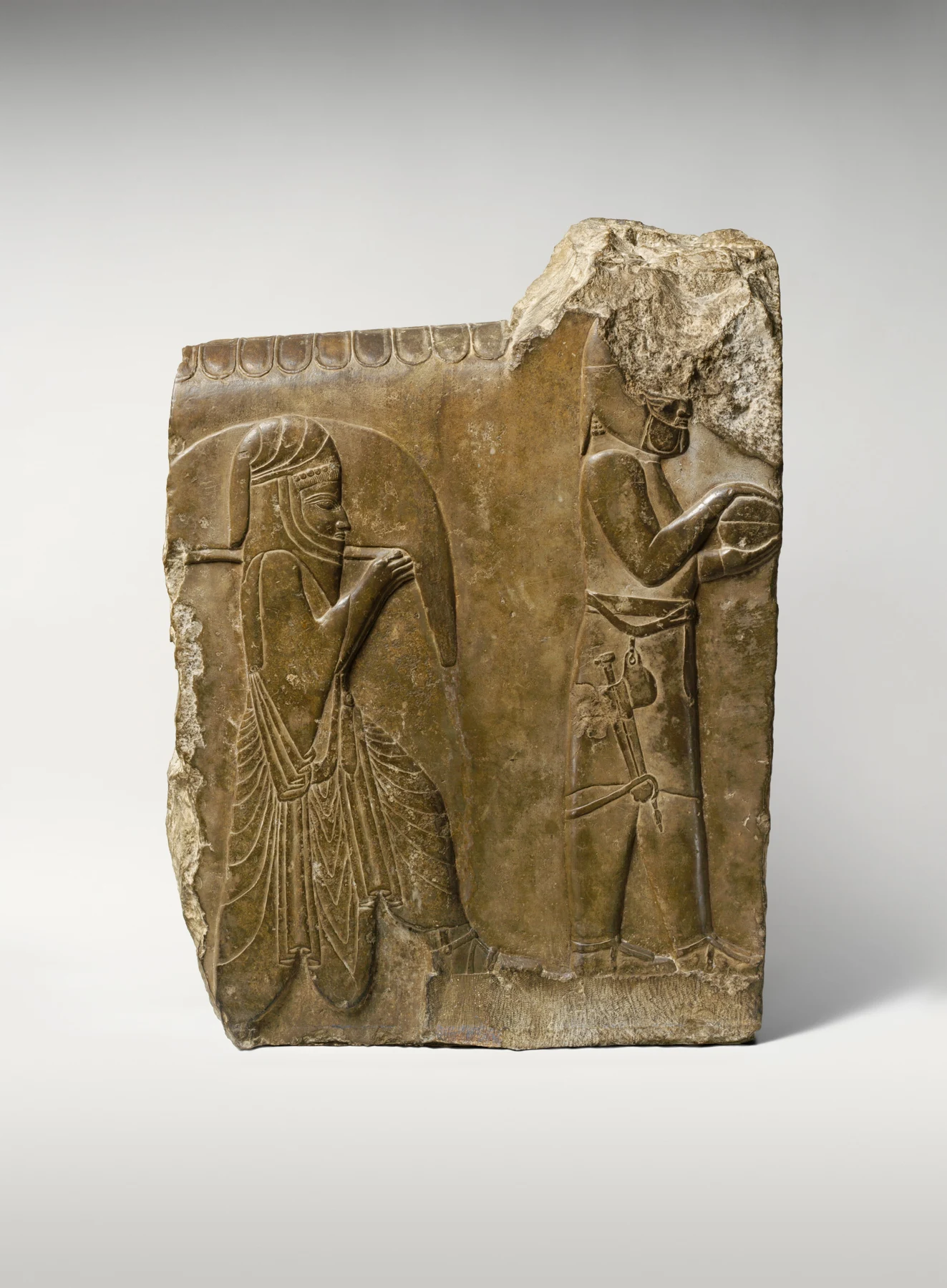
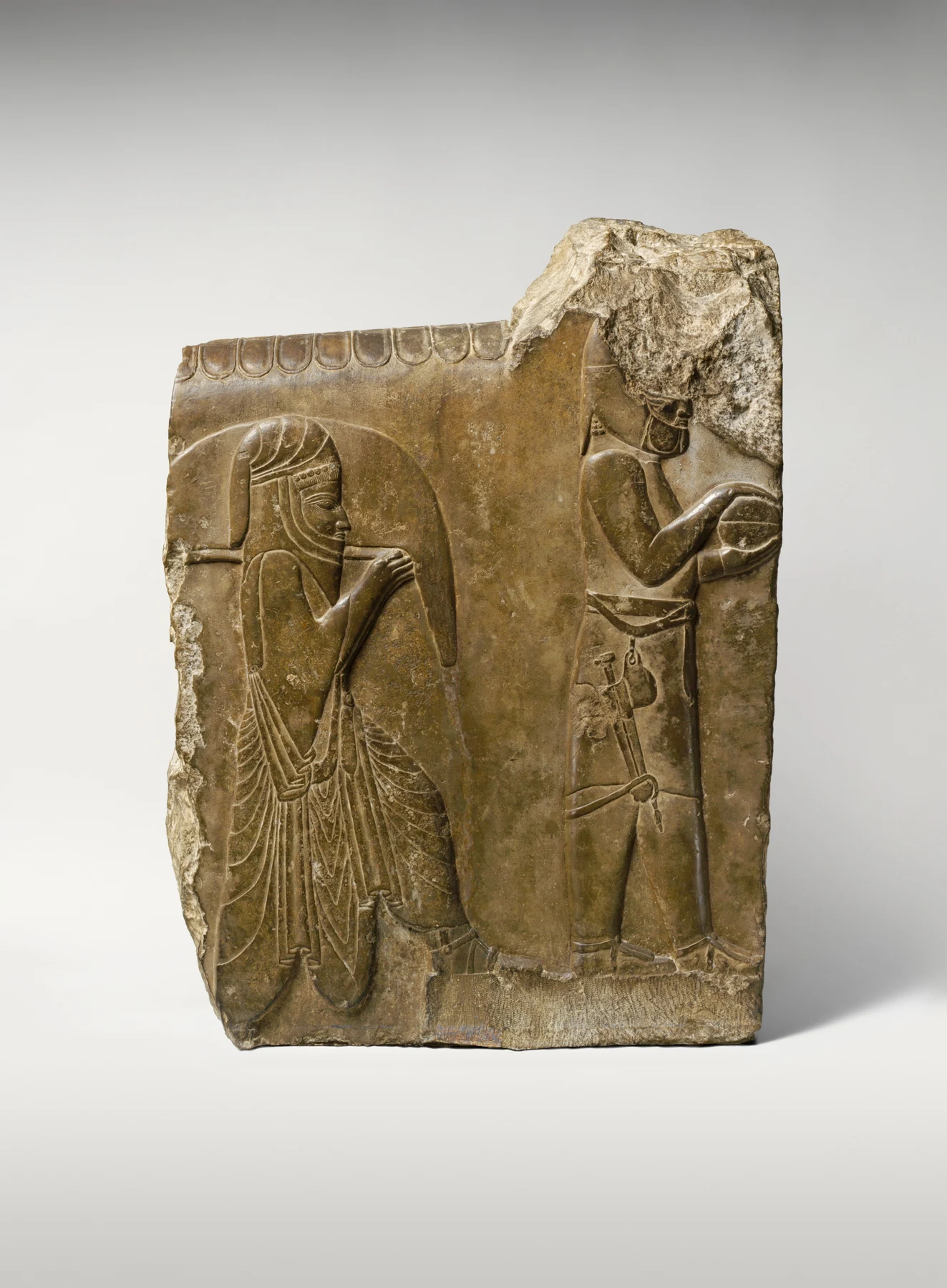
A narrative category for sages and outsiders at royal courts: a contest revealing skill, or a conflict leading to danger and deliverance. Ahiqar, Joseph, Daniel and Esther are compared without assuming direct borrowing.
Estimated reading time: 8 min Published Last reviewed:
Share article
Text
Introduction
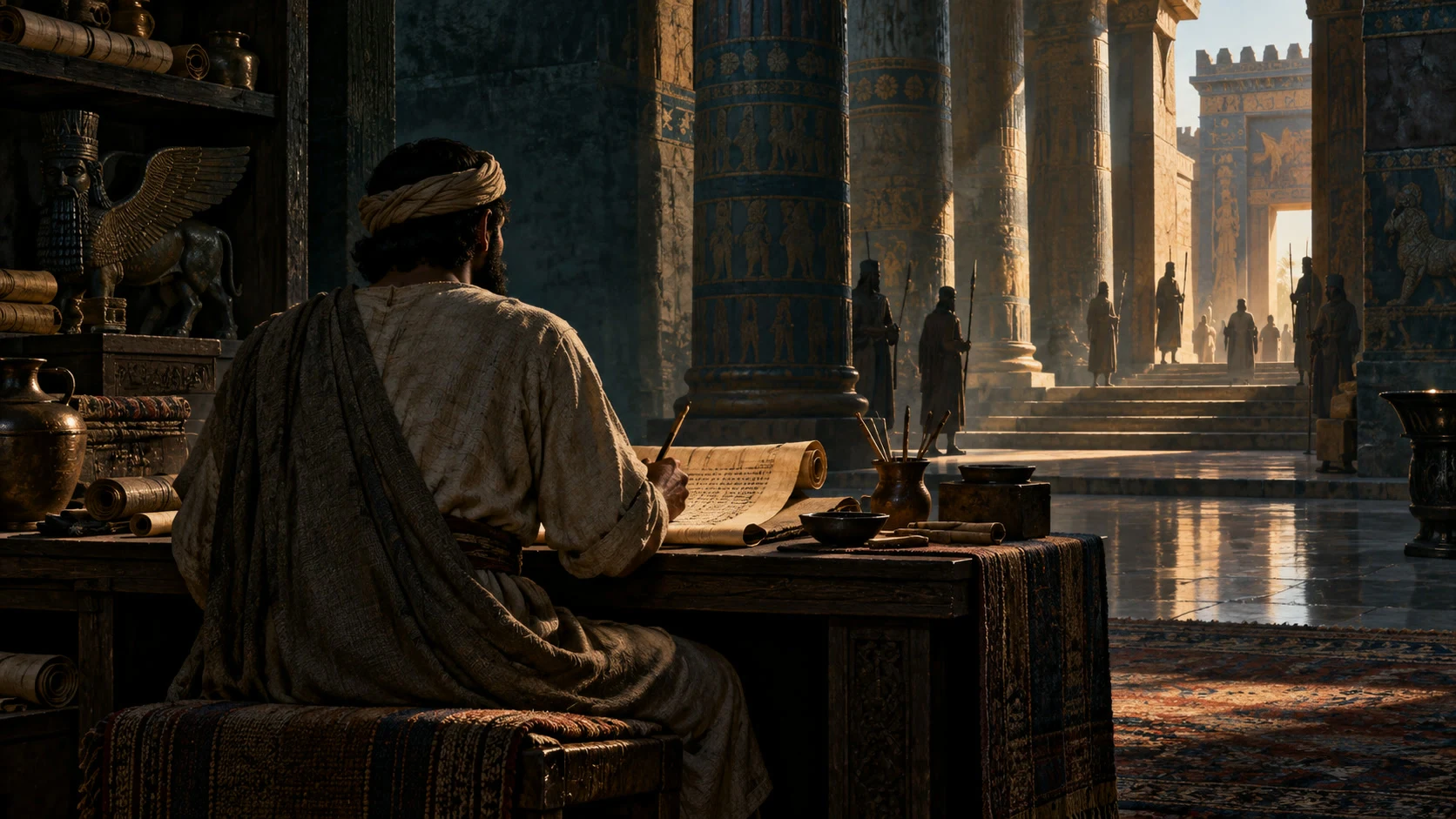
A court tale is an analytical term for a form of ancient storytelling, not the title of a single book or a label for every narrative containing a king. In such stories, service to a ruler or access to the royal household becomes a setting where a person's skill, loyalty, or survival is tested. Competition, accusation, the failure of other courtiers, or a precarious royal decision may transform the protagonist's standing. The comparison helps reveal different representations of wisdom, outsiders, and power, provided that a shared plot pattern is not mistaken for proof of literary borrowingLiterary borrowingUse of verbal or narrative material from an earlier text or tradition in a later work, distinguishing evidence of transfer from mere resemblance.Glossary · Click to read the explanation.
This entry examines specific passages from the Aramaic Ahiqar, Joseph in Genesis, Daniel, and Esther. It separates the time in which their stories are set from the proposed dates of composition and the dates of surviving witnesses; it does not impose one literary genre on every part of these books. [3]
Defining the form and its variants
A royal setting alone is insufficient. Some narratives begin with a character outside the inner circle who demonstrates an exceptional ability before a king and gains office. Others begin with an established counselor whom rivals endanger or disgrace and who eventually regains standing. Scholarship on biblical literature has usefully described these tendencies as the court contest and the court conflict. The former foregrounds dreams, riddles, expertise, and wisdom; the latter highlights jealousy, accusation, loyalty, and rescue. A single work may combine them. [3]
The plot commonly turns on a royal administration unable to solve a crisis, uncertainty over a ruler's intention, or the vulnerability of even a powerful official. Its implications, however, vary markedly: Joseph interprets a dream and organizes provisions against famine; Daniel both reveals mysteries and faces peril over worship; Ahiqar falls victim to betrayal within his household and court; and Esther works to save an endangered community. “Success story of a wise courtier” is consequently not a sufficient explanation of every case. A recent study proposes finer divisions among dream-and-sleeplessness episodes, banquet scenes, and tests of allegiance. This illustrates an active debate over classification rather than an agreed final taxonomy. [12]
Ahiqar: the adviser facing elimination
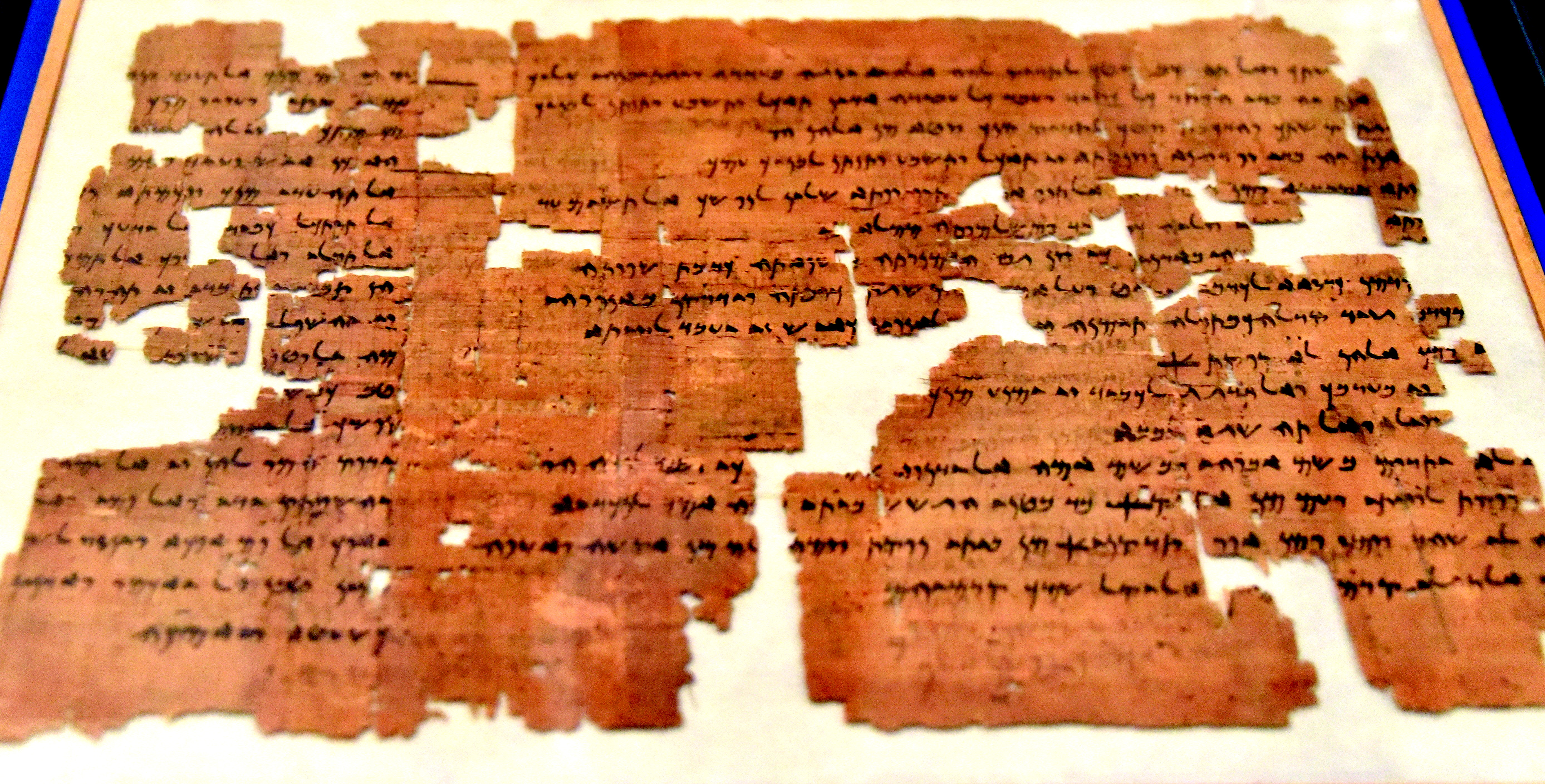
The story of AhiqarAhiqar the wise figureAhiqar is a wise figure in ancient Aramaic traditions.Glossary · Click to read the explanation concerns a wise counselor at an Assyrian royal court under Sennacherib and then Esarhaddon, within the story's setting. He raises Nadin as his intended successor, only for the plot to associate Nadin with betrayal and Ahiqar's fall. When the ruler orders his death, Ahiqar appeals to an officer whose life he had previously saved. His preservation depends not on winning a riddle contest but on remembered assistance and uncertain obligations within royal service. [1][2]
“Do not kill me”: Ahiqar addresses the officer charged with executing the order, in column Di, line 04, of the Ahiqar papyrusElephantine Ahiqar PapyrusA fragmentary Aramaic witness, probably from the later fifth century BCE, preserving Ahiqar’s tale and sayings with gaps and editorial restorations.Glossary · Click to read the explanation, Berlin P.13446. These Aramaic words are preserved in the line, while the surrounding sentence contains bracketed editorial restorations. Lines Di13–Di15, also fragmentary, suggest a plan to execute a servant instead of Ahiqar; rescue is therefore not an uncomplicated triumph of justice. The papyrus preserves incomplete narrative and wisdom sections. Later SyriacSyriacAn Aramaic literary language rooted in Edessa, first attested in non-Christian inscriptions and later prominent in Christian writing, scholarship, translation and liturgy.Glossary · Click to read the explanation retellings cannot simply be used to supply a missing ending and then attributed to this surviving manuscript. [1]
The papyrus belongs to the ElephantineElephantine / YebElephantine / Yeb, near Aswan at the Nile’s First Cataract, preserves a long-lived Egyptian town, temples of Khnum and Satet, and Persian-period garrisons. Aramaic papyri document several communities, including Judeans and Yaho’s temple, whose rebuilding was sought in 407 BCE; claims and archaeological interpretations must be distinguished.Glossary · Click to read the explanation evidence from southern Egypt and is generally assigned to the late fifth century BCE; the Assyrian kings in its narrative belong to the seventh century BCE. These are distinct dates. Seth A. Bledsoe interprets the text in the context of the Persian-period community at Elephantine, drawing attention to the coexistence of service to the king and the possibility of royal injustice. His argument draws on narrative structure and manuscript context; it does not demonstrate that every court tale attacks monarchy. [2]
Joseph: interpreting a dream and rising to office
In Genesis, especially chapter 41, JosephJoseph in Genesis and the Qur’anFigure whose story in Genesis and Sūrat Yūsuf combines enslavement, accusation, prison and advancement in Egypt.Glossary · Click to read the explanation emerges from imprisonment when Pharaoh's magicians and wise men cannot interpret a disturbing dream. Joseph explains that seven abundant years will be followed by seven years of famine, then recommends storing and administering food supplies. The exceptional insight is not presented as purely professional technique: Joseph credits God with disclosure, while Pharaoh appoints him to put the plan into practice. [6]
“There is no one as discerning and wise as you,” Pharaoh tells Joseph in Genesis 41:39, in the HebrewHebrewA Northwest Semitic language of the Canaanite group, encompassing Iron Age epigraphy, Biblical, Rabbinic, medieval and Modern Hebrew; its scripts and pronunciations changed over time.Glossary · Click to read the explanation text consulted. The line marks the moment the outsider's competence receives royal recognition; it is not an independent Egyptian administrative record. The wider Joseph cycle, Genesis 37–50, also deals with family conflict and reconciliation and cannot be reduced to its courtly episode. [6]
The chapter does not name an identifiable Pharaoh or establish a securely datable reign. The composition of the story remains disputed. Common modern approaches place its development in exilic, Persian, or Hellenistic settings; Nili Shupak's 2025 abstract instead proposes earlier layers on the basis of Egyptian details and their successive incorporation. Only the published abstract of that argument was consulted here, not the article's full demonstration. Neither the ancient setting nor the presence of Egyptian motifs, by itself, settles the date. [4]
Daniel: access to secrets and conflict of loyalties
Two chapters of the Book of DanielBook of DanielA book combining court tales of wisdom and deliverance with visions of kingdoms and the future, formed in stages.Glossary · Click to read the explanation illustrate different patterns. In chapter 2 Nebuchadnezzar demands both the content and the interpretation of his dream and threatens the experts if they fail. DanielDaniel in the biblical bookDaniel is the Jewish sage and visionary in the biblical book bearing his name.Glossary · Click to read the explanation receives the mystery through revelation attributed to his God, reports it, and is elevated by the king. The scene is a court contest, yet the interpretation also addresses the succession of kingdoms and divine sovereignty, reaching far beyond the reward of a successful official. The chapter begins in Hebrew and shifts to Aramaic at the Chaldeans' speech in verse 4; its entire wording should not be called Aramaic. [7]
In chapter 6, by contrast, Daniel is already an eminent official under Darius the Mede. Rivals engineer a decree penalizing prayer addressed to anyone but the king. The king wishes to spare Daniel but is constrained by his own edict within the plot. When Daniel survives the lions' den, the narrative explicitly credits divine intervention, not administrative skill or the king's mere tolerance. [9]
“My God sent his angel”: Daniel's answer in chapter 6, verse 23 in the Masoretic numbering of the edition consulted; other editions may shift the verse number. According to the published abstract of her study, Naama Golan also reads Daniel 1–6 through an internal tension between loyalty to the king and loyalty to God, not simply rivalry among officials. The completed Book of Daniel contains the apocalyptic visions of chapters 7–12 alongside these narratives. Its final compilation is commonly located around 164 BCE, which does not mean that every tale in chapters 1–6 was first written in that year. [5][11]
Esther: reversal on a communal scale
The Hebrew Book of EstherBook of EstherA book narrating Jewish communal survival at a Persian court and connecting its ending with Purim, preserved in differing Hebrew and Greek forms.Glossary · Click to read the explanation is set in the Persian court of Ahasuerus, a name commonly connected with Xerxes I of the fifth century BCE within the narrative setting. EstherEsther, the biblical queenThe Jewish heroine of Esther, portrayed as becoming queen and intervening to save her community at the Persian court.Glossary · Click to read the explanation becomes queen, and her relative MordecaiMordecai in EstherEsther’s relative and guardian in the story, who uncovers a plot, confronts Haman and rises at court.Glossary · Click to read the explanation uncovers a plot against the king; however, HamanHaman in EstherThe powerful court official opposing Esther and Mordecai, whose scheme to kill the Jews turns against him.Glossary · Click to read the explanation exploits his position to secure a threat against the Jews. The danger now extends beyond one courtier to an entire community. Esther's perilous unsummoned appearance before the king and her sequence of banquets become instruments of rescue. [10]
“Do this for Mordecai the Jew,” the king orders Haman in Esther 6:10. Haman expects to receive the honor himself; instead, records read aloud after the king's sleepless night reveal a service Mordecai had performed. The plot turns the adversary's expectations upside down. Written royal memory is a device within the story, not evidence that those administrative records have been independently recovered. [8]
The Hebrew form of Esther does not explicitly name God, unlike Daniel, whereas the Greek additions contain more overt religious language. Distinguishing textual traditions matters when describing the story's theology. The book's composition is uncertain; proposals include a post-Achaemenid horizon in the third or second century BCE. Identifying Ahasuerus with Xerxes in the narrated period does not date the writing of Esther to his reign. [10]
A short chronology of story and evidence
- Seventh century BCE: The reigns of Sennacherib and Esarhaddon supply the Assyrian story setting for Ahiqar, not the date of the Elephantine manuscript.
- Sixth century BCE: The Babylonian world in which Daniel's early experiences are narrated; it does not date the compilation of the book. Genesis 41 does not identify a Pharaoh whose reign could similarly anchor Joseph.
- Fifth century BCE: The Persian reign invoked by Esther's Ahasuerus; the surviving Ahiqar papyrus is generally placed toward the end of this century, in Persian-ruled Egypt.
- Persian and Hellenistic periods: Different, disputed proposals concerning the development of the Joseph story, Esther, and the Daniel court narratives. One copy or later translation cannot date every earlier stage.
- Around 164 BCE: A widely accepted approximate date for the completed Book of Daniel, encompassing both court narratives and visions, not a composition date for every embedded story. [1][2][4][10][11]
Resemblance, transmission, and interpretation
A serious case for borrowing requires convergent evidence: a rare sequence of close narrative details, distinctive wording that can be compared across actual text versions and languages, a chronologically and geographically plausible route of transmission, or discernible editorial reuse. A wise foreign courtier, angry ruler, or reversal of fortune belongs to a broad stock of story patterns. Those features alone do not establish that Joseph copied Ahiqar or that Esther derived episodes from Daniel. Ahiqar's damaged manuscript, differences among biblical textual traditions, and debated compositional histories make simple linear descent particularly difficult to demonstrate. [1][2][3]
Aramaic Dead Sea ScrollsDead Sea ScrollsManuscript collections from the Judaean Desert, best known through Qumran: diverse works, languages and textual forms, with copying distinguished from composition.Glossary · Click to read the explanation evidence, including 4Q550 (often called Tales of the Persian Court) and writings associated with Daniel, expands the comparison, although their fragmented state limits reconstruction. The stronger conclusion is that these works use overlapping narrative devices to examine different problems: competence, divided loyalties, vulnerability, and deliverance. Some challenge particular royal decisions; others imagine prosperity under imperial authority; still others make divine rescue central. None of those positions should be ascribed automatically to the entire court-tale category. [3][12]
References and notes (12)
- Berlin museum/Elephantine Texts, “Ahiqar Papyrus P.13446.” Institutional metadata and Aramaic narrative/translations Ai01–Dii15 and selected sayings consulted. Online narrative edition follows James D. Moore (2017), with disputed restorations; no independent palaeographical transcription was performed. Berlin P.13446, narrative Ai01–Dii15; attested words at Di04 and fragmentary Di13–Di15. Return to the text ↑
- Seth A. Bledsoe, “Conflicting Loyalties: King and Context in the Aramaic Book of Ahiqar,” in J. M. Silverman and C. Waerzeggers, eds., Political Memory in and after the Persian Empire (SBL Press, 2015). Selected printed pages on dating, context, and loyalty were consulted, not the full chapter. Printed book pp. 239–243 and 260–265, selected portions. Return to the text ↑
- Andrew Knight-Messenger, “New Perspectives on Court Tales in the Hebrew Bible and Early Jewish Literature,” Bible Interp, July 2026. Entire online essay consulted, including court-contest/conflict distinctions and 4Q550; not the book to which it refers. Whole online essay, genre distinctions and Dead Sea Scrolls discussion. Return to the text ↑
- Nili Shupak, “The Joseph Story (Genesis 37–50) from an Egyptological Perspective: Multilayered Story or Exilic Novella?,” Journal of the American Oriental Society 145.2 (2025), pp. 349–368. Only the journal abstract and metadata were read, not the full paper. Publisher abstract only; pp. 349–368 not read in full. Return to the text ↑
- Naama Golan, “The Daniel Narratives (Daniel 1–6): Structure and Meaning,” Journal of Hebrew Scriptures 19 (2019), DOI 10.5508/jhs29395. DOAJ abstract and bibliographic entry consulted only, not introduction, conclusion, or full article; the loyalty thesis is quoted only at abstract level. DOAJ abstract and publication metadata only. Return to the text ↑
- Genesis, chapter 41, Hebrew with facing English, Mechon Mamre. The chapter was read throughout, especially vv. 8–43; the short translations in this entry are editorial renderings. Genesis 41:8–43, Hebrew quotation from 41:39. Return to the text ↑
- Daniel 2, Mechon Mamre. Full chapter consulted in its Hebrew and Aramaic wording with facing English; the Aramaic portion begins at the Chaldeans’ speech in verse 4. Daniel 2:1–49, especially vv. 4–6, 17–23, 47–49. Return to the text ↑
- Hebrew Esther 6, Mechon Mamre. The full chapter was read in Hebrew with facing English, especially the reversal of honor at verse 10. Esther 6:1–14, Hebrew quotation from 6:10. Return to the text ↑
- Daniel 6, Aramaic and facing English, Mechon Mamre. Full chapter consulted in the edition’s Masoretic numbering; the excerpt in verse 23 is Daniel’s own speech. Daniel 6:1–29, especially 6:5–6, 15–24; quotation 6:23. Return to the text ↑
- Shaul Shaked, “Esther, Book of,” Encyclopaedia Iranica VIII/6, pp. 655–657 (1998; updated 2017). Entire online entry consulted for plot, identification of Ahasuerus, and uncertain composition date; not a direct manuscript edition. Entire encyclopedia entry, dating and Hebrew/Greek textual distinctions. Return to the text ↑
- Tawny Holm, “Book of Daniel,” Oxford Research Encyclopedia of Religion (2019). Published Oxford abstract only consulted, contrasting sixth-century setting, earlier tale materials, and probable completion c. 164 BCE; the chapter was not read in full. Oxford abstract only, published 30 October 2019. Return to the text ↑
- Joshua Joel Spoelstra, “Courts, Banquets, and Bedchambers: Mapping (Sub-)Genre Distinctions in Biblical Narratives Set in Foreign Imperia,” Religions 17.2 (2026), article 243, DOI 10.3390/rel17020243. Abstract and available indexed excerpts consulted; the complete journal page could not be accessed directly. Its typology is presented as a proposal. Abstract and selected indexed sections, not the full article. Return to the text ↑
Suggest a correction · Suggest a source for this record
Cite this record
IL Archive, «Court Tale», https://ilarchive.com/en/entities/court-tale-literary-form
Continue reading
Related readings