Entity
Purim
A reference page linking a name, group, or concept to the materials that discuss it.
A Jewish festival on 14 Adar, or 15 in Jerusalem and specially designated cities, linked by Esther to the Jews’ deliverance from Haman’s plot; the entry separates the religious narrative from proof of the Persian events.
Estimated reading time: 8 min Published Last reviewed:
Share article
Text
Introduction
Purim is a Jewish festival celebrated in the month of Adar. The Book of Esther links it to deliverance from a threatened attack on Jews within a Persian royal setting. Yet the story the book tells about the festival's foundation is not the same kind of evidence as a dated record of when people first celebrated it. This article follows Purim's name, dates and practices, and then examines the biblical account alongside later literary testimony, rabbinic law and scholarly proposals about its beginnings.
Three layers must be kept distinct: events within the narrative, documents that attest to the festival's recognition in later periods, and proposed Babylonian or Iranian antecedents that remain disputed. That distinction allows Purim to be described as a living Jewish observance without treating every detail of Esther as a recovered Persian state document.
Contents
- Name and calendar
- The lot and the threat in Esther's story
- Why the fourteenth and fifteenth?
- Mordecai's and Esther's letters: celebration and solidarity
- From the book to rabbinic rules
- Evidence for Purim beyond Esther
- Persian setting and the limits of historicity
- HebrewHebrewA Northwest Semitic language of the Canaanite group, encompassing Iron Age epigraphy, Biblical, Rabbinic, medieval and Modern Hebrew; its scripts and pronunciations changed over time.Glossary · Click to read the explanation Esther and its Greek forms
- Babylonian and Iranian origin proposals
- The cover image and what the sources establish
Name and calendar
Purim is a plural name associated with pur, the lot used to select a date. The festival is generally observed on 14 Adar, the twelfth month in the biblical sequence of religious months. JerusalemJerusalemJerusalem is a city of religious importance in Judaism, Christianity and IslamGlossary · Click to read the explanation and certain places of special standing in Jewish law observe 15 Adar instead. Its date varies on the civil calendar because the Hebrew calendar is lunisolar; in a Hebrew leap year the principal celebration falls in the second Adar. [4]
These statements describe the received observance, not its first historical appearance. The explanation involving a lot is given in the biblical narrative, whereas the question of the festival's possible existence before or during the composition of that narrative requires separate evidence.
The lot and the threat in Esther's story
The Book of EstherBook of EstherA book narrating Jewish communal survival at a Persian court and connecting its ending with Purim, preserved in differing Hebrew and Greek forms.Glossary · Click to read the explanation is set at Susa (Shushan)Susa, ancient ShushSusa is an archaeological city at Shush in southwestern present-day IranGlossary · Click to read the explanation, a centre of the Achaemenid empire, in the court of Ahasuerus. His name is often understood as a form of Xerxes IXerxes I and AhasuerusAchaemenid king, 486–465 BCE, usually identified by name with Ahasuerus in Hebrew Esther.Glossary · Click to read the explanation; that linguistic identification does not independently verify the story. In the narrative, MordecaiMordecai in EstherEsther’s relative and guardian in the story, who uncovers a plot, confronts Haman and rises at court.Glossary · Click to read the explanation refuses to bow to the official HamanHaman in EstherThe powerful court official opposing Esther and Mordecai, whose scheme to kill the Jews turns against him.Glossary · Click to read the explanation, who plans to target all the Jews of the kingdom. A lot is cast in Nisan to select the time of the attack in Adar. The Hebrew of Esther 3:7 glosses pur as ha-goral, “the lot”; the decree described later in the chapter fixes the attack for 13 Adar. [1]
EstherEsther, the biblical queenThe Jewish heroine of Esther, portrayed as becoming queen and intervening to save her community at the Persian court.Glossary · Click to read the explanation, whose Jewish identity has been concealed at court, ultimately exposes Haman's plan to the king amid banquets, letters and reversals of fortune. The chapter does not preserve the physical device used for the lot or a description sufficient to reconstruct its operation. Moreover, royal acts narrated in a literary work are not equivalent to surviving administrative tablets or decrees from an Achaemenid archive.
Why the fourteenth and fifteenth?
Esther 9 places the narrated fighting on 13 Adar. Jews elsewhere in the kingdom rest on the fourteenth and make it a day of feasting; in Susa, fighting continues on the fourteenth, so that rest and feasting take place on the fifteenth. This accounts, within the plot, for the distinction between unwalled settlements and Shushan. The chapter reports large numbers of people killed and repeatedly notes that the victors did not take plunder. Those numbers and actions should be attributed to the story rather than stated as independently established casualties or behaviour. [2]
The celebration is therefore not simply a commemoration of the day fixed for destruction. Within Esther's narrative logic, the threatening lot is overturned and the ensuing days of rest become the anniversary of escape.
Mordecai's and Esther's letters: celebration and solidarity
Esther 9:20–28 says that Mordecai sent letters to Jews near and far, establishing an annual observance on 14 and 15 Adar. The text specifies joy and feasting, sending portions of food to others and giving gifts to those in need. Verses 29–32 add a second letter associated with Esther and Mordecai, including a reference to fasts and lamentation. These passages function as the book's narrative authorization of Purim; no independently recovered original of those letters has been identified. [3]
Gifts to the poor are thus as central to the account as the communal meal. The later practice called the Fast of Esther should not be confused with an explicit annual calendar command in Esther 9. The chapter invokes fasting in connection with the confirmation of the festival but does not contain every detail of the liturgical timetable that later took shape. [8]
From the book to rabbinic rules
The MishnahMishnahThe Mishnah is a rabbinic compilation assembled around 200 CE, organizing teachings and discussions by topic.Glossary · Click to read the explanation, Megillah 1:1, specifies occasions for reading the megillah, the Scroll of Esther. Its rule assigns 14 Adar to ordinary towns and 15 Adar to cities enclosed by a wall since the time of Joshua, while some villages could advance the reading to an assembly day. This rabbinic criterion is not set out in that form in Esther 9. It provides the traditional framework for Jerusalem's observance on the fifteenth, widely called Shushan Purim. [5]
Mishnah Megillah 1:4 places the reading of the scroll and gifts to the poor in Adar II during a leap year. The presence of two months called Adar does not mean that the full principal celebration is simply held twice. Subsequent Jewish teaching identifies four familiar practices: hearing the scroll read, a festive meal, sending edible portions and giving to the poor. In the medieval Mishneh Torah, MaimonidesMoses MaimonidesJewish jurist, philosopher, and physician (c. 1138–1204). Wrote the Commentary on the Mishnah and Guide in Judeo-Arabic, and the Mishneh Torah in Hebrew; practiced in Egypt.Glossary · Click to read the explanation ranks generous gifts to poor people above lavish spending on the feast or food parcels to friends. This is an influential later legal and ethical interpretation, not a quotation from ancient Esther. [6] [7]
Costumes, playful performances and noise-making at the name of Haman also appear in many communities. These customs developed in different social settings; not all of them are prescribed in the biblical account. A scroll used for the reading documents a practice of textual transmission and worship, but is not thereby a manuscript from the putative date of the narrated Persian events.
Evidence for Purim beyond Esther
Second Maccabees 15:36 dates the observance of a victory over Nicanor to 13 Adar, described as the eve of “Mordecai's Day.” The battle belongs to a narrative set around 161 BCE. The designation suggests that the name of a commemorative day was intelligible to the author or intended audience. It does not, by itself, prove that this passage was written on the day of the battle. Second Maccabees is a Greek epitome of an earlier work; a date in the late second century BCE is commonly proposed for its surviving composition. [9] [10]
The first-century CE Jewish writer Flavius JosephusFlavius JosephusFirst-century Jewish historian who retold older narratives, including Abraham’s test, in Jewish Antiquities.Glossary · Click to read the explanation retells Esther in Jewish Antiquities 11.6.13 and says Jews continued to keep the days and exchange portions of food. This is valuable evidence for the story's reception and the festival as known to him. It is not an independent document about the existence of Esther and Haman at the fifth-century BCE court. [11]
Persian setting and the limits of historicity
Esther includes Iranian names, royal procedures and other features familiar from the Persian imperial world. The Iranologist Shaul ShakedShaul ShakedShaul Shaked was a scholar of Iranian languages, Zoroastrianism and its contacts with Jewish traditions.Glossary · Click to read the explanation emphasizes that this setting shows knowledge of the Achaemenid court, while noting a lack of independent historical corroboration for the events and uncertainty about the book's composition. His Encyclopaedia Iranica article considers a possible date in the third or second century BCE, well after the story's setting. The chronology of narrated events must not be substituted for that of composition or surviving witnesses. [12]
Adele Berlin approaches Esther as inventive diaspora storytelling, attentive to its extravagance, irony and reversals. This is a literary interpretation, not a denial of the historical significance of the festival to communities that observe it. Identifying Ahasuerus with Xerxes may be plausible on onomastic grounds; it cannot substantiate the book's banquets, decrees or threat of annihilation as reported events. [13]
Hebrew Esther and its Greek forms
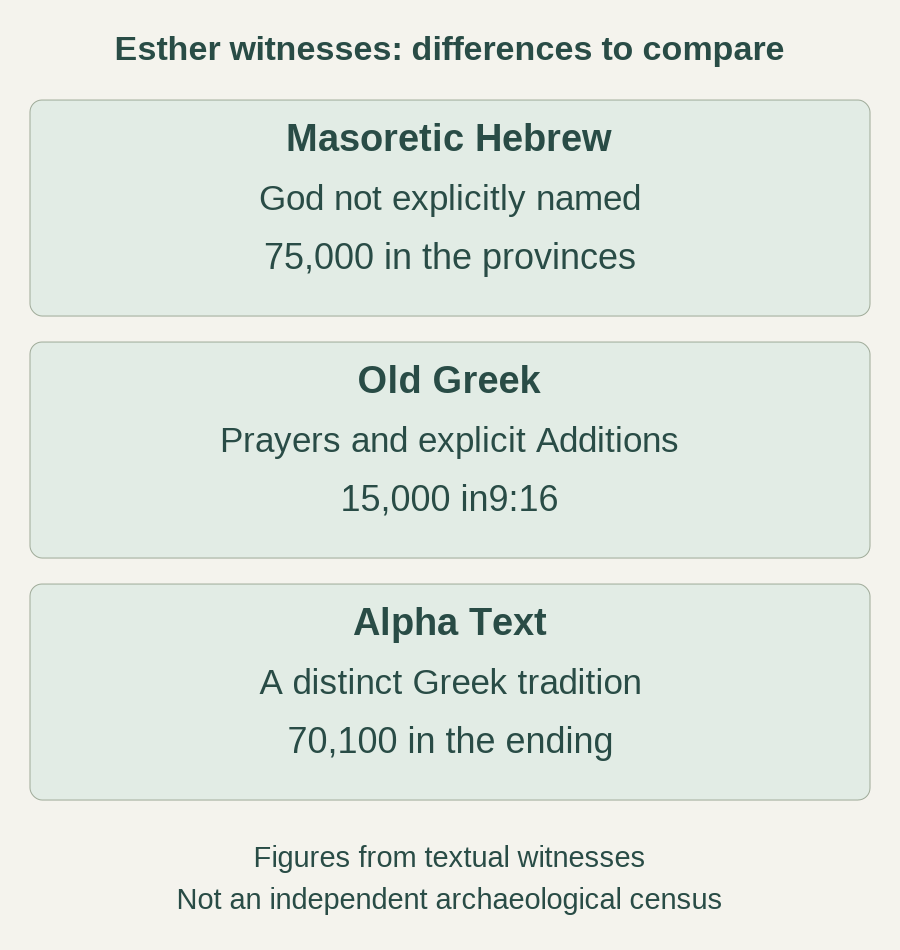
The divine name does not appear explicitly in the Masoretic Hebrew text of Esther, whose action prominently involves meals, royal correspondence, the lot and reversals of power. The surviving Greek forms differ, with additions such as prayers by Esther and Mordecai and longer royal edicts. The Old Greek (SeptuagintSeptuagintA name for the varied ancient Greek translations and writings associated with Jewish scripture; beginning with the Torah, the texts differ across books and manuscripts.Glossary · Click to read the explanation) text and the shorter Alpha Text should not be treated as one uniform Greek translation. These differences matter for the religious interpretation and transmission of the story, but do not themselves establish the date when Purim was first instituted. [14] [15]
Babylonian and Iranian origin proposals
Purim has been compared with festivals of the ancient Near EastAncient Near EastModern scholarly label for ancient societies of Mesopotamia, the Levant, Anatolia and Iran, sometimes extending to Egypt and other neighbours depending on the study; not one civilization or religion.Glossary · Click to read the explanation, notably the Sacaea, described in some Greek accounts with reversals of social roles, and the Iranian Frawardigan observances. Scholars have also noted possible associations between Mordecai and Esther and the Mesopotamian names MardukMardukBabylon’s leading god, worshipped at Esagil and elevated in the Akkadian Enūma eliš. His symbols include a spade and mušḫuššu dragon. His earliest origins remain obscure; Nibiru is no evidence of a planetary homeland.Glossary · Click to read the explanation and IshtarInanna / IshtarA prominent Mesopotamian goddess whose Sumerian name Inanna became associated with Akkadian Ishtar across diverse traditions. She was associated with desire, war, royal authority and Venus, while local forms and genealogies varied among texts.Glossary · Click to read the explanation. A firmer linguistic comparison is the AkkadianAkkadianAn ancient East Semitic language written in cuneiform from the third millennium BCE; its varieties include Babylonian and Assyrian, and it served in international diplomacy.Glossary · Click to read the explanation pūru, “lot.” The strength of these connections varies: word history, resemblance between names and festive motifs are not, together, a documented chain by which a specific older festival passed into Jewish practice. [4] [12]
Pierre Briant describes the ancient testimony on Sacaea as confused and inconsistent. Edmund Leach critically revisited James FrazerJames George FrazerJames George Frazer (1854–1941) studied classical literature, anthropology and comparative religion and was associated with Trinity College, Cambridge.Glossary · Click to read the explanation's speculation about a temporary or substitute king, but that comparative reconstruction remains an argument rather than an attested line of ritualRitualAn organised or distinguished practice meaningful to a community; it may leave traces, but its form alone does not reveal an associated doctrine.Glossary · Click to read the explanation transmission. Such comparisons may generate questions, yet they cannot settle the founding circumstances of Purim. Nor does Esther's account of casting lots independently confirm all the events assigned to Haman. [16] [17]
The cover image and what the sources establish
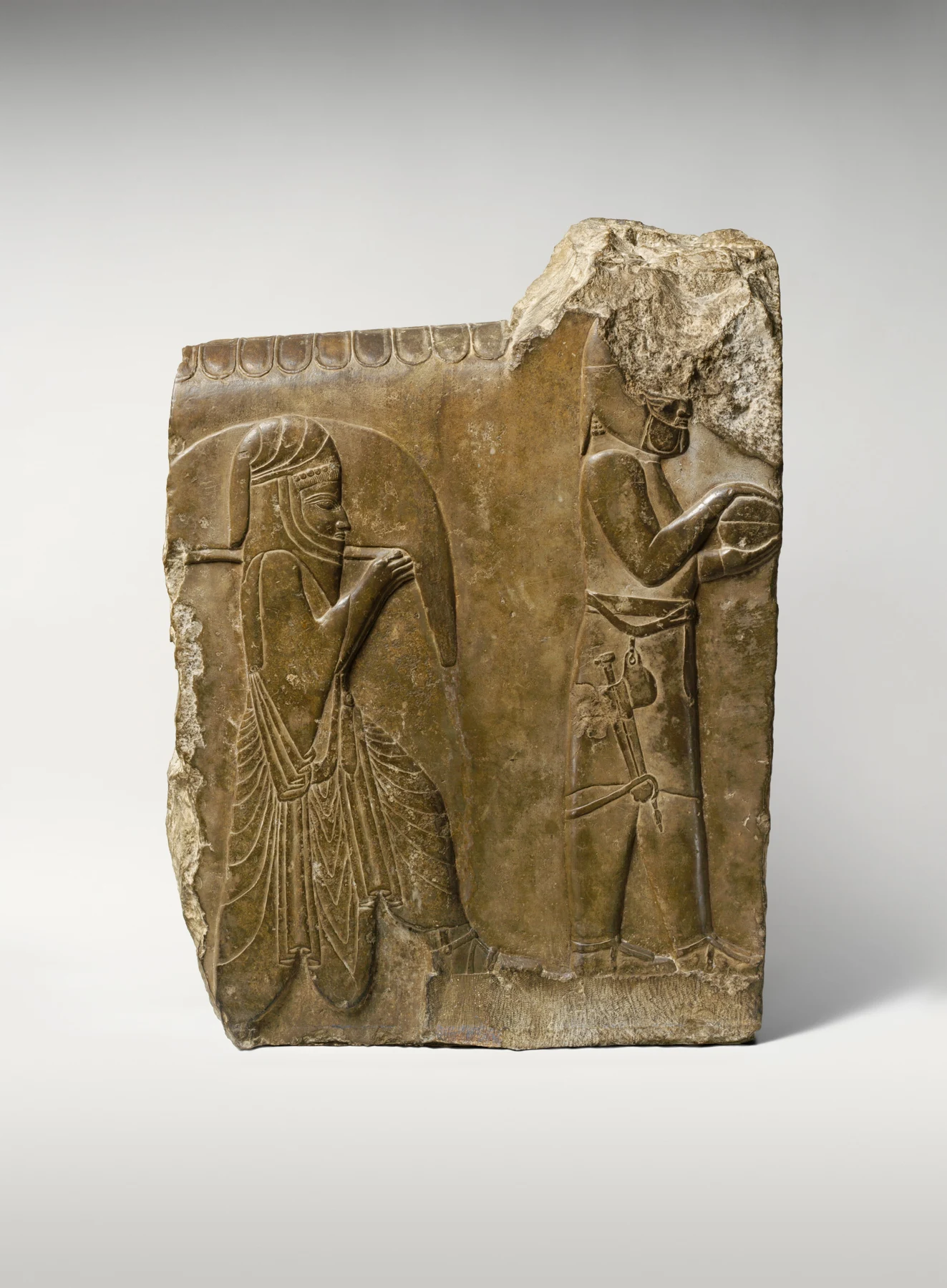
The cover shows an Achaemenid limestone relief from Persepolis, approximately 358–338 BCE, depicting two servants with food and drink. It documents an aspect of Persian banquet imagery; it is later than the reign of Xerxes I and does not depict the Scroll of Esther, Purim or anyone named in the narrative. The Metropolitan Museum of Art records it as 34.158, with a public-domain image. [18]
The sources thus answer different questions. Esther supplies the festival's narrative name and rationale; Second Maccabees and Josephus attest to awareness of the commemoration in later times; Mishnah and later legal writing document developments in practice. A direct Babylonian or Iranian ritual ancestor remains unproven. Purim is a continuing Jewish celebration in which shared reading, joy and material care for others stand together, even while its earliest history remains debated.
References and notes (18)
- Book of Esther, 3:7–13, parallel Hebrew and English at Mechon Mamre; the lot and the narrated decree for 13 Adar. Esther 3:7–13 Return to the text ↑
- Book of Esther, 9:1–19, parallel Hebrew and English; narrated dates, deaths and days of rest. Esther 9:1–19 Return to the text ↑
- Book of Esther, 9:20–32, the narrated letters, feasting, food gifts, poor relief and fasting. Esther 9:20–32 Return to the text ↑
- Amnon Netzer, “Festivals vii. Jewish,” Encyclopaedia Iranica; Purim passage only, on dates, terminology and comparisons. Part vii, “Jewish,” Purim paragraph Return to the text ↑
- Mishnah Megillah 1:1, Hebrew and English in Sefaria’s indexed passage; not a reading of the whole tractate. Megillah 1:1 Return to the text ↑
- Mishnah Megillah 1:4, indexed Hebrew-English passage on the first and second Adar and the scroll and gifts. Megillah 1:4 Return to the text ↑
- Maimonides, Mishneh Torah, Book of Seasons, Laws of Megillah and Hanukkah, ch. 2, especially final paragraphs on feasting and gifts; English version consulted. Laws of Megillah and Hanukkah 2:14–19 (19 = [17] in alternate numbering) Return to the text ↑
- Complete chapter 9 read in Hebrew and facing English. Esther 9:1–32 Return to the text ↑
- 2 Maccabees 15:36, USCCB English translation, identifying the next day as “Mordecai’s day.” 2 Maccabees 15:36 Return to the text ↑
- NABRE introduction to 2 Maccabees, Bible Gateway, on the Greek epitome of Jason of Cyrene and approximate composition; introduction excerpt only. Introduction; composition and epitome Return to the text ↑
- Flavius Josephus, Jewish Antiquities 11.6.13 §§291–295, displayed Greek with English translation; festival passage checked, no independent Greek translation claimed. Antiquities 11.6.13 §§291–295 Return to the text ↑
- Shaul Shaked, “Esther, Book of,” Encyclopaedia Iranica VIII/6 (1998), pp. 655–657; online article read on date, Persian court and historical limits. Online entry; print reference pp. 655–657 Return to the text ↑
- Adele Berlin, literary reading of Esther; indexed excerpt only at My Jewish Learning, cross-checked with JPS publisher description; her whole book was not read. Indexed excerpt on literary genre; not full commentary Return to the text ↑
- Adele Berlin, “How the Book of Esther Changed,” indexed summary on Hebrew and Greek forms and additions; full webpage inaccessible. Indexed excerpt on Greek textual forms Return to the text ↑
- Tyler Smith and Kristin de Troyer, “The Additions of the Greek Book(s) of Esther,” Oxford Handbook of the Apocrypha (2021), pp. 387–396; published abstract only. Abstract only; published chapter pp. 387–396 Return to the text ↑
- Pierre Briant, “Sacaea,” Oxford Classical Dictionary (online ed., 2016); accessible abstract/excerpt only, including the discordant ancient testimony. Entry abstract/excerpt only Return to the text ↑
- Edmund R. Leach, “Kingship and divinity: The unpublished Frazer Lecture, Oxford, 28 October 1982,” HAU 1/1 (2011), DOI:10.14318/hau1.1.012; relevant discussion of Frazer and Sacaea read. Relevant discussion of Frazer and Sacaea Return to the text ↑
- Metropolitan Museum of Art, “Relief: two servants bearing food and drink,” accession 34.158, Persepolis limestone, ca. 358–338 BCE; object page and public-domain declaration. Collection record 34.158; Public Domain Return to the text ↑
Suggest a correction · Suggest a source for this record
Cite this record
IL Archive, «Purim», https://ilarchive.com/en/entities/purim-festival
Continue reading