Person · Philosopher and Jewish scholar
Moses Maimonides
- Names
- Moses ben Maimon · Rambam
- Timeline
- 1204 CE
- Region
- Córdoba (al-Andalus), Fez (Morocco), Fustat (Egypt)
Moses Maimonides (c. 1138–1204) was a Jewish jurist, philosopher, and physician. An evidence-based study of his Mishnah commentary, legal code, Guide, medical writings, and Arabic philosophical context.
Estimated reading time: 10 min Published Last reviewed:
Share article

Text
Introduction
MosesMosesCentral figure in Exodus, Torah traditions and the Qur’an; childhood accounts differ in detail.Glossary · Click to read the explanation ben Maimon, known in Jewish tradition as the Rambam (c. 1138–1204 CE), was a Jewish jurist, philosopher, and physician whose life extended from al-Andalus through Morocco to Egypt. His importance lies in more than a single philosophical problem: he explained rabbinic legal tradition, systematized its rulings, and examined the limits of knowledge, religious language, social life, and the body. This entry reads his works according to their distinct aims, rather than reducing them to repeated expressions of one philosophical doctrine.
It compares what he actually wrote in the Mishneh Torah, the Guide of the Perplexed, and his medical letters. It also distinguishes his original HebrewHebrewA Northwest Semitic language of the Canaanite group, encompassing Iron Age epigraphy, Biblical, Rabbinic, medieval and Modern Hebrew; its scripts and pronunciations changed over time.Glossary · Click to read the explanation and Judeo-Arabic compositions from subsequent translations and surviving copies. That distinction matters when assessing scriptural interpretation and divine attributes, his connections with philosophers writing in the Islamic world, and positions later readers and critics attributed to him.
A life of journeys and diverse writings
Maimonides was born in Córdoba, in al-Andalus. Older accounts give 1135, whereas later historical research favors approximately 1137–1138. His family left amid pressures on non-Muslims following the Almohad advance in 1148, lived in Fez in Morocco, and eventually settled in Fustat, Egypt, around 1166. There he became an authority on Jewish law, practiced medicine, and corresponded with Jewish communities outside Egypt. He died in Fustat in 1204. Details of these movements vary in precision; the itinerary alone cannot explain his intellectual development. [3]
The principal texts and events can be arranged in an approximate chronology, provided that the dates of translations and extant copies are not confused with the composition of their originals:
- Around 1168: completion of the Commentary on the Mishnah in Arabic written in Hebrew letters, portions of which had been composed during his travels. [4]
- 1172: the Epistle to Yemen, a reply to a community confronting religious coercion and expectations surrounding a claimant to messiahship. [8]
- Late 1170s to about 1180: compilation of the Mishneh Torah, a major Hebrew code comprising fourteen books. [3][6]
- Around 1190: completion of the Judeo-Arabic Guide of the Perplexed; the Treatise on Resurrection followed in 1191 in the context of disputes over bodily resurrection. [3]
- Between 1193 and 1198: composition of On the Regimen of Health for a patient of the Ayyubid dynasty. In 1204, the year Maimonides died, Samuel Ibn Tibbon completed his Hebrew translation of the Guide, revising it in 1213. [9][10]
From commentary to a code of Jewish law
The MishnahMishnahThe Mishnah is a rabbinic compilation assembled around 200 CE, organizing teachings and discussions by topic.Glossary · Click to read the explanation is a rabbinic compilation assembled around 200 CE; it is not the book Maimonides called the Mishneh Torah. His Commentary on the Mishnah went beyond explaining individual legal rulings. Its introduction to the tractate Avot, commonly called the Eight Chapters, examines ethics; his discussion of the tenth chapter of Sanhedrin articulates thirteen principles of faith as he understood them. Their formulation became a subject of later debate, not a universally uncontested consensus dating back to the twelfth century. The commentary was written in Judeo-Arabic, and parts of his corrected autograph survive at the National Library of Israel: evidence of writing and revision, not an automatic date for every passage. [3][4]
The Mishneh Torah, by contrast, is a thematically arranged Hebrew code encompassing worship, private and public law, ethics, and fundamental beliefs, including laws not all practicable in his own period. It did not simply reproduce the early Mishnah: it distilled rulings from rabbinic literature into a concise, usable presentation. The resulting accessibility aided its influence, but its method provoked objections, notably the lack of detailed source references for many rulings; Abraham ben David of Posquières, known as the Raavad, was a prominent critic. The dispute concerned how legal reasoning could be checked and what authority a code should carry, not a simple universal acceptance or rejection. [3][6]
In the Mishneh Torah, Book of Knowledge, Laws of the Foundations of the Torah, chapter 1, paragraph five in the consulted site's numbering (also designated [ז] in another numbering), the original Hebrew reads: [5]
In our translation: “This God is one—not two or more than two, but one.” The passage then denies that divine unity resembles the unity of a body divisible into parts. Its claim is therefore about unity without composition, rather than merely counting how many gods there are. The quotation comes directly from his Hebrew legal code: it is neither a Judeo-Arabic quotation from the Guide nor a modern English translation retroactively ascribed to him. [5]
The Guide: language and the limits of describing God
Maimonides addressed the Guide to an advanced reader acquainted with both Jewish law and philosophy who found some scriptural expressions apparently at odds with intellectual argument. The original was composed in Judeo-Arabic—Arabic generally written in Hebrew characters. For the philosophical chapters, the text actually consulted here is M. Friedländer's English translation, revised in 1904, not a word-by-word collation against Maimonides' autograph. Where the exact English wording matters, it belongs to this translation. [1]
In Part I, chapter 1, Maimonides examines biblical terms used in Genesis to speak of the human being as the image of God. He separates words denoting perceptible bodily appearance from a form or distinctive intellectual capacity; on this reading the divine image does not imply a body shaped like a human one. The argument rests on linguistic distinctions within the biblical text together with a philosophical account of intellect, rather than on simply dismissing a difficult verse. [1]
In Part I, chapters 57–58, he develops divine simplicityDivine simplicityThe claim that God has no ontological constituents; strong versions deny real distinctions between essence and existence or between God and intrinsic attributes. It is not just numerical oneness or incorporeality.Glossary · Click to read the explanation, the denial that God's essence is composed of parts or independently existing attributes. Affirming divine knowledge or power in precisely the sense in which a human being has these properties risks treating them as additions to the divine essence. Negative theologyNegative theologyAn approach to divine language that denies limitations or defects and may emphasize the failure of human categories to capture divine essence; its forms vary across traditions.Glossary · Click to read the explanation can instead deny ignorance or powerlessness without pretending to offer a positive definition of God's essence. Maimonides further distinguishes claims about that essence from descriptions of observable actions and effects. This does not make scriptural language useless; it requires its role to be interpreted rather than equated with its corporeal surface sense. [1][2]
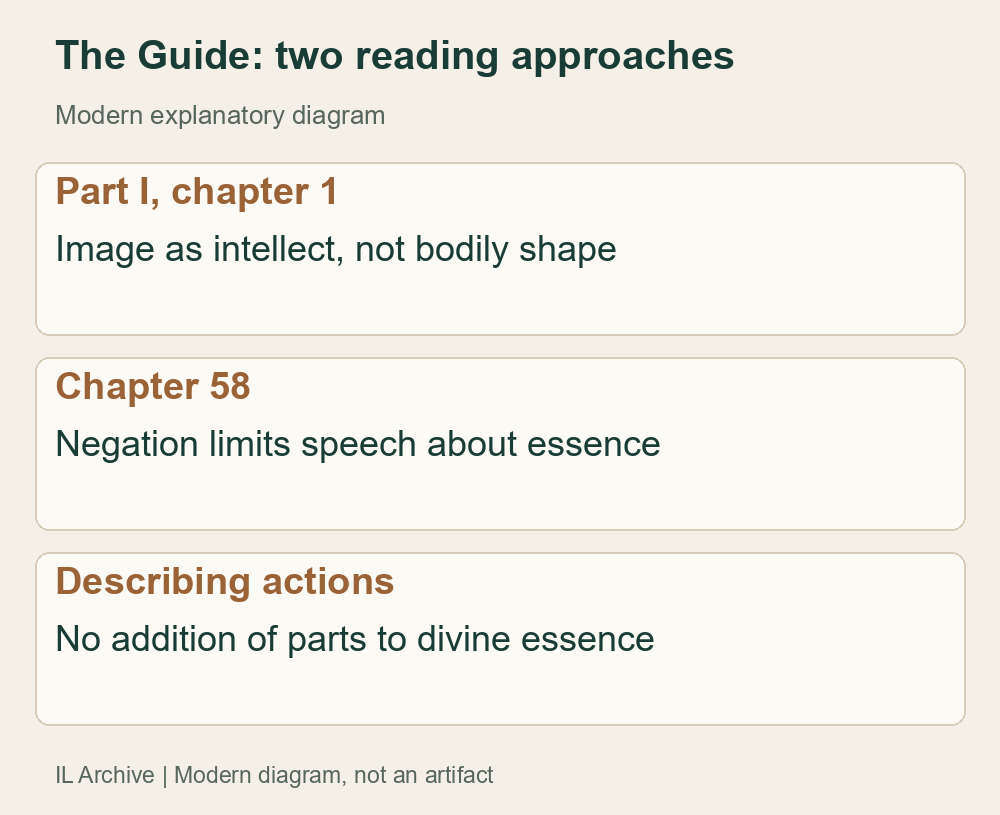
The modern diagram above illustrates two selected passages of the Guide, not his entire legal or philosophical outlook. Nor does an intellectual reading of “image” imply that every concrete biblical image is figurative in precisely the same way: textual context and the relevant philosophical argument both matter.
Demonstration, interpretation, and philosophical debts
Part II, chapter 25, of the Guide provides a particularly clear test of his method. In the consulted Friedländer translation he argues that divine incorporealityDivine incorporealityThe denial that divine essence is an extended body with parts or spatial occupation; distinct from invisibility and simplicity, with the meaning of body and place varying by school.Glossary · Click to read the explanation is demonstrable, so biblical language apparently implying a body must be reinterpreted. Aristotelian eternity of the universe, by contrast, has not, he thinks, been established by a compelling demonstration. The mere possibility of explaining creation figuratively is therefore insufficient reason to abandon the reading of creation that he defends. He adds that one form of the eternity thesis jeopardizes prophecy and miracles. The rule is neither that reason always wins nor that literal interpretation always prevails: the quality of the demonstration and the implications of the proposed reading determine the case. [1]
His project engages with AristotleAristotleAristotle (384–322 BCE) was a Greek philosopher who studied nature, life and thought. His writings influenced later religious philosophies.Glossary · Click to read the explanation and philosophical traditions composed in Arabic. Specialized research documents al-Farabi's particular importance to him, more complicated relations with Avicenna (Ibn Sina)Avicenna (Ibn Sina)Avicenna (Ibn Sīnā, died 1037) was a philosopher and physician from the Bukhara milieu, active across the eastern Islamic world. His philosophical Cure and medical Canon address distinct subjects; his arguments on essence, necessity, and soul require careful reading of the texts.Glossary · Click to read the explanation, and scholarly disagreement over whether he encountered certain writings by Averroes (Ibn Rushd) before or after completing the Guide. Similar treatments of creation or intellect therefore do not, by themselves, establish the direction of intellectual influence. Nor does calling him an “Aristotelian” replace examining the arguments in their actual chapters. [2]
His interpretation of scripture and rejection of corporeal descriptions may also recall Philo of AlexandriaPhilo of AlexandriaGreek-writing Jewish interpreter in Roman Alexandria (roughly first century CE), who read the Torah philosophically while defending its practices; his works survive through Greek copying and Armenian translation.Glossary · Click to read the explanation, a Jewish interpreter who wrote in Greek in the first century CE. Yet the chronological and linguistic distance is considerable. A shared question establishes neither direct reading of Philo by Maimonides nor a known, unbroken chain of transmission. The clearest evidence in the passages examined is an encounter between biblical interpretation and the argumentative practices of Arabic philosophy, with the precise extent of individual influences remaining open to investigation. [2]
The aims of law, ethics, and medicine
The Guide is not confined to God and cosmology. In Part III, chapter 27, Maimonides identifies two connected aims of the Law: improvement of bodily and social circumstances, limiting injustice and securing a livable community, and the cultivation of correct beliefs and knowledge. He regards the former as a practical condition for the latter, not a competing ultimate goal. Chapters 31–32 then defend looking for purposes in commandments and consider how worship takes account of inherited habits and historical circumstances; a key example is the interpretation of certain sacrificial arrangements in relation to established forms of worship. This is his philosophical and historical explanation within his own system, not independent archaeological proof of each proposed origin of a ritualRitualAn organised or distinguished practice meaningful to a community; it may leave traces, but its form alone does not reveal an associated doctrine.Glossary · Click to read the explanation. [1]
A connection between physical well-being and religious life also appears in the Mishneh Torah, Book of Knowledge, Laws of Character Traits, chapter 4, paragraph 1, where maintaining bodily health is counted among the ways that enable knowledge of the Creator. In his medical writings, however, he approached particular illnesses and treatments through his professional vocabulary. In On the Regimen of Health (1193–1198), written for al-Afdal Ali, son of the Ayyubid ruler Saladin, he considers nutrition, exercise, emotional balance, and the gradation of treatment according to a patient's condition. These passages illuminate his medicine in its medieval intellectual setting; their age does not make them present-day medical advice. [7][9]
In the subsequent medical letter, A Treatise in Elucidation of Some Symptoms and the Response to Them (about 1198), he assesses other physicians' prescriptions and proposes a daily regimen for his patient. The published extract distinguishes medical advice concerning bodily benefit from religious rules that may command or prohibit conduct. This neither equates medicine with religion nor turns an individual therapeutic recommendation into a law for all patients. The details are available to us here through a licensed English translated extract, not a full collation of its Arabic manuscript. [12]
Letters, controversy, and the texts that survive
The Epistle to Yemen shows his activity outside the philosophical treatise. Written in 1172 to Jacob ben Nethanel al-Fayyumi, a representative of Yemenite Jewry, it addresses forced conversion and anxieties raised by messianic claims. The letter takes a sharply defensive Jewish stance toward rival religious claims. That rhetoric needs to be understood in its polemical circumstances, neither neutralized nor projected indiscriminately onto his writings on medicine and philosophy. The passage consulted here is a translated excerpt. [8]
His reception was far from uniform. Some jurists criticized his method of codifying law; others challenged what they believed his account of the soul's survival implied about resurrection. In the Treatise on Resurrection in 1191 he defended the possibility of bodily resurrection, although the relation of this position to his account of intellectual perfection remains debated. Readers of the Guide have likewise disagreed over whether certain surface claims, arrangements, or apparent tensions conceal a deeper philosophical position. Neither a disciple's reconstruction nor an opponent's accusation, taken alone, establishes his intended teaching. [3]
Modern interpretations consequently differ on the relation between the legal code and the philosophical book. Leo Strauss emphasized a possible tension between law grounded in revelation and philosophical argument, whereas Isadore Twersky and David Hartman sought a larger continuity of purpose joining law and philosophy despite their different audiences and methods. Difference in genre can explain distinct modes of expression, but it proves neither that every detail agrees nor that an apparent divergence is an intentional contradiction. In the passages examined here, both works deny corporeality and composition in God, while differing in their degree of elaboration and presentation. [5][6]
Three stages of textual transmission must be kept apart: composition of the Judeo-Arabic Guide around 1190; Samuel Ibn Tibbon's first Hebrew translation in 1204 and its revision in 1213; and the date of a surviving later Hebrew copy, such as the illustrated Barcelona manuscript dated 1348 identified on a file page naming the Royal Danish Library. That manuscript's date attests to circulation of the work in that period, not its original composition, and proves nothing about the precise Judeo-Arabic wording of a passage not examined. Nor can any later artistic representation be presented as a verified portrait of Maimonides. [10][11]
The most reliable picture of Maimonides emerges when legal rulings are read for their legal purpose, philosophical arguments in their chapters, letters within their circumstances, and all of these texts in their proper languages and layers of transmission. His far-reaching influence can then be understood without reducing him to the slogan of “reconciling faith and reason,” or treating historical possibilities as certainties unsupported by evidence.
References and notes (12)
- Moses Maimonides, The Guide for the Perplexed, trans. M. Friedländer from Arabic, second revised edition, 1904 (CCEL text). Part I, 1, 57–58; Part II, 25; Part III, 27, 31–32. These passages were read in English translation, not collated against the Judeo-Arabic autograph. Return to the text ↑
- “The Influence of Islamic Thought on Maimonides,” Stanford Encyclopedia of Philosophy, Spring 2026 archive (substantive revision 2014). Introduction, §§1–2 and selected passages of §3, on al-Farabi, Avicenna, Averroes, and attributes. Return to the text ↑
- Kenneth Seeskin, “Maimonides,” Stanford Encyclopedia of Philosophy, substantive revision 18 November 2024. Sections 1, 4–7 and biographical notes; life, works, creation, competing readings, and resurrection. Return to the text ↑
- National Library of Israel, collection record “Maimonides’ Commentary on the Mishnah in Judeo-Arabic,” via Google Arts & Culture. Object description only: autograph with corrections, display date 1161/1168, paper and Arabic in Hebrew letters; the full manuscript was not read. Return to the text ↑
- Maimonides, Mishneh Torah, Book of Knowledge, “Foundations of the Torah,” ch. 1; original Hebrew text at Mechon Mamre. Chapter 1, especially paragraph ה [ז] in the presentation, followed by discussion of body, unity, and figurative speech. Hebrew quotation read directly. Return to the text ↑
- Bernard Steinberg, “Moses Maimonides: Mishneh Torah,” Oxford Bibliographies in Jewish Studies, 2017; review confirmed 2021. Public introduction/extract only: 1178–1180, fourteen books, Hebrew language, omitted legal source citations, and debate over law and philosophy; paywalled sections unread. Return to the text ↑
- Maimonides, Mishneh Torah, Book of Knowledge, “Character Traits,” ch. 4, §1; Hebrew alongside Eliyahu Touger’s translation at Chabad.org. Chapter 4, opening §1, Hebrew text and facing translation, on health and the knowledge of God. Return to the text ↑
- Maimonides, Epistle to Yemen (1172), excerpt trans. Boaz Cohen from Abraham Halkin’s 1952 edition, Posen Library. Editorial description and displayed letter extract; original Judeo-Arabic not collated and no long modern translated quotation reproduced. Return to the text ↑
- Maimonides, On the Regimen of Health (1193–1198), displayed extracts trans. Ariel Bar-Sela, Hebbel E. Hoff, and Elias Faris (1964), Posen Library. Editorial note and available 1964-translated excerpts on diet, exercise, emotional balance, and graduated medication; not the entire Arabic critical edition. Return to the text ↑
- “Samuel Ibn Tibbon,” Stanford Encyclopedia of Philosophy, revised 6 March 2024. Sections 1–3, especially the Guide translation completed 1204 and revised with glossary 1213, and Hebrew technical vocabulary. Return to the text ↑
- Wikimedia Commons, file page “Guiaperplexos_202a.jpg”: description of an illuminated Hebrew Guide manuscript dated 1348 and sourced to the Royal Danish Library; file-specific rights declaration. File description/date (1348) and licensing section only; the manuscript page was not transcribed and its image was not incorporated. Return to the text ↑
- Maimonides, A Treatise in Elucidation of Some Symptoms and the Response to Them (c. 1198), selected extracts trans. Bar-Sela, Hoff, and Faris (1964), Posen Library. Description and displayed translated passages assessing other doctors, daily regimen, and the distinction between medical advice and religious law; Arabic original not collated. Return to the text ↑
Suggest a correction · Suggest a source for this record
Cite this record
IL Archive, «Moses Maimonides», https://ilarchive.com/en/people/maimonides
Continue reading