Entity · philosophical_school
Neoplatonism
A reference page linking a name, group, or concept to the materials that discuss it.
Modern label for later Platonic traditions associated with Plotinus, centuries after Philo.
Text
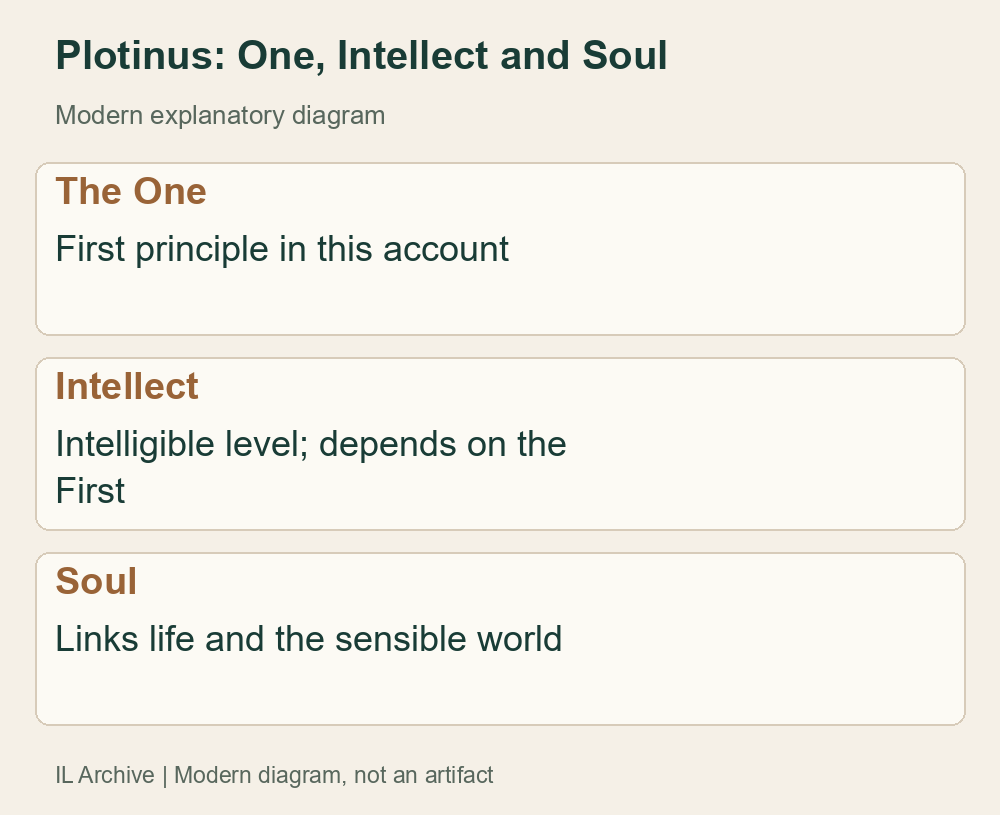
The label concerns traditions from the third century CE onward, rather than every earlier use of PlatoPlatoGreek philosopher; the Timaeus’s maker differs from later religious conceptions of God.Glossary · Click to read the explanation. Plotinian relations of dependence connect the One, Intellect and Soul; these are not simply locations on a literal cosmic map. Authors grouped under this modern term also differ. [1]
Plotinian material entered Arabic in the Theology of AristotleAristotleGreek philosopher whose concepts of actuality, soul and motion were reinterpreted in later religious traditions.Glossary · Click to read the explanation, attributed to Aristotle. This specifically documents altered attribution and reworking, rather than showing that the earlier PhiloPhilo of AlexandriaFirst-century CE Alexandrian Jewish author. In Life of Moses he presents Greek translation as inspired; the passage does not explicitly assign a separate room to each translator.Glossary · Click to read the explanation was a Neoplatonist or that all Arabic philosophy adopted one structure. The diagram is an explanatory simplification and does not identify One, Intellect and Soul with the Christian TrinityTrinityChristian formulation of divine unity and Father/Son/Spirit distinction, with a history of debate.Glossary · Click to read the explanation. [2]
References and notes
- Neoplatonism, Stanford Encyclopedia of Philosophy Introduction and selected sections 1–4; later school, One, Intellect and Soul. Return to the text ↑
- Cristina D’Ancona, Greek Sources in Arabic and Islamic Philosophy, Stanford Encyclopedia of Philosophy, revised 23 March 2026 Introduction and selected sections 1–3; Syriac background, translations and Theology of Aristotle. Return to the text ↑
Research history
Substantive changes are retained here. Minor copy edits remain in the internal operational log.
-
Substantive record update
Suggest a correction · Suggest a source for this record
Cite this record
IL Archive, «Neoplatonism», Edition 2, https://ilarchive.com/en/entities/neoplatonism