Entity · theological_concept
Divine immutability
A reference page linking a name, group, or concept to the materials that discuss it.
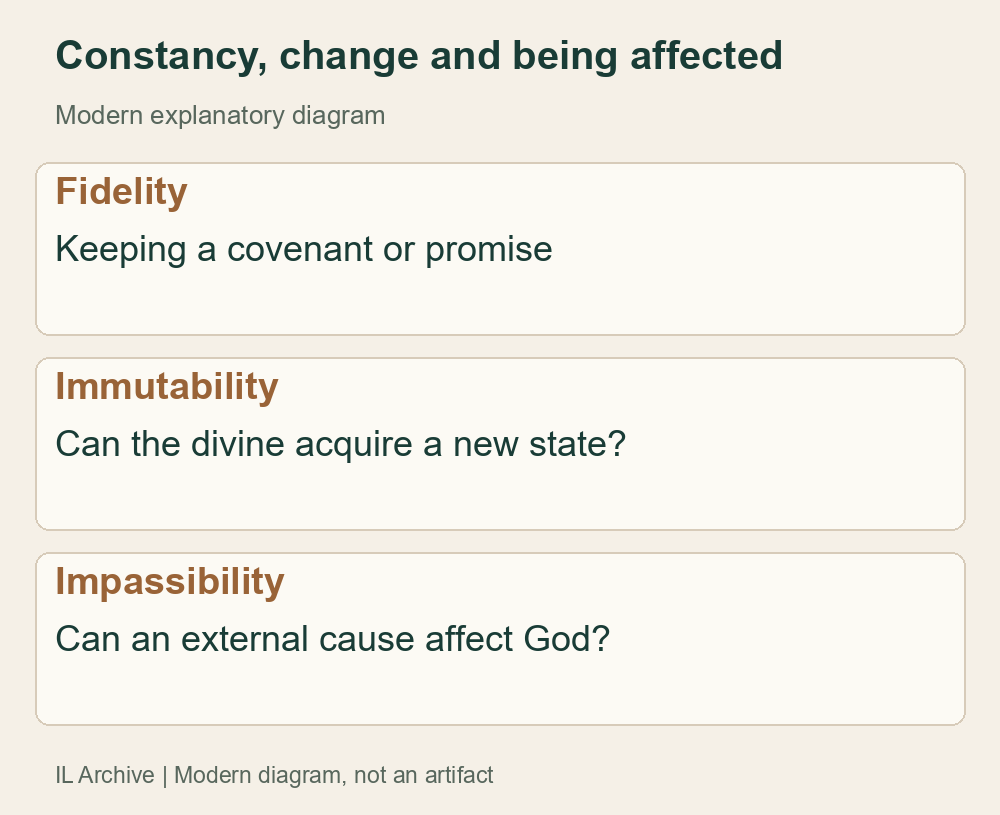
Inquiry into divine change, distinguished from fidelity and impassibility.
Text
A philosophical formulation may deny that divine essenceOusia — essenceGreek term for essence or nature, with meanings changing between authors.Glossary · Click to read the explanation acquires a new state or that knowledge and will alter. This exceeds the claim that God keeps a promise. Denying change also differs conceptually from denying effects of external causes, even when theologians connect the two. [1]
PhiloPhilo of AlexandriaFirst-century CE Alexandrian Jewish author. In Life of Moses he presents Greek translation as inspired; the passage does not explicitly assign a separate room to each translator.Glossary · Click to read the explanation interprets divine anger and regret as language suited to educating people rather than literal deficiencies in the creator. The term alone does not show that every religious tradition denies love or providence, or supply one answer about relations with a changing world or Christian incarnationChristian incarnationThe Word becoming flesh; distinct from every divine body or sensible manifestation.Glossary · Click to read the explanation. [2]
References and notes
- Immutability, Stanford Encyclopedia of Philosophy, Summer 2025 archive Selected sections 1–3; immutability, impassibility and relational/incarnation questions. Return to the text ↑
- Philo, On the Unchangeableness of God, translated by C. D. Yonge 51–54 and 67–71; rejection of bodily passions and pedagogical interpretation. Return to the text ↑
Research history
Substantive changes are retained here. Minor copy edits remain in the internal operational log.
-
Substantive record update
Suggest a correction · Suggest a source for this record
Cite this record
IL Archive, «Divine immutability», Edition 2, https://ilarchive.com/en/entities/divine-immutability