Study
When Israel’s God Encountered Greek Philosophy
An extended study of a topic, with evidence and references.
From Greek Torah and Philo to Christian reception, Arabic philosophy and Maimonides: changing language of perfection, creation and logos, with distinct schools and graded transmission evidence.
Share article
![Gold coin of Ptolemy II, Alexandria, ca. 261–246 BCE; the illustrated obverse bears Arsinoe II’s head. Context for Hellenistic Egypt, not a portrait of Philo or proof of a Torah translation commission. [24]](/media/1436)
Text
From narrative language to questions about nature
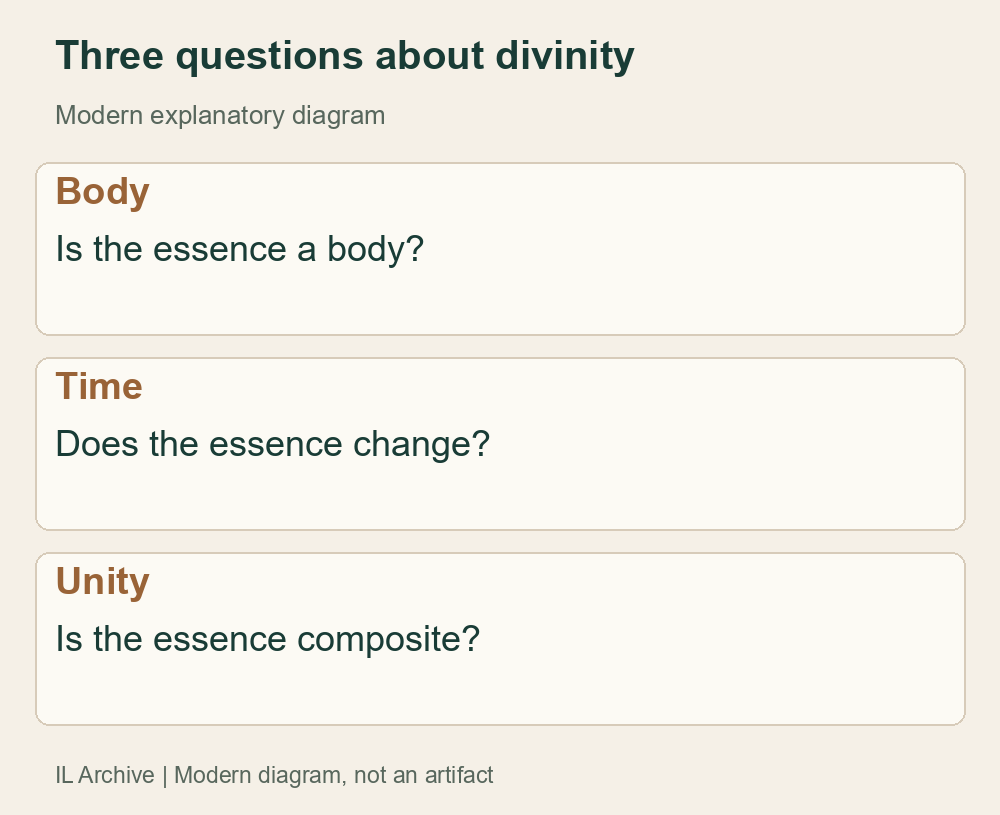
In biblical texts, YahwehYahwehThe divine proper name written YHWH in the Hebrew Bible.Glossary · Click to read the explanation speaks, hears his people's cries, descends, rescues and chooses a king. Genesis 6:6 says that he regretted making humanity and grieved. This is the language of relationship, action and narrative, rather than necessarily a philosophical account of God's body or nature. Metaphor and transcendence also belong to biblical tradition; we cannot assume that every ancient reader understood hands, thrones and anger as literal anatomy. [1]
Encountering philosophy made other questions more explicit. Can what is perfect change? Can the unlimited be a body? How does the one relate to a world of many things? Is divine knowledge like ours? These questions do not replace justice or covenant, but add another field of inquiry. Carlos Fraenkel places discussion of existence and attributes at the intersection of Jewish traditions and philosophical theology, while warning against reducing this encounter to religion confronting philosophy. [25]
Alexander brought a new environment
Between 334 and 323 BCE, Alexander's conquests extended from Greece and Asia Minor to Egypt, the Persian Empire and the fringes of India. After his death in 323, successor kingdoms emerged, including the Ptolemies in Egypt and the Seleucids across large parts of Asia. No single royal decree delivered books to every household, but networks of government, trade and education changed the circulation of language and ideas. [2]
Greek became a means of communication, employment and cultural activity in many places without eliminating local languages. Hellenization therefore did not replace the eastern world wholesale with a Greek one. Contact varied: some learned the language, others used it administratively, and some intellectuals pursued philosophical debate. These are different degrees of engagement, rather than a single event.
Three languages, rather than one
The spread of Greek added a layer to a world already familiar with HebrewHebrewA Northwest Semitic language in the Canaanite group, with ancient and modern forms.Glossary · Click to read the explanation and AramaicAramaicA group of Northwest Semitic language varieties with a long history across the Near East.Glossary · Click to read the explanation. Bernard Spolsky describes a pattern of three languages in Hellenistic and Roman Palestine. Their functions differed between the region and the diaspora, and between administration, worship, writing and everyday life. Sharing a language did not mean sharing a philosophical school. [3]
This distinction matters methodologically. A translation can introduce a new term without its translator having read AristotleAristotleGreek philosopher whose concepts of actuality, soul and motion were reinterpreted in later religious traditions.Glossary · Click to read the explanation. Someone can speak Greek while maintaining local religious traditions. Evidence for the spread of a language is broader than evidence for the transmission of a particular doctrine. Establishing the latter requires comparison of texts and concepts, rather than simply identifying the same alphabet.
The Torah in Greek
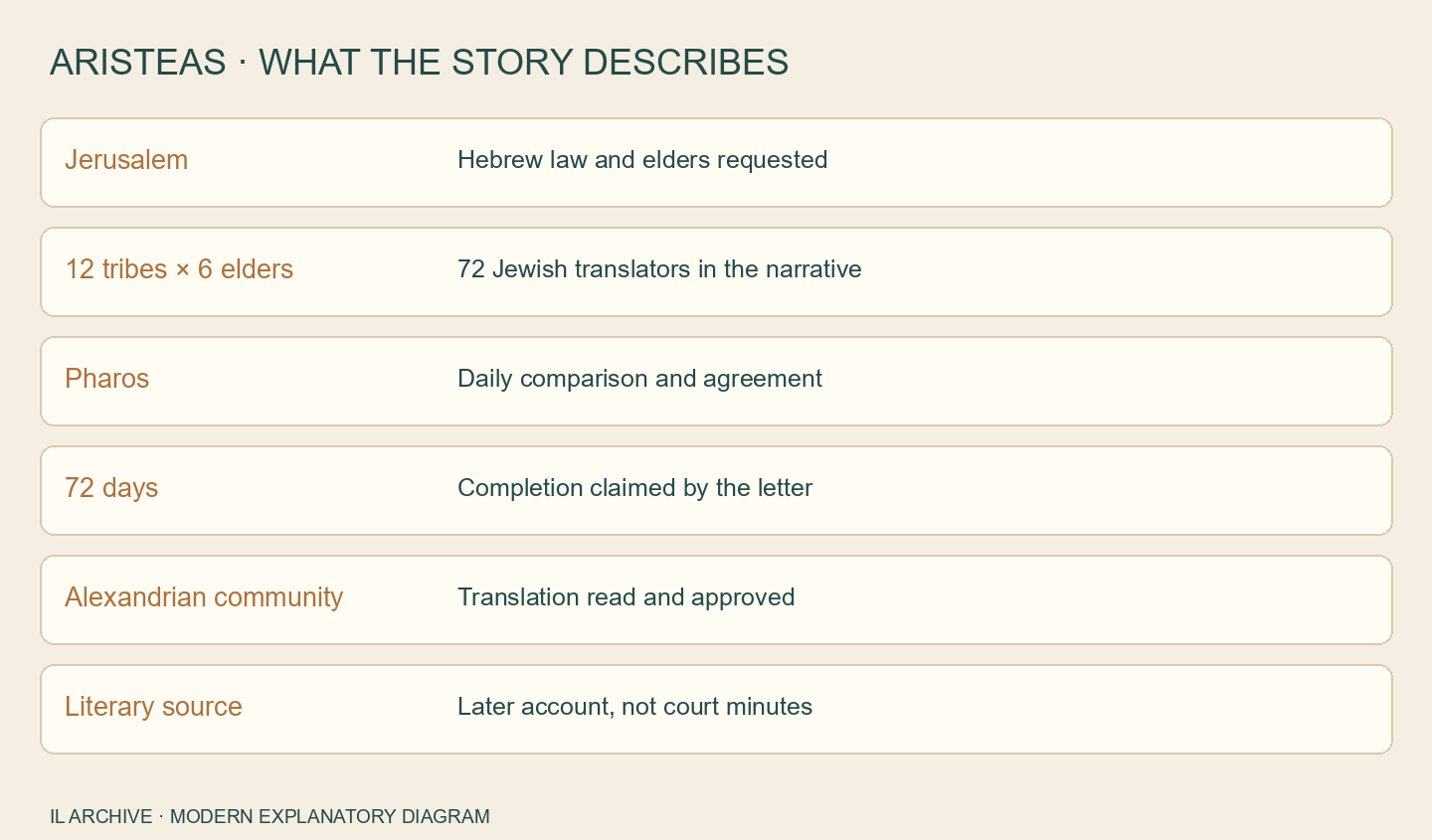
The TorahTorah / PentateuchGenesis, Exodus, Leviticus, Numbers and Deuteronomy: Mosaic corpus with a compositional history. Torah can also mean teaching or law beyond these five books.Glossary · Click to read the explanation was translated into Greek in Alexandria in the third century BCE, beginning the tradition called the SeptuagintSeptuagintTraditional designation for ancient Greek translations of Jewish scriptures, whose readings sometimes differ from the Hebrew Masoretic Text.Glossary · Click to read the explanation. This was a translation of earlier texts, rather than evidence that the Torah was composed in Alexandria. Nor can the translation dates of other books and the history of revisions be reduced to one operation that produced the whole Bible at once. [4][10]
In his Life of MosesMosesCentral figure in Exodus, Torah traditions and the Qur’an; childhood accounts differ in detail.Glossary · Click to read the explanation, PhiloPhilo of AlexandriaFirst-century CE Alexandrian Jewish author. In Life of Moses he presents Greek translation as inspired; the passage does not explicitly assign a separate room to each translator.Glossary · Click to read the explanation tells a story that gives the translation exceptional religious authority, treating the Greek text and what he calls the Chaldaean text as equivalent. His account reveals his esteem for the translation in the Roman period; it does not make his details about the translators contemporary reporting. The law could now be interpreted within Greek culture, but a specific philosophical borrowing still requires further evidence.
![Modern explanatory chronology; succession does not establish direct borrowing between authors. Philo predates Plotinian Neoplatonism. [10][20][21][22][19]](/media/1440)
Greek gods and their philosophers
The Greek world also had gods with human characteristics. Its stories included anger, jealousy, conflict and bodily relationships. Philosophers discussing divine perfection criticized aspects of their own poetic traditions. In the Republic, PlatoPlatoGreek philosopher; the Timaeus’s maker differs from later religious conceptions of God.Glossary · Click to read the explanation rejects stories that make gods responsible for evil or quarrelling and asks how they should be depicted. [5]
Contrasting “primitive Hebrews” with “rational Greeks” is therefore unhelpful. Both settings contained varied texts and interpretations. The encounter did not introduce thinking for the first time; it brought particular scholarly tools to the reading of existing religious materials. Philosophy itself was never a doctrine accepted by all Greeks.
Plato: can the perfect change?
In Book II of the Republic, PlatoPlatoGreek philosopher; the Timaeus’s maker differs from later religious conceptions of God.Glossary · Click to read the explanation offers an influential argument: a god already in the best condition needs no improvement and would not wish to become worse. He rejects divine transformation and deception through changing appearances. Perfection becomes a criterion governing what can be attributed to a god, rather than merely a poetic compliment. [5]
This argument belongs to Plato's project of educating the city and scrutinizing poetry; it is not a formulation of later Jewish or Christian monotheismMonotheismBelief in a single God as the only deity, rather than merely the highest among several gods.Glossary · Click to read the explanation. It does not settle every kind of change, such as a changing relationship with a changing world. Nevertheless, it supplies an interpreter with a powerful rule: if a religious narrative appears to say that God learned something or corrected a deficiency, should its surface meaning be accepted or reinterpreted?
The maker of the world in the Timaeus
The Timaeus presents the demiurgeDemiurgeMaker or organizer of the world in the Timaeus; not automatically a creator from nothing.Glossary · Click to read the explanation, a maker who orders the cosmos by looking to an unchanging intelligible model. Goodness, order and the model are central to the account, which describes a transition from disorder to arrangement. This does not automatically amount to creation from nothing in the sense debated by later traditions. [6]
The interpretation of this account—whether it describes a literal temporal beginning or the world's dependence on a cause and model—has a complex history. Plato did not simply present biblical doctrine in another vocabulary. He provided a structure that later interpreters could use: a sensible world, intelligible order and a good maker. Using that structure did not require accepting every detail of its original philosophy.
Aristotle and the mover that does not move
In Book XII of the Metaphysics, AristotleAristotleGreek philosopher whose concepts of actuality, soul and motion were reinterpreted in later religious traditions.Glossary · Click to read the explanation starts from eternal motion and seeks a permanently actual principle to explain it. The unmoved moverUnmoved moverAristotelian principle explaining eternal motion without its own transition from potentiality to actuality.Glossary · Click to read the explanation is immaterial, does not pass from unrealized potentiality into actuality, and has a life associated with thought. This differs from a narrative in which God begins making the universe at a particular time. [7]
Chapter 8 also discusses multiple principles associated with celestial movements, so Aristotle's theory cannot simply be presented as biblical monotheism. Later theologians used his terminology and arguments while reconstructing their relationship to creation and providence. The Aristotelian mover and a creator God are not established as identical merely because both texts use the word “god.”
The soul differs between schools
Plato's Phaedo argues for the soul's survival and connects its purification with turning away from the constraints of sensation and the body. Aristotle's On the Soul instead defines it as the form or first actuality of a natural body capable of life. For him, body and soul are not simply a container and a separate occupant. [8][9]
Questions about intellect in Aristotle remain disputed, but an unrestricted Platonic dualism should not be attributed to him. When the language of soul and body enters religious interpretation, we must ask which school and meaning are involved, and whether an author adopted the entire theory or only part of it. “Greek influence” alone answers none of these questions.
![Modern comparison of explanatory principles, not three names for the same god. Plato’s ordering does not establish creation from nothing; Aristotle’s mover is not automatically the biblical God. [6][7][13]](/media/1414)
Different Judaisms in the same environment
Jewish responses to Greek culture varied. Greek could be used while observing the law; local traditions could also be defended, or imposed practices resisted. Conflict involving Antiochus IV and the Maccabees does not make every use of Greek language or education a rejection of religion. Life in a multilingual environment complicates the picture of two wholly separate camps. [3][10]
One intellectual defence came from Aristobulus in the second century BCE, who attributed Greek philosophers' wisdom to Moses. This was a claim of precedence and superiority within ancient Jewish discourse, rather than independent proof that Plato read and borrowed from the Torah. We should attribute and evaluate the claim instead of treating its antiquity as historical confirmation.
Philo between the law and Greek culture
Philo of AlexandriaPhilo of AlexandriaJewish exegete writing Greek in the early Roman period and using philosophical tools to read the law.Glossary · Click to read the explanation lived from the late first century BCE to around the middle of the first century CE. He thus belongs to the early Roman period, within the continuing culture of the Hellenistic world. He wrote in Greek, interpreted Mosaic law and used Platonic, Stoic and other traditions. He should not be called a Neoplatonist in the sense associated with the later Plotinus. [10]
For Philo, the law was not an incidental addition to a completed philosophy. He sought to demonstrate its depth and truth, using philosophical language for that purpose. His work is more complex than abandoning Judaism to become Greek, or repeating philosophy unchanged. Both scripture and the concepts through which he read it shaped his project.
Allegorical interpretation did not abolish the law
Allegorical exegesisAllegorical exegesisReading narrative elements for further meanings; not inherently abolition of literal practice.Glossary · Click to read the explanation reads people, actions and places as signs of the soul, virtue or knowledge. In Philo's discussion of God's unchangeableness, anger and bodily organs become language for teaching and guiding human beings rather than literal descriptions of the creator's essenceOusia — essenceGreek term for essence or nature, with meanings changing between authors.Glossary · Click to read the explanation. He distinguishes divine reality from representations suited to educating a reader. [11]
This does not remove every literal meaning or practice. In On the Migration of Abraham, he criticizes those who treat laws as symbols and consequently neglect Sabbath observance, circumcision and other practices. Meaning and observance should both receive attention. Philo did not invent allegory from nothing; his importance lies in its extensive organization within his interpretation of the law. [12]
![Modern diagram of Philo’s approach, not a rule for every Jewish reader. Migration of Abraham rejects neglecting laws because of symbolic interpretation. [11][12]](/media/1420)
Transcendence does not mean abandoning providence
Passages in On the Migration of Abraham distinguish God, whom the world cannot contain, from his powers present within it. Language placing God in heaven and earth need not confine his essence to a location. The creator's powers continue to order and preserve the cosmos; transcendence therefore does not leave the world without providence. [12]
This raises a question that returns in many traditions: how can a transcendent source remain near and active? Calling God “distant” does not explain the position, because this is not distance between two bodies. The problem is also epistemological and ontological: how can we know what differs from sensible things, and describe its activity without making it one of them?
The Stoic logos
LogosLogosGreek word for word or discourse, used in John’s language of God and incarnation.Glossary · Click to read the explanation can mean speech, an account or reason, depending on context. For the Stoics it is associated with the active reason ordering and pervading the cosmos. Their school treats this principle as divine and corporeal, interpenetrating matter, rather than as a transcendent immaterial God in Philo's sense. [13]
A shared word does not guarantee a shared structure. An author can take a familiar term into another understanding of creator and world. We must therefore examine the logos's position, function and relationship to God and matter in each text. The term has multiple histories, rather than one paragraph of origin and one final definition.
Philo's logos: image and mediation
In On the Confusion of Tongues, Philo describes the logos as firstborn, image and an archangel with many names. In On the Creation, it is associated with the intelligible world and the model for the sensible one. These are genuine usages, but they do not turn every passage into a single definition of an independent person with an invariably fixed position. [14][15]
MediationIntercessionMediation subject in the cited Quranic texts to permission and approval, not divine independence.Glossary · Click to read the explanation helps him consider the relationship between divine transcendence and activity. Calling the logos a “son” does not establish that Philo anticipated the Son of Nicene doctrine, or narrated incarnation in a human person. Genre, context and function must remain distinct. Similarity opens comparison rather than predetermining identity.
Creation and its intelligible model
Philo uses the example of an architect who conceives a city before building it. The intelligible city is not in another country; it exists in the architect's thought. Similarly, he places the world's model in the divine logos and interprets the making of the sensible world accordingly. He presents this as Mosaic teaching, although its structure clearly uses philosophical language. [15]
It would be premature to say that he definitively established creation from nothing in its later formulation. The text also speaks of unorganized matter and its shaping, and scholars dispute its status. We can affirm God's creative role and the model's position in the logos while preserving debate over the origin of matter and the timing of creation. “Creation” by itself does not answer every metaphysical question. [10]
![Modern comparison retaining structural differences despite shared vocabulary. Logos alone does not establish direct transmission from Philo to John. [13][14][15][16][17]](/media/1432)
Unchangeableness: fidelity or metaphysics?
When a religious tradition says that God does not betray a promise, it affirms constancy and fidelity. Some philosophical formulations of divine immutabilityDivine immutabilityInquiry into divine change, distinguished from fidelity and impassibility.Glossary · Click to read the explanation instead consider whether knowledge and will can alter, or a new state can be acquired. These levels may be connected without automatically coinciding. Philo's treatment of anger and regret is an early example of sharpening the second question. [11][18]
Immutability should also be distinguished from impassibility: the former concerns changes of state, the latter God's being affected by an external cause. A theology may connect them, but the connection needs an argument. Neither term necessarily denies love or providence; both can seek to explain them without subjecting God to human weakness and fluctuation.
God's body and the limits of metaphor
Philo rejects bodily parts and irrational passions as literal divine attributes. Centuries later, MaimonidesMoses MaimonidesMedieval Jewish thinker; wrote the Guide in Judeo-Arabic and examined incorporeality and attributes.Glossary · Click to read the explanation made incorporealityDivine incorporealityDenial of a material divine body; distinct from image prohibition and simplicity.Glossary · Click to read the explanation central to reading biblical image and likeness. An interpreter can retain a scriptural expression while changing its kind of reference: power or understanding, rather than an organ, size or location. [11][19]
This does not establish that everyone before philosophy imagined a bodily God, or that everyone afterward rejected embodiment in the same way. Later debates about anthropomorphismAnthropomorphismRepresenting a thing or being with human features, such as arms, hands and dress. The term describes a form, without establishing an ordinary human or divine identity.Glossary · Click to read the explanation show continuing disagreement. A hand or throne may also be metaphorical in an early text without a complete Aristotelian theory behind it. Each usage requires examination rather than a single transformation attributed to all believers.
John's logos and its different limits
John's opening places the Word in relation to God and the creation of things, then declares that the Word became flesh. The story of Christ enters a position that Philo's writings do not present in the same way. This is more than a passing addition to a ready-made system; it has a different narrative and theological context. [16]
Philo helps illuminate Greek-speaking Jewish culture and language about mediation and creation. However, Torrey Seland's study abstract emphasizes the absence of firm evidence for direct contact between Philo and Christians in these texts. The two logoi can be compared alongside Jewish wisdom and word traditions without asserting that John's author copied a particular Philonic book. [17]
Christianity did not inherit a fixed dictionary
Christian theology used Greek terms such as ousia, hypostasisHypostasisTerm later used for distinguishing Father, Son and Spirit within one divinity.Glossary · Click to read the explanation and physis in discussions of substance, hypostasis or person, and nature. Fourth-century TrinitarianTrinityChristian formulation of divine unity and Father/Son/Spirit distinction, with a history of debate.Glossary · Click to read the explanation formulations became an influential basis for later inquiry. Yet these words have histories of usage; their modern translations should not be treated as definitions accepted from the outset. [27]
An enduring question was how incarnation and suffering relate to divine immutability. Mentioning Plato or Aristotle does not settle Christian answers, because Christians reconstructed concepts in light of their texts and differing positions. Philosophy could become the language of disagreement rather than a single foreign solution imposed upon everyone. [18]
Philo's survival and reception
Christian traditions preserved much of Philo's work, making it useful to later interpreters and theologians. This does not mean that every philosophical Christian idea came from him, or that every author read a text simply because it survived. Manuscript preservation, an author's reading and conceptual resemblance are distinct matters. [10]
Nor does Philo's reception in Jewish history form a simple continuous line to Maimonides. Similar questions can recur in different settings through other intermediaries. We should neither draw a sequence from Philo to all Jewish philosophy nor announce that Jewish thinking stopped when one author's presence diminished. Reception history requires evidence separate from a general history of ideas.
Maimonides and the question of attributes
Moses MaimonidesMoses MaimonidesMedieval Jewish thinker; wrote the Guide in Judeo-Arabic and examined incorporeality and attributes.Glossary · Click to read the explanation wrote the Guide of the Perplexed in Judeo-Arabic in the twelfth century, within a world familiar with Arabic philosophical writing and religious debate. Part I, chapter 1 interprets divine image through intellectual apprehension rather than bodily shape. Chapter 58 grounds appropriate language about God in denying deficiencies and describing actions. [19]
Calling God “knowing” should not, in this model, suggest a human attribute added to his essence as an independent component. Negation can clarify the limits of speech without providing a comprehensive picture of the essence. This approach belongs to a medieval Jewish and Islamic context, rather than a demonstrated personal succession from Philo. Resemblance between problems cannot replace the history of intermediaries. [26]
Greek, Syriac and Arabic
In late antiquityLate antiquityHistorical frame for late ancient transformations; boundaries vary by region and subject.Glossary · Click to read the explanation, philosophical reading continued in multilingual settings, including SyriacSyriacA literary form of Aramaic, with an extensive Christian heritage and earlier non-Christian attestations.Glossary · Click to read the explanation. Translation into Arabic then expanded substantially under the Abbasids, especially in the eighth and ninth centuries. Translators from varied backgrounds, including Christians, worked through routes directly from Greek and others through Syriac. [21]
Books, translations and translators' names make this a historically traceable process, but not every text followed the same path. Greek intellectual traditions in a region before Islam do not establish that every author of an Arabic religious text knew Aristotle. Date, place and the material transmitted must be specified, keeping general context distinct from a particular borrowing claim.
Aristotle carrying some Plotinus
Materials from Plotinus reached Arabic in a work known as the Theology of Aristotle. The title does not make it an authentic Aristotelian book: its contents derive from translation and reworking of parts of the Enneads. Here textual comparison can demonstrate that an attributed author's name differs from the content's origin. [21]
Plotinus belongs to the third century CE and to NeoplatonismNeoplatonismModern label for later Platonic traditions associated with Plotinus, centuries after Philo.Glossary · Click to read the explanation, which postdates Philo. That later school cannot explain earlier Hellenistic Jewish thought as though the earlier authors borrowed from it. An Arabic reader's Aristotle might also arrive with commentators and Neoplatonic materials; a transmitted book's history can change the perceived identity of its author. [20]
Avicenna: the necessary and the possible
AvicennaAvicenna (Ibn Sina)Philosopher in the Arabic Islamic tradition, distinguishing possible from necessary existence in itself.Glossary · Click to read the explanation distinguishes what is possible in itself and needs a cause from what is necessary in itself and depends on no other cause. This examines the basis of existence and dependence, rather than simply bodily motion or a temporal beginning. Even an eternal existent in his model may be caused and dependent on another principle. [22]
His distinctive account uses and reorganizes Aristotelian and Neoplatonic traditions rather than literally translating one passage. A principle established by an argument also does not automatically coincide with every detail supplied by a theologian or religious interpreter. Establishing a first principle is one step; its attributes and relationship to the world remain further subjects of debate.
Islamic philosophy did not speak with one voice
Al-Kindi, al-Farabi and Avicenna did not repeat a fixed Greek text under Arabic names. Their methods, aims and relations to revelation, prophecy and knowledge differed. The translation movement itself shows that selecting books, reworking them and incorporating them into new approaches were intellectual activities rather than mechanical transfers of words. [21]
Kalam likewise contains diverse positions. No Muslim is thereby obliged to adopt the world's eternity, every detail of emanation or every philosophical account of attributes. Debate between approaches belongs to this history. A generalization about “all Greeks” should not be replaced by one about “all Islam.” A common question does not force one answer, and a philosopher does not represent every member of his society. [22]
![Modern diagram of documented routes and their limits; not a direct Philo–Maimonides chain or one route for every translated book. [10][21][26]](/media/1426)
Different tools, rather than one toolkit
Distinguishing schools clarifies what was transmitted: Plato's intelligible model and relation between perfection and change; Aristotle's actuality, potentiality, matter, form and principles of motion; the Stoics' active corporeal cosmic reason; and Neoplatonic accounts of the One, Intellect and Soul. These elements do not function as interchangeable parts of one theory. [5][7][13][20]
A later author might combine and rearrange selected tools. We should explain the resulting structure rather than merely call it a mixture. Borrowing a term does not commit someone to its whole school, and using an Aristotelian argument does not make their scriptural interpretation Aristotle's own. Religious philosophy also has a history of selection, resistance and transformation.
Monotheism preceded Alexander
This history does not mean that Greeks invented Jewish monotheismMonotheismBelief in a single God as the only deity, rather than merely the highest among several gods.Glossary · Click to read the explanation. Isaiah 45:5 explicitly denies another god within a group of texts usually associated with the sixth century BCE, before Alexander's conquests. The subject here is the philosophical formulation of particular questions rather than the first appearance of every affirmation of divine unity. [23]
Exclusive worshipMonolatryWorship of one deity without necessarily denying others; variable analytical term, not one uniform doctrine of all Israelites.Glossary · Click to read the explanation is also not identical to every theory of simplicity, time or attributes. A tradition can affirm one God while its followers disagree about immutability or the nature of divine speech. The number of gods and the analysis of divine existence are different questions. They are related, but one cannot be substituted for the other.
Argument did not erase narrative
God's existence and attributes became subjects of argument and conceptual analysis for Jewish, Christian and Muslim philosophers. This did not erase covenant, prayer, law, creation and justice. Rational inquiry itself could be a religious practice for them rather than necessarily an activity outside religion. [25]
The history is not a transition from unthinking faith to faithless reason. Biblical texts address justice, suffering and knowledge in their own language, while philosophers reason with religious commitments. A change in the kind of question and answer does not turn every earlier period into ignorance or every later analysis into religion's definitive conclusion.
How can an influence claim be tested?
Every transmission claim needs six tests: chronology, possible contact, the specificity of resemblance, a concept's structural role, an intermediary, and possible independent developmentIndependent developmentSimilar elements arising without historical transmission between them.Glossary · Click to read the explanation. Is the proposed source earlier? Did it actually become available? Is the resemblance distinctive or merely a general attribute such as wisdom? Does the element retain its function, or acquire another meaning in a new text?
Our examples show the difference. Arabic translation of parts of Plotinus permits strong material textual comparison; the word logos alone cannot fill the gap in a direct route from Philo to John. A shared environment may be established more securely than borrowing from a particular book. The language used for a hypothesis should reflect its evidence rather than the attractiveness of a line drawn between two names. [17][21]
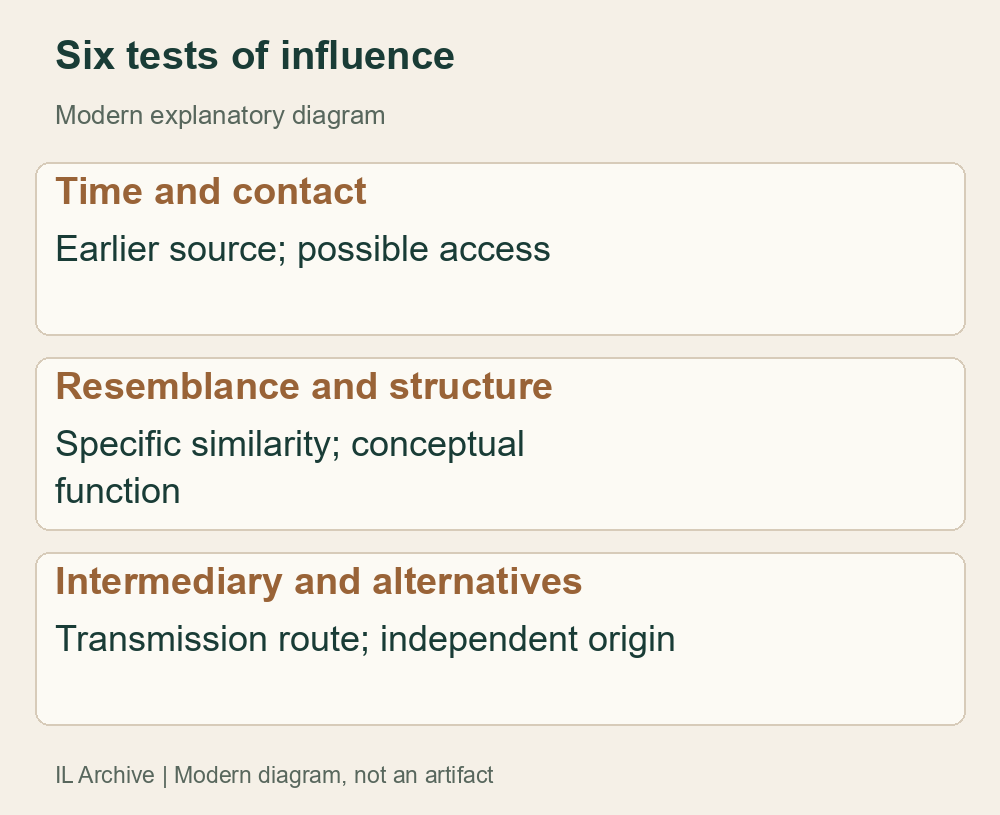
What do the sources establish?
Texts establish that Greek philosophers formulated precise questions about perfection, cause and soul; that Philo read the law within that environment; and that Greek texts and commentators entered Arabic. They also reveal real differences between Plato's maker, Aristotle's mover, the Stoic logos, Philo's logos and John's Word. Shared vocabulary does not erase these differences. [6][7][13][14][16][21]
Visual evidence must also remain within its limits. The Ptolemaic coin illustrated here comes from Alexandria, dates to around 261–246 BCE and bears the head of Arsinoe II. It documents Hellenistic Egypt, rather than depicting Philo, supplying a philosophical manuscript or proving a royal order to translate the Torah. The accompanying diagrams are modern explanatory aids, rather than ancient objects. [24]
When the language of questions changed
Israel's God did not become the philosophers' God in one day, nor did the God who hears and rescues disappear behind “first cause.” New interpretations explained how a creator could be transcendent and near, how a hand could be understood without a body and anger without human fluctuation, and how “one” could accommodate many names and actions. The texts remained while their interpretive rules expanded. [11][19]
This encounter produced a long history of agreement and disagreement in Judaism, Christianity and Islamic thought. Historical inquiry traces texts, concepts and transmission; it does not decide faith's truth or label influence as progress or corruption. The history shows how religious language can endure while readers change what they ask of its expressions and what counts as an adequate answer.
References and notes
- Genesis 6:6 — King James Version Genesis 6:6; narrative regret and grief. Return to the text ↑
- The Metropolitan Museum of Art, Art of the Hellenistic Age and the Hellenistic Tradition Opening historical paragraphs: Alexander’s campaigns, 334–323 BCE, and successor kingdoms. Return to the text ↑
- Bernard Spolsky, The Languages of the Jews, chapter 4: Three languages in Hellenistic and Roman Palestine Publisher summary of chapter 4; Hebrew, Aramaic and Greek. Return to the text ↑
- Philo, On the Life of Moses II, translated by C. D. Yonge Book II, 31–44; translation narrative and its authority for Philo, not contemporary third-century BCE reporting. Return to the text ↑
- Plato, Republic II, translated by Benjamin Jowett Book II, 380–383; goodness, perfection and rejection of divine transformation. Return to the text ↑
- Plato, Timaeus, translated by Benjamin Jowett 27d–30b; good maker, intelligible model and ordering disorder. Return to the text ↑
- Aristotle, Metaphysics XII, translated by W. D. Ross Selected passages in chapters 6–9; eternal motion, actuality, thought and multiple movers in chapter 8. Return to the text ↑
- Aristotle, On the Soul II, translated by J. A. Smith Book II, chapter 1; soul as form of a natural body capable of life. Return to the text ↑
- Plato, Phaedo, translated by Benjamin Jowett Selected affinity-argument and purification passages; soul’s survival and relation to body. Return to the text ↑
- Carlos Lévy, Philo of Alexandria, Stanford Encyclopedia of Philosophy, Summer 2024 archive Selected passages in 1.1–1.2, 2.2, 3.2 and 4.1–4.6; life, reception, allegory, logos and creation. Return to the text ↑
- Philo, On the Unchangeableness of God, translated by C. D. Yonge 51–54 and 67–71; rejection of bodily passions and pedagogical interpretation. Return to the text ↑
- Philo, On the Migration of Abraham, translated by C. D. Yonge 89–93: observance alongside symbol; 180–187: transcendence, powers and providence. Return to the text ↑
- Stoicism, Stanford Encyclopedia of Philosophy Section 2.7 and selected 2.3 passages; corporeal active principle and cosmic reason. Return to the text ↑
- Philo, On the Confusion of Tongues, translated by C. D. Yonge 146–147; logos, firstborn, image and archangel. Return to the text ↑
- Philo, On the Creation, translated by C. D. Yonge 16–25; intelligible city, architect and model in the logos. Return to the text ↑
- John 1:1–3,14 — King James Version John 1:1–3 and 14; Word, creation and becoming flesh. Return to the text ↑
- Torrey Seland, The New Testament, in The Reception of Philo of Alexandria, Oxford University Press, 2025 Search-indexed publisher abstract; limits of evidence for direct contact with Philo. Return to the text ↑
- Immutability, Stanford Encyclopedia of Philosophy, Summer 2025 archive Selected sections 1–3; immutability, impassibility and relational/incarnation questions. Return to the text ↑
- Moses Maimonides, The Guide for the Perplexed, translated by M. Friedländer, 1904 Part I, chapter 1, chapter 58 and opening of 60; intellectual image and negative attributes. Return to the text ↑
- Neoplatonism, Stanford Encyclopedia of Philosophy Introduction and selected sections 1–4; later school, One, Intellect and Soul. Return to the text ↑
- Cristina D’Ancona, Greek Sources in Arabic and Islamic Philosophy, Stanford Encyclopedia of Philosophy, revised 23 March 2026 Introduction and selected sections 1–3; Syriac background, translations and Theology of Aristotle. Return to the text ↑
- Ibn Sina’s Metaphysics, Stanford Encyclopedia of Philosophy Selected 4.1–4.2 and 5.2–5.4 passages; necessary/possible, creation and emanation. Return to the text ↑
- Isaiah 45:5 — King James Version Isaiah 45:5; denial of another god. Dating context: publisher description of Blenkinsopp’s commentary, not inferred from this verse alone. Return to the text ↑
- The Metropolitan Museum of Art, Gold oktadrachm of Ptolemy II Philadelphos, 30.115.23 Object 253074: Alexandria, ca. 261–246 BCE, head of Arsinoe II; Public Domain. Return to the text ↑
- Carlos Fraenkel, God’s Existence and Attributes, The Cambridge History of Jewish Philosophy, 2008, pp. 559–598 Publisher summary and chapter metadata; intersection of religion and philosophical theology. Return to the text ↑
- The Influence of Islamic Thought on Maimonides, Stanford Encyclopedia of Philosophy, Spring 2026 archive Selected section 1 passages; Maimonides’ Islamic philosophical context. Return to the text ↑
- Trinity, Stanford Encyclopedia of Philosophy, Summer 2011 archive Introduction and selected opening survey passages; fourth-century formulations and varied later analyses. Return to the text ↑
Suggest a correction · Suggest a source for this record
Cite this record
IL Archive, «When Israel’s God Encountered Greek Philosophy», Edition 1, https://ilarchive.com/en/studies/hellenistic-god-language
Continue reading