Entity
Monolatry
A reference page linking a name, group, or concept to the materials that discuss it.
Worship of one deity without necessarily denying others; variable analytical term, not one uniform doctrine of all Israelites.
Text
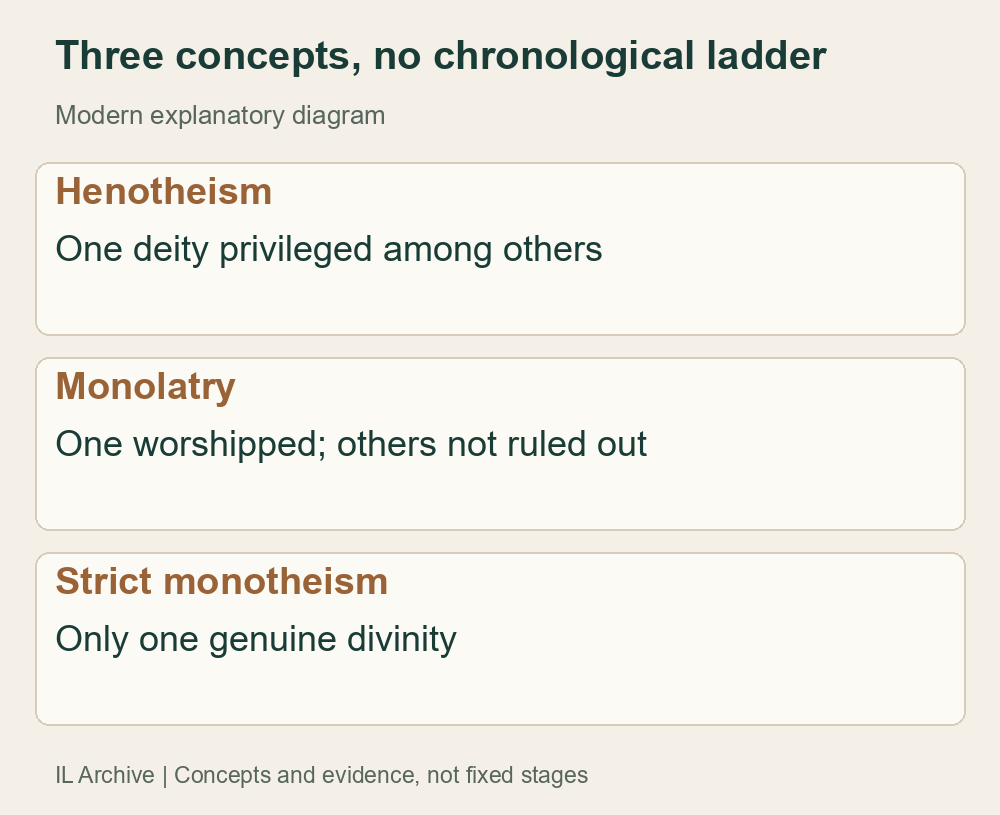
Exclusive worship separates whom to worship from who exists or has divinity. Prohibiting other gods alone proves neither their acceptance nor their denial; context matters. [1]
Monolatry and henotheismHenotheismPrivileging one god while acknowledging others in the working definition used here; not automatically monotheism or a fixed social phase.Glossary · Click to read the explanation sometimes overlap in scholarship. Here the former emphasizes allegiance, without becoming a fixed chronological stage preceding monotheismMonotheismBelief in a single God as the only deity, rather than merely the highest among several gods.Glossary · Click to read the explanation. Diagram supplies a modern definition, not an archaeological scene. [2]
References and notes
- Hebrew Bible: Exodus 20, prohibition of other gods and their worship. Mechon-Mamre. Hebrew prohibition read; commandment/verse numbering varies across traditions. Direct concern is allegiance; author’s complete ontology and popular belief not inferred from this alone. Return to the text ↑
- Baruch A. Levine. Global Monotheism: The Contribution of the Israelite Prophets. In Melammu: The Ancient World in an Age of Globalization, 2014. DOI: 10.34663/9783945561003-04. Introduction, proposed phases/dating and expanded prophetic horizon read. Late eighth/early seventh in Levine’s model; imperial explanation attributed, not consensus or universal adoption. Return to the text ↑
Research history
Substantive changes are retained here. Minor copy edits remain in the internal operational log.
-
Substantive record update
Suggest a correction · Suggest a source for this record
Cite this record
IL Archive, «Monolatry», Edition 2, https://ilarchive.com/en/entities/monolatry