Entity · Book
Torah / Pentateuch
A reference page linking a name, group, or concept to the materials that discuss it.
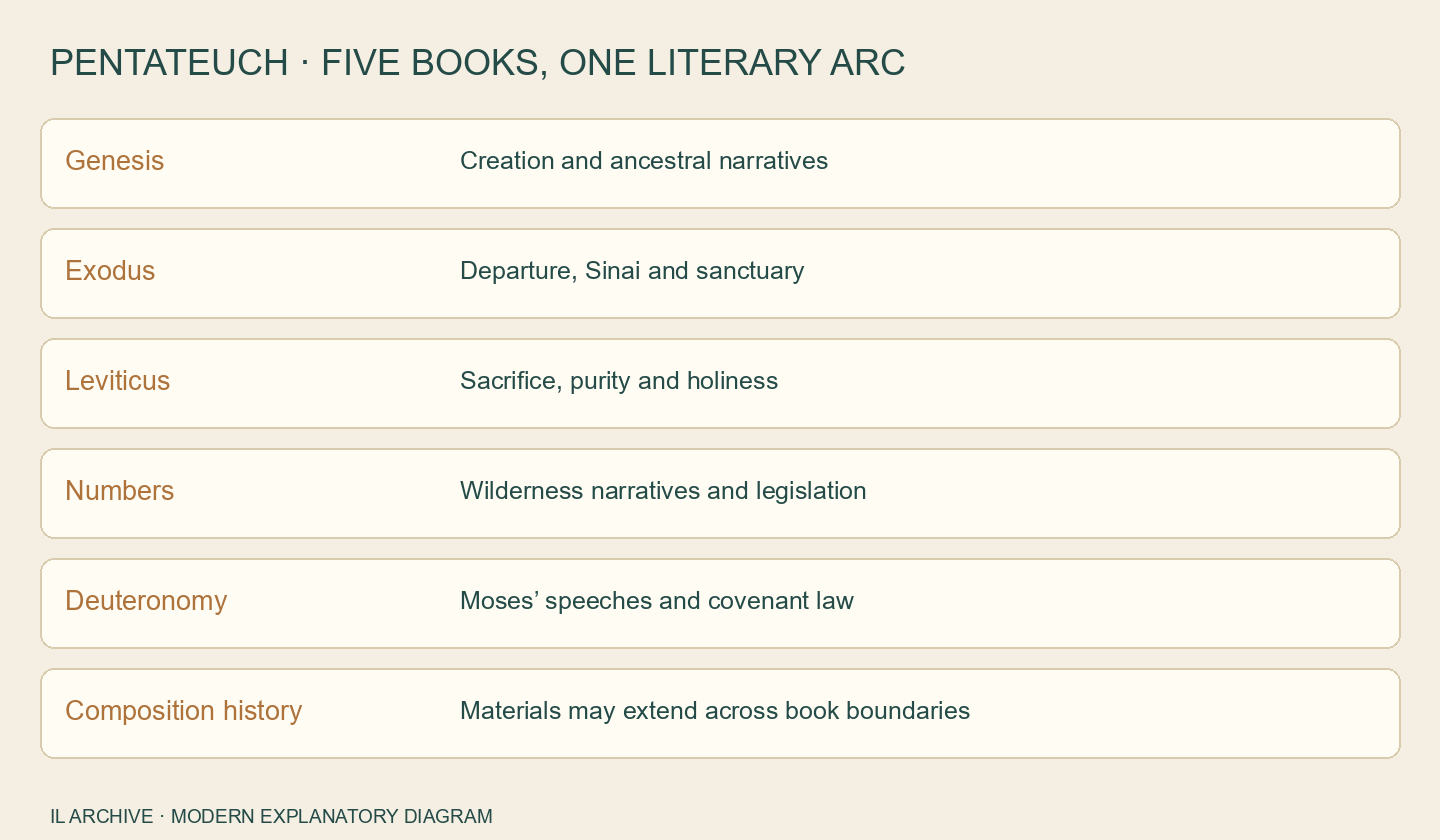
Genesis, Exodus, Leviticus, Numbers and Deuteronomy: Mosaic corpus with a compositional history. Torah can also mean teaching or law beyond these five books.
Text
Term and corpus
HebrewHebrewA Northwest Semitic language in the Canaanite group, with ancient and modern forms.Glossary · Click to read the explanation Torah means instruction or law; an ancient use need not designate all five current books.[1] The Pentateuch runs from creation to MosesMosesCentral figure in Exodus, Torah traditions and the Qur’an; childhood accounts differ in detail.Glossary · Click to read the explanation’ death. Book divisions need not coincide with literary sources or layers.[2]
History and witnesses
Third-century BCE Greek translation attests Hebrew pentateuchal texts. Traditions, editing and surviving copies have different dates.[3] The image is a modern guide to book order, not an ancient manuscript.
References and notes
- Molly M. Zahn (2021). The Relevance of Moses Traditions in the Second Temple Period. The Oxford Handbook of the Pentateuch, pp. 79–94. Torah not always coterminous with the Pentateuch; textual plurality and authority. Publisher abstract only; full chapter not read. Return to the text ↑
- Olivier Artus (2021). The Pentateuch: Five Books, One Canon. The Oxford Handbook of the Pentateuch, pp. 22–40. Division into five unequal scrolls and relation to literary formation. Publisher abstract only; full chapter not read. Return to the text ↑
- Oxford Bibliographies in Biblical Studies. Septuagint, Introduction. Open introduction: Pentateuch translated in Ptolemaic Egypt, likely Alexandria, mid/late third century BCE. Full entry not read. Return to the text ↑
Research history
Substantive changes are retained here. Minor copy edits remain in the internal operational log.
-
Substantive record update
Suggest a correction · Suggest a source for this record
Cite this record
IL Archive, «Torah / Pentateuch», Edition 2, https://ilarchive.com/en/entities/pentateuch