Entity · Religious concept
Intercession
A reference page linking a name, group, or concept to the materials that discuss it.
Intercession, a request for another, varies with intercessor, addressee and context. A comparative study of prophets’ prayers in the Torah, Christ’s intercession, Qur’anic conditions and Muslim and Christian debates.
Estimated reading time: 9 min Published Last reviewed:
Share article
Text
Introduction
In religious usage, intercession is an appeal made by one party on behalf of another before God, seeking mercy, pardon, or deliverance. Yet its function changes across texts: a living person's plea for a community, the prayer of righteous people after death as portrayed in a vision, Christ's continuing ministry, or intercession on the Day of Judgment subject to permission. Whether such a plea occurs is a separate question from whether living people may address a would-be intercessor.
This entry compares who acts, whom the request addresses, who benefits, and the situation in which it is made. It distinguishes what a source depicts from what later communities authorize. Similarity alone cannot establish a direct historical transmission.
The parties and the vocabulary
In the narrow sense, there are three parties: an intercessor making a request, a beneficiary for whom help is sought, and the addressee whose favorable decision is requested. Prayer can be directed to God for oneself or others without introducing another intermediary; a plea for forgiveness concerns sin in particular; and tawassul describes how a supplicant approaches God or frames an appeal, not necessarily an intercession that has actually taken place. Nor does secular mediation automatically equal religious intercession. These distinctions matter when the intercessor is alive or dead, and when a text recognizes intercession without authorizing requests addressed to its supposed agent.
Pleas by the living in Torah narratives
In Genesis, the first book of the Torah, AbrahamAbrahamCentral figure in Genesis, the Qur'an and Jewish, Christian and Islamic traditions; the sacrifice study compares what each text says about him.Glossary · Click to read the explanation challenges the announced judgment of Sodom: will the righteous be swept away with the wicked? His successive requests concern how many righteous people might preserve the city. God is addressed directly, the city stands to benefit, and the reasoning concerns divine justice. The scene neither depicts a petition to a dead holy figure nor guarantees the city's rescue without qualification. [4]
In Exodus, the Torah's second book, MosesMosesCentral figure in Exodus, Torah traditions and the Qur’an; childhood accounts differ in detail.Glossary · Click to read the explanation pleads with God following the episode of the golden calf, invoking the deliverance from Egypt and the promises to the ancestors. The opening of his appeal reads, in the consonantal display of the Westminster Leningrad Codex tradition: [5][6]
That is, “Moses implored the LORD his God” (Exodus 32:11). The narrative recounts the withdrawal of an announced punishment in verse 14, but still describes punishment in verse 35. It therefore does not establish that every plea removes every consequence. This is the narrative of a living prophet's petition, not a ready-made ruling on later forms of intercession. [5][6]
The departed righteous praying: 2 Maccabees
Second Maccabees, a Greek historical-theological work about resistance to Seleucid rule in Judea, offers a different witness. Before the battle against Nicanor, Judas Maccabeus recounts a dream or waking vision: Onias, the former high priest, raises his hands in prayer for the Jewish community. Another figure appears whom Onias identifies as the prophet Jeremiah, often praying for the people and the holy city. The passage reports a vision; it does not say Judas addressed a request for intercession to Onias or Jeremiah. [7]
A phrase describing Jeremiah in the digital Greek text of 2 Maccabees 15:14 reads: [7]
That is, “the one praying much for the people and the holy city.” The passage's evidential force is its depiction of a deceased righteous figure praying for the living within a literary vision. Its limit is that this does not by itself demonstrate a practice of addressing the dead or consensus across Jewish communities. The book's narrative extends to about 161 BCE, whereas its Greek epitome of a lost five-volume work by Jason of Cyrene is generally dated to the late second century BCE. The vision's setting is neither the date of extant manuscripts nor the date of the digital edition consulted here. [7][8]
Jesus and other intercessors in Christian sources
In Romans 8:34, Paul describes the risen Jesus ChristJesus ChristJesus Christ is Christianity’s central figure, who lived in the first century CEGlossary · Click to read the explanation as interceding for believers. Hebrews 7:25 associates this role with his continuing priesthood: [9][10]
That is, “always living to intercede on their behalf.” This excerpt comes from the Greek text printed in Nestle's 1904 edition, not from a transcription of any one manuscript. In a specialized study of Hebrews, Abiola Mbamalu interprets intercession as a continuation of Christ's representative action on behalf of human weakness and sin, reading Isaiah 53 alongside Psalm 110. A competing interpretation views Christ's very presence before God as continuing intercession without repeated acts of pleading. The disagreement is about the priestly office as well as the verb. [10][11]
First Timothy urges the community to offer prayers “for everyone” (2:1–2), but calls Christ the “one mediator” (μεσίτης) between God and humanity (2:5). The source itself thus distinguishes prayer for others from Christ's saving mediation. Permission to pray for one another does not, on its own, authorize every practice of requesting the prayers of the dead. The dating and authorship of particular New Testament letters are separate scholarly questions; the time of a narrated person must not be treated as the composition date of every letter. [12]
Later reception is not uniform. The Catechism of the Catholic Church teaches that saints in heaven intercede and may be asked for their prayers while maintaining Christ's unique position. By contrast, the Lutheran Augsburg Confession of 1530 commends honoring saints' memories and following their examples, but does not find scriptural authority for invoking them. Significantly, the later Apology of that confession acknowledges Jeremiah's prayer in the dream of 2 Maccabees while distinguishing the dead praying from a command authorizing the living to invoke them. The dispute concerns the authority for a practice and its theological meaning; it is not a blanket denial of all prayer for others. [13][14][15][16]
The Qur'an: denied entitlement and conditional permission
The Qur'anThe QuranThe central scripture of Islam, consisting of 114 Arabic surahs; its study distinguishes Quranic discourse from manuscript history, reading traditions, and historical inference.Glossary · Click to read the explanation combines emphatic denials in warnings about judgment—such as “no intercession will be accepted” in 2:48—with passages specifying permission. The Throne Verse (2:255) asks: [17][1]
That is, “Who can intercede with Him except by His permission?” Its wording denies an intercessor's capacity to compel a decision independently, rather than excluding any intercession God allows. In 21:26–29, after rejecting claims that God's honored servants are His offspring, the text says: “They intercede only for one He approves” (21:28). In 20:109, benefit depends on authorization and speech God accepts; in 53:26 even the angels' intercession is ineffective without God's leave and approval. In explaining 21:28, al-Tabari identifies the servants in context as angels and transmits more than one view concerning whom God approves. The distinct settings of these declarations matter. [2][20][26][21]
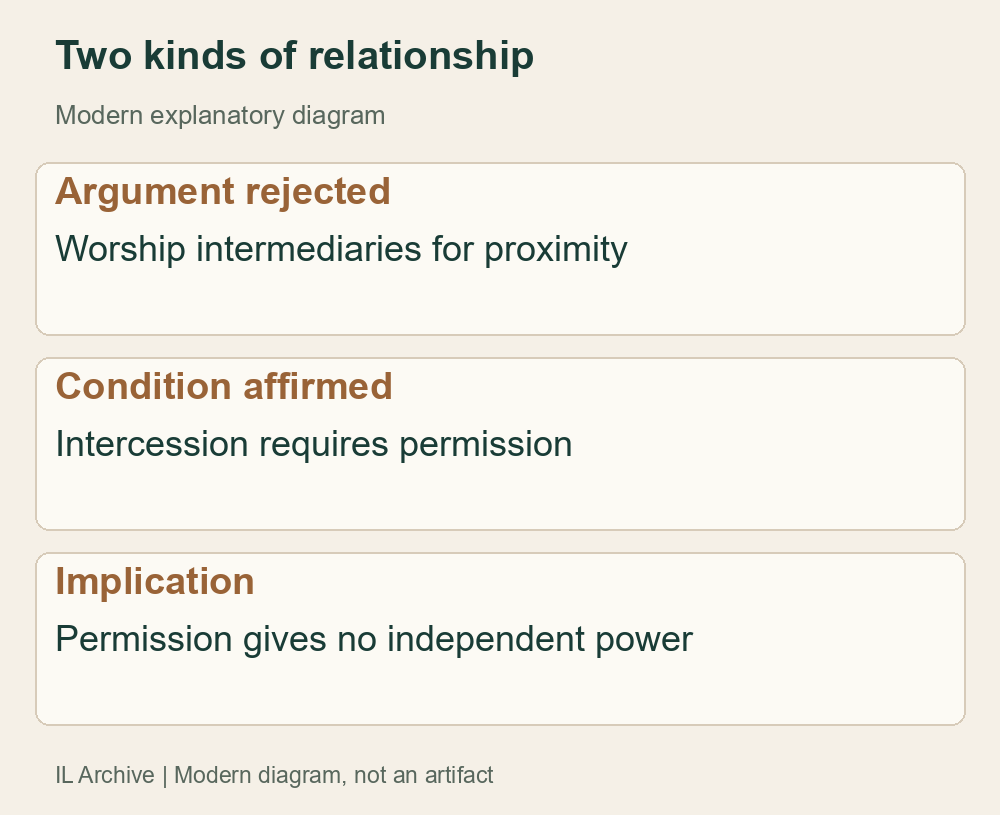
Qur'an 39:44 declares that all intercession belongs to God. Other passages reject worship of supposed intermediaries on the grounds that they offer access or proximity: 10:18 reports worshippers saying “These are our intercessors with God,” while 39:3 represents them as saying “We worship them only to bring us nearer to God.” The objection concerns the worship and purported autonomous standing of intermediaries; it cannot be automatically extended to every living person's prayer for another or every authorized intercession. Conversely, conditional permission does not legitimate worship of intermediaries in the Qur'anic argument. [18][19][3]
The accompanying image is a modern explanatory comparison of this Qur'anic argument only, not an ancient artifact or a map of every school of interpretation.
Hadith, theology, and tawassul
A narrative in Sahih al-Bukhari 4476 portrays people at the future judgment seeking intercession successively from Adam, NoahNoahNoah is the flood-story figure in Genesis and a prophet in the Qur’anGlossary · Click to read the explanation, Abraham, Moses, and Jesus, before MuhammadMuhammad, prophet of IslamMuhammad is the prophet of Islam, living about 570–632 CE in the setting of Islam’s seventh-century emergenceGlossary · Click to read the explanation seeks God's permission and receives authorization to intercede. Jamiʿ al-Tirmidhi 2435 records the saying, “My intercession is for those of my community who commit major sins.” These reports are preserved in hadith collections compiled in the ninth century CE; the future eschatological episode they describe is not dated to the compilation of the collections. [22][23]
Classical theological disagreements are not always about whether intercession exists. A 2024 study of Fakhr al-Din al-Razi's criticism of the Muʿtazila identifies a dispute over the beneficiaries and effects: can intercession mitigate the punishment of believers guilty of grave sins, or is its effect confined to raising the rank of those entitled to reward? In the account summarized by that study, Muʿtazili reasoning emphasizes justice and the divine warning, whereas al-Razi stresses mercy dependent on God's will. This description is based on the article's accessible abstract only, not a claim to have read al-Razi's entire treatise or the full research paper. [24]
Tawassul concerns how a person formulates an appeal to God; istighatha may entail asking a prophet or saint for help; shafaʿa refers to the intercession attributed to someone acting for another. These categories overlap in some practices but are not interchangeable. Khalil Andani's research on divine unity documents divergent Sunni, Sufi, and Shiʿi approaches to assistance mediated through prophets, imams, and saints, and Salafi objections to addressing the dead and seeking their intervention. Rejecting such petitions is not necessarily rejecting every intercession at judgment. Likewise, accepting prophetic intercession does not entail endorsing every practice at a shrine. [25]
A short chronology and the limits of comparison
- Torah narratives: Abraham's and Moses' story-world is not the date at which Genesis and Exodus were edited. The HebrewHebrewA Northwest Semitic language of the Canaanite group, encompassing Iron Age epigraphy, Biblical, Rabbinic, medieval and Modern Hebrew; its scripts and pronunciations changed over time.Glossary · Click to read the explanation excerpt above was read in a digital display of the Leningrad textual tradition, not from the manuscript itself; it cannot by itself date the books' literary layers. [4][5][6]
- About 161 BCE: the battle narrated at the close of 2 Maccabees. The surviving Greek epitome is more plausibly a late-second-century BCE composition, and Jason's larger work is lost. The text consulted is a digital edited presentation, not a dated manuscript photograph. [7][8]
- Early Christian era: Romans, Hebrews, and First Timothy are distinct works with distinct compositional questions; the Greek edition used here is much later. [9][10][12]
- Seventh century CE and beyond: the Qur'anic discourse belongs to its early setting, while commentaries and later hadith compilations belong to subsequent phases, including ninth-century collections. The reported Day of Judgment is not a ninth-century event. [1][21][22][23]
- Later reception: medieval theological disputes, the Lutheran confession of 1530, and modern Catholic catechesis are stages of interpretation and practice, not stages in the creation of one fixed universal concept. [24][15][13]
All these examples involve seeking a benefit for somebody other than the requester. Yet they differ decisively: a living advocate, a departed figure in a vision, Christ's saving priesthood, and eschatological intercession by divine leave. The texts attest these depictions within their literary and doctrinal traditions, not the metaphysical truth of the depictions or a demonstrable chain of borrowing from one text to another. The strongest comparison begins with the action, its parties, and its setting before imposing a single name.
References and notes (26)
- Qur’an, 2:255, displayed Arabic verse at Quran.com. Q 2:255: intercession by permission. Return to the text ↑
- Qur’an, 21:26–29, displayed Arabic verses at Quran.com. Q 21:26–29, especially verse 28 in context. Return to the text ↑
- Qur’an, 39:3, displayed Arabic verse at Quran.com. Q 39:3: worship of intermediaries for proximity. Return to the text ↑
- Genesis, ch. 18, New American Bible Revised Edition (NABRE), United States Conference of Catholic Bishops. Genesis 18:22–33 and the displayed contextual notes. Return to the text ↑
- Exodus, ch. 32, New American Bible Revised Edition (NABRE), United States Conference of Catholic Bishops. Exodus 32:11–14 and 30–35: withdrawn threat and subsequent punishment. Return to the text ↑
- Exodus 32:11, Westminster Leningrad Codex Hebrew text, digital presentation at OpenBible, including consonantal display. Exod. 32:11; consonantal excerpt «ויחל משה את־פני יהוה אלהיו». Return to the text ↑
- Second Maccabees, ch. 15, continuous Greek text with English rendering, GreekDoc digital text (not a transcription of a particular manuscript). 2 Macc. 15:11–16, especially Onias and Jeremiah in vv. 12–14; Greek excerpt v. 14. Return to the text ↑
- NABRE, Introduction to the Second Book of Maccabees, editorial introduction at Bible Gateway. Displayed introduction in full: narrative to 161 BCE; epitome of Jason; probable late-2nd-century BCE composition; possibility regarding letters after 124 BCE. Return to the text ↑
- Paul, Romans, ch. 8, NABRE text at the United States Conference of Catholic Bishops. Romans 8:34: the risen Christ intercedes. Return to the text ↑
- Hebrews 7:25, Eberhard Nestle’s 1904 printed Greek New Testament, digitally displayed at OpenBible. Heb. 7:25; Greek phrase «πάντοτε ζῶν εἰς τὸ ἐντυγχάνειν ὑπὲρ αὐτῶν». Return to the text ↑
- Abiola Mbamalu, “Jesus the interceding High Priest: A fresh look at Hebrews 7:25,” HTS Theological Studies 71/1 (2015), doi:10.4102/HTS.V71I1.2765. Accessible full article: abstract, introduction, static-intercession debate, interpretation of Isaiah 53 and Psalm 110, conclusion. Return to the text ↑
- First Timothy, ch. 2, NABRE text; Greek wording in Nestle’s 1904 text at BibleHub. 1 Tim. 2:1–5: prayers for all, then μεσίτης in v. 5. Return to the text ↑
- Catholic Church, Catechism of the Catholic Church, “The Communion of Saints,” Holy See website. Paragraphs 954–956, especially §956, on the intercession of the saints and Christ. Return to the text ↑
- Catholic Church, Catechism of the Catholic Church, “Guides for Prayer,” Holy See website. §2683: requesting the saints’ intercession for the living and the world. Return to the text ↑
- Lutheran Augsburg Confession (1530), Article XXI, “Of the Worship of the Saints,” English translation at Book of Concord. Article XXI as displayed, especially §§1–4 on remembering saints and Christ as mediator. Return to the text ↑
- Lutheran Apology of the Augsburg Confession (1531), Article XXI, “Of the Invocation of Saints,” English translation at Book of Concord. Article XXI, especially §§8–13: 2 Macc. 15:14 and the distinction between prayer and invocation. Return to the text ↑
- Qur’an 2:48, verse and 2:47–48 context at Quran.com. Q 2:47–48, denial of accepted intercession in the Judgment warning. Return to the text ↑
- Qur’an 39:43–44, Arabic text at Quran.com. Q 39:43–44: all intercession belongs to God. Return to the text ↑
- Qur’an 10:18, Arabic text at Quran.com. Q 10:18: worshippers’ claim “These are our intercessors.” Return to the text ↑
- Qur’an 20:109, Arabic text at Quran.com. Q 20:109: permission and acceptable speech at Judgment. Return to the text ↑
- Muhammad ibn Jarir al-Tabari (d. 923), Jamiʿ al-bayan, commentary on Qur’an 21:28, Arabic text at Quran.com. Commentary on Q 21:28: angels; reports from Ibn Abbas, Mujahid, and Qatada about approval and judgment. Return to the text ↑
- Muhammad al-Bukhari (d. 870), Sahih al-Bukhari, hadith 4476, Book of Qur’anic Exegesis; text and translation at Sunnah.com. Sahih al-Bukhari 4476: succession of petitions and Muhammad’s authorization. Return to the text ↑
- Muhammad al-Tirmidhi (d. 892), Jamiʿ al-Tirmidhi, hadith 2435, Chapters on the Day of Judgment; Arabic text and translation at Sunnah.com. Jamiʿ al-Tirmidhi 2435: “My intercession is for those committing major sins”; Arabic report and page grading. Return to the text ↑
- Yakup Ertuğrul, “Fahreddin Razi’s Muʿtazila Criticism on Intercession,” Mevzu – Journal of Social Sciences, no. 11 (15 March 2024); English and Turkish abstracts only. Abstract only, not full article: al-Razi/Muʿtazila dispute over grave sinners and higher rank. Return to the text ↑
- Khalil Andani, “Divine Unicity (tawḥīd),” St Andrews Encyclopaedia of Theology, 29 August 2024. Full section 8, “Contesting tawḥīd: intercessory prayer (istighātha) in Islam,” and related doctrinal contexts. Return to the text ↑
- Qur’an 53:26, Arabic text and context 53:19–28 at Quran.com. Q 53:26: angels’ intercession without benefit until permission and approval. Return to the text ↑
Suggest a correction · Suggest a source for this record
Cite this record
IL Archive, «Intercession», https://ilarchive.com/en/entities/intercession
Continue reading