Study
From gods to angels
An extended study of a topic, with evidence and references.
From Ugarit’s council to heavenly beings in Kings, Job, Daniel, Tobit and Enoch: continuity of structures, roles and names, and the limits of proving an individual god became an angel.
Share article

Text
A populated heaven
When we imagine monotheismMonotheismBelief in a single God as the only deity, rather than merely the highest among several gods.Glossary · Click to read the explanation, we may picture other gods disappearing and leaving one god alone in an empty heaven. Yet many Jewish and Christian texts describe a crowded world of messengers, guardians, warriors, spirits and beings standing before a throne.
How does this world relate to earlier divine assemblies? Three questions must be separated: continuity of the council’s structure, continuity of a role such as protection or healing, and continuity of an individual divine character. The first two can often be established without proving the third. That distinction is our starting point, rather than assuming every angel had a former divine identity.
Before angelology: the Ugaritic council
At UgaritUgaritAncient city and kingdom at Ras Shamra on the Syrian coast, flourishing between the fourteenth and early twelfth centuries BCE and preserving multilingual archives.Glossary · Click to read the explanation in the fourteenth and thirteenth centuries BCE, ElEl at UgaritA deity prominent in West Semitic traditions, especially as head of the divine family in Ugaritic texts.Glossary · Click to read the explanation appears as father and king at the head of a divine world. AthiratAthiratA high-ranking goddess commonly understood as El’s consort in Ugaritic texts; associated with the progenitress epithet and the palace intercession.Glossary · Click to read the explanation is its great maternal figure, while BaalBaalStorm god and protagonist of Ugarit’s Baal Cycle; exercises active kingship while El retains importance and authorizes the palace.Glossary · Click to read the explanation is an active, prestigious warrior god. El’s position does not abolish other gods’ powers or worship.
Texts refer to El’s sons and circle, and to divine gatherings. Family, court and council are overlapping models, rather than modern institutions with a fixed legal membership. Nor were all ancient gods equal or autonomous: the divine world already included leaders, subordinate figures and messengers. [1]
Yahweh at the council’s centre
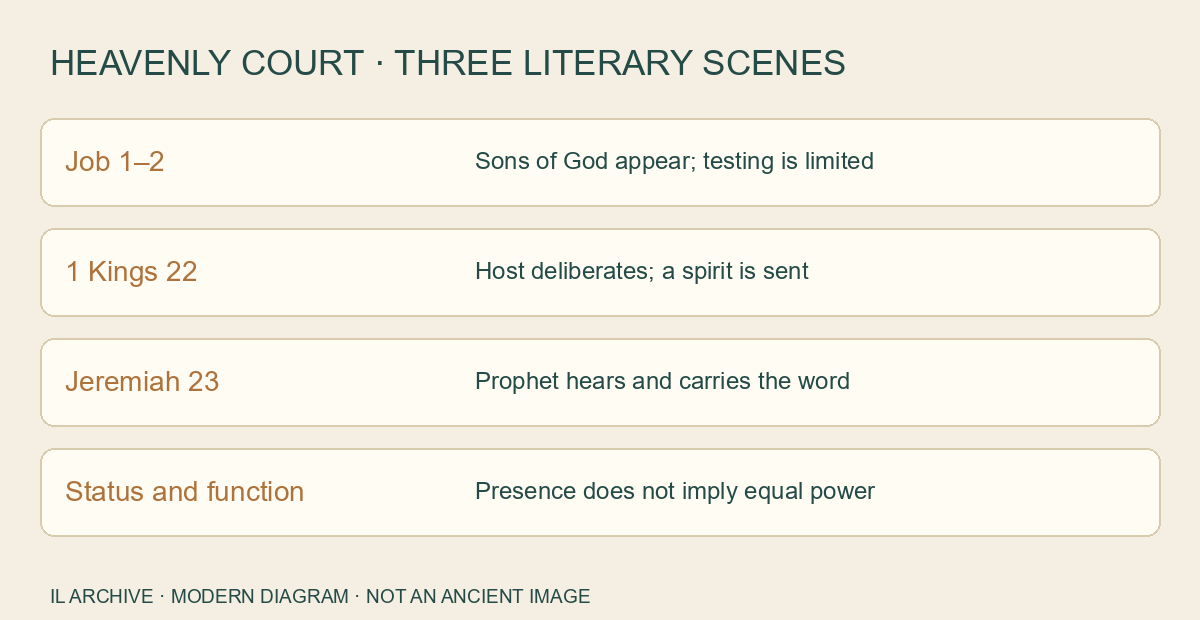
HebrewHebrewA Northwest Semitic language in the Canaanite group, with ancient and modern forms.Glossary · Click to read the explanation texts place YahwehYahwehThe divine proper name written YHWH in the Hebrew Bible.Glossary · Click to read the explanation at the head of a heavenly councilDivine councilA representation of divine beings acting as an assembly with authority and differentiated roles.Glossary · Click to read the explanation. In 1 Kings 22:19–23, Micaiah sees a throne, a host and deliberation: a spirit proposes a plan and receives permission to carry it out. Members speak, but the enthroned ruler decides. [3]
Psalm 89 mentions a holy council and sons of gods. Psalm 82 depicts ElohimElohimA Hebrew word with plural morphology, used for “gods” or for a singular deity according to context.Glossary · Click to read the explanation judging in El’s assembly among other elohim. A heavenly interpretation has substantial comparative support, alongside an interpretation as human judges. Yahweh’s name does not explicitly occur in that psalm; historical reconstruction must preserve this distinction. [4]
Sons of God are not automatically angels
Sons of GodSons of GodA Hebrew expression for heavenly beings in texts such as Job; context determines its meaning, rather than biological descent or a fixed angelic roster.Glossary · Click to read the explanation classifies a heavenly group through kinship and belonging. The phrase alone does not tell us that all its members are called malakhim, or require a literal birth story for each one. Its function must be examined in each text.
Mark S. Smith argues for continuity between West Semitic family/council organization and some later Israelite imagery. This is a substantial comparative reconstruction, not a table proving that Ugaritic members received new angelic names. Continuity in heaven’s organization is broader and better established than the survival of every individual within it. [2]
The messenger before the category
Hebrew malakh means a messenger or envoyAngel / Divine MessengerHebrew malʾakh means messenger, human or celestial according to context; the word alone proves neither wings nor origin from a particular Canaanite god.Glossary · Click to read the explanation. It can designate human and heavenly beings. Adjacent passages in Genesis 32 mention God’s messengers meeting Jacob and then Jacob’s envoys to Esau: the same word accommodates both. [5]
The word therefore names a sending function; it does not itself imply wings or a particular rank in every occurrence. This lexical point, however, does not prove that all angelic history was one transition from a function to a species. Textual classifications developed along different paths.
Roles older than monotheism
Earlier divine courts already knew sending, guarding, assisting and fighting under a higher deity. A being who carried messages or offered protection was therefore not an invention requiring monotheism. The historical question concerns changes in that being’s authority and status. [1][2]
Role must be separated from identity: MichaelMichael / MīkālTheophoric name asking who is like God; borne by humans and a heavenly figure in Daniel. It establishes no former Canaanite deity.Glossary · Click to read the explanation’s protection does not automatically make him an old warrior god renamed, and RaphaelRaphael / RephaelTheophoric name from healing and El; human Rephael in Chronicles and angel Raphael in Tobit. Distinct from Israfil, whose etymology is a separate question.Glossary · Click to read the explanation’s healing does not identify a divine ancestor. Resemblance establishes a subject for comparison, but further evidence is needed to demonstrate the transmission of an individual character.
The host around the throne
The heavenly hostHeavenly HostA heavenly group whose meaning varies: celestial bodies in some texts, attendants around the throne deliberating in 1 Kings 22.Glossary · Click to read the explanation evokes a group under command. In the Kings vision it surrounds the throne and participates in a scene ending with the spirit’s dispatch. The group’s existence abolishes neither hierarchy nor Yahweh’s authority. [3]
The expression does not mean precisely the same thing everywhere: context may connect it with celestial bodies or with God’s surrounding retinue. Every reference to stars, hosts and messengers cannot therefore be combined into a single angelic roster. These classifications can overlap without being identical.
Deuteronomy 32 and versions of heaven
Deuteronomy 32:8 has sons of Israel in the Masoretic textMasoretic TextA Hebrew textual transmission and reading tradition, compared in textual criticism with ancient manuscripts and translations.Glossary · Click to read the explanation, but sons of God in the QumranDead Sea ScrollsJudaean Desert manuscripts, especially Qumran cave finds. Biblical copies and other works reveal textual diversity; a copy’s age is not the work’s initial date.Glossary · Click to read the explanation manuscript 4QDeutʲ, or 4Q37. The Greek SeptuagintSeptuagintTraditional designation for ancient Greek translations of Jewish scriptures, whose readings sometimes differ from the Hebrew Masoretic Text.Glossary · Click to read the explanation tradition includes angels/messengers of God. Verse 9 then assigns Israel to Yahweh. These variants are attested; no single translation thereby invented angelologyAngelologyStudy and organization of angels and heavenly beings: names, ranks and roles within particular traditions, without assuming one fixed system.Glossary · Click to read the explanation. [6]
Some scholars understand Elyon as the supreme El and Yahweh as receiving Israel in the nations’ allocation. Others take Elyon as Yahweh’s title: he distributes and retains his own portion. The earlier divine-being reading has strong support; separating El and Yahweh in this scene is a historical interpretation with a different level of certainty.
Princes of Persia, Greece and Israel
In Daniel 10, a heavenly speaker encounters the prince of Persia and mentions Greece’s prince and Michael, the audience’s prince. Earthly politics has a heavenly counterpart. The speaker is not explicitly called GabrielGabriel / JibrīlName joining El with an element involving man or strength; interpreter in Daniel, messenger in Luke, named Jibrīl in the Qurʾan.Glossary · Click to read the explanation here; his name should not be supplied merely because Gabriel appears in other chapters. [7]
Daniel 12:1 presents MichaelMichael / MīkālTheophoric name asking who is like God; borne by humans and a heavenly figure in Daniel. It establishes no former Canaanite deity.Glossary · Click to read the explanation as the great prince associated with the people’s protection. The text does not display a pantheonPantheonThe set of deities associated with a religious tradition, including their roles and relationships.Glossary · Click to read the explanation of national temples, but a heavenly conflict interpreting collective destinies. Comparison with Deuteronomy 32’s nations is significant, without either text providing an individual character’s transmission record. [8]
Power and subordination
A heavenly being can be formidable without being an autonomous god entitled to worship. Power alone does not determine classification: Michael is a prince, and the spirit in Kings can act, yet their relationship to the deciding authority is essential. [3][8]
We should not construct two entirely opposite worlds: limitless old gods followed by angels without agency. Earlier councils knew subordination; angelic texts knew proposals, conflict and choice. The change concerns authority’s status and legitimate worship, rather than the mere fact that a subordinate being acts.
Job and the adversary’s limits
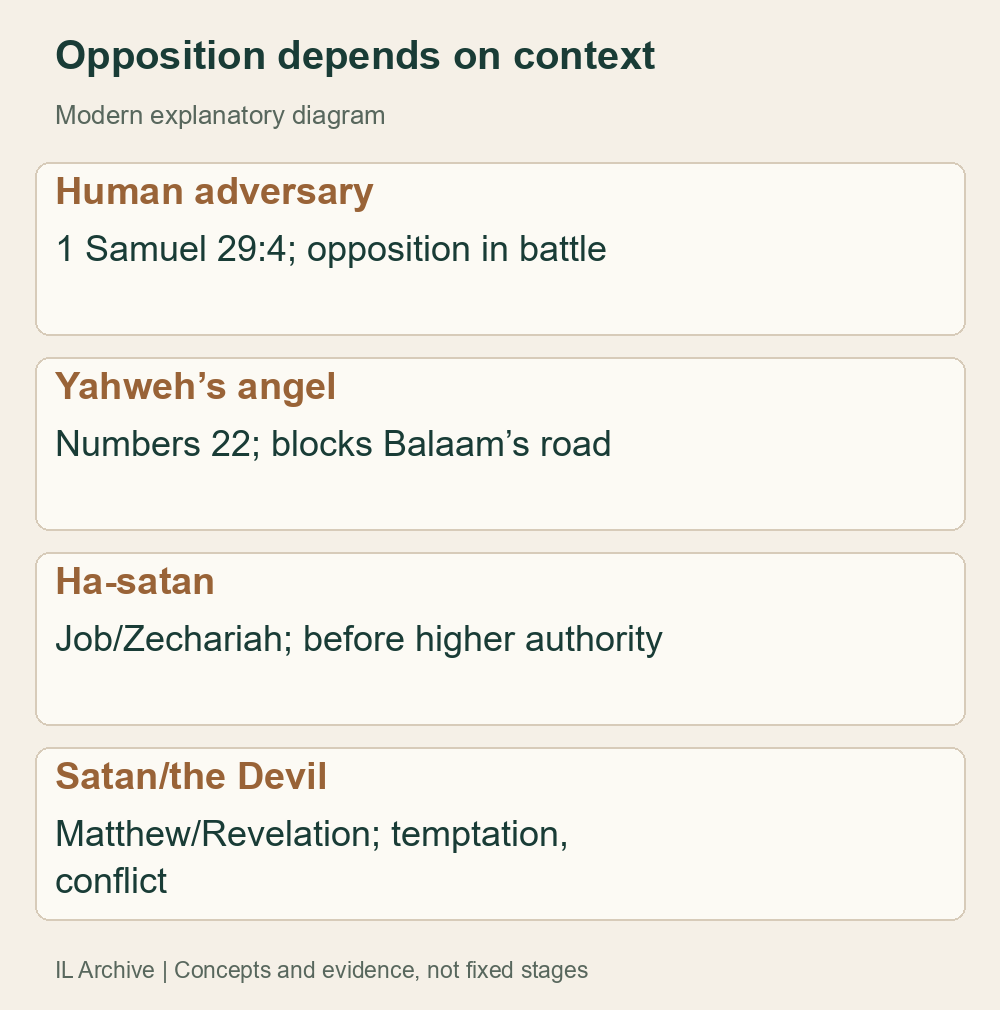
In Job 1–2, sons of God appear before Yahweh with ha-satanHa-satan in JobThe adversary or accuser in Job, with the Hebrew definite article; among the sons of God, acting within permission and limits rather than carrying every later Satanic trait.Glossary · Click to read the explanation, the adversary or accuser, bearing the definite article. He questions Job’s motives and then acts within limits Yahweh permits. In this scene he is not an independent ruler of evil with parallel sovereignty. [9]
The structure matters for understanding the council, but does not date Job. Calling the book a fixed intermediate stage between Ugarit’s gods and Daniel’s angels exceeds the scene’s evidence; composition and layers require separate investigation. Functional comparison need not put books into an assumed chronological progression.
The messenger representing the sender
Exodus 3 introduces the burning bush through Yahweh’s messenger, before the narrative shifts to Yahweh and Elohim addressing MosesMosesCentral figure in Exodus, Torah traditions and the Qur’an; childhood accounts differ in detail.Glossary · Click to read the explanation. Speaker and messenger overlap in the encounter’s narration. [10]
Representation of the sender can explain this, but one ontological account should not be imposed on every angel-of-Yahweh passage. Here a messenger can carry authority and voice without automatically becoming a second god. An unnamed being is not necessarily older than every named one either; omission of a name is also a narrative choice.
Names and the dating of texts
Written angelologyAngelologyStudy and organization of angels and heavenly beings: names, ranks and roles within particular traditions, without assuming one fixed system.Glossary · Click to read the explanation became more elaborate in Second Temple literature. Annette Yoshiko Reed places important developments in the third century BCE, drawing on AramaicAramaicA group of Northwest Semitic language varieties with a long history across the Near East.Glossary · Click to read the explanation evidence. This is an argument about writing and classification, not a date for the first angel’s invention. [11]
Michael and GabrielGabriel / JibrīlName joining El with an element involving man or strength; interpreter in Daniel, messenger in Luke, named Jibrīl in the Qurʾan.Glossary · Click to read the explanation appear in Daniel, whose principal literary form is commonly dated to the crisis of 167–164 BCE, with older tales. Its characters’ Babylonian setting is not the book’s composition date. Enochic and Tobit materials and traditions likewise resist a simple sequence beginning with Daniel and then introducing all other names in order. [12]
Four statements about El
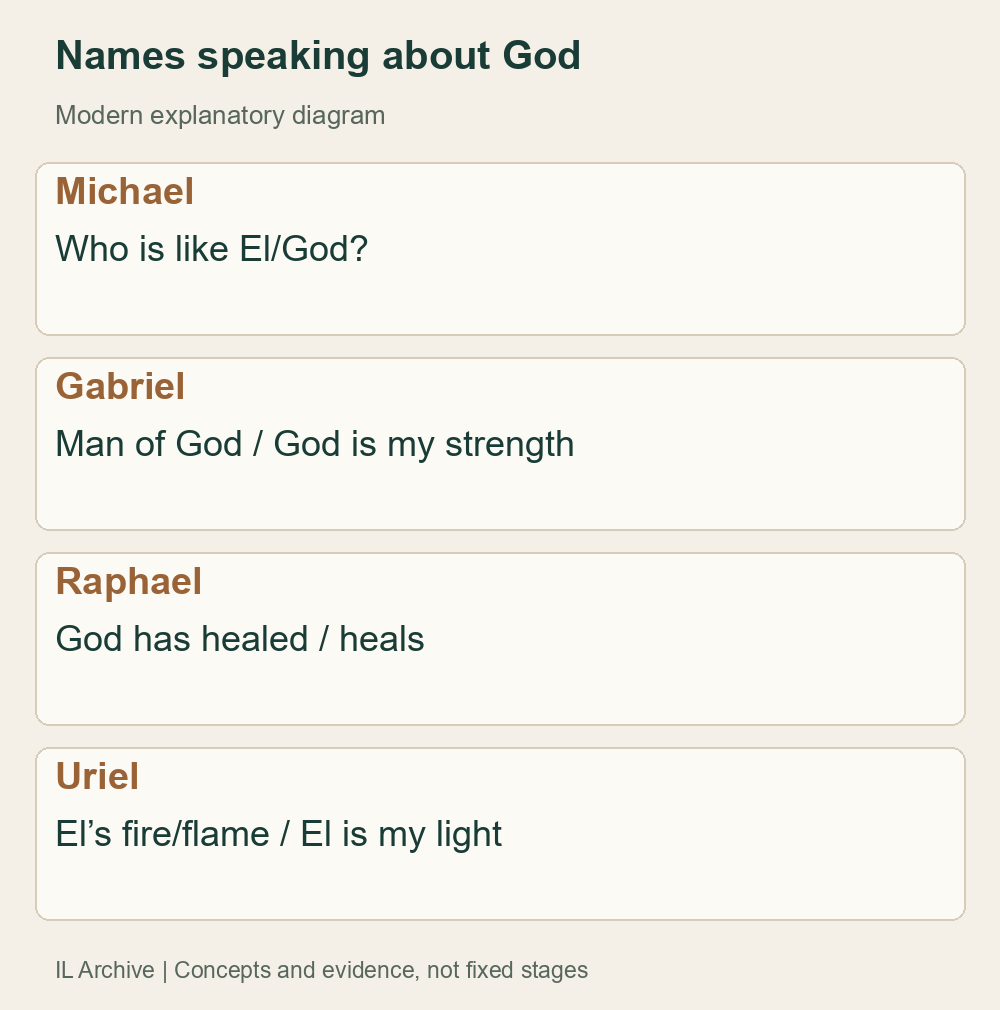
The names reveal religious language: Michael asks who is like El/God; Gabriel is interpreted as man of God or God is my strength; RaphaelRaphael / RephaelTheophoric name from healing and El; human Rephael in Chronicles and angel Raphael in Tobit. Distinct from Israfil, whose etymology is a separate question.Glossary · Click to read the explanation contains the healing root, expressing God has healed or heals. [14]
UrielUrielName joining El to an element interpreted as light or fire; human in Chronicles, heavenly figure in Enoch. No Ugaritic divine origin established.Glossary · Click to read the explanation has competing analyses involving El’s fire/flame or El is my light. This variation should be preserved, rather than reconstructing a character’s entire origin or role from one translation. All four clearly contain El, but a name’s meaning alone establishes neither its heavenly bearer’s first appearance nor a previous identity. [14]
A theophoric name does not make its bearer a god
A theophoric nameTheophoric nameA personal name containing the name of a deity or a divine element.Glossary · Click to read the explanation contains a divine element without conferring divinity on its bearer. IsraelAncient IsraelA name for an ancient population and later historical traditions, attested on the Merneptah Stele.Glossary · Click to read the explanation, Ishmael and Daniel are familiar human examples containing El; such name sentences can express protection, hope or trust.
Michael does not identify its bearer as El: it asks who resembles him. Raphael refers to divine healing, rather than to an angel independent of God. Moving from the El ending to former-god theories confuses a name’s meaning with its bearer’s identity. That history requires separate evidence. [14]
Why did El remain?
El could be both the West Semitic deity’s name and a common word for a god. Once El and Yahweh were identified within Israelite tradition, old and new names could use the same element for Israel’s god. The word’s survival does not require Ugarit’s character to remain independent. [2]
This linguistic continuity can travel across changes in belief and language. A later reader can understand Michael within a fully monotheistic framework without invoking El’s Ugaritic council. A name preserves linguistic history, not necessarily every belief once associated with its vocabulary.
Guardians of nations: a structure, not a conversion list
Deuteronomy 32 and Daniel matter comparatively because both connect peoples with heavenly organization, although imagery and vocabulary differ. Daniel’s national princes can be understood as a later reshaping of wider traditions about peoples assigned to heavenly powers. This is a comparative inference, not Daniel’s explicit account of its own origins. [6][7]
The text does not name Persia’s prince MardukMardukBabylon’s god, elevated with the city’s history. Enuma Elish celebrates his rise and cosmic ordering; sources associate him with Nibiru and Jupiter. Earliest origins and functions remain uncertain.Glossary · Click to read the explanation or identify Michael as Baal. Individual continuity requires more than a shared protective domain: names, transitional texts, distinctive combinations of traits and a historical setting connecting the witnesses.
Several paths into the angelic world
Development cannot be reduced to demoting every god. An old messenger role can persist, a council member can be reinterpreted, an unnamed being can acquire a name, and a new literary character can emerge for interpretive or visionary purposes.
Smith’s model of changing council ranks helps identify continuity, while Reed emphasizes writing, Aramaic and the organization of knowledge in angelology’s elaboration. Both questions belong together: which structures did texts inherit, and what did scribes make of them? A single conversion process cannot answer both. [2][11]
Cherubim and seraphim: keep the text’s distinctions
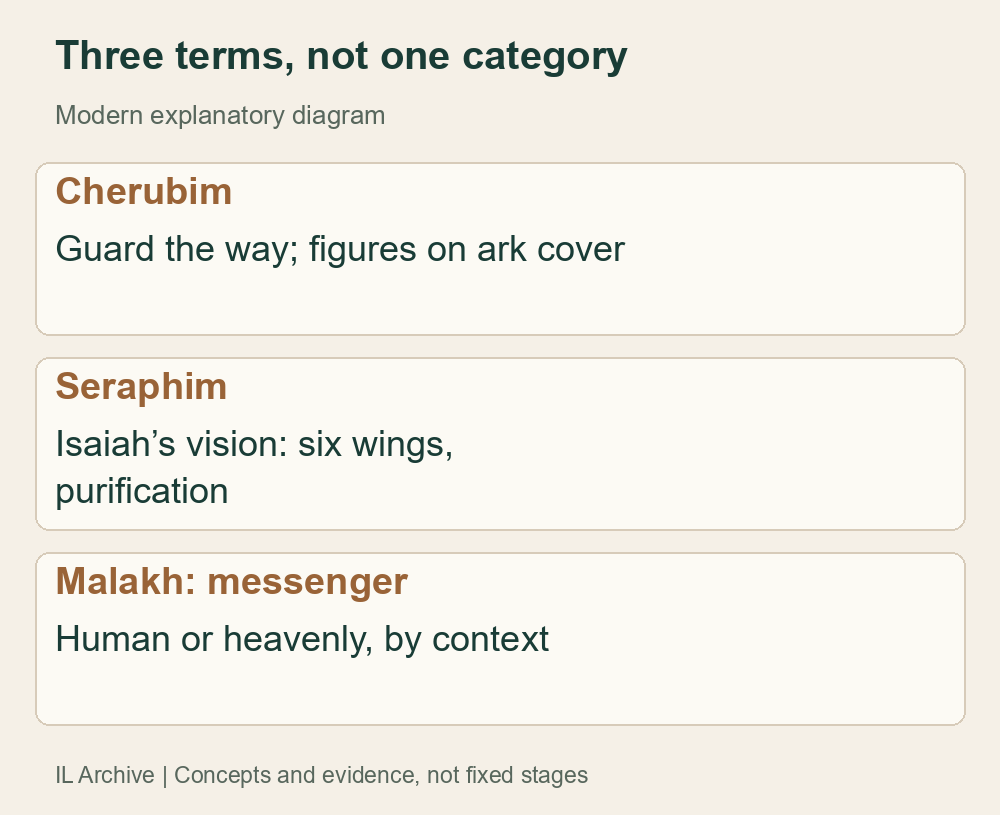
CherubimCherubimBeings or figures with guarding and sacred functions in Hebrew texts, at the tree-of-life access and on the ark; not equivalent to every heavenly messenger.Glossary · Click to read the explanation guard the way to the tree of lifeTree of Life in GenesisA tree distinct from the knowledge tree in Genesis 2–3; after the other tree is eaten, the way to it is guarded lest humans eat and live forever.Glossary · Click to read the explanation in Genesis 3:24; Exodus 25 prescribes two winged figures on the ark cover. These are not the winged infants of some later art, and the texts do not automatically equate them with every heavenly messenger. [15]
SeraphimSeraphimSix-winged beings in Isaiah 6’s throne vision, associated with praise and purification; not automatically identical to cherubim or every angel.Glossary · Click to read the explanation in Isaiah 6 belong to the throne vision, each with six wings; one purifies the prophet’s lips with a coal. Guardian, messenger and throne-being roles and categories may overlap in later interpretation. We should first retain the terms and distinctions used by the texts themselves. [16]
Monotheism and mediation
An intermediary does not imply a second god. One king can have messengers, soldiers and agents, and religious literature can display supreme authority through their execution of commands.
This analogy does not explain every detail or every Jewish practice across all periods. Honour, invocation, power and subordination had contested and varied boundaries. Our selected texts establish a specific point: the spirit’s activity in Kings and ha-satan’s in Job depend on the presiding authority’s permission. Monotheism need not empty heaven, but redefines the legitimacy of its inhabitants. [3][9]
Michael: a warrior under higher authority
Daniel associates Michael with the people; Revelation 12 depicts him and his angels fighting the dragon. A name continuing in Christian tradition does not make every role identical across books, but it clearly documents a named angelic character’s reception in connected traditions. [8][18]
Resemblance to an earlier divine warrior is striking, without proving Michael was Baal. We have direct evidence for the name and role in receiving texts, but lack the link connecting that individual with a specific Ugaritic god. Comparison cannot substitute for that missing link.
Raphael: healing as a commissioned task
In Tobit 12, Raphael reveals that God sent him to heal Tobit and Sarah and that he is one of seven in the divine presence. He heals, accompanies and reveals his identity, but the text ties his work to his commission. Tobit the father should be distinguished from Tobias the son. [13]
Healing and protection are domains also familiar from older gods. Sharing that domain, however, identifies no particular healing god transformed into Raphael. The name associates healing with El/God, and the text narrates an angel’s mission rather than descent from a former deity.
Gabriel: interpretation, announcement and revelation
Gabriel interprets visions in Daniel, identifies himself in Luke 1 and brings announcements to Zechariah and Mary. Qur’an 2:97 associates Jibril with revelation brought to the heart by God’s permission. The name and connected reception are clear, although the message’s setting and form differ. [14][17][19]
Heavenly sending is an older role, but Gabriel is not thereby a copy of every preceding divine envoy. The transmission of a name and character through connected texts must be distinguished from a shared communication function across religions.
Uriel and Enochic lists
Uriel is prominent in Enochic literature. First EnochFirst EnochLayered collection of Jewish writings about heaven, evil and judgment.Glossary · Click to read the explanation 20 lists named beings with assigned roles, including Uriel, Raphael, Michael and Gabriel. The list witnesses heaven’s organization, rather than a uniform rule for all Judaism or Christianity. [20]
Names and responsibilities vary across texts, manuscripts and traditions. We cannot assume four fixed chief angels in every period, or make Uriel’s light/fire etymology explain all his activities. Each list must be read in its own setting, preserving differences between accounts.
Why did the angelic world expand?
An angel can explain a vision, protect a people, convey a message, heal or execute judgment. As texts describing heaven multiplied, names and responsibilities became more elaborate. Angelology also records what scribes wanted to know, organize and write. [11]
More angels are not an arithmetical consequence of fewer gods. Literary genres, forms of knowledge, debate and historical conditions also matter. Expanding lists do not show that an entire society adopted one doctrine, or that each new role needed an old deity in order to emerge.
Watchers: holy does not mean fallen
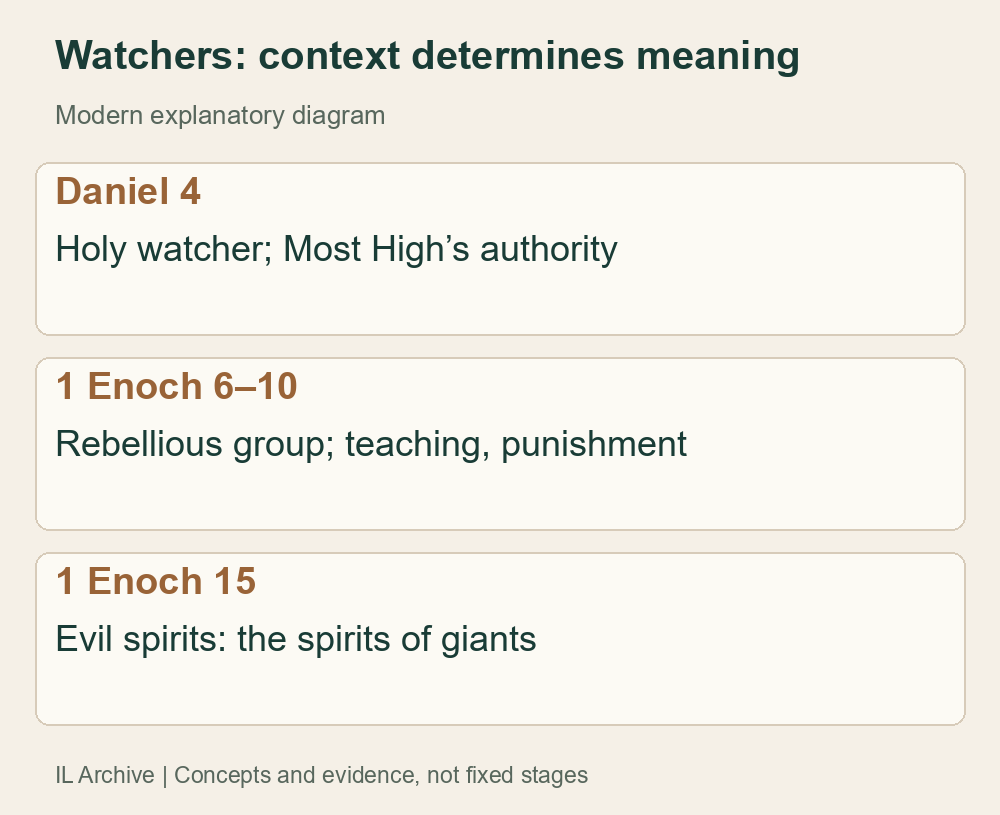
WatchersWatchersDesignation for heavenly beings in Daniel and Enochic literature, covering an obedient holy watcher or a rebellious group according to context.Glossary · Click to read the explanation requires context. Daniel 4 has a holy watcher descending, with judgment under the Most High’s sovereignty. The designation itself does not imply rebellion. Verse numbering differs between the Aramaic text and some translations. [24]
First Enoch 6–16 expands traditions of descent, marriage, forbidden teaching and punishment. Reed discusses these accounts’ composite formation and connections with Genesis 5 and 6: they were not a single narrative born complete. Genesis 6:1–4 mentions sons of God, human daughters and mighty beings, without supplying every Enochic detail. [20][21][22]
Rebellion does not make an independent god
Enochic narratives allow a heavenly being to rebel and transmit destructive knowledge, then be judged and bound. This differs from an independent god retaining legitimate worship in a pantheon. Yet all Jewish traditions of evil should not be reduced to one scheme. [20]
First Enoch 15 contains an easily lost distinction: evil spirits are associated with the spirits of giants born from heavenly-human unions, not simply a new name for the fallen watchers themselves. Watchers, giants and their spirits form different categories and relationships within this account.
Mediation and the problem of evil
Angelic narratives can attribute harm to rebellion, forbidden knowledge or intermediary beings. They do not eliminate the question of God’s sovereignty. In Job, Yahweh retains permission and limits, and divine responsibility remains part of the dialogue. [9]
Isaiah 45:7 associates light, darkness, peace and raʿ with God. The last word is translated evil or calamity according to context; one word cannot yield an entire theory of moral evil. Intermediaries supplied different explanatory paths, rather than one solution everyone accepted. [23]
How can an individual transmission be established?
Specific evidence is needed: a name or distinctive cluster of traits, textual or ritualRitualAn organised or distinguished practice meaningful to a community; it may leave traces, but its form alone does not reveal an associated doctrine.Glossary · Click to read the explanation witnesses linking old and new contexts, and a defensible historical sequence. A shared martial or healing role alone is much weaker.
Messenger and guardian are broad functions; theophoric naming is a broad system. Without a transmission link, resemblance and structural continuity should be described while the character’s origin remains open. Missing evidence does not prove influence impossible, but prevents a possibility becoming a documented biography.
What persisted and what was redefined
Council, throne, messenger, host and heavenly decisions persisted, as did the language of sons and holy ones. Increasing Yahweh’s exclusivity allowed these groups to be read as subordinate and subsequently interpreted within monotheism. One influential reading of Psalm 82 depicts judgment on heavenly beings, rather than their simple coexistence. [4]
Some divine roles entered the supreme deity’s portrayal; others remained with agents, while characters disappeared or were redescribed. There is no single list converting every god into an angel, and councils need not all have undergone the same change simultaneously.
Four levels of certainty
Attested: Ugarit knew a divine council, Hebrew texts knew heavenly groups and messengers, and Second Temple literature presented named beings with roles. These witnesses exceed any single theory of development. [1][3][7][13]
Probable: some older structures and functions survived a redefinition of heavenly ranks. Possible: particular angelic traditions preserved older material whose individual figures cannot now be identified. Unproved: Michael, Gabriel, Raphael or Uriel was a known Canaanite god renamed, or gods became angels all at once. Strong structural continuity must not be confused with missing proof of individual identity.
Heaven did not lose its inhabitants
The path from divine assembly to angelic world was not a simple deletion of heaven’s inhabitants. Divinity, worship and subordination were redefined, while structures, names and roles remained available for new interpretation.
A function can outlive its holder, and El can remain in a name after readers understand a changed divine identity. Named angels in later Jewish and Christian texts belong to a history of constructing and reclassifying heaven. Some of its architecture is old and some details new; the connecting history is richer than saying old gods became angels.
References and notes
- Mark S. Smith (2006). The Rituals and Myths of the Feast of the Goodly Gods of KTU/CAT 1.23. Resources for Biblical Studies 51, pp. 101–102. Previously extracted pp. 101–102 reread: sons/circle of El and assembly formulas. Not full-book reading or independent tablet examination; astral parallelism in damaged context remains provisional. Return to the text ↑
- Mark S. Smith. The Origins of Biblical Monotheism. Author overview of the 2001 book, Bible Interp. Author’s council/family/messenger model and changed ranks read. Attributed reconstruction; not decisive dating of each text or separation of El/Yahweh in Deut 32. Full book not read. Return to the text ↑
- Hebrew Bible — 1 Kings 22:19–23. Mechon-Mamre, Hebrew/Aramaic text with JPS 1917 English translation. Throne, host, deliberation and dispatched spirit; literary vision, not an event dated by the scene alone. Return to the text ↑
- Hebrew Bible — Psalms 82 and 89:6–9 (Hebrew numbering). Mechon-Mamre, Hebrew/Aramaic text with JPS 1917 English translation. Hebrew elohim checked; displayed English sometimes reads judges. Heavenly-member interpretation is comparative, not uncontested; Psalm 82 does not explicitly name Yahweh. Return to the text ↑
- Hebrew Bible — Genesis 32:2–4 (Hebrew numbering). Mechon-Mamre, Hebrew/Aramaic text with JPS 1917 English translation. Malakhim for heavenly beings and Jacob’s human envoys in adjacent passages; numbering varies by translation. Return to the text ↑
- Israel Antiquities Authority, Leon Levy Dead Sea Scrolls Digital Library. 4Q37 / 4QDeutj, plate 172, fragment 10, photograph B-359054. Corrected supplied 4Q34 link to 4Q37. Sons-of-God reading compared with scholarly discussion; no independent decipherment of every photographed letter. Distinct Elyon/Yahweh remains debated. Return to the text ↑
- Hebrew Bible — Daniel 10:13,20–21. Mechon-Mamre, Hebrew/Aramaic text with JPS 1917 English translation. Prince of Persia, prince of Greece, Michael your prince. Chapter’s speaker not explicitly named Gabriel; identity not imposed. Return to the text ↑
- Hebrew Bible — Daniel 12:1. Mechon-Mamre, Hebrew/Aramaic text with JPS 1917 English translation. Michael, great prince associated with the people; textual role, no proof of former identity as Baal. Return to the text ↑
- Hebrew Bible — Job 1:6–12 and 2:1–6. Mechon-Mamre, Hebrew/Aramaic text with JPS 1917 English translation. Sons of God, ha-satan with definite article, permission and limits. Adversary/accuser, not accused. Job not assigned a fixed transitional date. Return to the text ↑
- Hebrew Bible — Exodus 3:2–6. Mechon-Mamre, Hebrew/Aramaic text with JPS 1917 English translation. From Yahweh’s messenger to speech of Yahweh/Elohim in the bush; representation is one explanation, not settled ontology for every text. Return to the text ↑
- Annette Yoshiko Reed (2020). Rethinking Scribalism and Change in Second Temple Judaism. Demons, Angels, and Writing in Ancient Judaism, pp. 87–131. doi:10.1017/9781139030847.004. Summary situates important written angelology/demonology in third century BCE, using Aramaic evidence; scholar’s thesis, not year of first angel’s invention. Full chapter not read. Return to the text ↑
- USCCB. The Book of Daniel: introduction to the New American Bible text. Dates principal literary form to Antiochus IV crisis, 167–164 BCE, with older tales; narrated era not date of compilation. Return to the text ↑
- Tobit 12:11–20. USCCB, New American Bible, longer Greek recension represented in translation. God sends Raphael to heal Tobit and Sarah; one of seven. Indexed publisher text read when direct fetch failed. Healing not proof of descent from a specific healing god. Return to the text ↑
- University of Iowa, Bible & Archaeology. Hello, My Name Is: Gabriel; lexical comparison with Jewish Encyclopedia entries Michael, Raphael, Uriel. Gabriel: man of God or God is my strength; Michael: who is like God; Raphael: healing root; Uriel: fire/light traditions. Lexicons alone do not date characters’ origins. Return to the text ↑
- Hebrew Bible — Genesis 3:24 and Exodus 25:18–22. Mechon-Mamre, Hebrew/Aramaic text with JPS 1917 English translation. Cherubim guard way to tree of life and appear on ark cover; roles/images, no identification with particular Canaanite gods. Return to the text ↑
- Hebrew Bible — Isaiah 6:1–8. Mechon-Mamre, Hebrew/Aramaic text with JPS 1917 English translation. Six-winged seraphim in throne vision and purification with a coal. Category not automatically cherubim or every messenger. Return to the text ↑
- Luke 1:19,26–38. USCCB, New American Bible. Gabriel identifies himself and addresses Zechariah/Mary; Christian reception, not all roles identical across religions. Return to the text ↑
- Revelation 12:7–9. USCCB, New American Bible. Michael and his angels fight dragon; Christian text does not establish Baal under a new name. Return to the text ↑
- Qur’an 2:97. Quranic Arabic Corpus, displayed translations and word analysis. Gabriel brings revelation to heart with God’s permission; Qur’anic role, not investigation of every later Islamic detail. Return to the text ↑
- 1 Enoch 20; 6,8,10,15. R. H. Charles’s early twentieth-century English translation, digitally transcribed at Wikisource. Names and selected descent/teaching/punishment/giant-spirit passages. Historical translation, not newest critical edition; name/role variation retained, not whole work read. Return to the text ↑
- Annette Yoshiko Reed (2005). Angelic Descent and Apocalyptic Epistemology. Fallen Angels and the History of Judaism and Christianity, pp. 24–57. doi:10.1017/CBO9780511499104.004. Cambridge online 2009. Summary: composite units and integration of Enoch/Genesis 5 with sons of God/Genesis 6. Book 2005, availability 2009. Full chapter not read. Return to the text ↑
- Hebrew Bible — Genesis 6:1–4. Mechon-Mamre, Hebrew/Aramaic text with JPS 1917 English translation. Sons of God, human daughters and mighty beings; brief account does not supply every Enochic detail or later Satan system. Return to the text ↑
- Hebrew Bible — Isaiah 45:7. Mechon-Mamre, Hebrew/Aramaic text with JPS 1917 English translation. Light/darkness, peace and raʿ, translated evil or calamity in context. Intermediaries do not erase Yahweh’s sovereignty over disasters. Return to the text ↑
- Hebrew Bible — Daniel 4:10,14 (Hebrew/Aramaic numbering; commonly 4:13,17). Mechon-Mamre, Hebrew/Aramaic text with JPS 1917 English translation. Watcher/holy one descends; watchers’ decree under Most High. Not every watcher is fallen; edition numbering varies. Return to the text ↑
Suggest a correction · Suggest a source for this record
Cite this record
IL Archive, «From gods to angels», Edition 1, https://ilarchive.com/en/studies/gods-to-angels
Continue reading