Study
From El’s Council to Yahweh’s Court
An extended study of a topic, with evidence and references.
How did heavenly council structures persist as sovereignty and membership changed? Ugarit, Deuteronomy 32 and Job through messengers and angels, separating evidence from a presumed single evolutionary path.
Estimated reading time: 19 min Published Last reviewed:
Share article
Video
The Night the Gods Closed the Sky: Balaam and the Council of the Gods
More than twenty-seven centuries ago, someone wrote a vision on a plastered wall at Deir ʿAlla: the gods come to Balaam son of Beor at night, and a council orders the sky shut. We read the wall line by line, then set it beside Ugarit, the Book of Numbers and later traditions, and settle neither reading. Some scenes are AI-generated illustrations.
The YouTube player loads only when you press play. Watch on YouTube
Dates
Dates have distinct roles. The timeline uses creation, composition or historical coverage, rather than publication or discovery dates.
- Historical coverage
- Approximately From 1400 BCE to 100 BCE
Text
Introduction
In the texts of UgaritUgaritAncient city and kingdom at Ras Shamra on the Syrian coast, flourishing between the fourteenth and early twelfth centuries BCE and preserving multilingual archives.Glossary · Click to read the explanation, an ancient city on the Syrian coast, El heads a family of gods. In the books of the HebrewHebrewA Northwest Semitic language of the Canaanite group, encompassing Iron Age epigraphy, Biblical, Rabbinic, medieval and Modern Hebrew; its scripts and pronunciations changed over time.Glossary · Click to read the explanation Bible, YahwehYahwehThe proper name of Israel’s deity, written יהוה (YHWH), the Tetragrammaton. Its exact ancient pronunciation is not directly preserved; texts and inscriptions witness its history.Glossary · Click to read the explanation, Israel’s God, appears enthroned before the sons of God and the heavenly hostHeavenly HostA heavenly group whose meaning varies: celestial bodies in some texts, attendants around the throne deliberating in 1 Kings 22.Glossary · Click to read the explanation. How are these representations related, and what changed in the status of the heavenly community?
This study follows the language of household, council and messenger from Ugaritic witnesses through Deuteronomy, Psalms, Job, the prophets and Daniel. Comparison reveals substantial continuity without turning every angel into a renamed Ugaritic deity. The central issue is the redistribution of authority and redefinition of membership, distinguishing the wording of the texts from historical reconstructions of religion.
Chronological map: story, composition and witness
This sequence maps witnesses rather than settled evolutionary stages. Where the Leningrad Codex is named, this complete early-eleventh-century CE Masoretic manuscript is a specific surviving witness, not a claim to the earliest attestation of every passage. A copy’s date establishes that wording existed by then; it does not automatically date the invention of its religious imagery.[31]
- Ugarit: the divine family belongs to mythic time, not a dated event. Surviving city tablets fall broadly within the fourteenth–twelfth centuries BCE, before its destruction around 1200 BCE. This is the physical archive’s horizon, not an independently established date for each oral tradition or quoted tablet.[27]
- Deuteronomy 32: the narrative frame gives MosesMosesCentral figure in Exodus, Torah traditions and the Qur’an; childhood accounts differ in detail.Glossary · Click to read the explanation’ words before his death; verse 8 recalls the primeval distribution of peoples. Proposed composition dates range from the eleventh to fourth centuries BCE. Hebrew Bible scholar Tina Dykesteen Nilsen argues for the late sixth–early fifth, against pre-exilic proposals. None of these dates automatically applies to every layer of Deuteronomy. Manuscript 4Q37 has Herodian script; Manuscript scholar Michael Langlois favors the first half of the first century CE, preferably its second quarter. The complete Masoretic wording in Leningrad is approximately a millennium later than this fragment.[28][29][31]
- Psalms 82 and 89: their council scenes are poetic, not dated meetings. Proposals for Psalm 82 range across pre-exilic and post-exilic settings; council language alone fixes neither a year nor the two psalms’ sequence. Collection and editing of the Psalter are distinct from the age of each poem. Leningrad is a late complete witness to both, not their composition date.[25][31]
- Job 1–2 and 38: the story gives its hero no calendar date; chapter 38 looks back to the earth’s foundation. Hebrew Bible scholar Carol A. NewsomCarol A. NewsomHebrew Bible scholar and professor emerita at Emory’s Candler School, working on Daniel, apocalyptic and wisdom literature.Glossary · Click to read the explanation summarizes a preference for composition in the early post-exilic period, approximately the sixth–fifth centuries BCE, while retaining uncertainty. This need not give the prose frame and dialogues identical ages. Leningrad preserves the complete text within an older transmission history.[30][31]
- 1 Kings 22 and Jeremiah 23: the former attributes the vision to Ahab’s court, the latter belongs to the prophetic world of Judah’s final monarchy. Those settings do not date surviving copies. Hebrew Bible scholar Daniel O. McClellanDaniel O. McClellanBiblical scholar studying concepts of deity and divine agency through cognitive and historical approaches.Glossary · Click to read the explanation’s model of historical and prophetic editing places major scribal work in the seventh–sixth centuries BCE, continuing into the Persian period; it does not establish each phrase’s individual date. The complete witness specified here is Leningrad.[8][15][16][31]
- Isaiah 44–45: the discourse is usually associated with the exilic crisis and transition to Persian rule in the sixth century BCE, alongside the wider book’s editorial history. The Great Isaiah Scroll, 1QIsaᵃ, around 125 BCE, survives several centuries after that setting.[20][32]
- Second Temple literature and Daniel: Ancient Judaism scholar Annette Yoshiko ReedAnnette Yoshiko ReedAnnette Yoshiko Reed studies ancient Judaism, early Christianity and their relationships in late antiquity, and is a professor at Harvard Divinity School.Glossary · Click to read the explanation studies an Aramaic corpus of approximately 333–167 BCE for the organization of heavenly knowledge, not the dates of every Second Temple work. Daniel’s visions have a sixth-century BCE Babylonian/Persian narrative frame; their final formulation is generally placed in the second century BCE, around the crisis of 167–164. Leningrad is a late complete witness to Daniel, not its earliest attestation.[8][22][26][31]
Ugaritic heaven: household and council
UgaritUgaritAncient city and kingdom at Ras Shamra on the Syrian coast, flourishing between the fourteenth and early twelfth centuries BCE and preserving multilingual archives.Glossary · Click to read the explanation, at Ras Shamra in Syria, preserved mythological and ritualRitualAn organised or distinguished practice meaningful to a community; it may leave traces, but its form alone does not reveal an associated doctrine.Glossary · Click to read the explanation texts from the Late Bronze AgeLate Bronze AgeAn archaeological period around 1600–1200 BCE in much of the Near East, with international diplomacy, exchange and religious diversity; its endpoints vary by region.Glossary · Click to read the explanation. They portray ElElEl is a senior deity in Late Bronze Age Ugaritic texts, portrayed as father of the divine family and a council authority, alongside his consort Athirat. This entry does not cover every linguistic use of El.Glossary · Click to read the explanation as father and king, and AthiratAthiratA prominent goddess commonly understood as El’s consort in Ugaritic texts; she bears the progenitress epithet and intercedes for Baal’s palace.Glossary · Click to read the explanation as his consort and mother within the divine household. The opening lines of KTU 1.65 bring together El, his sons, their circle and their assembly. Joel S. Burnett, a scholar of ancient Israelite religion, reads this list alongside the divine family depicted in the myths.[1]
KTUKTU: Ugaritic Text ReferencesAbbreviation for a modern edition of alphabetic cuneiform texts. Its text references can be cross-identified with find numbers such as RS or RIH; they are not dates.Glossary · Click to read the explanation numbers identify texts in a published collection of alphabetic cuneiformUgaritic alphabetAlphabetic cuneiform system of Late Bronze Age Ugarit, using thirty chiefly consonantal written signs, distinct from Akkadian syllabic cuneiform.Glossary · Click to read the explanation writings; they do not date mythological events.[2]
A short phrase makes the evidence inspectable: Hebrew Bible and Ugaritic religion scholar Mark S. SmithMark S. SmithScholar of the Hebrew Bible and Ugaritic religion whose work examines the divine family and biblical monotheism.Glossary · Click to read the explanation prints mpḫrt bn ʾil, “assembly of El’s sons,” at KTU 1.65, line 3. His cited transcription marks no restoration within these words. The singular ʾil, unlike plural ʾilm, supports his reading of El’s name here. This is linguistic evidence for a group associated with El, not by itself a complete divine roster or a constitution of the council.[2]
Other texts preserve expressions such as pḫr ʾilm, “assembly of the godsDivine councilA divine council is a religious and literary scene in which divine beings gather before a superior authority for discussion, commissioning or judgment; it is not identical to a pantheon list.Glossary · Click to read the explanation,” and pḫr bn ʾilm, “assembly of the divine sons.” The formulas bn ʾil and dr bn ʾil refer to El’s sons and their circle. Wording and contexts vary; these need not be interchangeable names for one group with fixed membership.[2]
The Ugaritic divine councilDivine councilA divine council is a religious and literary scene in which divine beings gather before a superior authority for discussion, commissioning or judgment; it is not identical to a pantheon list.Glossary · Click to read the explanation was not an assembly of equal powers. El held supreme rank, BaalBaalUgaritic storm god and warrior king who defeats Yamm, builds his palace with El’s consent and confronts Mot. References to El and Dagan as fathers do not define a single genealogy.Glossary · Click to read the explanation was a major storm god, and messengers and servants occupied lower positions. The order in KTU 1.65 places Baal within a world headed by El: active power did not erase seniority and paternal authority.[1][8]
The divine court also extended beyond Ugarit. A sudden transition from a council of equals to a royal court is therefore misleading. The comparison concerns a shared regional inheritance within which the ruler’s standing and the legitimacy of other powers changed, rather than a meeting room invented by one society and copied by another.[8]
The language of sons can express descent, but also membership in a family or heavenly group. The texts provide no surviving birth story for every figure included under these terms. Nevertheless, fatherhood and kinship are central to El’s divine community, rather than decorative metaphors.[1]
Sons of God: surviving words, changing meanings
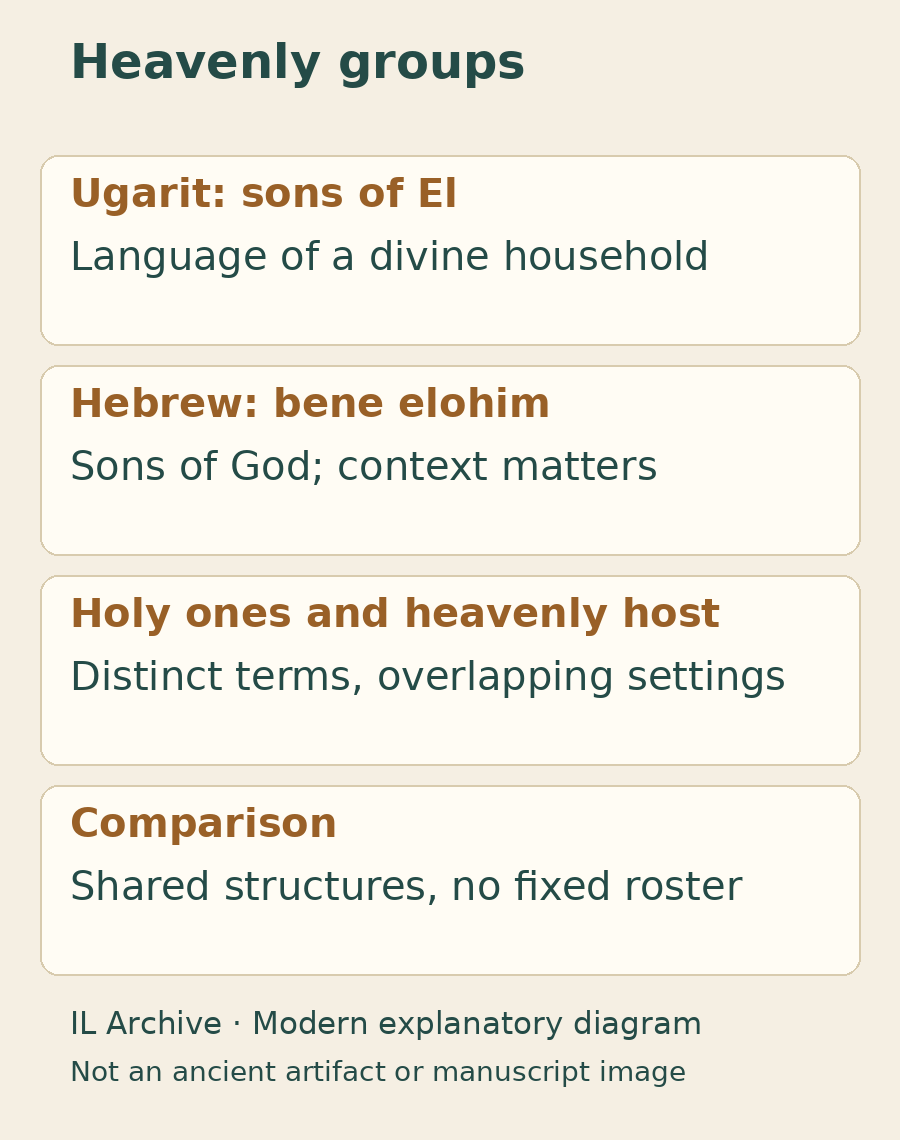
Hebrew uses bene elohimSons of God“Bene elohim” is a Hebrew expression in Job and Genesis whose interpretation depends on context; it also appears in Qumran 4Q37 at Deuteronomy 32:8. It does not itself establish biological descent or a fixed divine roster.Glossary · Click to read the explanation (“sons of God” or divine beings), bene elim, holy ones and the heavenly hostHeavenly HostA heavenly group whose meaning varies: celestial bodies in some texts, attendants around the throne deliberating in 1 Kings 22.Glossary · Click to read the explanation for celestial groups. Psalm 89 brings together bene elim and the council of holy ones, placing Yahweh above those around him. Collective language remained while the ruler’s position was clear.[4]
The terms are not identical in every occurrence. “Heavenly host” can mean celestial bodies, as in Deuteronomy 4:19, or the heavenly attendants in 1 Kings 22. The language of children also describes human relationships with Yahweh: Deuteronomy 14:1 addresses Israelites as Yahweh’s children. The point concerns particular formulas for council members, not the absence of fatherhood from Israelite religion.[4]
Deuteronomy 32: three witnesses
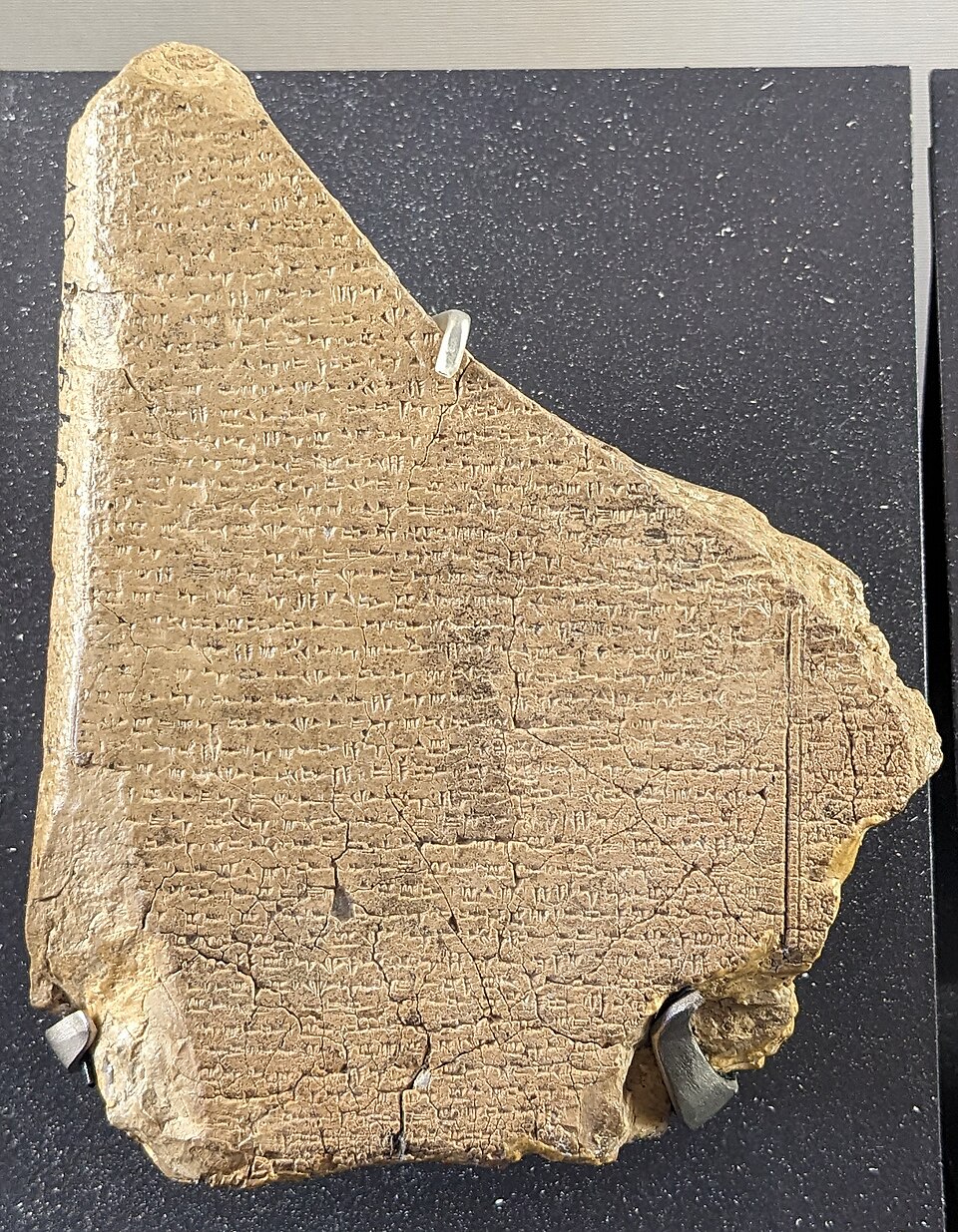
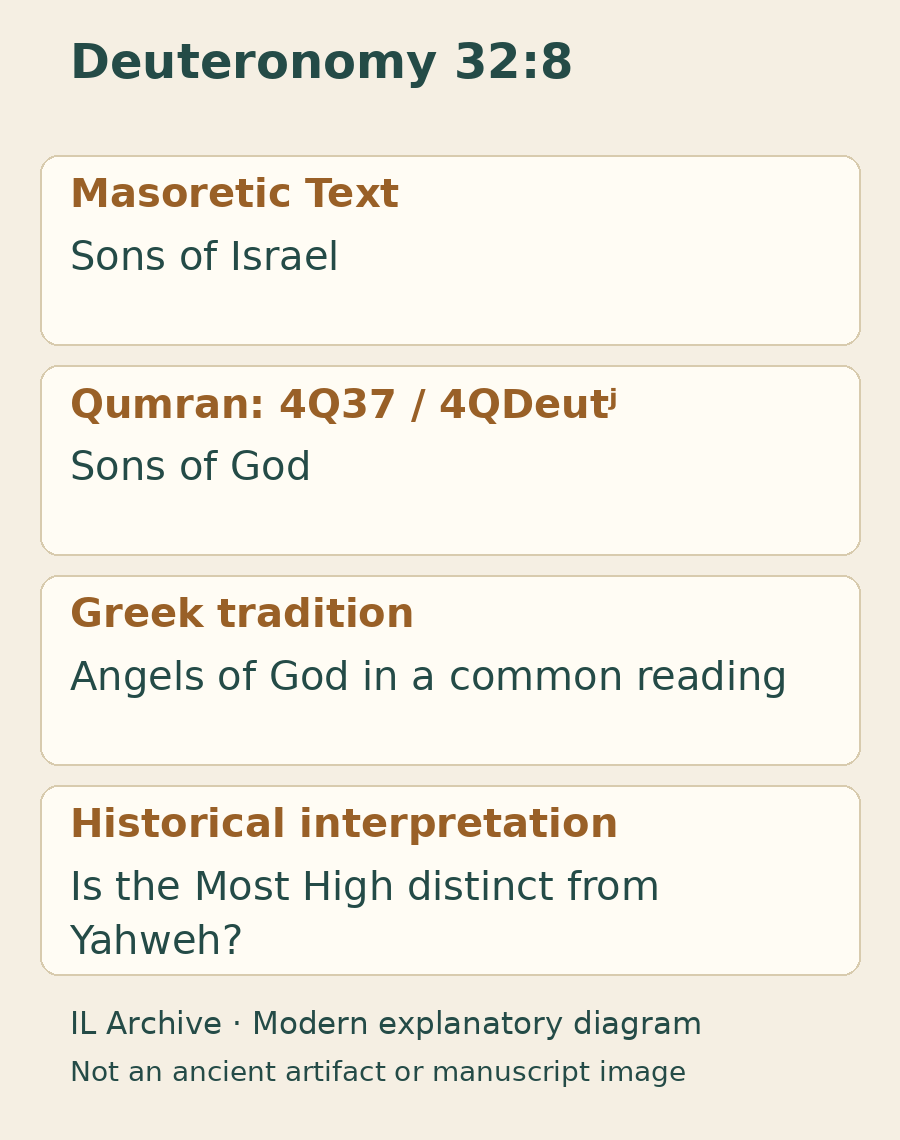
The Masoretic TextMasoretic TextThe Hebrew Bible’s transmission tradition combining its consonantal text, transmitted vocalization and accentuation, and Masorah notes. The consonantal text has ancient roots; surviving codices that bring these layers together in their Masoretic form are medieval.Glossary · Click to read the explanation preserves the Hebrew tradition transmitted with vowel and accent signs in medieval manuscripts, with older roots. In Deuteronomy 32:8 it says that the Most High established peoples according to the number of the sons of Israel. By contrast, manuscript 4Q37 from Qumran Cave 4 near the Dead SeaDead SeaThe Dead Sea is a salt lake in the Jordan Rift Valley, near sites where ancient manuscripts were foundGlossary · Click to read the explanation, also known as 4QDeutʲ, preserves bene elohimElohimA Hebrew word with plural morphology, used for “gods” or for a singular deity according to context.Glossary · Click to read the explanation. The Dead Sea ScrollsDead Sea ScrollsManuscript collections from the Judaean Desert, best known through Qumran: diverse works, languages and textual forms, with copying distinguished from composition.Glossary · Click to read the explanation Digital Library identifies image B-359054 as the recto of plate 172, fragment 10; the fragment’s photograph is available there for inspection.[5]
Dead Sea Scrolls scholar Eibert TigchelaarEibert J. C. TigchelaarScholar of the Hebrew Bible, ancient Judaism and the Dead Sea Scrolls; professor at KU Leuven from 2009 to 2024, with research on Jubilees’ textual growth.Glossary · Click to read the explanation confirms this reading in 4QDeutʲ.[6] The SeptuagintSeptuagintA name for the varied ancient Greek translations and writings associated with Jewish scripture; beginning with the Torah, the texts differ across books and manuscripts.Glossary · Click to read the explanation, the ancient Greek translation tradition of the Hebrew Bible, has a common reading giving “angels of God.” Textual comparison strongly favors divine beings behind these witnesses. The variation alone, however, establishes neither when the wording changed nor that a particular scribe intended to alter doctrine.[7]
The comparison rests on distinct passages, not a composite text assembled from different witnesses:
- Masoretic, Deuteronomy 32:8: לְמִסְפַּר בְּנֵי יִשְׂרָאֵל, “according to the number of the sons of Israel.” The excerpt is unrestored, with accent signs omitted.[7]
- 4Q37, column 12, line 14: בני אלוהים, “sons of God.” Qumran-Digital prints these words without restoration brackets, followed by a gap. We quote only the surviving phrase, not the reconstructed preceding line. The spelling includes a waw in אלוהים; Tigchelaar’s בני אלהים is normalized spelling, not a different meaning. Neither should be confused with בני אל, “sons of El,” discussed in a modern edition’s apparatus as a conjectural emendation.[6][34]
- Greek tradition, Deuteronomy 32:8: ἀγγέλων θεοῦ, “angels of God,” as reported in NET textual note 14. This quotation follows that note, not an independent collation of all Septuagint manuscripts.[7]
“Sons of God” supports a heavenly group; “angels” interprets its identity in this Greek branch. The comparison alone cannot establish the original Hebrew wording letter by letter or sequence every stage of transmission.
Was Yahweh one of the Most High’s sons?
The following verse identifies Yahweh’s people as his portion. Hebrew Bible scholar Daniel O. McClellanDaniel O. McClellanBiblical scholar studying concepts of deity and divine agency through cognitive and historical approaches.Glossary · Click to read the explanation reads the distribution as a scene in which the Most High gives nations to his offspring and Yahweh receives Israel. In this model, the Most High and Yahweh differ within the layer preserved by the passage.[8]
Divine-council scholar Michael S. HeiserMichael S. HeiserScholar of the Bible and Semitic languages whose work examined the divine council and divine plurality in Hebrew texts.Glossary · Click to read the explanation objects, treating Elyon as Yahweh’s own title and appealing to the verses’ syntax and the song’s context. On that reading, Yahweh distributes the nations and reserves Israel for himself.[9] The strong manuscript case for “sons of God” does not make the separation of El and Yahweh a consensus conclusion. The fragment itself does not state, “Yahweh is El’s son.”
The argument can now be weighed at three levels. Textually, divine beings are preferable to “sons of Israel”: the Hebrew Qumran witness and Greek tradition agree in this broad sense, which also explains the connection between the nations’ allocation and Yahweh’s portion. “Sons of Israel” can be related to the number of Jacob’s descendants and is not meaningless; that link, however, is unstated in these verses and requires an additional interpretive step.[6][7]
Within the surviving song, the father-and-maker argument is strong. Deuteronomy 32:6 asks הֲלוֹא־הוּא אָבִיךָ קָּנֶךָ, “Is he not your father who acquired you?”, then says הוּא עָשְׂךָ וַיְכֹנְנֶךָ, “He made you and established you.” Verse 32:9 states כִּי חֵלֶק יְהוָה עַמּוֹ, “For Yahweh’s portion is his people.” These are unrestored Masoretic excerpts with accent signs omitted. Their context favors an author of the final wording understanding the Most High and Yahweh as one. Yet verse 6’s fatherhood concerns Yahweh’s relationship with Israel; it does not alone settle the parentage of every heavenly member.[7][9]
For reconstruction of an older tradition, the distribution among nations and Israel’s particular allotment give explanatory force to the model of a national god within a larger family. Mark S. SmithMark S. SmithScholar of the Hebrew Bible and Ugaritic religion whose work examines the divine family and biblical monotheism.Glossary · Click to read the explanation presented this model in his research synthesis on monotheismMonotheismBelief that only one God possesses divinity in its fullest sense. Historically distinct from exclusively worshipping one deity without denying others; its theological forms vary.Glossary · Click to read the explanation before McClellan; it is not the latter’s isolated opinion.[24] But identifying “Most High” necessarily as a separate El, then making Yahweh his named son, requires two inferences rather than simply reading preserved words. Heiser’s objection limits deductions from the final text; it does not by itself disprove reuse of an older tradition. This study therefore favors a background of heavenly allocation of nations while distinguishing the less secure claim that a particular recoverable layer makes Yahweh El’s son. Dating that layer requires independent evidence, not assuming an evolutionary sequence and dating the passage by it.[8][9][24]
The song’s structure reinforces this distinction: Hebrew Bible scholar Dominik Markl traces its movement from accusation against Israel to rescue in verses 34–43, and treats its Mosaic framing as purposeful editorial integration. Verses 8–9 thus belong within a discourse about Yahweh’s relationship with his people, not simply a register of divine genealogy.[33]
Psalm 82: judgment within the council
The decisive Masoretic wording follows, retaining vowels but omitting accent signs; no missing letters are restored here:[10]
- Psalm 82:1: אֱלֹהִים נִצָּב בַּעֲדַת־אֵל — “God stands in the assembly of El.”
- Psalm 82:6: אֱלֹהִים אַתֶּם וּבְנֵי עֶלְיוֹן כֻּלְּכֶם — “You are gods, and all of you sons of the Most High.”
- Psalm 82:7: אָכֵן כְּאָדָם תְּמוּתוּן — “Yet you will die like humans.”
“Gods” is an interpretive translation supported by the following context, not a mandatory meaning of the word in every occurrence.
Psalm 82 opens with elohim standing in the assembly of El and judging among elohim. The first has a singular predicate (“standing”); in the celestial reading, the second denotes the group of deities among whom judgment takes place. The addressees are charged with failing the vulnerable, described as gods and sons of the Most High, and sentenced to die like mortals.[10]
The celestial reading is supported by the “assembly of El,” the designation “sons of the Most High,” and the contrast between their status and dying “like mortals.” The closing appeal to inherit all nations also fits deities with responsibilities beyond one local community. The human-judges tradition instead stresses the charges of injustice and the duty to judge fairly; it informs portions of the displayed JPS translation. The case therefore rests on the scene as a whole, not on the form of elohim alone.[8][10]
Yahweh’s four-letter name does not appear explicitly in this psalm; its terms are elohim, El and Elyon. In the Psalter’s final context, the judging deity is understood as Israel’s God. Reconstructing the passage’s origin and date requires an additional argument.[10]
McClellan interprets the death sentence as withdrawing the council members’ privileged status and responsibilities. This is a historical and literary reading, not a document giving the year their worship ended. Nor does the psalm tell us that they became angels under new names.[8]
This study favors the celestial reading because the combined signals explain the scene more economically than treating all of them as honors bestowed on human rulers. Injustice charges do not require human defendants: gods too could be portrayed as guardians of justice. Conversely, recent work on the psalm’s ethics rightly insists that the poor and fatherless are central, not dispensable once the gods have been identified.[25] The poem can judge heavenly authority while addressing human practice.
The proposal of El as a silent presider and Yahweh as a separate prosecutor is less secure than the presence of a divine group. “Standing” does not restrict a figure to prosecution, and “assembly of El” does not by itself depict a second, seated individual. Nor does the text explicitly transfer speech to another presider for sentencing. Heiser’s objection identifies a real weakness here. Yet his use of the final “arise” to prove previous sitting is not necessary either: it can call for action. A continuous reading more readily presents one divine judge condemning the group, leaving the council image’s earlier history a separate question.[9][10]
Job: appearing before Yahweh
Job is the righteous man whose piety and suffering the narrative explores. In chapter 1, the sons of GodSons of God“Bene elohim” is a Hebrew expression in Job and Genesis whose interpretation depends on context; it also appears in Qumran 4Q37 at Deuteronomy 32:8. It does not itself establish biological descent or a fixed divine roster.Glossary · Click to read the explanation present themselves before YahwehYahwehThe proper name of Israel’s deity, written יהוה (YHWH), the Tetragrammaton. Its exact ancient pronunciation is not directly preserved; texts and inscriptions witness its history.Glossary · Click to read the explanation, with ha-satan among them. Yahweh addresses him and permits him to test Job within limits: Job’s possessions are accessible, but he may not touch Job himself during that round.[11]
The gathering recurs in Job 2. Permission changes, while Job’s life remains excluded. The narrative presents a heavenly group and an authority determining what one of its participants may do.[12]
Ha-satanHa-satan in Job: Title, Role, and InterpretationHebrew “the adversary” in Job 1–2, who challenges Job’s motives with Yahweh’s permission. “Accuser” is a common functional interpretation, but “enforcer” has been argued; later Satan traditions cannot simply be read back into the passage.Glossary · Click to read the explanation carries the Hebrew definite article: the adversary or accuser, a figure who challenges or makes an accusation. Scholar of Jewish philosophy Warren Zev Harvey describes Job’s character as a celestial being among the sons of God, with a special role. A formal judicial office is an interpretation of that role: the narrative depicts his challenge to Job’s motives, not an administrative constitution of heaven.[13]
The scene should not inherit every characteristic assigned to Satan in later traditions. Testing requires permission here, and Job’s life lies beyond its limits. At the same time, the character’s role is harsh and ethically troubling; subordination does not make the action harmless.
Morning stars and sons of God
Job 38:7 pairs singing morning stars with sons of God shouting at the earth’s foundation.[14] It depicts a heavenly celebration without providing a roster or a full explanation of the participants’ relationship to the stars.
Mark S. SmithMark S. SmithScholar of the Hebrew Bible and Ugaritic religion whose work examines the divine family and biblical monotheism.Glossary · Click to read the explanation, a scholar of the Hebrew Bible and Ugaritic religion, compares this language with Ugaritic expressions in KTU 1.10 for El’s sons, the assembly of stars and the circle of heavenly beings. The Ugaritic context is damaged, and parts of its parallelism remain uncertain.[2]
The comparison can be anchored in a bounded transcription of KTU 1.10, column I, lines 4–5, printed by Smith on p. 101:[2]
The brackets […] represent an unfilled gap at the beginning of each line, not translated words omitted for rhetorical effect. Line 3 contains bn ʾil, “El’s sons,” but its verb and context are damaged, leaving the three-way parallelism provisional. Job 38:7 has כּוֹכְבֵי בֹקֶר, “morning stars,” and כָּל־בְּנֵי אֱלֹהִים, “all the sons of God.” No Hebrew letters are restored. The strength is the association of stars and the divine community, not proof that Job directly translated this tablet.[14]
Micaiah ben Imlah: audible deliberations
In 1 Kings 22:19–22, the prophet Micaiah ben ImlahMicaiah son of ImlahThe prophet who recounts the throne and heavenly-host scene in 1 Kings 22.Glossary · Click to read the explanation sees Yahweh enthroned with the heavenly host to his right and left. The ruler asks who will entice Ahab, the narrative’s king of Israel, into a fatal military expedition. Different proposals arise; a spirit then offers to become a lying spirit in the prophets’ mouths and receives an order to act.[15]
This is a session with a question, proposals, dialogue and a commission, not silent attendance around a throne. But the text calls the speaker a “spirit”; we should not automatically turn it into a named angel. The vision also belongs to a narrative dispute over true prophecy, rather than archaeological minutes of a historical meeting.
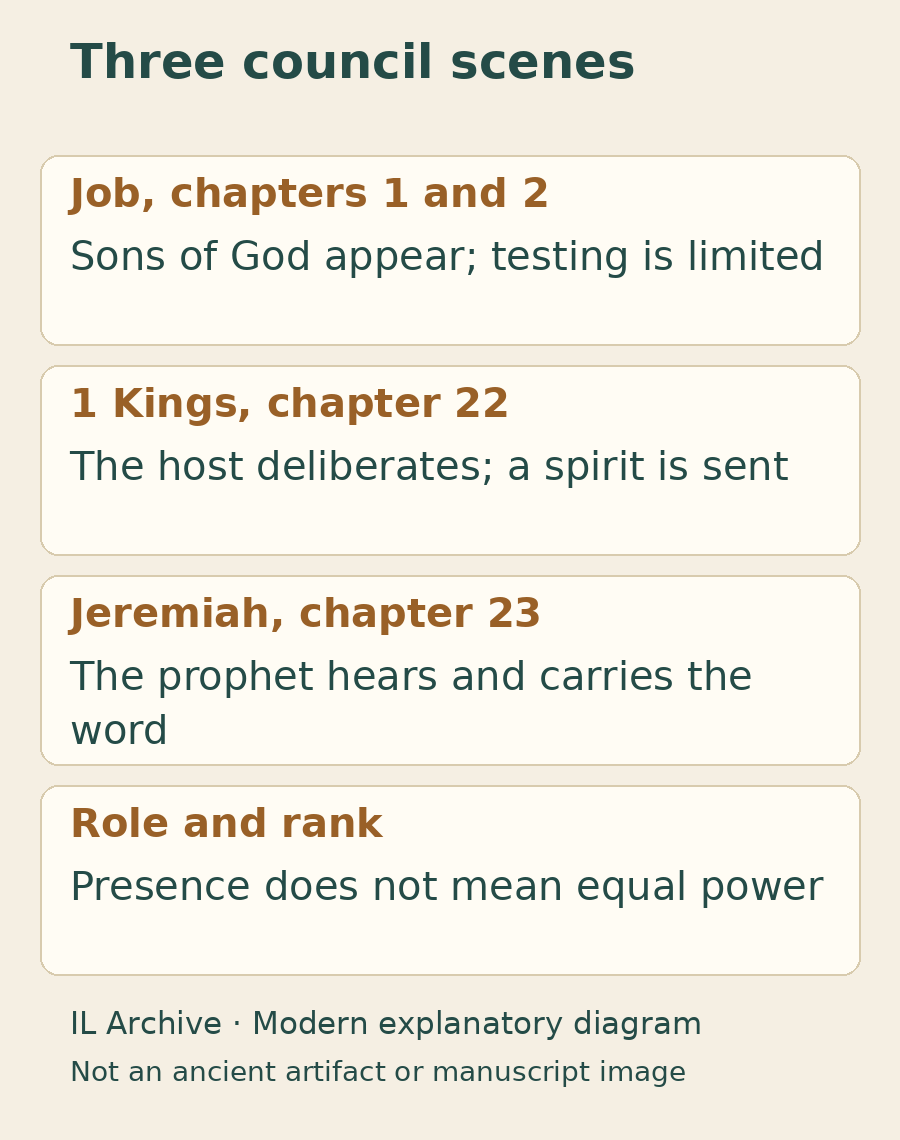
Jeremiah 23:18 asks who has stood in Yahweh’s sod and heard his word. Verse 22 connects standing in the council with carrying that word to the people and changing their conduct.[16] Historian of liturgy Bryan D. Spinks places this within a tradition of prophetic vision of a celestial assembly headed by Yahweh.[3]
Jeremiah 23:18 has מִי עָמַד בְּסוֹד יְהוָה, “Who has stood in Yahweh’s council?” This unrestored Masoretic phrase contains sod, the term discussed below.[16]
Sod encompasses council, counsel and intimate or secret deliberation. Context determines the sense; not every occurrence describes a heavenly chamber. Within this tradition, prophetic authority comes from hearing the divine decision. It is one model of prophecy, rather than its only definition.
What remained of El’s council?
Comparable elements survived: a ruler, a heavenly group, sons, ranks, missions and deliberations. McClellan identifies a strong relationship between some Israelite council representations and Ugaritic and broader Southwest Asian traditions.[8]
Such continuity does not establish the transfer of one religious institution with all its members. Ugarit offers a window onto West Semitic traditions, rather than necessarily being the library Hebrew authors consulted. Hierarchy and messengers already existed within polytheistic worlds. The changes requiring explanation concern independence, sovereignty and worship.
Malʾakh: the messenger and its context
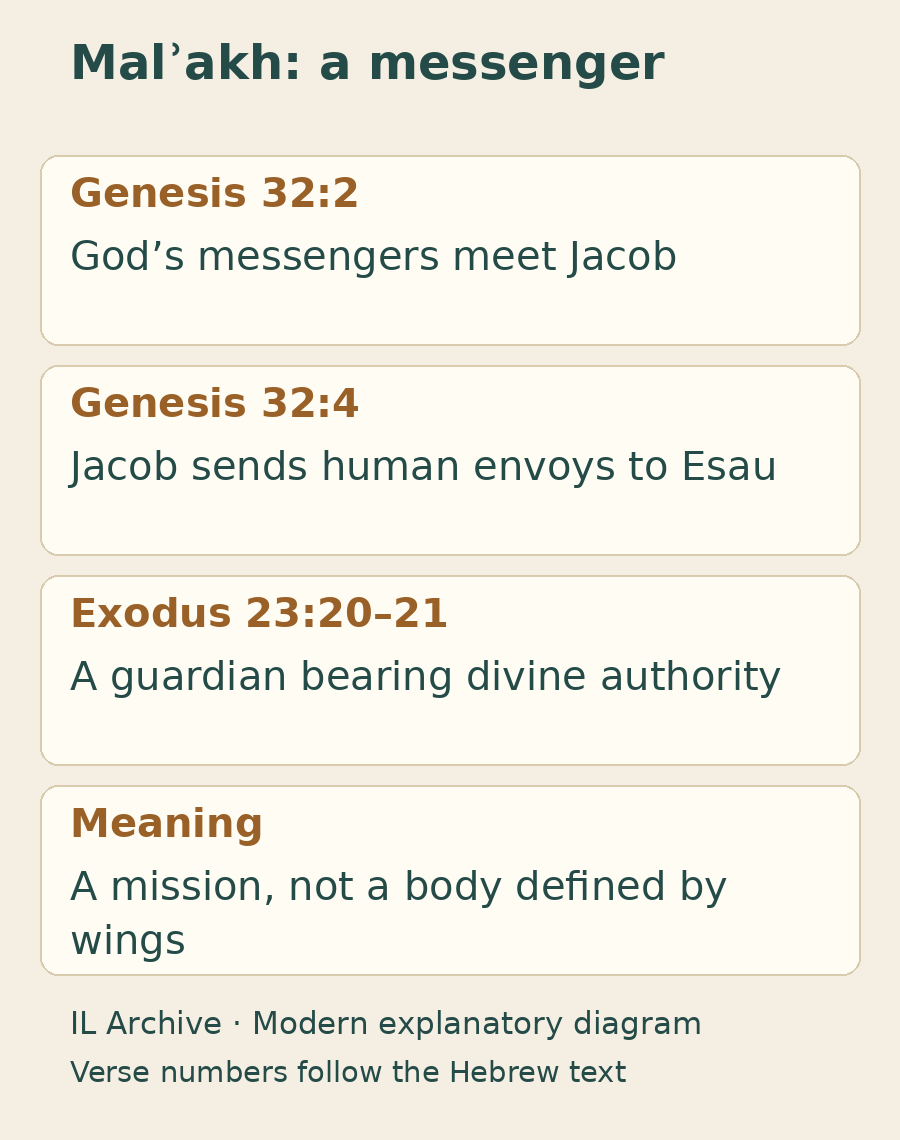
MalʾakhAngel / Heavenly MessengerHebrew malʾakh (מַלְאָךְ) means “envoy,” human or heavenly according to the passage. Messenger roles vary; the word alone proves neither wings nor an earlier divine identity.Glossary · Click to read the explanation (מַלְאָךְ) means messenger or envoy. Genesis 32 depicts angels of God, then Jacob sends malʾakhim (מַלְאָכִים) to his brother Esau: human messengers. The same word takes its meaning from the sender and the context.[17]
Exodus 23:20–21 describes an envoy sent to guard and guide, carrying powerful authority associated with the divine name.[18] The word therefore does not simply identify one fixed class of winged creatures. Monotheism did not invent the heavenly messenger’s function; Ugarit and other societies knew it, with differing rank and classification.[8]
Worshipping one god and asserting that only one exists
An injunction to worship Yahweh alone does not automatically deny every other divine being’s existence. Isaiah 44:6 and 45:5–6 use more exclusive language: the speaker declares that no other god exists beside him.[19]
Isaiah 44:6 states וּמִבַּלְעָדַי אֵין אֱלֹהִים, “And apart from me there is no god.” This unrestored Masoretic excerpt is more explicit negation than an instruction to worship one deity.[19]
The core conventionally called Second Isaiah is usually associated with the sixth-century BCE exilic context. Hebrew Bible scholar Robert P. Gordon discusses disagreement over whether this period began monotheismMonotheismBelief that only one God possesses divinity in its fullest sense. Historically distinct from exclusively worshipping one deity without denying others; its theological forms vary.Glossary · Click to read the explanation or expressed it most clearly; definitions affect its dating.[20] Not all communities need have adopted identical claims simultaneously, and a heavenly court need not contradict a single god in every conceptual framework.
Second Temple writings: organizing a vast heavenly world
Some Jewish writings of the Second Temple period—the era following the rebuilding of JerusalemJerusalemJerusalem is a city of religious importance in Judaism, Christianity and IslamGlossary · Click to read the explanation’s temple after the Babylonian exile—elaborate celestial names, functions and knowledge. Scholar of ancient Judaism Annette Yoshiko ReedAnnette Yoshiko ReedAnnette Yoshiko Reed studies ancient Judaism, early Christianity and their relationships in late antiquity, and is a professor at Harvard Divinity School.Glossary · Click to read the explanation proposes locating an important beginning of written Jewish angelologyAngelologyStudy and organization of angels and heavenly beings: names, ranks and roles within particular traditions, without assuming one fixed system.Glossary · Click to read the explanation and demonologyDemonologyStudy or organization of harmful powers, names, origins and roles within specific traditions; no single doctrine or claim about existence beyond the text is assumed.Glossary · Click to read the explanation in the third century BCE, drawing on Aramaic Dead Sea texts and Hellenistic scribal knowledge.[21]
This dates a literary and organizational phenomenon, not the first belief in any angel. Different writings preserved diverse conceptions of mediators and heavenly authority. More detail can coexist with exclusive worship of the highest deity, but no historical rule makes increasing monotheism automatically produce more angels.
Reed’s argument changes the question. In early Hellenistic Aramaic writings, approximately 333–167 BCE, intermediaries acquire not just names: scribes collect and organize knowledge about their classes and roles as a source of intellectual authority. This is “angelology,” as distinct from belief in a heavenly messenger. Reed situates that organization within its literary environment, not automatically as declining monotheism or a prelude to Christianity.[26]
Michael, Gabriel and the limits of comparison
GabrielGabriel / JibrīlA Semitic theophoric name for an interpreter of visions in Daniel and a messenger in Luke; named Jibrīl in the Qurʾan. His functions depend on each textual context.Glossary · Click to read the explanation interprets a vision in Daniel 8. MichaelMichael / MīkālA name meaning “Who is like God?”, borne by humans and an angel. The angel protects Daniel’s people, is called archangel in Jude and fights the dragon in Revelation. The Qurʾan names Mīkāl without assigning a task; later traditions develop different roles.Glossary · Click to read the explanation appears among the princes in Daniel 10, alongside princes associated with Persia and Greece.[22] McClellan locates this representation in the second century BCE, rather than the Persian time in which the vision is narratively set.[8] It is a later representation of celestial agency connected with peoples. It can be compared with the council without equating it with every earlier depiction.
The names contain El, and Michael is commonly understood as the question “Who is like God?”[23] But a theophoric name—a name containing a divine element—expresses a relationship to the deity; it does not establish that Michael was an independent god at Ugarit. We have no table equating particular Canaanite gods with Gabriel or Michael after a demotion.
What do we know, and with what confidence?
- Established: council terminology and sons of El occur at Ugarit; heavenly assemblies occur in Hebrew texts.
- Established: Deuteronomy 32:8 varies between sons of Israel and sons of God, with angels of God in the Greek tradition.
- Probable: West Semitic council structures and language continued within representations of Yahweh’s council.
- Favored in Psalm 82’s context: celestial addressees; a separate El and Yahweh within the scene is less secure.
- Historically contested: which layer of Deuteronomy 32:8–9 distinguishes the Most High from Yahweh, and when it was formed; this uncertainty does not weaken the textual preference for “sons of God.”
- Probable: traditions of Yahweh’s exclusivity reinterpreted the status and subordination of many heavenly beings.
- Unproven: every later angel was an ancient god under another name, or one date marks the polytheistic council’s end.
These grades apply to specific claims. The different texts cannot be assembled as securely dated chapters in one inevitable sequence.
Heaven remained; membership changed its meaning
Belief in one god did not require an empty heaven. A throne, host, messengers and holy beings could carry divine commands and participate in the celestial world without deserving independent worship.
This is what comparison between El’s and Yahweh’s councils most securely reveals: continuity in language and structure, alongside redefinition of sovereignty and members’ legitimacy. The council remained viable within different conceptions, and Jewish traditions could read it as a court serving the one God. The older structure did not disappear entirely; belonging to it came to mean something different.
References and notes (34)
- Joel S. Burnett (2022). The Persistence of El in Iron Age Israel and Ammon. In Biblical and Ancient Near Eastern Studies in Honor of P. Kyle McCarter Jr., pp. 299–303. Pp. 299–303, especially 300–301: divine household, KTU 1.65.1–18 and Baal’s position. Ugaritic wording is mediated by Burnett’s discussion. Return to the text ↑
- Mark S. Smith (2006). The Rituals and Myths of the Feast of the Goodly Gods of KTU/CAT 1.23. Resources for Biblical Studies 51. pp. 101–102, 105. Pp. 101–102 and 105: group terminology and astral parallelism in KTU 1.10 I 3–5. Smith stresses the damaged context and provisional interpretation. Return to the text ↑
- Bryan D. Spinks (1991). The Old Testament Background and Setting. The Sanctus in the Eucharistic Prayer, chapter 1, pp. 11–24. doi:10.1017/CBO9780511520242.003. Accessible Summary excerpt on the council and prophetic vision. Its “Jer 22:18” is a miscitation: the passage is Jeremiah 23:18, read with 23:22. The inaccessible remainder of the chapter is not used. Return to the text ↑
- Hebrew Bible, Psalm 89:6–9; Deuteronomy 4:19; 14:1. Mechon-Mamre: Hebrew text and JPS English translation (1917). Psalm 89:6–9 in Hebrew numbering (89:5–8 in other translations); Deuteronomy 4:19 for the heavenly host and 14:1 for human children. Chapters: https://mechon-mamre.org/p/pt/pt0504.htm and https://mechon-mamre.org/p/pt/pt0514.htm Return to the text ↑
- Israel Antiquities Authority. Leon Levy Dead Sea Scrolls Digital Library: B-359054, 4Q37 / 4QDeutj, plate 172, fragment 10, recto. Photograph: Shai Halevi, April 2013. Catalogue metadata: 4Q37 / 4QDeutʲ, plate 172, fragment 10, recto; photograph by Shai Halevi, April 2013. The bene elohim reading relies here on Tigchelaar’s critical reference [6]. The manuscript photograph is not reproduced. Return to the text ↑
- Eibert Tigchelaar (2012). Editing the Hebrew Bible: An Overview of Some Problems. In Editing the Bible: Assessing the Task Past and Present, ed. John S. Kloppenborg and Judith H. Newman, pp. 41–65, especially p. 46 n. 22. Pp. 45–47, especially p. 46 nn. 22 and 24: distinguishes bene elohim in 4QDeutʲ from the editorial proposal bene El; pp. 55–57 distinguish ancient text from Masoretic vocalization and accentuation. Return to the text ↑
- NET Bible. Deuteronomy 32, textual note 14 on verse 8. Textual note 14 on Deuteronomy 32:8; also the Masoretic text at https://mechon-mamre.org/p/pt/pt0532.htm, verses 6–9. The Greek reading follows the note, not an independent collation of all Septuagint manuscripts. Return to the text ↑
- Daniel O. McClellan (2022). YHWH’s Divine Images: A Cognitive Approach. Ancient Near East Monographs 29. pp. 88, 97–99, 102–103, 125–126. P. 88 on Deuteronomy 32 and Daniel 10; pp. 97–99 on Psalm 82; pp. 102–103 on messengers and divine classification; pp. 125–126 on councils and prophecy. The Elyon–Yahweh distinction and historical reconstruction are McClellan’s interpretation. Pp. 6–9 also read for the composition/redaction model, not independent dating of every poem. Return to the text ↑
- Michael S. Heiser (2006). Are Yahweh and El Distinct Deities in Deut. 32:8–9 and Psalm 82? Hiphil 3, pp. 1–9; pp. 5–7. Pp. 5–7, especially the song’s context and the Most High title on pp. 6–7. Open reprint: https://www.dburnett.com/wp-content/uploads/2011/07/Heiser-on-Deut-32-Ps-82.pdf Return to the text ↑
- Hebrew Bible, Psalm 82:1–8. Mechon-Mamre: Hebrew text and JPS English translation (1917). Whole psalm, verses 1–8. Hebrew elohim appears where the JPS translation chooses “judges” in verse 1. The surviving text does not contain the four-letter name YHWH. Return to the text ↑
- Hebrew Bible, Job 1:6–12. Mechon-Mamre: Hebrew text and JPS English translation (1917). Job 1:6–12: presentation, challenge to the motives of piety, and first-stage limits. Return to the text ↑
- Hebrew Bible, Job 2:1–7. Mechon-Mamre: Hebrew text and JPS English translation (1917). Job 2:1–7: renewed assembly and permission to afflict Job while sparing his life. Return to the text ↑
- Warren Zev Harvey (2022 online; 2023 issue). Questions on the Book of Job. Religious Studies 59, S1, S7–S16. doi:10.1017/S0034412521000585. Section “The Framework Story”: satan as adversary or accuser, his place among the sons of God, and authorized testing. The article’s wider philosophical conclusions are not all attributed to the narrative. Return to the text ↑
- Hebrew Bible, Job 38:4–7. Mechon-Mamre: Hebrew text and JPS English translation (1917). Job 38:4–7, especially the pairing of morning stars and sons of God in verse 7. Ugaritic comparison in Smith [2]. Return to the text ↑
- Hebrew Bible, 1 Kings 22:19–23. Mechon-Mamre: Hebrew text and JPS English translation (1917). 1 Kings 22:19–23; the chapter’s context identifies Micaiah ben Imlah and Ahab king of Israel. The dispatched figure is a “spirit,” not a named angel. Return to the text ↑
- Hebrew Bible, Jeremiah 23:18–22. Mechon-Mamre: Hebrew text and JPS English translation (1917). Jeremiah 23:18–22: hearing Yahweh’s word in the council and criticism of prophets who were not sent. Return to the text ↑
- Hebrew Bible, Genesis 32:2–4, Hebrew numbering. Mechon-Mamre: Hebrew text and JPS English translation (1917). Genesis 32:2–4 in Hebrew numbering (32:1–3 in other translations): God’s messengers, then Jacob’s envoys to his brother Esau. Return to the text ↑
- Hebrew Bible, Exodus 23:20–21. Mechon-Mamre: Hebrew text and JPS English translation (1917). Exodus 23:20–21: protection, guidance and obedience to the envoy because the divine name is in him. Return to the text ↑
- Hebrew Bible, Isaiah 44:6; 45:5–6. Mechon-Mamre: Hebrew text and JPS English translation (1917). Isaiah 44:6; and 45:5–6 at https://mechon-mamre.org/p/pt/pt1045.htm. These are the text’s exclusive claims; dating and the definition of monotheism are discussed in [20]. Return to the text ↑
- Robert P. Gordon (2007). Introduction. The God of Israel. Cambridge University Press, publisher excerpt. Publisher’s Introduction excerpt, paragraphs discussing the origins of monotheism and beginning “More often it is asserted…”: Second Isaiah, the sixth century BCE and how definitions affect dating. Return to the text ↑
- Annette Yoshiko Reed (2020). Rethinking Scribalism and Change in Second Temple Judaism. Demons, Angels, and Writing in Ancient Judaism, chapter 2, pp. 87–131. doi:10.1017/9781139030847.004. Publisher’s abstract only: proposed third-century BCE beginnings of angelology and demonology in Aramaic literature and scribal knowledge. Not used to date the first belief in a heavenly messenger. Return to the text ↑
- Hebrew Bible, Daniel 8:15–17; 10:1,13,20–21. Mechon-Mamre: Hebrew text and JPS English translation (1917). Daniel 10:1,13,20–21; and 8:15–17 at https://mechon-mamre.org/p/pt/pt3408.htm: Gabriel as interpreter and Michael as a prince attached to the people. Composition is discussed in [8], distinct from the narrative setting. Return to the text ↑
- Francis Brown, S. R. Driver and Charles A. Briggs, A Hebrew and English Lexicon of the Old Testament, entry מִיכָאֵל (Michael), lexical text reproduced by Bible Hub. Brown–Driver–Briggs section only: “Who is like God?” and use for human names as well as a heavenly prince. The page’s separate devotional commentary is not used. Return to the text ↑
- Mark S. Smith, The Origins of Biblical Monotheism, author’s account of his argument, Bible Interp, University of Arizona. Paragraphs on the four-tier family, Deuteronomy 32:8–9 and Psalm 82; the author’s own synthesis, not a full reading of his 2001 book. Return to the text ↑
- Erica Mongé-Greer, Divine Council, Ethics, and Resistance in Psalm 82, chapter 1, “Current Approaches to Psalm 82,” pp. 1–8, publisher excerpt (copyright 2023). Pp. 1–4 on justice for the poor; pp. 5–8 on dating and reception. The rest of the book was not read; no conclusions from its unavailable chapters are claimed here. Return to the text ↑
- Annette Yoshiko Reed, Demons, Angels, and Writing in Ancient Judaism (2020), Introduction, pp. 1–10, publisher’s textual excerpt. Pp. 4–5 on the 333–167 BCE corpus and belief versus organized knowledge; pp. 6–10 on decline narratives and method. This actual text supplements the chapter abstract in [21]; chapter 2 itself was not read. Return to the text ↑
- Department of Ancient Near Eastern Art, Metropolitan Museum of Art, “Ugarit” (2004). Archive paragraphs, earliest tablets around 1400 BCE and destruction around 1200; a broad horizon, not individual dating of KTU 1.65 or 1.10. Return to the text ↑
- Michael Langlois (2019), “Dead Sea Scrolls Palaeography and the Samaritan Pentateuch,” p. 258. 4Q37 (4QDeutʲ) subsection, printed p. 258 (PDF page 10): first half of first century CE, preferably second quarter; ca. 50 CE remains possible. Dating discussion read, not a new collation of the scroll. Return to the text ↑
- Tina Dykesteen Nilsen (2019), “Did Moses Sing? Perspectives on Deuteronomy 32,” Bible Interp. Article, especially “Is Moses the Author of the Poem?” and “What Is the Function of the Poem?”; the author’s argument, not a full reading of her 2018 book or Sanders 1996. Return to the text ↑
- Carol A. Newsom, “Job,” Oxford Bibliographies (2010; currency confirmed 2023), accessible Introduction. Introduction only: uncertain dating and preference for the early post-exilic period; not a reading of the works listed in the bibliography. Return to the text ↑
- Princeton Geniza Project, record 38606, RNL Yevr. I B 19, Leningrad Codex. Description of complete manuscript and date around 1008–1010 CE, with colophon transcription; used to date the witness, not to collate this study’s verses against its folios. Return to the text ↑
- Israel Museum, “Great Isaiah Scroll Exhibition,” Introduction. Museum Introduction read in its indexed text: complete scroll and date around 125 BCE. Direct PDF retrieval failed; no column inspection is claimed. Return to the text ↑
- Dominik Markl (2020), “Cultural Trauma and the Song of Moses (Deut 32),” Old Testament Essays 33/3, doi:10.17159/2312-3621/2020/v33n3a18. Sections A–D: dating debate, accusation/rescue structure and editorial framing. Used for literary analysis, not psychological diagnosis of an ancient author. Return to the text ↑
- Qumran-Digital: Text und Lexikon, 4Q37 transcription, version dated 2022-10-14. Column 12, lines 12–14, especially 14. בני אלוהים reproduced unchanged. ©2022 DFG-Projekt 465277421, CC-BY-SA 4.0: https://creativecommons.org/licenses/by-sa/4.0/ . Based on the Göttingen Qumran-Wörterbuch text, itself based on an earlier Martin Abegg text. Published transcription inspected, not an independent facsimile collation. Return to the text ↑
Suggest a correction · Suggest a source for this record
Cite this record
IL Archive, «From El’s Council to Yahweh’s Court», https://ilarchive.com/en/studies/divine-council
Continue reading