Entity · deity
Baal
A reference page linking a name, group, or concept to the materials that discuss it.
- Timeline
- From 1400 BCE to 1200 BCE
Storm god and protagonist of Ugarit’s Baal Cycle; exercises active kingship while El retains importance and authorizes the palace.
Reading path
Links recorded in this entry.
Periods
When does it appear?
- From 1400 BCE to 1200 BCE
Dates
Dates have distinct roles. The timeline uses creation, composition or historical coverage, rather than publication or discovery dates.
- Historical coverage
- Approximately From 1400 BCE to 1200 BCE
Text
Name and authority
This entry concerns Ugaritic Baal in the Baal CycleBaal CycleA group of Late Bronze Age Ugaritic religious texts recounting Baal’s conflicts, relationships with the gods and the building of his palace.Glossary · Click to read the explanation, not every use of baal, which can mean lordRabbTitle of lordship, ownership or care by context; applied to God in Lord of worlds.Glossary · Click to read the explanation. He is called DaganDaganDeity known in Syria and Mesopotamia, attested in Ugaritic lists, offerings and names; Baal is called his son. Temple attribution remains debated.Glossary · Click to read the explanation’s son and also addresses El as father; the relationships do not yield a final genealogy. His palace requires El’s permission in KTUKTU: Ugaritic Text ReferencesAbbreviation for a modern scholarly corpus of alphabetic cuneiform texts; its numbers are references, not dates.Glossary · Click to read the explanation 1.3–1.4.
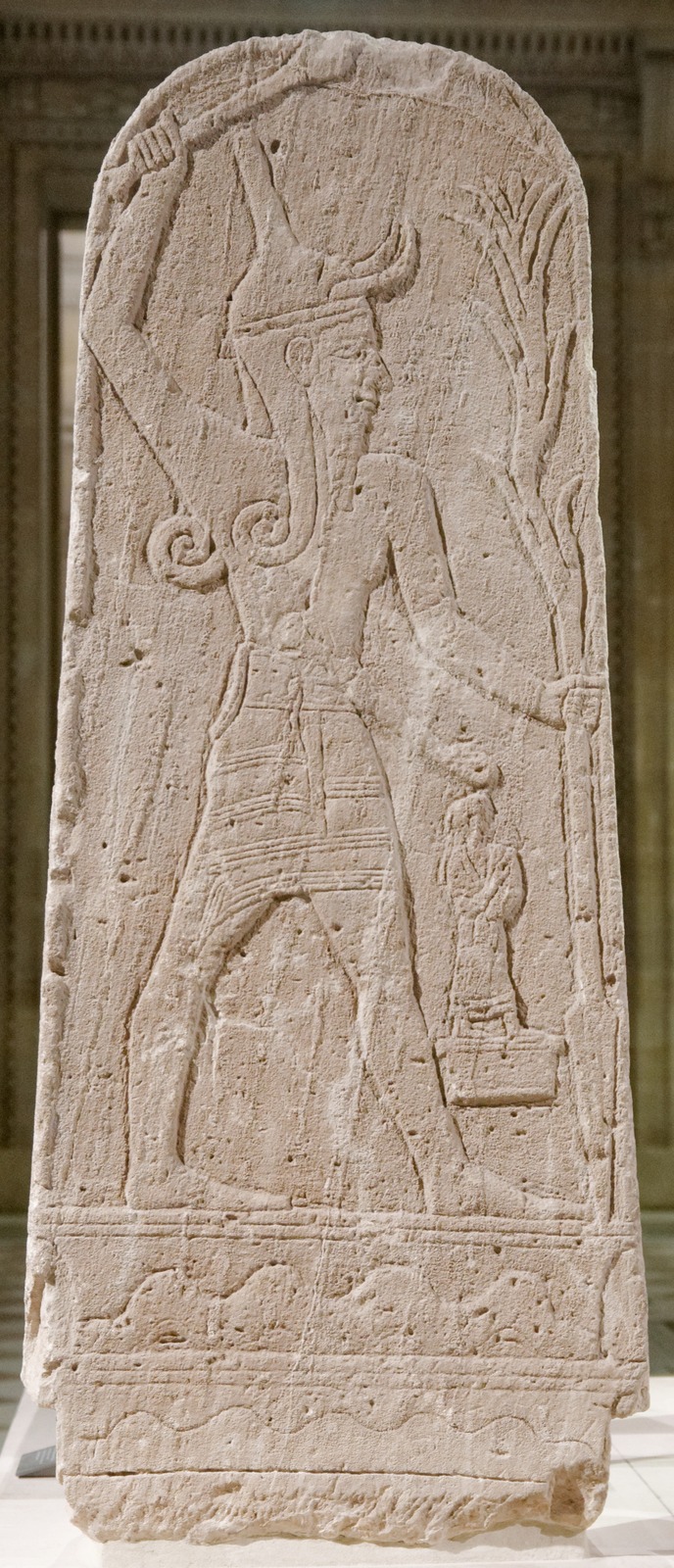
The accompanying stela AO 15775 from UgaritUgaritAncient city and kingdom at Ras Shamra on the Syrian coast, flourishing between the fourteenth and early twelfth centuries BCE and preserving multilingual archives.Glossary · Click to read the explanation depicts Baal according to the Louvre. It does not prove an overthrow of El. This entry’s period concerns the Ugaritic literature discussed, not the god’s origin; the stela has the broader museum date 2000–1150 BCE. [1][2][3]
References and notes
- Joel S. Burnett (2022). The Persistence of El in Iron Age Israel and Ammon. In Biblical and Ancient Near Eastern Studies in Honor of P. Kyle McCarter Jr., eds. Christopher Rollston, Susanna Garfein and Neal H. Walls. SBL Press. Pp. 301–303 only: Ugaritic background, son of Dagan, ʾab ʾadm, offspring in Kirta/Aqhat, disputed bny bnwt, and interpretation of El/Baal authority. P. 303 also visually checked. Later Israel/Ammon discussion not imported; whole book not read. Return to the text ↑
- Mark S. Smith & Wayne T. Pitard (2009). The Ugaritic Baal Cycle, Volume II: Introduction with Text, Translation and Commentary of KTU/CAT 1.3–1.4. Brill. doi:10.1163/ej.9789004153486.i-864. University abstract: Baal obtains El’s permission to build the palace and constructs it in KTU 1.3–1.4. Volume metadata and abstract only; full 864-page commentary not read. Return to the text ↑
- Musée du Louvre. Stèle du Baal au foudre, AO 15775 / RS 4.427. Museum record: limestone, Ugarit, range 2000–1150 BCE. Jastrow (Marie-Lan Nguyen) photograph on Commons released into the public domain; no narrower date taken from the image title. Return to the text ↑
Research history
Substantive changes are retained here. Minor copy edits remain in the internal operational log.
-
Substantive record update
Suggest a correction · Suggest a source for this record
Cite this record
IL Archive, «Baal», Edition 2, https://ilarchive.com/en/entities/baal