Entity · Concept
KTU: Ugaritic Text References
A reference page linking a name, group, or concept to the materials that discuss it.
A guide to KTU/CAT references for Ugaritic texts: editions, text groups, RS and RIH inventory numbers, columns and lines, and limits of interpretation.
Estimated reading time: 6 min Published Last reviewed:
Share article
Text
Introduction
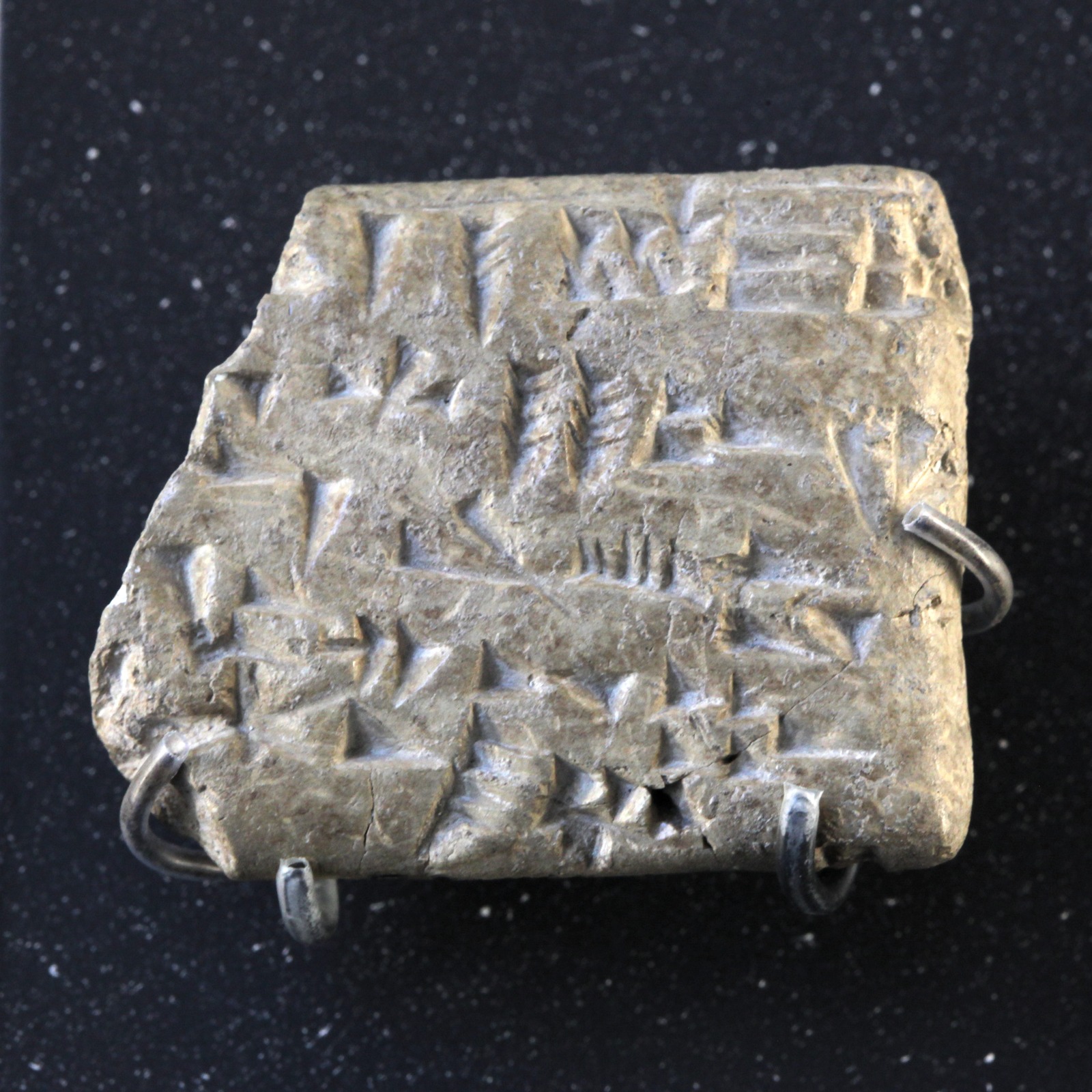
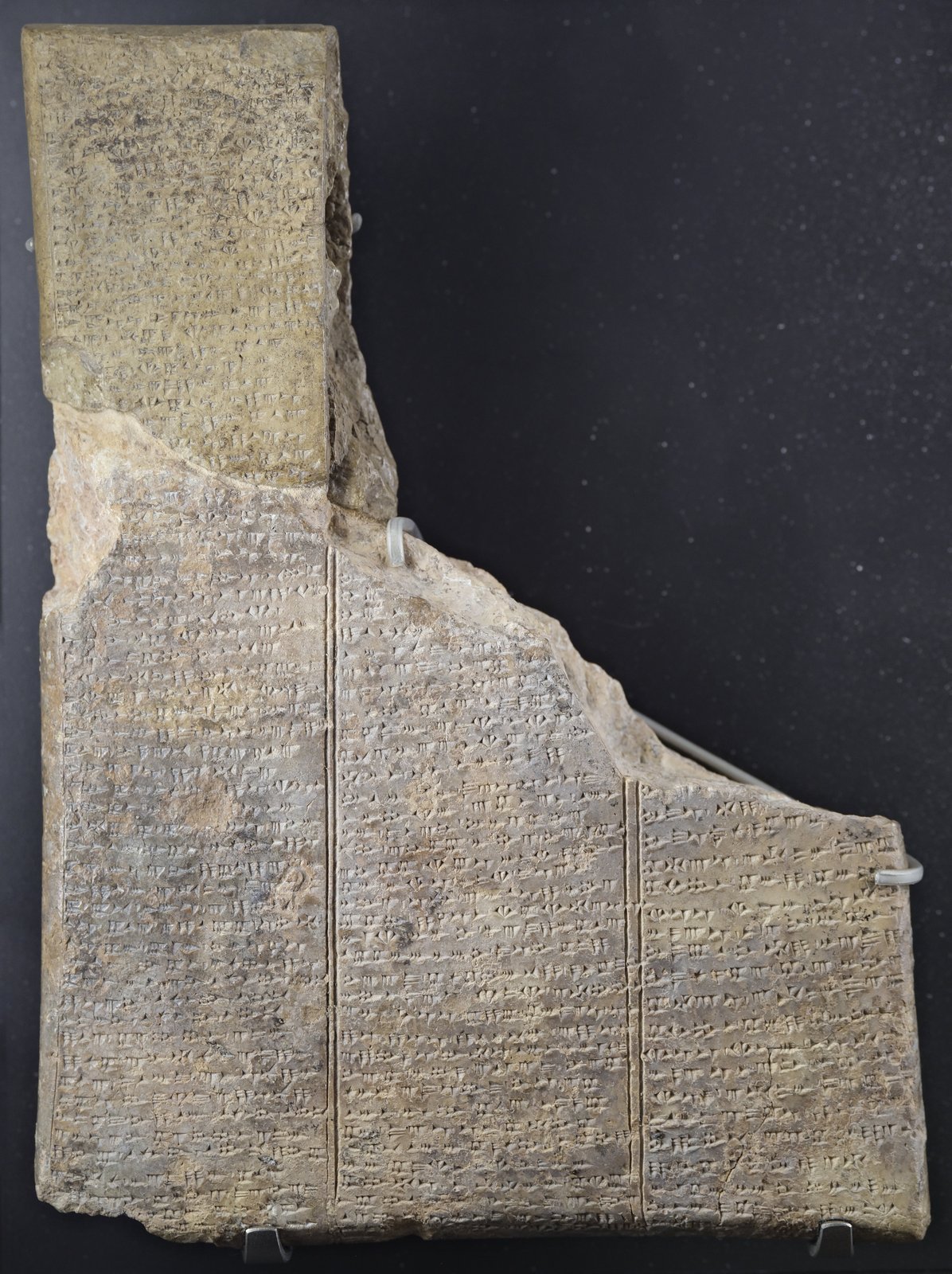
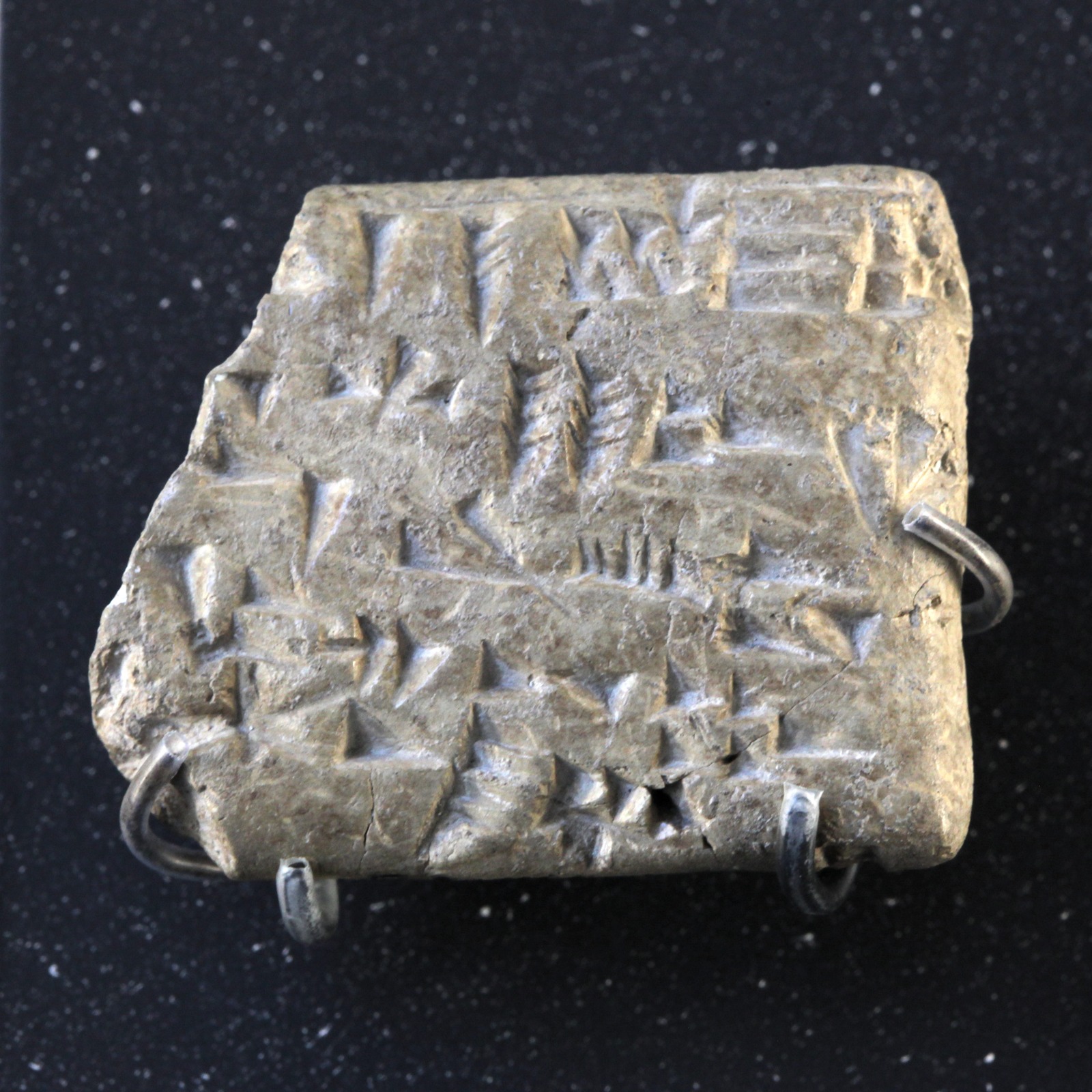
How does a reference such as “KTU 1.114” lead to a particular Ugaritic text, and what can—and cannot—be inferred from its numbers? KTU is a modern editorial classification of alphabetic cuneiformUgaritic alphabetAlphabetic cuneiform system of Late Bronze Age Ugarit, using thirty chiefly consonantal written signs, distinct from Akkadian syllabic cuneiform.Glossary · Click to read the explanation texts, not a title assigned by an ancient scribe or a date of composition. This entry explains how the citation works, relates it to excavation identifiers and editions, and tests its use against documented examples while distinguishing readings from interpretations.
What KTU is and what it covers
KTU abbreviates the German title Die keilalphabetischen Texte aus UgaritUgaritAncient city and kingdom at Ras Shamra on the Syrian coast, flourishing between the fourteenth and early twelfth centuries BCE and preserving multilingual archives.Glossary · Click to read the explanation, “The Alphabetic Cuneiform Texts from Ugarit.” It is an edited collection of texts with numbers and transliterations—not one manuscript and not a separate language. Its sources include material discovered at UgaritUgaritAncient city and kingdom at Ras Shamra on the Syrian coast, flourishing between the fourteenth and early twelfth centuries BCE and preserving multilingual archives.Glossary · Click to read the explanation (Ras Shamra) and at other places, including Ras Ibn Hani. The corpus principally concerns texts written in alphabetic cuneiform, which must be distinguished from the syllabic cuneiformCuneiformWriting with wedge-shaped signs, developed from Mesopotamian recording traditions and used for several languages from the third millennium BCE.Glossary · Click to read the explanation system also used in the region. See the separate entries on the Ugaritic alphabetUgaritic alphabetAlphabetic cuneiform system of Late Bronze Age Ugarit, using thirty chiefly consonantal written signs, distinct from Akkadian syllabic cuneiform.Glossary · Click to read the explanation and the Ugaritic languageUgaritic languageAncient Semitic language preserved in Ugarit’s tablets on the Syrian coast, from the fourteenth–twelfth centuries BCE, written in a cuneiform alphabet.Glossary · Click to read the explanation.[1][3]
Editions and citation abbreviations
Manfried Dietrich, Oswald Loretz and Joaquín Sanmartín published the first KTU edition in 1976. An enlarged English-language second edition, The Cuneiform Alphabetic Texts from Ugarit, Ras Ibn Hani and Other Places (1995), is also called CAT or KTU². A third German edition, KTU³, followed in 2013. These dates and titles were checked against the bibliography of the Göttingen editorial project, not through a complete reading of all three volumes. Consequently, where a reading or number matters, the edition in use should be specified rather than assuming every detail remained unchanged.[1]
Older concordances include CTA, Andrée Herdner's collection published in 1963. Similar-looking text numbers in different catalogues do not turn those works into a single edition; concordances must establish the correspondence.[3]
What the digits indicate
In `KTU 1.114`, the first numeral identifies an editorial group, while the number after the point identifies an entry within that group. In the CAT system set out by John Huehnergard, group 1 comprises literary and religious texts; 2, letters; 3, legal documents; 4, economic and administrative documents; 5, scribal exercises; and 6, inscriptions on seals, ivory and related objects. Other categories cover unclassified or illegible texts and items unpublished in the system described. These are modern organizational headings, not necessarily ancient categories used by Ugarit's scribes.[3]
The number 114 is not a year BCE, nor does it by itself establish when or where a tablet was written. Equally, the prefix `1` does not imply that every item in its group is a myth: prayers, ritualsRitualAn organised or distinguished practice meaningful to a community; it may leave traces, but its form alone does not reveal an associated doctrine.Glossary · Click to read the explanation and other materials are also included. Genre requires examining the contents and their condition, not simply the catalogue number.[3]
KTU, RS, RIH and CTA identify different things
KTU/CAT identifies a text in an editorial arrangement, whereas RS identifies an archaeological find in the Ras Shamra mission's records. Huehnergard's example pairs `CAT 3.2` with `RS 15.111`; the `15` in this excavation numbering example indicates the fifteenth field season. Texts from Ras Ibn Hani can carry RIH identifiers: for example, `RIH 77/25 = CAT 2.79`. Such matches must be taken from a published concordance; an RS number cannot be guessed from the appearance of a KTU number.[3]
A physical witness may comprise joined fragments and can have more than one find designation in some editions. When known, both the edited text identifier and the find inventory identifier are worth recording. Neither should be confused with an edition's date or the date of discovery.[3]
Columns and lines are not extra text numbers
The form `KTU 1.14 II:30` refers to text 1.14, column II, line 30. It may also be printed `CAT 1.14.ii:30` or with different spacing. Likewise, `KTU 1.2 IV:6–26` points to a run of lines in column IV of a text belonging to the Baal CycleBaal CycleA group of Late Bronze Age Ugaritic religious texts recounting Baal’s conflicts, relationships with the gods and the building of his palace.Glossary · Click to read the explanation. The publisher's contents page for the textbook by Tropper and Vita gives `KTU 1.2:IV:6–26 = RS 3.367+`. The plus sign belongs to the cited witness designation and should not, on its own, be turned into a claim about how every fragment was joined.[3][4]
Before quoting or translating a line, the exact place in a named edition needs checking, including whether the signs survive, have been supplied or remain contested. A precise citation leads the reader toward the evidence; it is not itself the evidence.[6]
A checked case: KTU 1.114 and RS 24.258
`KTU 1.114` corresponds to `RS 24.258` in Klaas Spronk's chapter on incantations. The text recounts ElElEl is a senior deity in Late Bronze Age Ugaritic texts, portrayed as father of the divine family and a council authority, alongside his consort Athirat. This entry does not cover every linguistic use of El.Glossary · Click to read the explanation drinking to excess, after which two goddesses seek a remedy; its closing lines seem to offer a recipe relevant to intoxication. Spronk reports that Dietrich and Loretz classified it as an incantation treating drunkenness and discusses this as an interpretation of the text's function. It is not a direct record proving every historical occasion on which the tablet was used.[2]
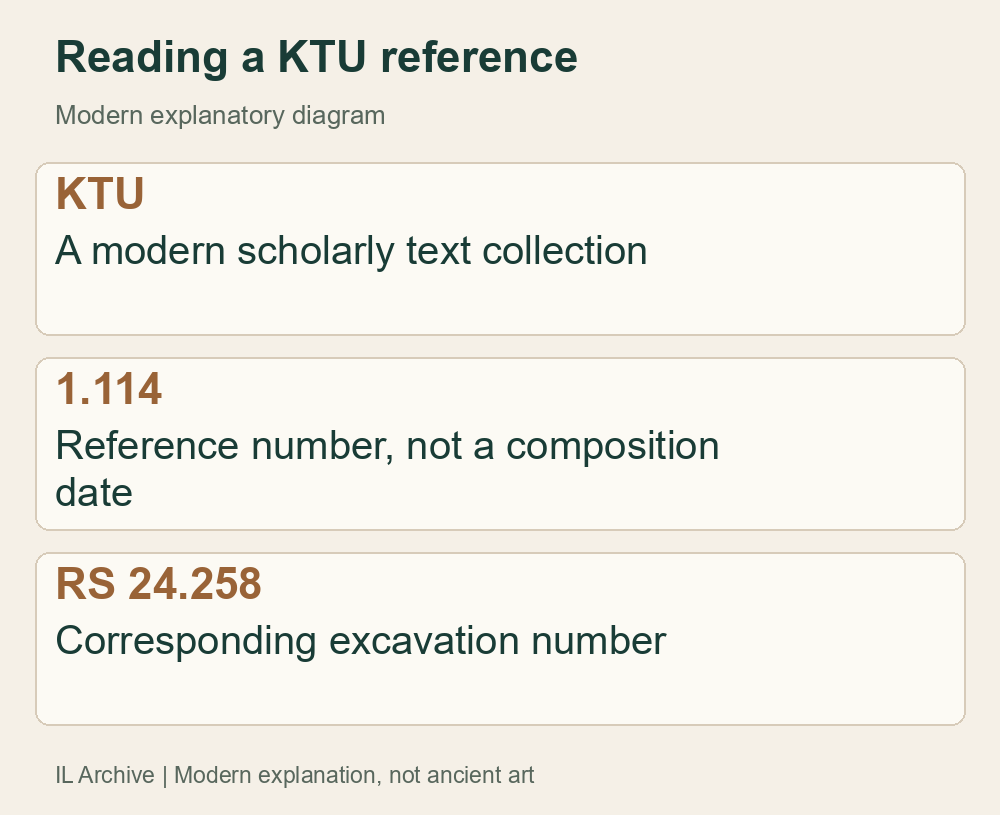
KTU thus points to a traceable edited text, RS supplies an archaeological identifier, and a column and line identify a passage. Describing it as myth or incantation, or reconstructing a damaged word, still entails scholarly judgements that must be attributed.[2][6]
Contrasting examples across the corpus
The publisher's table of contents for Tropper and Vita's textbook—not full critical editions of the texts—lists `KTU 5.6 = RS 12.063` as an abecedary, `KTU 3.2 = RS 15.111` as a legal document, `KTU 4.145 = RS 15.034` as an economic text, and `KTU 1.2:IV:6–26 = RS 3.367+` as an epic passage. These examples demonstrate that KTU extends beyond religious poetry into administrative work and scribal education. The publisher's descriptive entries were checked, but the inscriptions on all these tablets were not independently read in full.[4]
Limits of certainty and good citation practice
An ancient tablet, its photographs and drawings, and later transliterations, readings, translations and interpretations represent different levels of evidence.[5] A newly identified fragment or a re-examination of signs can change a published reading. Spronk notes disagreement over the initial signs of `KTU 1.96`, with earlier editorial corrections revisited by subsequent scholars. This illustrates why the basis of a reading and translation should be specified instead of treating the catalogue number as an immutable text.[6]
- Start with the complete KTU/CAT identifier and name the edition or year when it matters.
- Add RS, RIH or CTA only when a published concordance verifies the match.
- Specify column and line, distinguishing lost text, editorial restorations and disputed readings where relevant.
- Separate what the signs actually preserve from an editor's proposal, a translation and any historical inference.
Used this way, KTU is a key to verification, not a substitute for textual criticismTextual criticismComparison of written witnesses and ancient translations to explain variant readings and textual transmission, distinguishing attested text from restorations and inferred ancestors.Glossary · Click to read the explanation or sufficient grounds, on its own, to date a tablet or prove the beliefs of an entire community.[3][6]
References and notes (6)
- M. Dietrich, O. Loretz and J. Sanmartín, bibliographic records of KTU¹ (1976), KTU²/CAT (1995) and KTU³ (2013), in “Bibliographische Abkürzungen,” Edition des ugaritischen poetischen Textkorpus, University of Göttingen. Abbreviations page, entries CTA, KTU¹, KTU² (CAT), KTU³; relevant page read in full, but not the three actual edited volumes. Return to the text ↑
- Klaas Spronk, “The Incantations,” chapter 5 of Handbook of Ugaritic Studies, §5.5, on KTU 1.114 / RS 24.258. Section 5.5, printed p. 285 (PDF p. 16 of 17), paragraph about KTU 1.114, its proposed medical interpretation; the passage and adjoining context were read, not the tablet signs. Return to the text ↑
- John Huehnergard, An Introduction to Ugaritic, Hendrickson, 2012, Introduction §§C–D, “Text Genres” and “Tools and Resources.” Printed introduction pp. 3–7, especially pp. 6–7 for CAT categories, editions, column and line notation and RS/RIH/CTA concordances (approximately PDF pp. 23–26 of the publisher’s preview). Preview accessed; not the complete book. Return to the text ↑
- Josef Tropper and Juan-Pablo Vita, Lehrbuch der ugaritischen Sprache (Textbook of the Ugaritic Language), Zaphon, 2020. Publisher page only, table of contents, section “10 Textauswahl,” items 1 (KTU 5.6), 13 (KTU 3.2), 8 (KTU 4.145), 18 (KTU 1.2 IV:6–26); not the sample text chapters or complete volume. Return to the text ↑
- John Huehnergard, An Introduction to Ugaritic, Introduction §D, on hand copies, photographs, transliterations and cross-indexes. Printed p. 7 (approximately PDF p. 26), where images, copies and concordances are described; relevant passage in a publisher preview only. Return to the text ↑
- Klaas Spronk, “The Incantations,” Handbook of Ugaritic Studies, chapter 5 §5.3, on differing readings of KTU 1.96. Section 5.3, approximately printed pp. 281–282 (PDF pp. 12–13): opening signs of KTU 1.96 and an earlier editorial correction reconsidered later; passage inspected, not the tablet itself. Return to the text ↑
Suggest a correction · Suggest a source for this record
Cite this record
IL Archive, «KTU: Ugaritic Text References», https://ilarchive.com/en/entities/ktu
Continue reading
Related readings