Study
Ugarit: The City and the Gods
An extended study of a topic, with evidence and references.
Ugarit at Ras Shamra: its city, harbor, alphabet, archives and Baal Cycle, and what texts and archaeology reveal about Levantine deities—and the limits of comparison with Canaan and Hebrew literature.
Estimated reading time: 14 min Published Last reviewed:
Share article
Video
The Name No One Owns | The Road of El
More than four thousand years ago a palace burned at Ebla, and one small word waited in its clay: ʾl, El. We follow it through names and inscriptions, from Ebla, Mari and Ugarit to the kings of Samʾal, Karatepe and Saba and the stones of the basalt desert, then set the Torah's names and the Arabic question side by side. Some scenes are AI-generated illustrations.
The YouTube player loads only when you press play. Watch on YouTube
Text
Introduction
How did UgaritUgaritAncient city and kingdom at Ras Shamra on the Syrian coast, flourishing between the fourteenth and early twelfth centuries BCE and preserving multilingual archives.Glossary · Click to read the explanation, the ancient capital at Ras Shamra on the Syrian coast, bring a world of divine names and written traditions into clearer view? This study follows the city, its harbor, scribes and archives, and places Ugaritic texts alongside archaeological evidence from palaces, houses and sanctuaries.
Ugarit's texts do not represent every religion of Canaan, and the date of a surviving tablet does not date the first telling of its story. The distinction between excavated evidence, textual interpretation and hypotheses about transmission guides the discussion.
The city that brought the gods of Canaan back into view
In spring 1929, archaeologists began work at Ras Shamra on the Syrian coast. The first season produced tablets in a cuneiformCuneiformWriting with wedge-shaped signs, developed from Mesopotamian recording traditions and used for several languages from the third millennium BCE.Glossary · Click to read the explanation script previously unknown to scholars. Its decipherment opened a window onto a city whose scribes described their gods in their local language. El, Baal and AnatAnatAnat is an ancient Near Eastern goddess attested at Mari, Ugarit and in Egypt. In Ugaritic narratives she is a warrior, Baal’s ally and a mourner for him; her roles vary by tradition and context.Glossary · Click to read the explanation were no longer merely names encountered in other sources: readers could follow conversations, narratives and ritualsRitualAn organised or distinguished practice meaningful to a community; it may leave traces, but its form alone does not reveal an associated doctrine.Glossary · Click to read the explanation. [1][4]
This is the sense in which Ugarit brought the gods of Canaan back into view. Its discovery provided an exceptional body of direct evidence for a West Semitic religious tradition. The phrase nevertheless needs a qualification: these are the texts of a particular northern city, rather than a complete record of religion throughout the LevantThe LevantThe Levant is a regional name for lands along the eastern MediterraneanGlossary · Click to read the explanation. [8][15]
A harbor tomb before the city’s tablets
The modern discovery began with a tomb found accidentally in 1928 at Minet el-Beida, close to the coast. The following year, Claude Schaeffer directed excavations at the harbor and nearby Ras Shamra. The two sites proved to be the port and capital associated with the kingdom of Ugarit. [1]
Finding the tomb did not itself reveal the myths. It identified an archaeological setting; excavation then uncovered buildings and tablets that required new methods of reading. Discovery and understanding were separated by considerable work: identifying the script, comparing signs, reconstructing the language and translating the texts.
Where was Ugarit?
The mound of UgaritUgaritAncient city and kingdom at Ras Shamra on the Syrian coast, flourishing between the fourteenth and early twelfth centuries BCE and preserving multilingual archives.Glossary · Click to read the explanation lies about ten kilometers north of LatakiaLatakiaA coastal city in Syria, south of ancient Ugarit at Ras Shamra.Glossary · Click to read the explanation and roughly 800 meters from the bay of Minet el-Beida. It covers some 28 hectares. The bay was the site of Mahadu, the capital's harbor, linking the Syrian coast with Cyprus, Egypt, AnatoliaAnatoliaAnatolia is the region occupying the Asian part of present-day TurkeyGlossary · Click to read the explanation and MesopotamiaMesopotamiaHistorical region associated with the Tigris and Euphrates: Uruk, Ur, Eridu, cuneiform, Sumer, Akkad, Babylon and Assyria, their languages and cults, and the limits of archaeological evidence.Glossary · Click to read the explanation. Buildings interpreted as warehouses have been found, but actual quays have not yet been identified archaeologically; texts also attest harbor activity. [1][18]
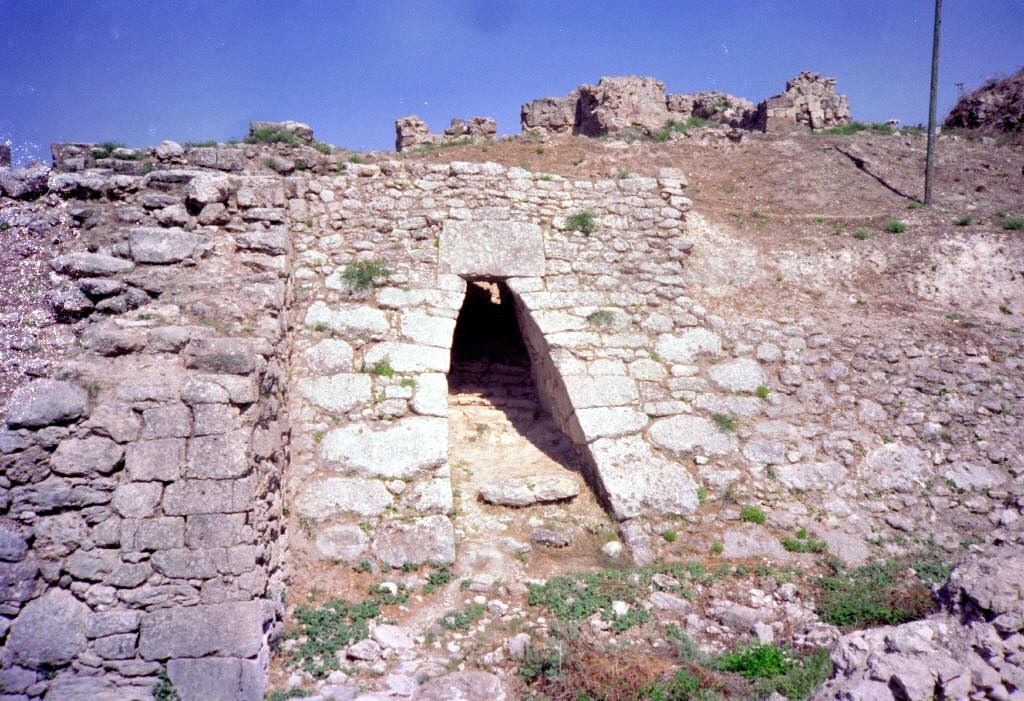
Excavations revealed residential neighborhoods, palatial areas and an acropolis with two large temples. At Ras Ibn Hani, about 4.5 kilometers away, a further coastal royal center was established during the thirteenth century BCE; the precise reasons for its foundation remain debated. These places connect tablets to houses, streets, sanctuaries, palaces and maritime movement, rather than leaving them detached from the society that used them. [18]
Streets and squares: another dimension of power
Ugarit was more than temples and a palace. Excavation plans reveal large and small houses sharing irregular blocks, narrow passages and open squares. Alessandra Gilibert examines these spaces in relation to the economic and political lives of thirteenth-century BCE inhabitants, without reducing the city's layout to a single royal blueprint. [19]
She interprets a central square as a probable marketplace, drawing on small weights, seals and neighboring buildings associated with exchange. Other squares near the palace may have supported public gatherings and ceremonial activities. These uses are scholarly inferences from finds and routes through the city, not ancient labels attached to the squares. [19]
The age of the site and the age of its archives
Settlement at Ras Shamra began long before the famous tablets, in the Neolithic. The documents that provide the fullest picture of the kingdom belong principally to the Late Bronze AgeLate Bronze AgeAn archaeological period around 1600–1200 BCE in much of the Near East, with international diplomacy, exchange and religious diversity; its endpoints vary by region.Glossary · Click to read the explanation. AkkadianAkkadianAn ancient East Semitic language written in cuneiform from the third millennium BCE; its varieties include Babylonian and Assyrian, and it served in international diplomacy.Glossary · Click to read the explanation material extends from the mid-fourteenth to the early twelfth century BCE. Mnamon’s language entry gives a conservative range of about 1300–1190 BCE for the Ugaritic linguistic evidence. [1][2][7]
Reference works differ over the earliest alphabetic evidence; all the texts should not be assigned a single date. More fundamentally, the age of a clay copy does not establish when the story or religious practice it records began. Some traditions may be older, but determining how much older requires independent evidence.
The kingdom’s end and the survival of part of its memory
The city was destroyed around 1180 BCE, during the upheavals ending the Late Bronze Age in the eastern Mediterranean. This marks the end of the kingdom represented in the archives. It does not mean that the site was never used again: the excavation mission records smaller later occupations. [1]
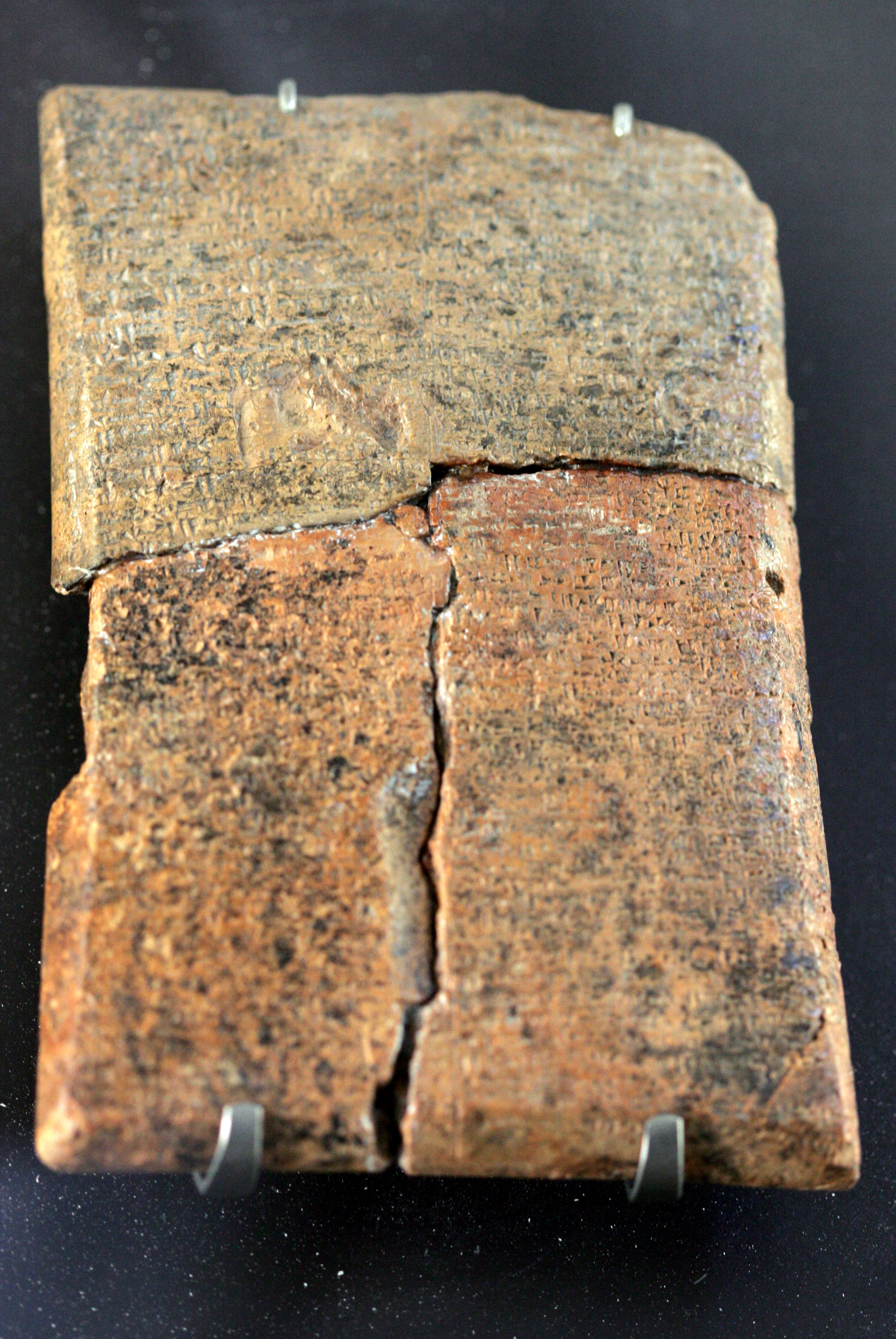
Tablets and fragments remained beneath ruined buildings. Some preserve substantial texts; others have lost lines or large portions. The excavated archive is consequently an incomplete sample of the city’s written material. What we can read depends on preservation, destruction, excavation and reconstruction, as well as on what scribes originally chose to write. Survival in a destroyed building does not necessarily date a tablet’s copying to the day the building fell. [16]
A city with several languages
Ugarit used the local Ugaritic languageUgaritic languageAncient Semitic language preserved in Ugarit’s tablets on the Syrian coast, from the fourteenth–twelfth centuries BCE, written in a cuneiform alphabet.Glossary · Click to read the explanation, Babylonian AkkadianAkkadianAn ancient East Semitic language written in cuneiform from the third millennium BCE; its varieties include Babylonian and Assyrian, and it served in international diplomacy.Glossary · Click to read the explanation with its important international role, and other documented languages including Hurrian, Sumerian and Hittite. Several writing systems were present. This diversity cannot be converted directly into a census of languages spoken daily: a written language might serve education or diplomacy. [6]
International correspondence and treaties were written in Akkadian, as were local contracts. Ugaritic was used for literature, rituals and many administrative documents. These patterns reveal overlapping scribal traditions within the same society, rather than two entirely separate cultural worlds.
An alphabet with a cuneiform appearance
The long Ugaritic alphabetUgaritic alphabetAlphabetic cuneiform system of Late Bronze Age Ugarit, using thirty chiefly consonantal written signs, distinct from Akkadian syllabic cuneiform.Glossary · Click to read the explanation contains thirty signs. Their shapes are wedge-like, but their principle differs from the Akkadian system combining syllabic signs and word signs. In Ugaritic, a sign generally represents a single consonant; the system can therefore be described as a consonantal alphabet or abjad. [3][4]
It does not record vowels in the manner of many modern alphabets. Nevertheless, three signs for the glottal stop are associated with accompanying vowels. Ordinary texts run from left to right. Similar tools and wedge impressions do not imply identical methods of representing language.
Did Ugarit invent the first alphabet?
The evidence does not support that claim. Mnamon favors a local adaptation of an existing alphabetic system to cuneiform technique. The French Ministry of Culture also explains that no secure direct successor is apparent comparable to the continuity of the linear Phoenician alphabet. [3][4]
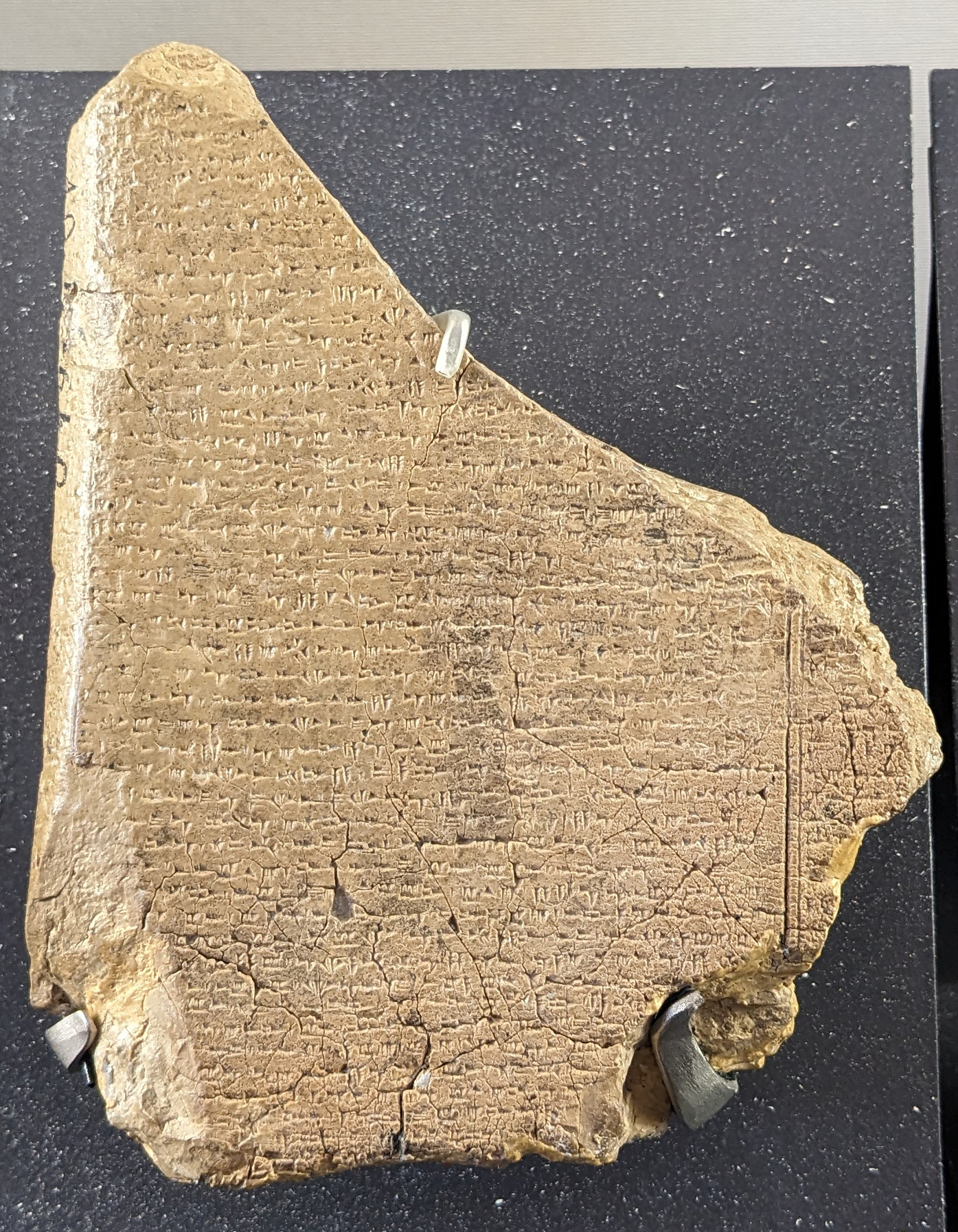
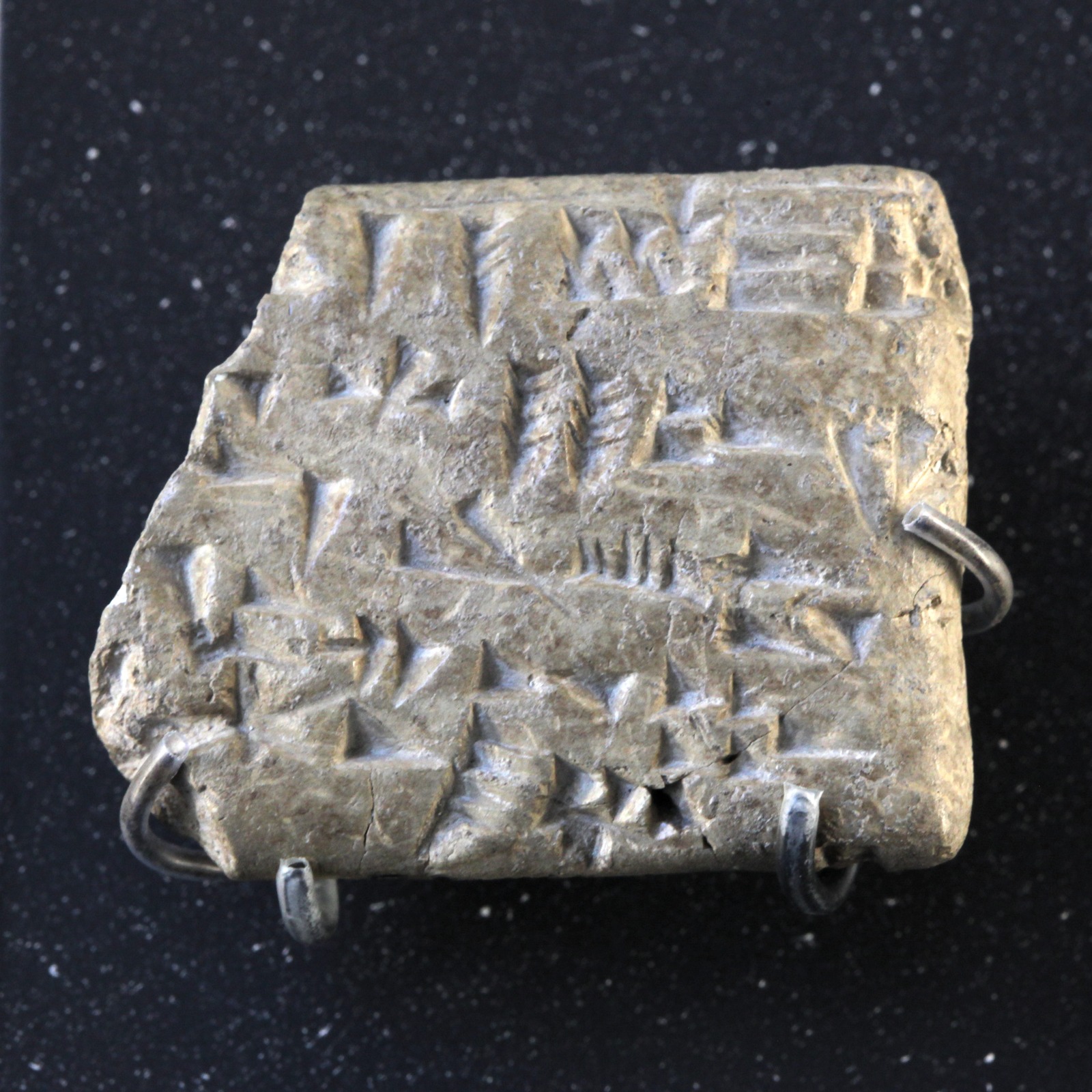
Ugarit’s importance does not depend on being awarded the title of first alphabet. It supplies clear evidence of alphabetic literary, administrative and religious writing, and of teaching the order of signs. The complete tablet RS 12.033, discovered in 1948, is an important witness. The photographed tablet, AO 19992 / RS 10.087, was found in 1938 and lacks seven letters; it is not a photograph of the complete tablet. [5][17]
The archive was not a single library
Texts were distributed among palaces, houses and buildings with religious connections. Research on fragments shows that calling a collection an archive does not remove the need to study its formation, retention and the possible movement of its parts. [16]
A house could hold letters, contracts, exercises and literary works. Administrative, cultural and ritual activities could overlap. A building’s modern label consequently cannot determine the genre of every text found there, nor establish that all the tablets formed one collection accessible to the whole city.
Urtenu’s house: commerce, writing and ritual
Discoveries in the south-central sector, particularly from 1973 onward, produced an important collection later associated with the house of UrtenuUrtenu and his houseUrtenu was an elite figure of Late Bronze Age Ugarit, associated with a house and tablet archives in the city’s southern sector; correspondence links him with court affairs and trade, although his precise office is uncertain.Glossary · Click to read the explanation. Its owner had commercial connections and was close to the court. Bordreuil and Malbran-Labat explain how family letters and a personal protective text helped identify him. [9]
Administrative lists, royal letters and lexical texts occurred alongside a document concerning a royal funeral. The collection reminds us that religion, commerce, family and palace affairs were not always separate subjects in scribal work. It does not give every document the same function or make every wealthy householder an author of myths.
Small fragments still change readings
The mission describes a project studying unpublished alphabetic materials, chiefly small fragments from several sectors. Tasks include finding joins and examining clay, handwriting, line arrangement and context. [16]
A fragment only a few centimeters wide can alter a name’s reading or connect two lines. Translating an ancient text is thus an ongoing activity. A number quoted on a project page should not be treated as an updated census of all unpublished material. The project itself shows how knowledge depends on continuing reconstruction and investigation.
The two temples and Dagan’s name
The acropolis preserves remains of Baal’s temple and the building traditionally called the temple of DaganDaganA god worshipped in Syria and Mesopotamia, especially at Tuttul and Terqa on the Euphrates, and associated with royal authority. His name appears as Dagon in the Hebrew Bible; no ancient image of him is securely identified.Glossary · Click to read the explanation. The publisher’s summary of Olivier Callot’s study describes their Middle Bronze Age construction, collapse in a mid-thirteenth-century BCE earthquake, and rebuilding of Baal’s temple before the final destruction. [10]
The second attribution is disputed. ORACC’s Dagan entry presents a reinterpretation identifying it as a temple of El. We therefore retain the traditional name while indicating the debate. Identifying a building’s cult requires comparison of finds, inscriptions and context, rather than reliance on its modern designation. [11]
Ilimilku: the scribe’s hand and the story’s age
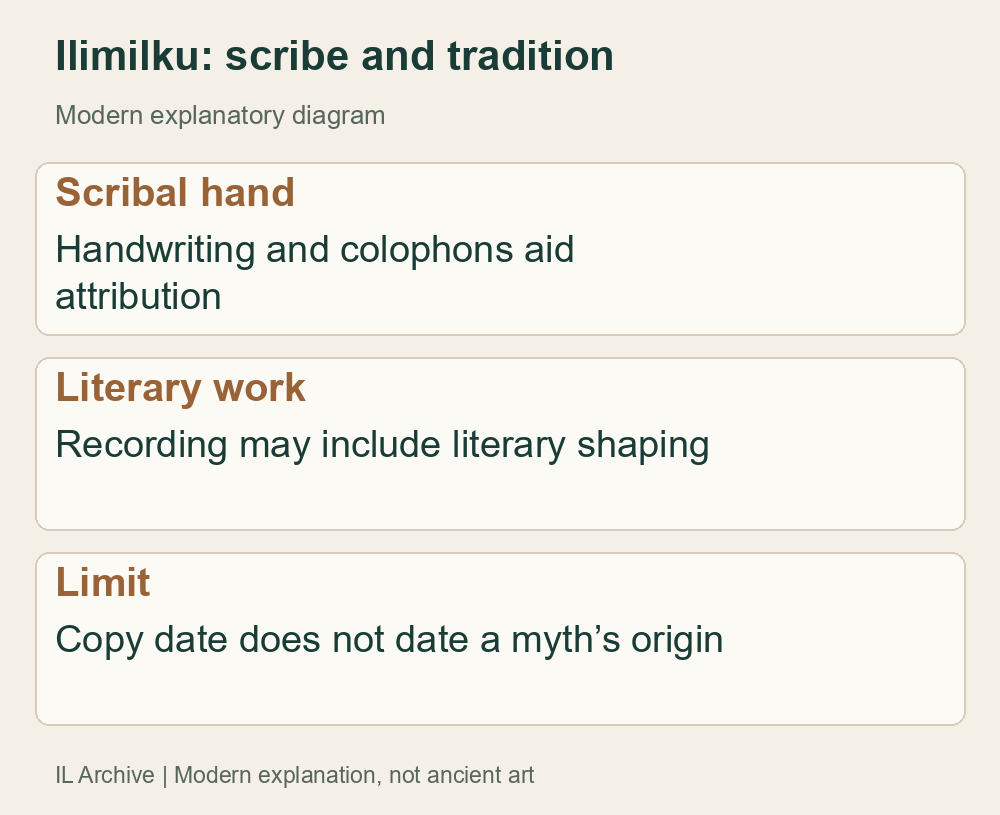
The name IlimilkuIlimilkuUgaritic scribe associated with the Baal Cycle, Kirta and Aqhat; handwriting and colophons aid attribution. His work alone does not date the traditions’ origins.Glossary · Click to read the explanation is associated with several major literary works. Handwriting and scribal colophons help attribute tablets of the Baal CycleBaal CycleA group of Late Bronze Age Ugaritic religious texts recounting Baal’s conflicts, relationships with the gods and the building of his palace.Glossary · Click to read the explanation and the Kirta and Aqhat narratives to his activity. Modern scholarly presentations place this writing in the late thirteenth century BCE, against a history of chronological debate. [7][8]
This establishes a role in recording literature; scholars may also discuss his contribution to composition or literary shaping. It does not prove that he invented every myth he transmitted. The date of the hand producing a copy must be distinguished from the history of a tradition that may have circulated orally or in writing before it. A colophon documents a scribe’s work, rather than the birth of an entire religion.
Six tablets and a world of conflict
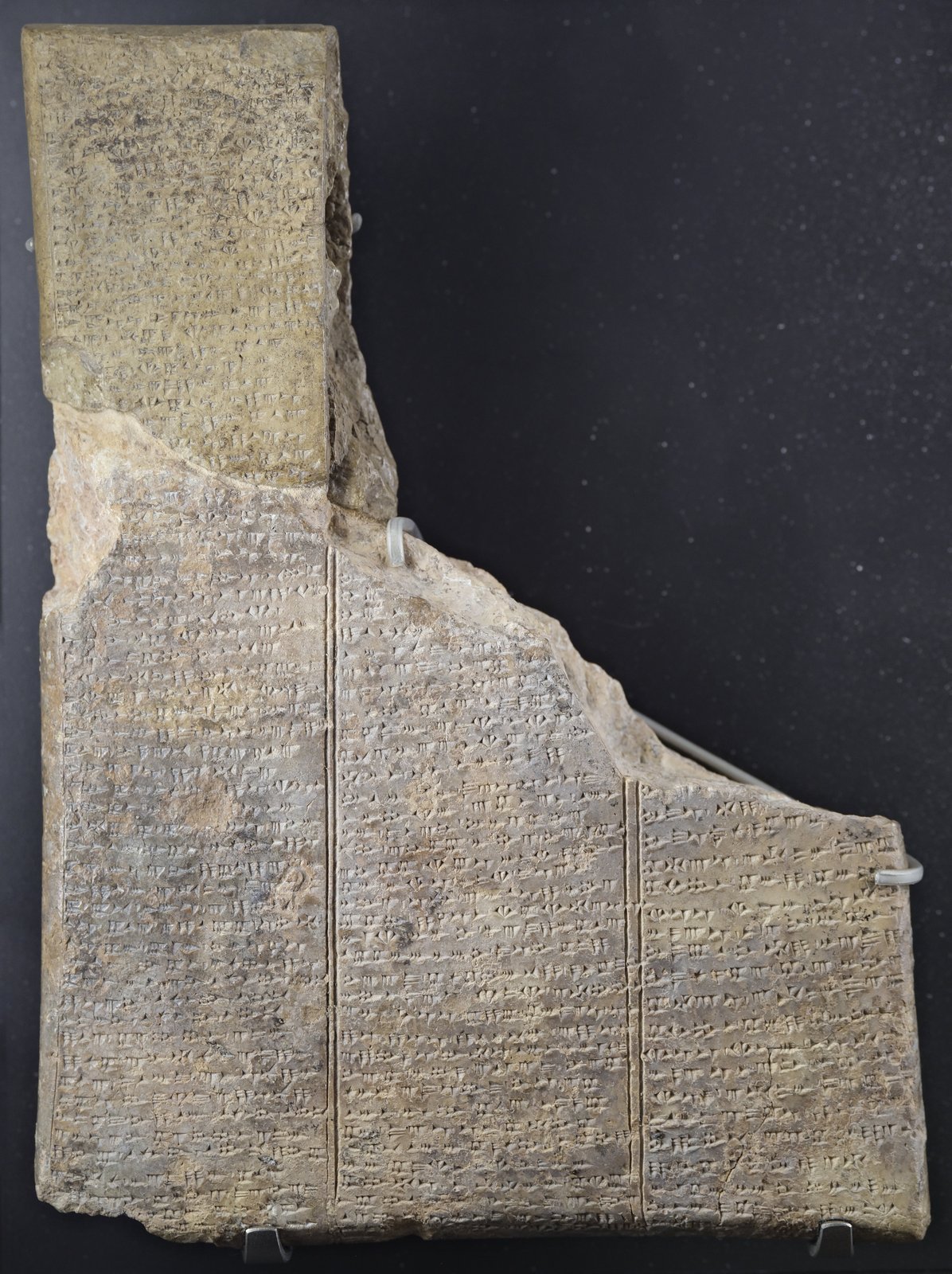
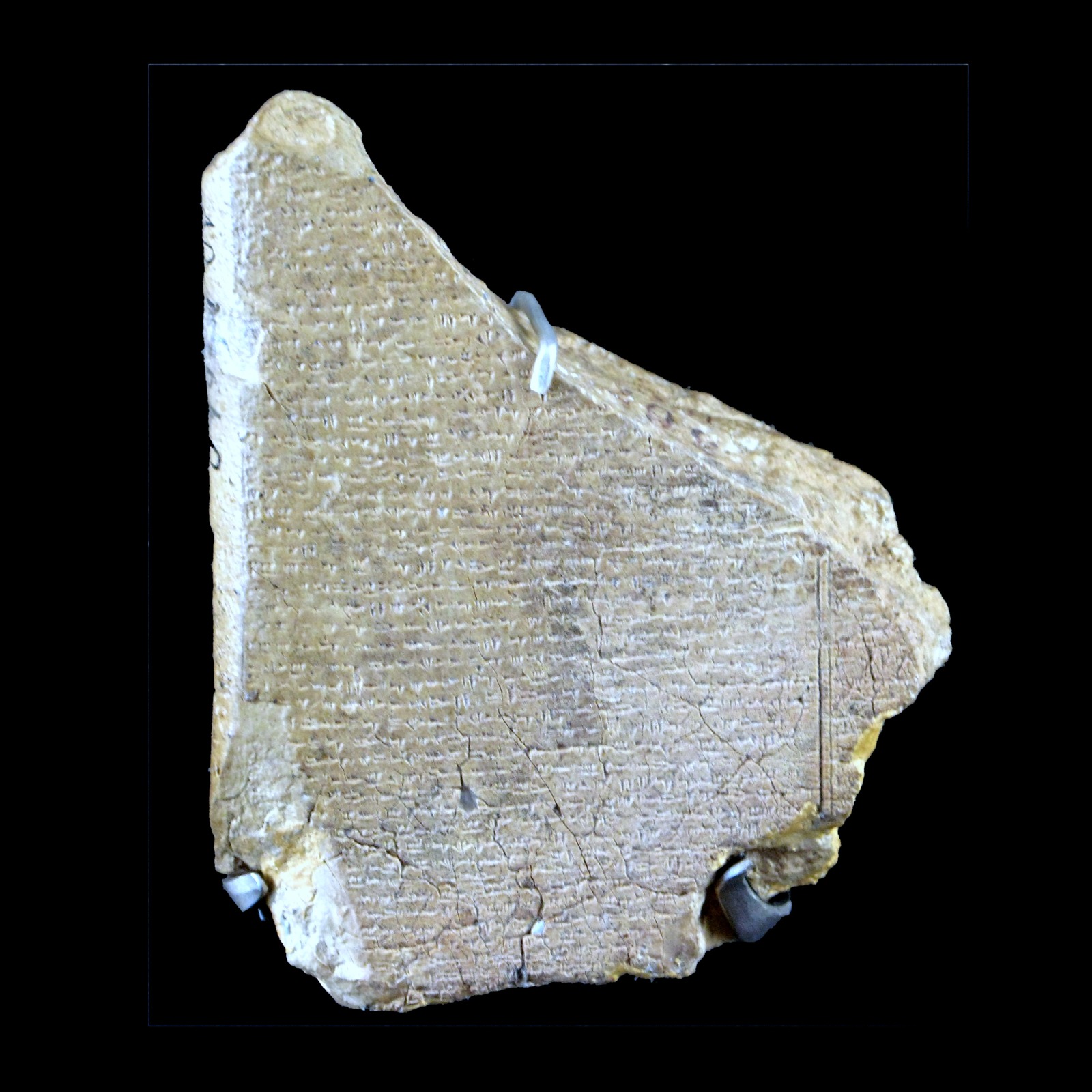
The Baal CycleBaal CycleA group of Late Bronze Age Ugaritic religious texts recounting Baal’s conflicts, relationships with the gods and the building of his palace.Glossary · Click to read the explanation is known from six tablets numbered KTUKTU: Ugaritic Text ReferencesAbbreviation for a modern edition of alphabetic cuneiform texts. Its text references can be cross-identified with find numbers such as RS or RIH; they are not dates.Glossary · Click to read the explanation 1.1–1.6 in modern cataloguing. BaalBaalUgaritic storm god and warrior king who defeats Yamm, builds his palace with El’s consent and confronts Mot. References to El and Dagan as fathers do not define a single genealogy.Glossary · Click to read the explanation fights Yam, the Sea, aided by two weapons made by the craftsman Kothar-wa-HasisKothar-wa-HasisUgaritic divine craftsman who makes Baal’s weapons, builds his palace and proposes its window; also associated with Aqhat’s bow. No securely identified ancient portrait.Glossary · Click to read the explanation. The palace-building issue follows, then conflict with Mot, Baal’s absence and renewed struggle. [8][12][14]
This summarizes the surviving course of events, rather than every missing episode. Damage can interrupt the causal link between events. Gaps should not automatically be filled with a smooth modern narrative or the whole cycle converted into a fixed agricultural calendar. Seasonal interpretations can be useful comparisons, but remain interpretations of the text. [14]
The photographed tablet AO 16640 / RS 3.367 below is a witness to KTU 1.2, not to all six tablets or the later palace scene. A published translation of its fourth column relates Kothar’s address to Baal, the making of two weapons, and Yam’s defeat. This is an ancient literary account in a modern translation, not a record of a historical battle. [12]
El: the father who remained at the head
ElElEl is a senior deity in Late Bronze Age Ugaritic texts, portrayed as father of the divine family and a council authority, alongside his consort Athirat. This entry does not cover every linguistic use of El.Glossary · Click to read the explanation appears as father, king and head of the divine household. Texts reveal roles involving offspring, family and governance. Joel Burnett explains the divine councilDivine councilA divine council is a religious and literary scene in which divine beings gather before a superior authority for discussion, commissioning or judgment; it is not identical to a pantheon list.Glossary · Click to read the explanation through the household model: senior El heads it, while prominent warrior Baal exercises kingship within that framework. [13]
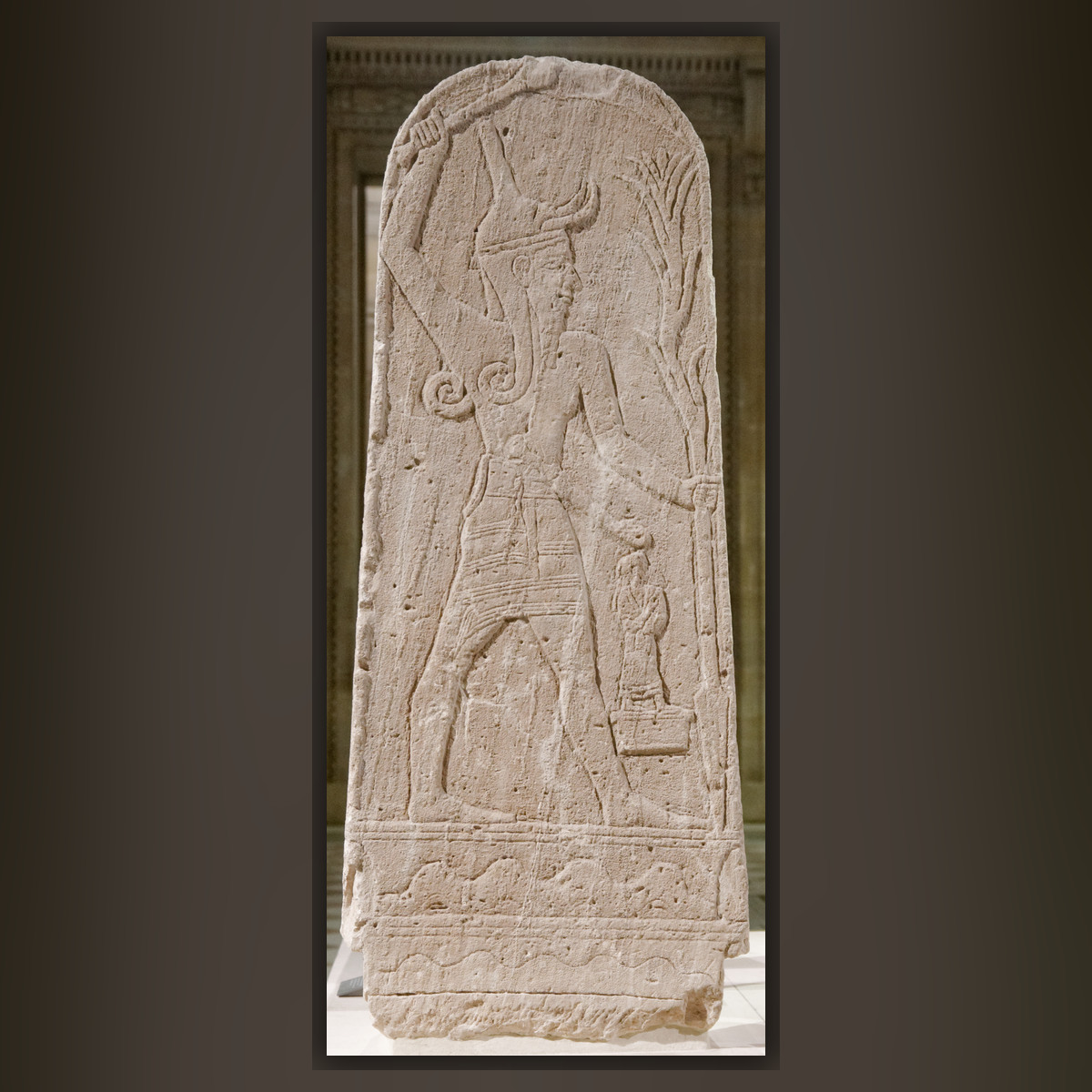
Although some passages call Baal the “son of Dagan,” he participates in a divine household headed by El. Genealogical language and hierarchy vary across texts and should not be flattened into a single family tree. Baal’s central role in the action does not deprive El of authority: in the palace story his approval matters, and other figures seek it or press for it. The father granting recognition and the fighting hero combine tension with complementary roles. The cycle preserves no story in which Baal kills El and takes his place.
Athirat alongside El
AthiratAthiratA prominent goddess commonly understood as El’s consort in Ugaritic texts; she bears the progenitress epithet and intercedes for Baal’s palace.Glossary · Click to read the explanation is commonly understood as El’s consort and the divine community’s great mother. Her title associates her with bearing gods, and the texts speak of her sons. In the palace story she mediates with El and helps Baal obtain approval. [13][14]
The texts do not thereby supply a complete birth register of the gods. Family language organizes the celestial community and can express membership, rank and descent together. Shared divine names or titles across sites also do not guarantee an unchanging personality or identical worship practices everywhere.
Anat, Yam and Mot: personalities beyond their names
AnatAnatAnat is an ancient Near Eastern goddess attested at Mari, Ugarit and in Egypt. In Ugaritic narratives she is a warrior, Baal’s ally and a mourner for him; her roles vary by tradition and context.Glossary · Click to read the explanation acts violently in the cycle and participates in the palace affair and the crisis of Baal’s death. Yam and Mot combine the familiar domains of sea and death with individual personalities who speak, struggle and seek authority. [12][14]
Calling them abstract symbols alone is inadequate, as is treating Anat as an exact equivalent of every warlike goddess. Local texts give figures particular relationships and actions. Comparison is useful when it preserves these distinctions instead of dissolving them into a general function.
Religious literature does not encompass all worship
Alongside myths are offering texts, rituals, incantations and documents involving the dead and kingship. Ritual texts place some offerings within the palace itself; excavations reveal altars and cultic spaces on the acropolis, in residential quarters and at the harbor. A building type alone cannot securely name its deity. Such evidence shows that worship involved actions, materials, people and occasions beyond narratives of Baal’s victory. [6][8][9][20]
A deity can be prominent in cultic lists yet less visible in literature. Dagan, for example, appears in lists, offerings and personal names more strongly than in the surviving mythological narratives. Narrative prominence alone does not measure the extent of worship, and literary silence does not prove the absence of temples or devotees. [11]
Tombs beneath houses and the limits of funerary evidence
Built chamber tombs became widespread in the Late Bronze Age; some were planned together with the foundations of houses. Many excavated burials were robbed, and written descriptions of funerary practice remain scarce. Archaeologists relate the closeness of the living and the dead to possible acts of honoring ancestors and seeking their protection, but this is an interpretation of the practice, not a preserved script for each burial ceremony. [21]
Why speak of the gods of Canaan?
Ugarit preserves a tradition sharing divine names, images and religious language with a wider West Semitic world. These links make the phrase gods of Canaan understandable in a general presentation. Yet Ugarit was a city and kingdom, while Canaan designated a broader region rather than a unified state with one doctrinal book. [15]
Peter Craigie’s study identifies both the value and the risks of equating the two. An Ugaritic text may illuminate a parallel known farther south. It cannot establish that every Canaanite settlement narrated the same stories or assigned the gods identical ranks.
A Syrian kingdom and a West Semitic language
Calling Ugarit an ancient Syrian kingdom locates its historical setting; calling its language Northwest Semitic identifies linguistic relationships. Mnamon notes that Ugaritic’s precise position within the Semitic family is debated. The classification Canaanite dialect should therefore not be presented as settled. [2]
These categories should not be converted into modern national identities or treated as mutually exclusive. The kingdom had connections with Hittite power and Mediterranean and Mesopotamian settings. Those connections are part of its history and coexist with its clear location on the Syrian coast. [1][6]
Why did Ugarit change the reading of Hebrew texts?
The tablets supplied independent comparative material: El and the divine household, councils and messengers, and storm-god Baal, called rider of the clouds, fighting the Sea. They made religious and literary images visible outside the polemical settings in which some HebrewHebrewA Northwest Semitic language of the Canaanite group, encompassing Iron Age epigraphy, Biblical, Rabbinic, medieval and Modern Hebrew; its scripts and pronunciations changed over time.Glossary · Click to read the explanation texts describe rival worship. [12][13]
Finding a parallel nevertheless does not prove that a Hebrew writer read a particular tablet at Ugarit. Geography, chronology and differing contexts matter. Craigie discusses how historical links and common traditions support comparison, while rejecting treatment of the corpora as one literature exempt from critical controls. [15]
How should a similarity be tested?
Comparison begins with wording, context and the date of the witness. Is the parallel an identical title, a general image or a narrative structure? It then asks how a tradition might pass between regions and periods, and considers alternatives such as shared older traditions or independent reuse. [15]
Two similar words do not establish direct copying. Later religious differences do not erase every continuity either. Ugarit’s strength is that it supplies one inspectable side of a comparison. Each claim of transmission still requires its own supporting evidence.
Texts within a material landscape
The tablets belong to a site containing architecture, objects, routes, houses and tombs. Reconstructing an archive involves findspots, clay, shape, handwriting and possible movement or breakage. The mission explains how imprecise early excavation records and objects dispersed among museums complicate that work. [16]
These clues do not identify every statuette with a named god in a poem or every building with that deity’s temple. They do help connect texts with the society producing them. The city contextualizes words, and words illuminate some finds. Where the evidence fails to converge, an identification should remain tentative.
One city opened a broad window
Some divine names were known through other traditions before Ras Shamra’s discovery. The novelty was the expanded context: speaking gods, named scribes and collections revealing literature, worship and administration. Researchers gained a setting in which to test accounts of West Semitic religion against its own documents. [8][13][15]
Ugarit did not provide all Canaanite religion or the origin of every later idea. It provided a more specific resource: a city with partly known streets, houses and scribes, together with significant portions of its imagined divine world. Its value follows from that specificity. We encounter El, Baal, Athirat and Anat in a tradition with a time and place, then compare its surviving evidence with other cities and periods.
References and notes (21)
- Valérie Matoïan, “History of the Franco-Syrian Archaeological Mission at Ras Shamra–Ugarit” (Historique de la Mission archéologique syro-française de Ras Shamra–Ougarit), mission website. Mission’s indexed historical account and retrieved excerpts checked; 1928/1929, ca. 1180 and later reuse cross-checked against the French Ministry of Culture’s open overview. Not the mission’s complete archive. Return to the text ↑
- Paolo Merlo, “Ugaritic: Language,” Mnamon, Scuola Normale Superiore. Mnamon language entry read: introduction, identification/decipherment, linguistic relationship; ca. 1300–1190 BCE and classification debate. Return to the text ↑
- Paolo Merlo, “Ugaritic: Writing,” Mnamon, doi:10.25429/sns.it/lettere/mnamon019. Mnamon writing entry read, including evidence/spread, sign forms and writing arrangement: 30-sign long and rare short varieties; probable local adaptation. Return to the text ↑
- Anne-Sophie Dalix, “The Alphabets at Ugarit” (Les alphabets à Ougarit), French Ministry of Culture. Entire French ministry page read: 1929, uses, limited reach, lack of a secure direct successor; proposed alphabet chronology not universal consensus. Return to the text ↑
- Anne-Sophie Dalix, “An Abecedarium: Tablet RS 12.033” (Un abécédaire : la tablette RS 12.033), French Ministry of Culture. Full page on RS 12.033 read: 1948 find, thirty-sign sequence and teaching; distinguished from AO 19992 photo. Return to the text ↑
- Carole Roche-Hawley, “Corpus and Language: The Textual Documentation of Ugarit” (Corpus et langue / La documentation textuelle d’Ougarit), French Ministry of Culture. Full page on written languages and scripts read, including Akkadian/Ugaritic genres, diplomatic/legal/scribal/ritual uses. Return to the text ↑
- Carole Roche-Hawley, “Scribes at Ugarit” (Les scribes à Ougarit), French Ministry of Culture. Full scribal-education page read: scribal family, proposal of mid-13th-century alphabet, Ilimilku, Babylonian curriculum. Return to the text ↑
- Arnaud Sérandour, “The Earliest Known Levantine Literature” (La première littérature levantine connue), French Ministry of Culture. Entire short literary-overview page read: six Baal tablets, three each for Kirta and Aqhat, Ilimilku’s colophons; copies do not date myth origins. Return to the text ↑
- Pierre Bordreuil and Florence Malbran-Labat, “The Archives of the House of Urtenu” (Les archives de la maison d’Ourtenou), Comptes rendus de l’Académie des Inscriptions et Belles-Lettres 139/2 (1995), pp. 443–451; doi:10.3406/crai.1995.15480. Persée bibliographic record and visible p. 443 read. Pp. 444–451 were not rechecked; fuller household details were inherited from earlier evidence and are distinguished from directly read passages. Return to the text ↑
- Olivier Callot, “Sanctuaries of the Acropolis of Ugarit: The Temples of Baal and Dagan” (Les sanctuaires de l’acropole d’Ougarit. Les temples de Baal et de Dagan), RSO XIX, MOM Éditions, 2011. Publisher summary, contents and metadata read: chronology and earthquake/rebuilding; no claim to the full 238-page volume. Return to the text ↑
- Adam Stone, “Dagan (God),” Ancient Mesopotamian Gods and Goddesses, ORACC, 2019. ORACC Dagan entry read, particularly functions, genealogy, cult places and Ugarit: the temple reassignment to El is reported as an interpretation, not consensus. Return to the text ↑
- Robert Hawley, “The Baal Cycle” (Le cycle de Baal), French Ministry of Culture; with the translation by Pierre Bordreuil and Dennis Pardee in Manuel d’Ougaritique (2004). Intro and published translation of KTU 1.2 IV read: Kothar’s address, two weapons and Yam’s defeat. This is Bordreuil/Pardee’s French translation, not a personal collation of Ugaritic signs. Return to the text ↑
- Joel S. Burnett, “The Persistence of El in Iron Age Israel and Ammon,” in Biblical and Ancient Near Eastern Studies in Honor of P. Kyle McCarter Jr., 2022. Academia.edu HTML text read, especially passages labeled pp. 301–303 on El’s household, “son of Dagan” and royal authority; institutional PDF returned 403, and page images were not inspected. Return to the text ↑
- Jeffery B. Lloyd, The Goddess Anat: An Examination of the Textual and Iconographic Evidence from the Second Millennium B.C., PhD thesis, University of Edinburgh, 1994. Edinburgh thesis metadata and abstract only. Previously cited pp. 181–184, 191–192, 197–198, 203–208 were not opened in this review; no personal reading of them is claimed. Return to the text ↑
- Peter C. Craigie, “Ugarit, Canaan, and Israel,” Tyndale Bulletin 34 (1983), pp. 145–167; doi:10.53751/001c.30586. Publisher citation and available introductory passage (Galaxie) only. The full PDF and formerly cited pp. 145–146 and 165–167 were not directly inspected; conclusions are cross-checked against other accessible studies. Return to the text ↑
- Anne-Sophie Dalix, “Editing and Studying Unpublished Alphabetic Cuneiform Documents” (Édition et exploitation des documents inédits rédigés en cunéiformes alphabétiques), Ras Shamra–Ugarit Mission. Entire mission project page read: roughly 300 project documents, joining fragments, fabric/handwriting and contextual spread; not a universal census of unpublished material. Return to the text ↑
- Musée du Louvre, “Tablet: Incomplete Abecedarium” (Tablette : abécédaire incomplet), AO 19992 / RS 10.087, KTU 5.4. Complete Louvre AO 19992 / RS 10.087 object record read: seven letters missing, 1938 discovery and museum dating 1400–1200 BCE; separately checked the Commons photo and license. Return to the text ↑
- Valérie Matoïan, “Coastal Establishments of the Capital” (Les établissements côtiers de la capitale), Ugarit archaeology portal, French Ministry of Culture. Entire short page read: Minet el-Beida/Mahadu, unexcavated quays, textual port evidence and hypotheses for Ras Ibn Hani. Return to the text ↑
- Alessandra Gilibert, “Urban Squares in Late Bronze Age Ugarit: A Street View on Ancient Near Eastern Governance,” Journal of Near Eastern Studies 80/2 (2021), doi:10.1086/716076. Publisher HTML read: introduction, households/residential patterns, street network, central square and opening of palace-squares section; not the whole article or PDF. Return to the text ↑
- Valérie Matoïan, “Places Devoted to Religious Practice” (Les lieux dévolus aux pratiques religieuses), Ugarit archaeology portal, French Ministry of Culture. Entire short page read: royal ritual texts, temples, altar, cultic settings in the palace, domestic blocks and harbor. Return to the text ↑
- Nolwen Chatiron, “Burying the Dead” (Enterrer ses morts), Ugarit archaeology portal, French Ministry of Culture. Entire short page read: changing grave types, Late Bronze chamber tombs, domestic contexts, looting and sparse ritual evidence. Return to the text ↑
Suggest a correction · Suggest a source for this record
Cite this record
IL Archive, «Ugarit: The City and the Gods», https://ilarchive.com/en/studies/ugarit-city-and-gods
Continue reading
Related readings