Study
Yahweh and Asherah
An extended study of a topic, with evidence and references.
A study of blessings at Kuntillet ʿAjrud and Khirbet el-Qom, female figurines and reform narratives: goddess, cult object, the disputed suffix and religious diversity in ancient Israel and Judah.
Estimated reading time: 17 min Published Last reviewed:
Share article
Text
Introduction
What do ancient blessings combining YahwehYahwehThe proper name of Israel’s deity, written יהוה (YHWH), the Tetragrammaton. Its exact ancient pronunciation is not directly preserved; texts and inscriptions witness its history.Glossary · Click to read the explanation’s name with the term asherah reveal about religion in Israel and Judah? This study compares the inscriptions from Kuntillet ʿAjrudKuntillet ʿAjrudA Sinai site with blessings invoking Yahweh of Samaria/Teman and “his asherah” around 800 BCE; inscriptions illuminate religion and writing, while the site’s function and imagery remain debated.Glossary · Click to read the explanation and Khirbet el-QomKhirbet el-QomSite west of Hebron known for an eighth-century BCE funerary inscription commonly associating Yahweh with “his asherah”; damaged text and readings disputed.Glossary · Click to read the explanation with female figurinesFigurineA small shaped object depicting a human, animal or abbreviated form, in clay, stone or another medium. Its form alone does not establish its use; manufacture, handling traces and find context matter.Glossary · Click to read the explanation and biblical narratives, distinguishing goddess, cult object and scholarly interpretation. The comparison begins with UgaritUgaritAncient city and kingdom at Ras Shamra on the Syrian coast, flourishing between the fourteenth and early twelfth centuries BCE and preserving multilingual archives.Glossary · Click to read the explanation in the late second millennium BCE and then concentrates on the ninth through sixth centuries BCE: these witnesses do not form one contemporary scene or establish a creed shared by every inhabitant.
The witnesses do not share one date
- Late second millennium BCE: surviving Ugaritic tablets attest Athirat in a Syrian Bronze Age city; their writing date does not date the origin of every tradition they transmit. [1]
- Around 800 BCE: Kuntillet ʿAjrud’s vessel and wall inscriptions are material witnesses from the site’s occupation. Eighth century BCE: the el-Qom inscription is an independent funerary witness, with debate over closer dating and reading. [1][2]
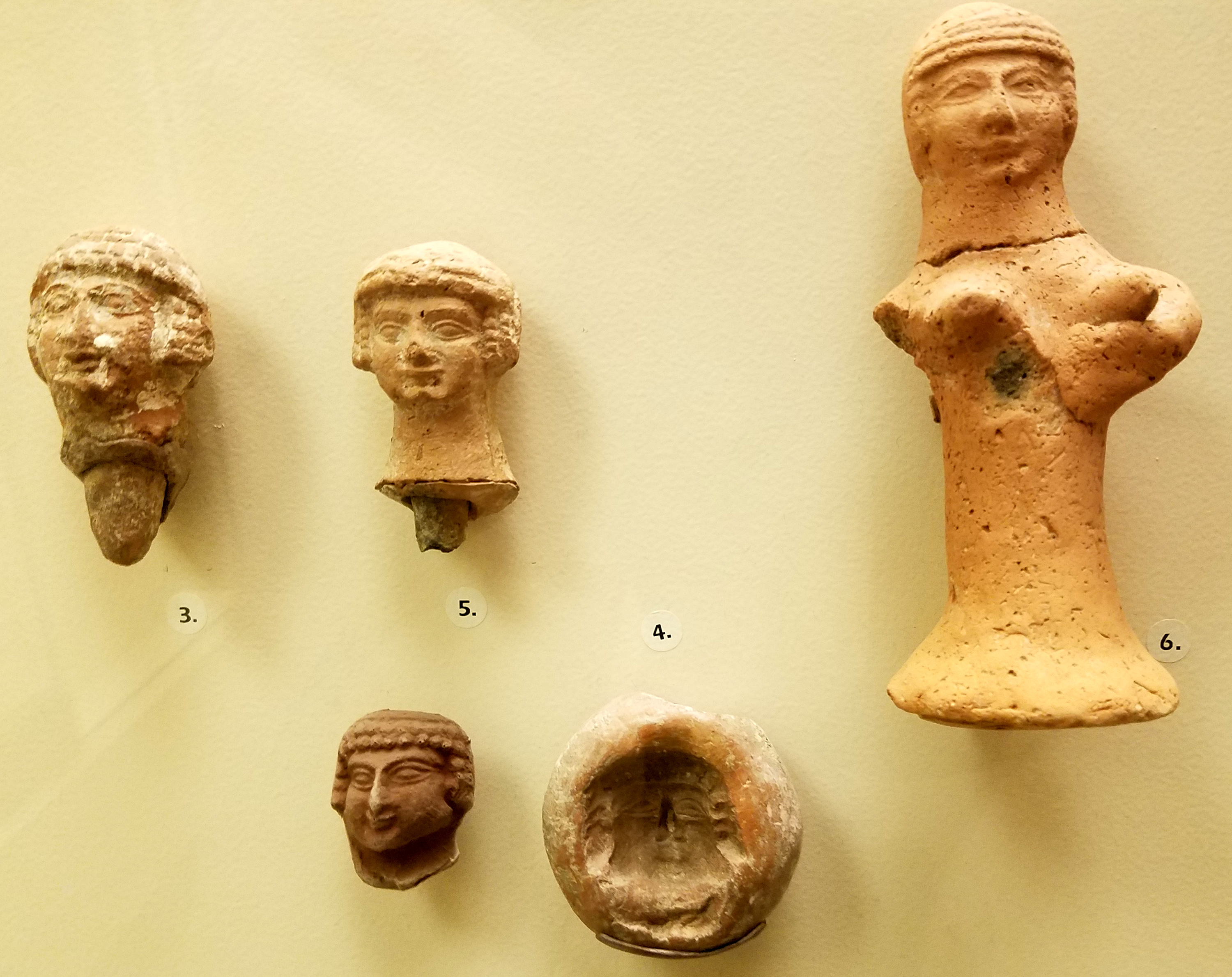
- Eighth–seventh centuries BCE: the main distribution of Judean pillar figurinesJudean pillar figurinesSmall late Iron Age terracotta female figures of Judah, with pillar-like bases and moulded or hand-shaped heads; neither their represented identity nor their ritual or protective use is settled.Glossary · Click to read the explanation; archaeological context dates objects, not the identity of the figures represented. [6][7]
- Seventh century BCE: Manasseh’s and Josiah’s time within Kings. Proposed composition models include a Josianic version expanded after JerusalemJerusalemJerusalem is a city of religious importance in Judaism, Christianity and IslamGlossary · Click to read the explanation’s sixth-century fall; Hadley discusses disagreement and the possibility of later composition. This does not date every source or sentence. [1]
- Sixth century BCE: the setting to which much scholarship relates Isaiah 40–55, not the date of the Masoretic manuscript from which one reads today. As a separate illustration of manuscript distance, the complete Leningrad Codex dates to 1008–1009 CE. It is neither the earliest biblical witness nor evidence that the text was composed when copied. [10][15]
The study’s comparative sequence is therefore not a verified chain from El and Athirat to Yahweh and his asherah and then monotheismMonotheismBelief that only one God possesses divinity in its fullest sense. Historically distinct from exclusively worshipping one deity without denying others; its theological forms vary.Glossary · Click to read the explanation. A physical inscription, a literary narrative and the date of its surviving copy represent different kinds of testimony.
Between textual commands and lived practice
Many biblical texts, in their received form, present a clear religious boundary: YahwehYahwehThe proper name of Israel’s deity, written יהוה (YHWH), the Tetragrammaton. Its exact ancient pronunciation is not directly preserved; texts and inscriptions witness its history.Glossary · Click to read the explanation is the god of ancient IsraelAncient IsraelName attested for a population on the Merneptah Stele around 1208 BCE, later for the northern Iron Age kingdom and for broader textual and religious identities; the senses are not identical.Glossary · Click to read the explanation, while worship of BaalBaalUgaritic storm god and warrior king who defeats Yamm, builds his palace with El’s consent and confronts Mot. References to El and Dagan as fathers do not define a single genealogy.Glossary · Click to read the explanation, Asherah and other gods is rejected. Inscriptions and material remains complicate that picture. Blessings associate Yahweh with “his asherah”; female figurines occur in JudahKingdom of JudahJudah was an ancient southern Levantine kingdom centered on Jerusalem in the Iron AgeGlossary · Click to read the explanation, the southern kingdom; biblical narratives describe removing cult equipment from the temple itself. [1][2][13]
These witnesses do not give every inhabitant the same beliefs, or make Israel identical to Ugarit. They expose the difference between the religious programme an author promotes and practices material evidence can reveal. Historical inquiry concerns both: what people were told to worship, and what they did when blessing others, burying their dead or protecting their households.
Before Yahweh and Asherah: El and Athirat
At UgaritUgaritAncient city and kingdom at Ras Shamra on the Syrian coast, flourishing between the fourteenth and early twelfth centuries BCE and preserving multilingual archives.Glossary · Click to read the explanation, the city and kingdom at modern Ras Shamra on the Syrian coast in the late second millennium BCE, Athirat / AsherahAthiratA prominent goddess commonly understood as El’s consort in Ugaritic texts; she bears the progenitress epithet and intercedes for Baal’s palace.Glossary · Click to read the explanation is a major goddess associated with ElElEl is a senior deity in Late Bronze Age Ugaritic texts, portrayed as father of the divine family and a council authority, alongside his consort Athirat. This entry does not cover every linguistic use of El.Glossary · Click to read the explanation, father and head of the divine household. Her titles concern divine motherhood, and literary texts speak of her children. The name in eighth-century inscriptions therefore has an older West Semitic background. [1]
Comparison does not establish an unchanged personality surviving across the centuries. Languages, kingdoms and cult institutions changed between Ugarit and Israelite or Judahite inscriptions. The older tradition helps explain the name; it does not supply a complete chain showing how every attribute and ritualRitualAn organised or distinguished practice meaningful to a community; it may leave traces, but its form alone does not reveal an associated doctrine.Glossary · Click to read the explanation moved between communities.
Kuntillet ʿAjrud: a small site, large questions
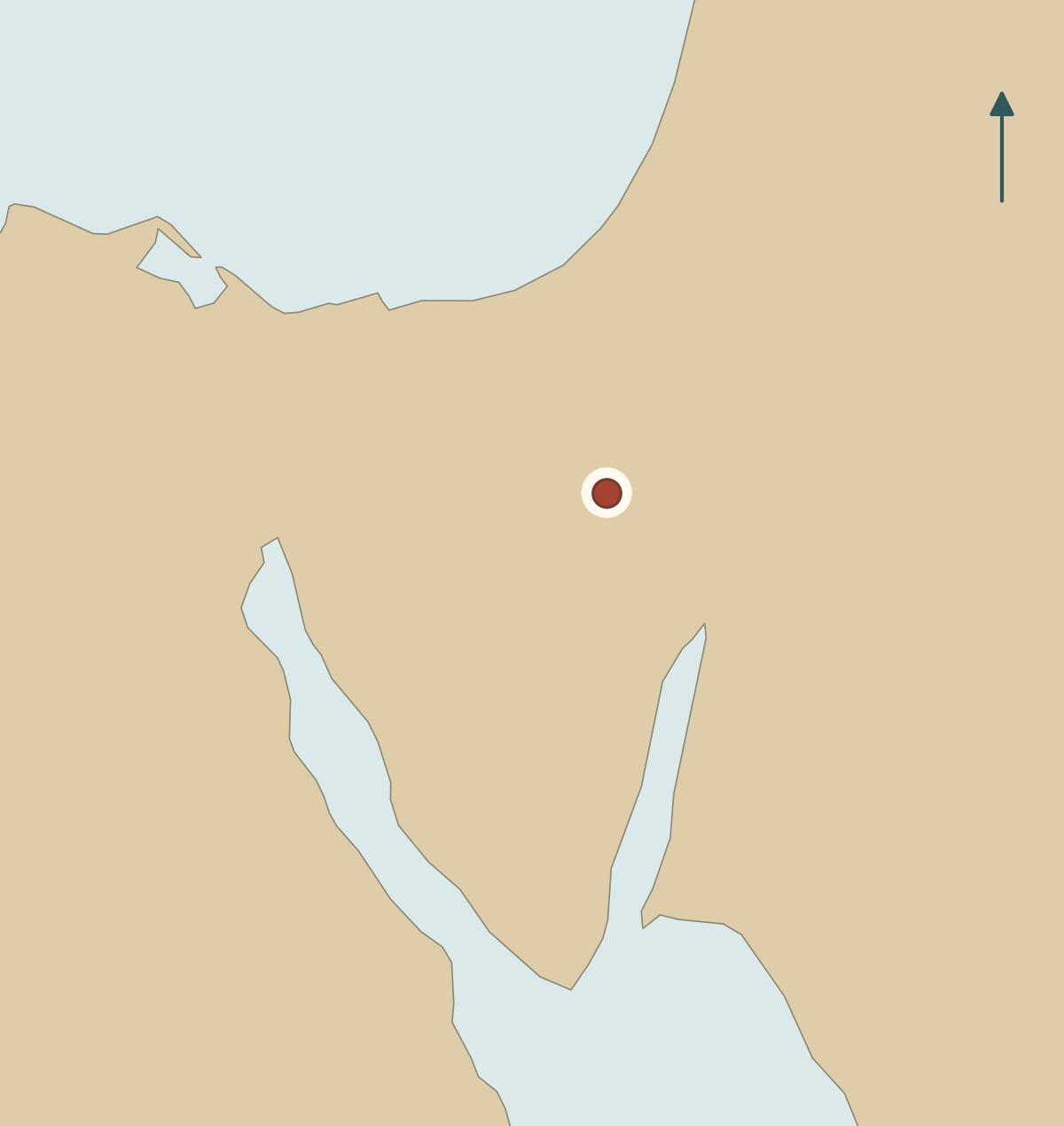
Kuntillet ʿAjrudKuntillet ʿAjrudA Sinai site with blessings invoking Yahweh of Samaria/Teman and “his asherah” around 800 BCE; inscriptions illuminate religion and writing, while the site’s function and imagery remain debated.Glossary · Click to read the explanation lies in the interior of SinaiSinai: peninsula and biblical mountainSinai is a peninsula in eastern Egypt; in the Torah the name also denotes the mountain of revelation to MosesGlossary · Click to read the explanation, the Egyptian peninsula, about fifty kilometres south of Kadesh Barnea. Its wells provided water for travellers between the Red Sea and Gaza, although it lay off the direct route. Excavations in 1975–1976 uncovered buildings, vessels, inscriptions and drawings, although the site was known earlier. The relevant material is usually dated to the late ninth and early eighth centuries BCE, around 800 BCE. [2]
Its function is disputed: way station, state establishment with scribes, or a place with ritual activity. A blessing on a wall or vessel does not make the whole building a temple. This matters because the site's interpretation affects how we understand the people responsible for its texts.
The blessings that made the site famous
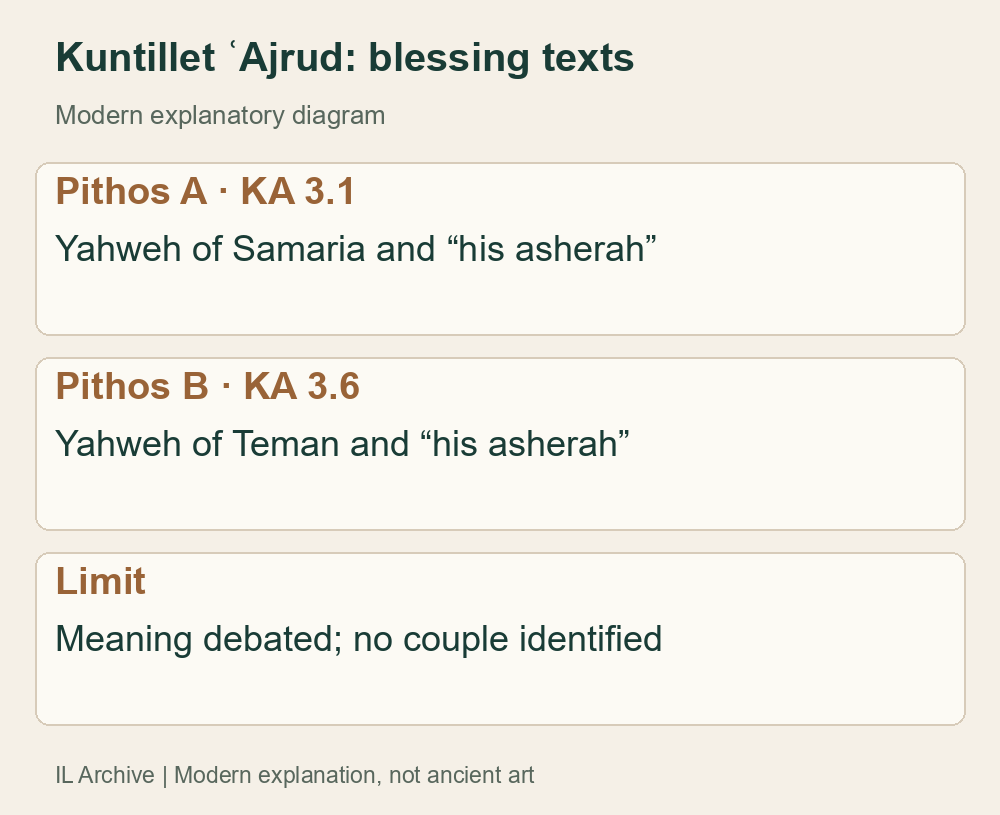
The best-known formulas occur on large storage jars, called pithoi. An inscription on Pithos A, KA 3.1, contains a blessing by Yahweh of Samaria and “his asherah.” On Pithos B, KA 3.6 invokes Yahweh of Teman and “his asherah,” followed by wishes for blessing and protection. The decisive excerpts follow, with their limits explained. [2]
The short formula has substantial historical value. It shows that Yahweh's name could be used with ʾšrth in a favourable blessing. It does not define the writer's entire theology or establish that every Israelite prayed this way.
KA 3.1, line 2 on Pithos A, preserves the following phrase in Latin-letter transliteration of the Semitic consonants: [1][2][14]
The corresponding segment in KA 3.6, lines 5–7 on Pithos B, with words joined across line breaks, reads: [14][16]
These excerpts reproduce only the invocation within the blessing. Word separation is simplified, and neither excerpt supplies restored letters. “His asherah” follows the common pronominal analysis; it does not settle the question under investigation. Šmrn and tmn are the readings before interpretation of their regional referents. The surrounding letter formulas and protective wishes explain Smoak and Schniedewind’s proposal that some texts were scribal exercises, without removing their value as witnesses to circulating blessing language. [2]
Yahweh of Samaria and Yahweh of Teman
The regional descriptions deserve attention in their own right. SamariaSamaria: city and regionAncient city and administrative region; the city’s site is at Sebastia, northwest of Nablus in the West Bank.Glossary · Click to read the explanation was the capital city of the northern kingdom of Israel; its name connects the blessing with that centre. Teman is associated with the southern world in several interpretations, although its exact identification here is disputed. The two formulas do not prove that their users believed in two separate gods named Yahweh. [1][2]
They may refer to a cult location or regional manifestation. Personal names and material culture underline northern connections, alongside wider cultural contacts. One Sinai site consequently cannot stand for a single uniform religion shared by Israel, Judah and Phoenicia.
What does “his asherah” mean?
The form ʾšrth is commonly analysed as containing a possessive suffix, “his.” That grammatical analysis is itself disputed, as is the identity of the referent. Is it the goddess Asherah associated with Yahweh, or an asherah cult symbolAsherah cult symbolAsherah as a cult object or symbol, often wooden in biblical contexts; relation to the goddess and inscriptional ʾšrth remains debated.Glossary · Click to read the explanation, an object or installation belonging to his worship? [1][11][12]
The Arabic rendering used in this study is a convention for the ancient term, not a reference to a human clan. Translating the phrase in advance as “his wife” also builds an interpretation into the wording. Retaining the term and explaining the alternatives makes the evidential distinction easier to see.
One objection to identifying a goddess is that proper names do not ordinarily take a possessive suffix as names of objects do. “His asherah” therefore looks more suitable for a religious symbol than a goddess's personal name. Treating this as an absolute linguistic prohibition, however, goes beyond the debate. [11][12]
Advocates of a goddess interpretation discuss flexible uses of names, titles and divine representations. Some propose the personification of a divine power associated with Yahweh. The available abstracts of Kang and Kim present contrasting approaches. Translating the word, or choosing an English capital letter, cannot settle that disagreement.
Richard S. HessRichard S. HessOld Testament and Semitic-language scholar at Denver Seminary, studying ancient inscriptions, names and religion.Glossary · Click to read the explanation, a scholar of HebrewHebrewA Northwest Semitic language of the Canaanite group, encompassing Iron Age epigraphy, Biblical, Rabbinic, medieval and Modern Hebrew; its scripts and pronunciations changed over time.Glossary · Click to read the explanation and the ancient Near EastAncient Near EastModern scholarly label for ancient societies of Mesopotamia, the Levant, Anatolia and Iran, sometimes extending to Egypt and other neighbours depending on the study; not one civilization or religion.Glossary · Click to read the explanation, offers a different objection in a 2025 study: he proposes that the ending in ʾšrth preserves the divine name Asherata, with final h marking a vowel rather than the pronoun “his.” He draws on Bronze Age spellings, including a recently published Amorite–Akkadian bilingual, and comparisons of feminine endings and later orthography. He therefore favours the goddess’s name in both Kuntillet ʿAjrud and Khirbet el-Qom, rather than simply ownership of an object. [14]
This is a linguistic argument to weigh against the common reading, not a newly discovered marriage inscription. Even if the divine-name reading without a pronoun is accepted, the nature of the relationship to Yahweh and its social distribution remain separate questions. The disagreement concerns the word’s segmentation and analysis before its translation as “wife” or “symbol.”
Scholars discussing Asherah should not all be assigned the same position. In her published 2008 account, Judith M. HadleyJudith M. HadleyScholar of ancient Israelite religion and inscriptions who taught theology and religious studies at Villanova; a specialist in the evidence for Asherah and el-Qom.Glossary · Click to read the explanation, a scholar of ancient Israelite religion, favours a wooden cult object representing the goddess for the Kuntillet ʿAjrud inscription. This connects an object to the goddess's tradition; it does not make the phrase alone an explicit declaration that Yahweh had a wife. [1]
Asherah as Yahweh's consort remains an influential historical interpretation, including within the model of changes to the divine family proposed by Mark S. SmithMark S. SmithScholar of the Hebrew Bible and Ugaritic religion whose work examines the divine family and biblical monotheism.Glossary · Click to read the explanation, a scholar of the Hebrew Bible and Ugaritic texts. It should be attributed to that reconstruction while keeping linguistic and archaeological objections visible. No preserved marriage text describes the relationship this model proposes. [10]
An object interpretation need not deny all connection with the goddess's history. A symbol can bear the name of a deity it represents and subsequently be understood within another god's worship. Ritual functions may continue while explanations change. [1]
The reverse inference also requires care. A name resembling the goddess's does not make every tree motif her image, or prove that every user imagined Yahweh with a personal consort. Text, setting, imagery and use must be compared; the word cannot carry the entire argument.
How should the alternatives be weighed?
The object interpretation is strong where texts describe cutting and burning, and fits analysis of “his” as a possessive suffix in inscriptions. Yet it transfers a material meaning into inscriptions that do not themselves describe a material. The goddess interpretation draws strength from the attested name Athirat and the word’s pairing with Yahweh in blessing language; it must nevertheless explain the name or title’s form, and coordination alone does not express marriage. The evidence is not equally strong everywhere: Judges more directly identifies wood, whereas the blessings more directly establish a positive religious association with Yahweh. [1][2][14]
Hess’s linguistic argument makes a divine name without a pronoun more plausible, but does not remove the chronological and dialectal distance between Bronze Age forms and Iron Age inscriptions. The bilingual tablet he discusses comes from a private collection, not a known excavation context: it informs linguistic comparison while retaining contextual limitations. Singular wishes at Kuntillet ʿAjrud also fit a blessing focused on Yahweh, but alone cannot exclude an associated goddess or a symbol representing her. [2][14]
This study therefore gives priority to an attested religious association between Yahweh and ʾšrth in the inscriptional settings, with a substantial connection to the goddess’s history, without deciding that every occurrence has one referent. A consort remains a reasonable explanatory model, not information literally stated by the inscriptions. Unidentified images cannot close that linguistic gap on their own.
The famous drawings are not a verified divine couple
A widely reproduced scene from Pithos A includes two standing figures and a seated musician. It is sometimes presented as a portrait of Yahweh and Asherah. That identification is unresolved. Influential readings compare the standing figures with motifs of the Egyptian god Bes and dispute the musician's identity, gender and status. [1][3]
An inscription next to a drawing need not caption it. Differences in execution and overlaps require examination of the sequence and different hands. The surviving material cannot automatically become an official portrait of Yahweh and his consort. This study therefore does not present an invented image of them as a discovered artifact.
Tallay Ornan, a specialist in ancient Near Eastern art, proposes that jar drawings may be sketches related to wall paintings, reading some elements in the context of kingship, protection and state buildings. The published abstract of Nadav Na’aman and Nurit Lissovsky’s study of sacred trees offers another proposal: activity around a sacred tree, with a building housing the goddess's possessions and receiving travellers. [3][4]
These are interpretations of the assemblage, not the discovery of an actual sacred tree or proof of one building function. Hebrew-text scholars Jeremy Smoak and William M. SchniedewindWilliam M. SchniedewindUCLA professor of Biblical Studies and Northwest Semitic Languages and author of The Finger of the Scribe.Glossary · Click to read the explanation argue for everyday life and scribal education. The disagreement shows why religious language must be distinguished from proof that every text was a prayer performed in a local temple. [2]
Khirbet el-Qom: a blessing in a funerary setting
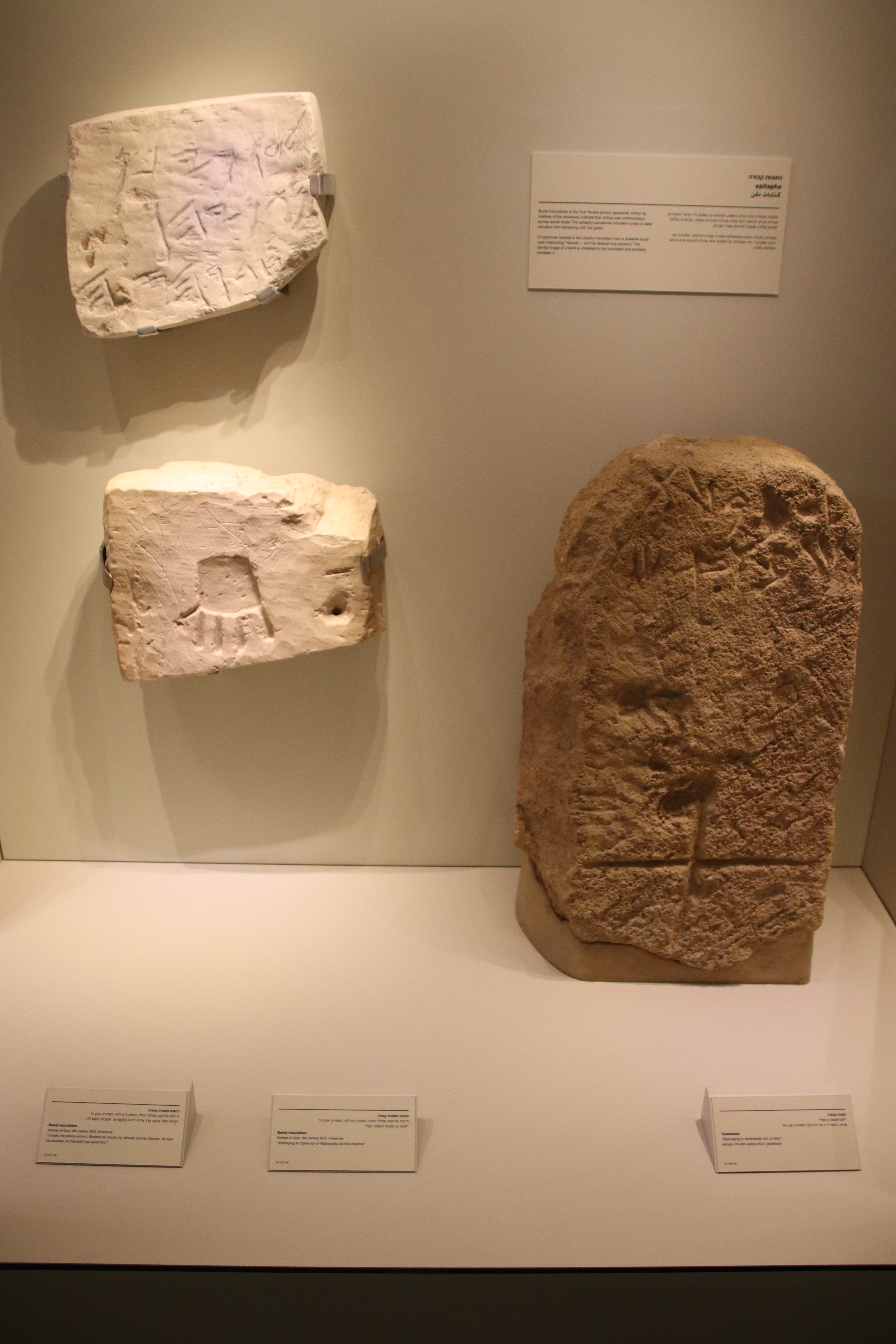
Another important witness comes from Khirbet el-QomKhirbet el-QomSite west of Hebron known for an eighth-century BCE funerary inscription commonly associating Yahweh with “his asherah”; damaged text and readings disputed.Glossary · Click to read the explanation, west of Hebron, in a funerary inscription generally dated to the eighth century BCE. A common reading associates a man named Uriyahu with Yahweh's blessing and with protection or rescue from enemies through “his asherah.” [1]
Its setting differs from the jars of Kuntillet ʿAjrud, making comparison valuable. General similarity does not make the two texts identical. The precise relations among words, verbs and names at el-Qom are debated; a short formula cannot supply a complete account of the tomb family's worship.
To show the reading difficulty rather than only its result, this is a simplified transcription of lines 2–3 according to the reading Hadley discusses, with spacing normalized and word-divider dots removed: [1]
This is an interpretive translation of a published reading, not a new decipherment. Especially in line 3, word division, pronoun reference and the relationship of rescue to asherah are disputed; it is not treated as an intact, unanimously understood sentence. The excerpt excludes line 1 and names or additions in later lines whose readings differ. The association of Yahweh with ʾšrth warrants comparison; identifying the rescuer and meaning of mediation first requires deciding between readings.
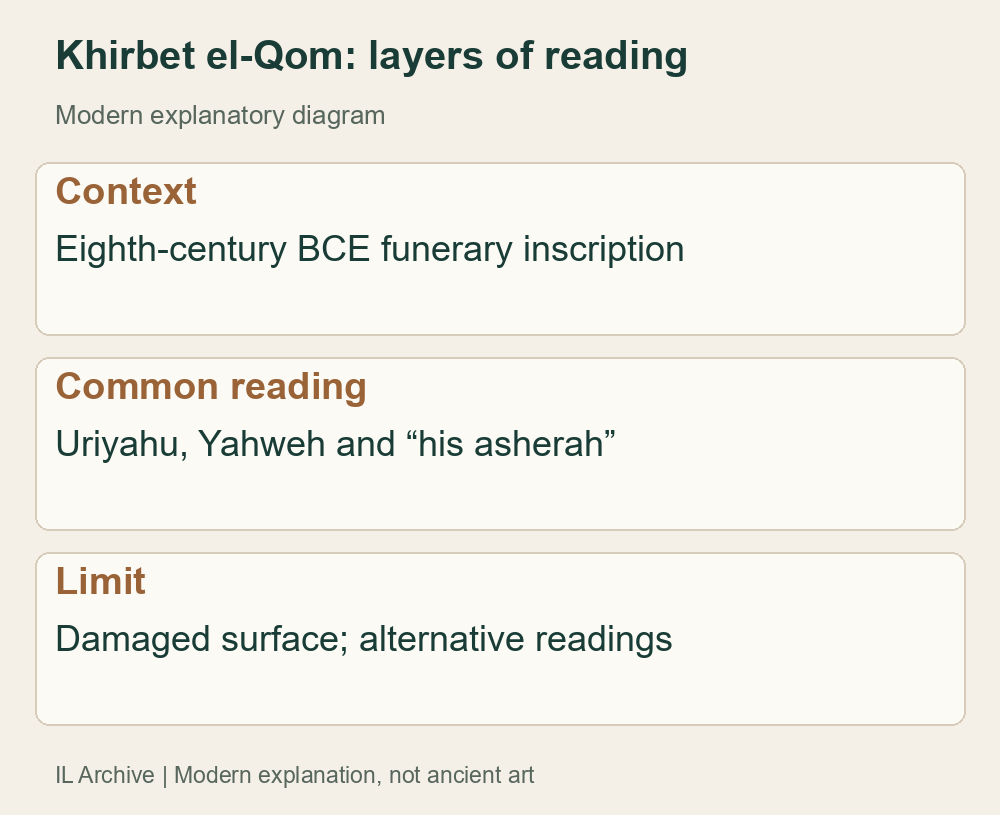
Surface damage, intersecting marks and removal from its original location affect interpretation. Hadley discusses letters, cracks and alternative readings, warning against treating surface marks automatically as deliberate erasure or a drawing of a tree. A translation should keep these difficulties visible. [1]
According to its published abstract, the 2015 study by Émile PuechÉmile PuechSpecialist in Semitic inscriptions and the Dead Sea Scrolls, emeritus professor at Jerusalem’s École biblique; proposes a shrine reading at el-Qom.Glossary · Click to read the explanation, a specialist in Semitic inscriptions, proposes reading ʾšrh as “shrine.” This expands the debate beyond wife versus wooden pole. The abstract establishes that the proposal exists; it cannot substitute for reading the whole article when evaluating each step of the revised decipherment. [5]
Female figurines in Judah
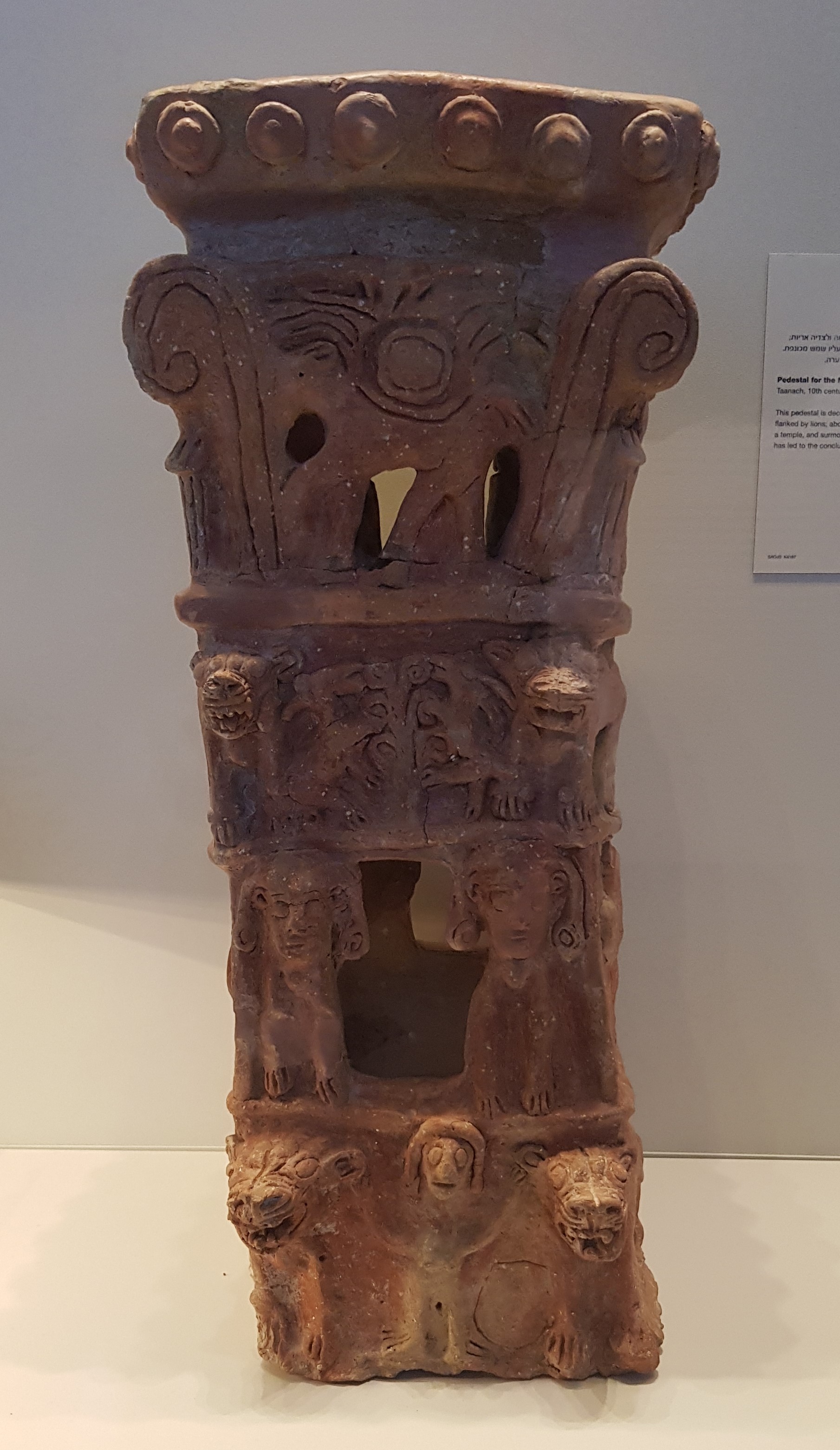
The archaeological record includes many Judean pillar figurinesJudean pillar figurinesSmall late Iron Age terracotta female figures of Judah, with pillar-like bases and moulded or hand-shaped heads; neither their represented identity nor their ritual or protective use is settled.Glossary · Click to read the explanation: small clay female images whose arms hold or support the breasts, above a pillar base. Some have separately moulded heads; others have heads shaped by hand and pinching. They were particularly widespread in the eighth and seventh centuries BCE. [6][7]
“Hundreds” is sufficient here: counts vary with the corpus and how fragments are counted. The internal photograph below shows an example from Lachish, the Judahite city at Tell ed-Duweir southwest of Jerusalem, dated by the Metropolitan Museum to approximately the eighth–seventh century BCE. Its existence, form and recorded provenance are documented; identifying the represented goddess or figure is a different question. [9]
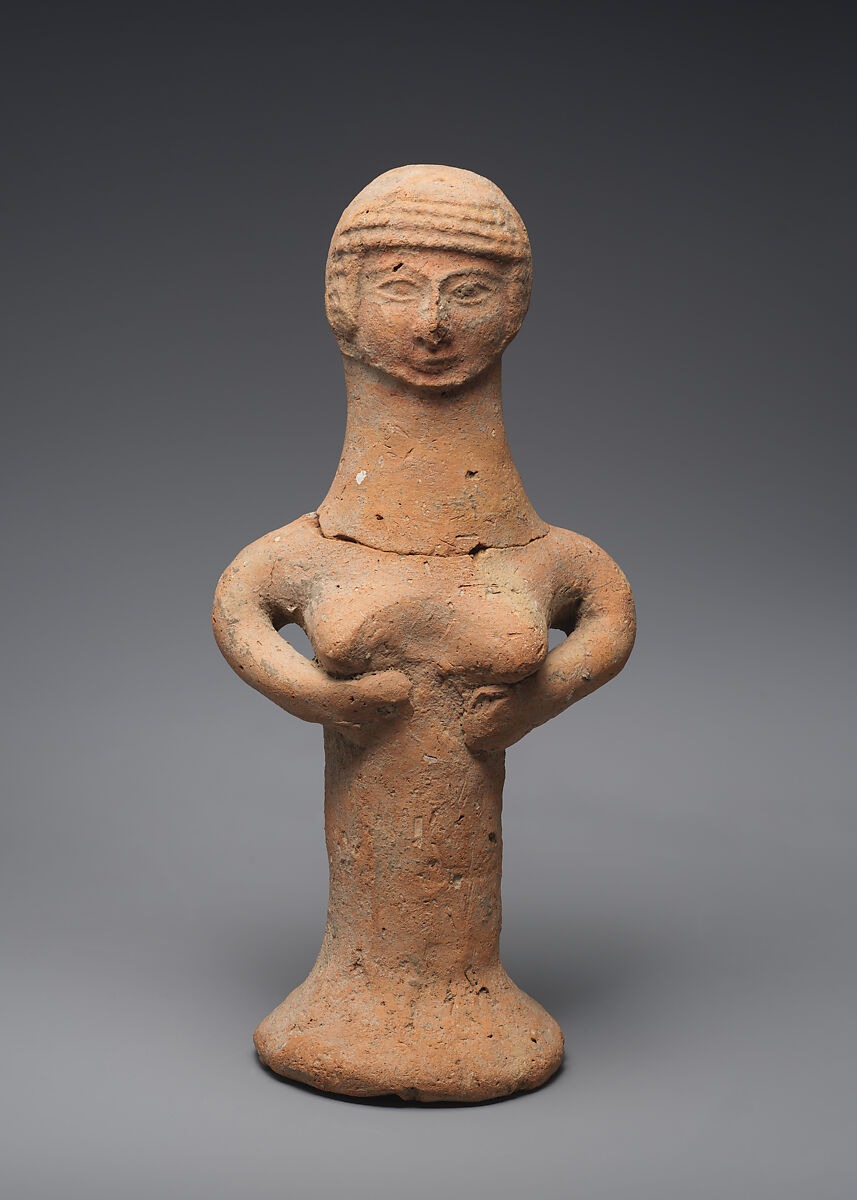
Asherah is a familiar attribution, but it is not a name inscribed on every object. These figurines generally do not carry inscriptions identifying the figure. Proposed readings include motherhood, fertility and nursing, healing and protection, or beings of lower divine rank. Breasts alone do not establish a fertility ritual. [6]
Erin DarbyErin DarbyScholar of ancient religion, archaeology and imagery, with research on Judean pillar figurines and their use-contexts.Glossary · Click to read the explanation, a scholar of Israelite religious archaeology and ancient imagery, tests such assumptions against context, material and comparative texts. She proposes protective and healing functions while leaving precise identity open. A Yahweh worshipper might use a protective object without treating it as a competing major god. A figurine's presence therefore does not always establish a shrine to an independent goddess.
The household as evidence for religious history
Houses help reveal activities missing from official offering lists. Illness, fear, birth and ordinary life can prompt ritual actions absent from royal narratives. Yet find context also requires analysis: original use differs from later deposition in fill, rubbish or reused construction. [6]
Household assemblages contain more than female images. Animal, horse-and-rider and incense-related objects appear, with protective, practical and religious roles potentially intersecting. In his study of Judean identity, Ian Douglas Wilson interprets the figurines as part of maintaining local identity during Assyrian expansion. This offers another perspective; it does not finally identify every figure. [7][8]
The 2018 abstract by biblical archaeologist Aaron Brody presents five connected pillared houses at Tell en-Naṣbeh north of Jerusalem, inhabited by an extended family. Objects include female and animal figurines, horses and riders, incense stands and animal-shaped vessels. The case demonstrates the diversity of household equipment. [8]
Brody suggests that a concentration near two kitchens may relate to a female household head's role in its religious wellbeing. This is a contextual interpretation, not proof that only women used figurines or that every Judahite house resembled this compound. The abstract, rather than the complete report's detailed analysis, is available here.
It is easy to construct a story in which men worshipped Yahweh while women worshipped Asherah. An object's form does not automatically reveal who made, carried or used it. Households contained men, women and children, and rituals could involve them together. [6][8]
Assigning particular use needs evidence from location, associated objects and texts; conclusions may differ between sites. Just as every clay rider is not a war god, every clay woman is not a named goddess. Recognizing these limits makes the figurines more reliable historical evidence.
Biblical texts are witnesses with a position
Texts reject BaalBaalUgaritic storm god and warrior king who defeats Yamm, builds his palace with El’s consent and confronts Mot. References to El and Dagan as fathers do not define a single genealogy.Glossary · Click to read the explanation, asherim, high places and other altars. Their disputes are important evidence for what their authors regarded as religious problems. Prohibitions, however, are not a census of practice: they do not alone establish the same activity in every village and period. [1][10]
Nor can references from different works be assembled into one contemporary scene. Composition, editing and transmission intervene. Historians must distinguish the narrated event's time from the time of the author's judgment and compare narratives with inscriptions and material contexts.
Second Kings 21:3–7 says that Manasseh, king of Judah in the seventh century BCE, made an asherah and put its image in Yahweh's house. Narratives about Josiah, king of Judah in the late seventh century BCE, describe removing equipment from the temple and taking out and burning the asherah. The term can concern a manufactured object and, in some contexts, the goddess herself. [1][13]
The decisive expression in 2 Kings 21:7 is “פֶּסֶל הָאֲשֵׁרָה”, “the carved image of the asherah”. Verse 23:6 reads “וַיֹּצֵא אֶת־הָאֲשֵׁרָה מִבֵּית יְהוָה”, “and he brought the asherah out of Yahweh’s house”. Join marks in the second excerpt are typographically normalized; no letters are restored. A manufactured image followed by removal supports a material referent within this narrative, without deciding whether it was human-shaped or a nonhuman symbol. [13]
This makes a rigid division between pure official religion and deviant popular religion difficult: an author's condemned practices can be attributed to king and temple. Yet the existence of the passage does not independently establish every detail and date of the event. The narrative presents and judges the past through a religious programme.
A national god is not necessarily the only god
Yahweh could be Israel's central god while other powers, beings or religious objects remained present. Affiliation with his worship does not alone establish denial of every other deity or rejection of every related symbol. [2][10]
Worshipping Yahweh alone must therefore be distinguished from saying that no other god exists. Exclusive devotion can precede the strongest formulations of monotheismMonotheismBelief that only one God possesses divinity in its fullest sense. Historically distinct from exclusively worshipping one deity without denying others; its theological forms vary.Glossary · Click to read the explanation. Differences between blessings, names and texts show that divine identity and worship did not develop in a static, uniform society.
Within a model of El–Yahweh convergence, the question is reasonable. If Yahweh occupied the highest divine position and absorbed El's titles, a goddess associated with El might also become associated with him. Smith includes this in his reconstruction of the divine family's history. [10]
Plausibility is not a verified sequence. Converging evidence can support a historical argument without a document naming a particular transfer; the available witnesses nevertheless do not establish its route or timing in every community. “His asherah” could indicate a symbol related to that tradition in one setting and a different understanding in another. The model explains converging clues; missing direct links limit it.
Reform has a history of its own
Accounts of HezekiahHezekiah, king of JudahKing of Judah in the late eighth century BCE, named in Sennacherib’s Assyrian accounts of the 701 BCE campaign.Glossary · Click to read the explanation, king of Judah in the late eighth and early seventh centuries BCE, and Josiah describe removing high places and cult equipment and redirecting worship toward Yahweh. They matter for understanding how scribes narrated exclusivity. The actual extent and details of reform, and the narrative's relationship to Deuteronomy's editing, require separate investigation. [1]
Not every broken object can be assigned to reform, or a practice's disappearance dated solely from a king's narrative. Temple rules might change before or after household practices. Religion changes through authorities, institutions, families and regions, not a single decision adopted by every inhabitant.
Passages in Isaiah 40–55, usually associated with the sixth-century BCE Babylonian setting, explicitly deny other gods. The claim now reaches beyond preferring a national patron to neighbouring peoples' deities. [10][13]
Smith situates the transformation within social change, political trauma and expanding empires. This is a historical explanation, not a rule that every crisis produces monotheism. Layer dating and the definition of monotheism remain debated. These texts diminish others' legitimacy while extending Yahweh's rule over the world.
What does the evidence establish?
Secure: Athirat is a goddess in Ugarit; Kuntillet ʿAjrud preserves formulas associating Yahweh with ʾšrth; Judah has many female figurines; biblical texts condemn forms of worship and narrate removal of the asherah. These witnesses do not all belong to one period or society. [1][2][6][13]
Probable: religious practices varied and Yahweh's worship interacted with other traditions. Possible and influential: Asherah as his consort in some settings, or the survival of a symbol associated with her history. Unproven: the famous drawing as their portrait, every pillar figurine as Asherah, or all Israelites believing Yahweh had a wife.
References and notes (16)
- Judith M. Hadley. Evidence for Asherah. Bible Interp, 2008. Read sections on Athirat, Kuntillet ʿAjrud/el-Qom inscriptions, drawings, figurines, biblical terminology and reform. Hadley favours a wooden symbol representing the goddess; not attributed an exclusively wife-based interpretation. Reported disagreements not treated as consensus. Return to the text ↑
- Jeremy Smoak and William Schniedewind. Religion at Kuntillet ʿAjrud. Religions 10 (2019), 211. DOI: 10.3390/rel10030211. Introduction, site-function passages pp. 2–3, KA 3.1/3.6 blessings p. 5 and available scribal-context passages read. Selected pages, not the entire article. Scribal education is the authors’ interpretation, not an established exclusive site function. Return to the text ↑
- Tallay Ornan. Sketches and Final Works of Art: The Drawings and Wall Paintings of Kuntillet ʿAjrud Revisited. Tel Aviv 43 (2016), 3–26. DOI: 10.1080/03344355.2016.1161374. Institutional abstract only: sketches, royal/protective motifs, state building with cult space. No claim of full-article reading or secure identification of every drawing. Return to the text ↑
- Nadav Na’aman and Nurit Lissovsky. Kuntillet ʿAjrud, Sacred Trees and the Asherah. Tel Aviv 35 (2008), 186–208. DOI: 10.1179/tav.2008.2008.2.186. Abstract only: proposed sacred tree, activity around it and a goddess’s treasury. Proposal not converted into an excavated tree. Return to the text ↑
- Émile Puech. L’inscription 3 de Khirbet el-Qôm revisitée et l’Ashérah. Revue Biblique 122 (2015), 5–25. DOI: 10.2143/RBI.122.1.3149557. Publisher abstract only: ʾšrh as shrine. Full revised decipherment not evaluated or presented as consensus. Return to the text ↑
- Erin Darby. Fatal Attraction: Obsession, Aversion, and the Femme Fatale of Ancient Judah. Bible Interp, February 2015. Author’s main article read: head types, context/redeposition, critique of inferring deity identity or user gender from form, proposed protection/healing. Proposal not imposed as the sole function of all objects. Complete book not read. Return to the text ↑
- Ian Douglas Wilson. Judean Pillar Figurines and Ethnic Identity in the Shadow of Assyria. Journal for the Study of the Old Testament 36 (2012), 259–278. DOI: 10.1177/0309089212438002. Abstract only: eighth/seventh-century popularity and proposed maintenance of local identity under empire. Interpretation, not definitive figurine identification. Return to the text ↑
- Aaron Brody. Materiality of Religion in Judean Households: A Contextual Analysis of Ritual Objects from Iron II Tell en-Naṣbeh. Near Eastern Archaeology 81 (2018), 212–221. DOI: 10.5615/neareastarch.81.3.0212. Abstract only: five connected houses, object diversity, proposed female household-head role from distribution near kitchens. Not generalized to all families or all users’ genders. Return to the text ↑
- The Metropolitan Museum of Art. Nude female figure, object 34.126.53, collection record 323163. Ceramic, Lachish, about eighth–seventh century BCE, 18.4 cm; public-domain image. Artifact identity/image rights separated from proposed mother-goddess or Asherah attribution. Return to the text ↑
- Mark S. Smith. The Origins of Biblical Monotheism: Israel’s Polytheistic Background and the Ugaritic Texts. Author’s account, Bible Interp. Author’s account read, not entire book: exclusivity, El/Yahweh/Asherah model, social/political change. Dating debates retained and model distinguished from inscriptions. Return to the text ↑
- 강승일 (Kang). Yahweh’s Consort? Korean Journal of Old Testament Studies 17 (2011), 123–144. DOI: 10.24333/jkots.2011.17.2.123. English abstract only: challenge to absolute suffix objection and divine hypostasis discussion. Its drawing identification not adopted as fact; Korean main text not read. Return to the text ↑
- 김준 (Kim). Kuntillet Ajrud “Yahweh and His Asherah” and the Goddess Asherah, Who Had No Archeological Presence in Israel in the Eighth Century B.C.E. Korean Journal of Old Testament Studies 24 (2018), 354–368. DOI: 10.24333/jkots.2018.24.3.354. English abstract only: cult-object reading and critique of drawing/inscription association. Title’s absence claim belongs to the author, not this study’s finding for all Israel. Korean main text not read. Return to the text ↑
- Hebrew Bible: 2 Kings 21:3–7; 23:4–7; Isaiah 45:5–7, 18, 21–22. Mechon-Mamre. Specified passages; Hebrew wording of 21:7 and 23:6 checked alongside the displayed translation, with editorial translations of the excerpts. No independent manuscript collation. Chapter 23: https://mechon-mamre.org/p/pt/pt09b23.htm. Narrative/historical limits retained. Return to the text ↑
- Richard S. Hess, “New Evidence for Asherata/Asherah”, Religions 16/4 (2025), 397. DOI: 10.3390/rel16040397. Complete main text of the open publisher version: name forms, suffix analysis and KA 3.1:2 / 3.6:7 locators. No independent examination of epigraphic originals. Return to the text ↑
- Ktiv catalogue, National Library of Israel, National Library of Russia manuscript EVR I B 19a, Leningrad Codex. Catalogue data and scribal date 1008–1009 CE only; manuscript leaves not collated against this study’s passages. Return to the text ↑
- Michael R. Simone, On Fire: Preternatural and Hypostatic Fire in Ancient Israelite Religion, PhD dissertation, Johns Hopkins University, 2015. PDF page 65, note 159: KA 3.6:5–10 reproduced from Aḥituv, Eshel and Meshel 2012, p. 95. Used only to check word distribution over lines 5–7; not the complete dissertation. Return to the text ↑
Suggest a correction · Suggest a source for this record
Cite this record
IL Archive, «Yahweh and Asherah», https://ilarchive.com/en/studies/yahweh-and-asherah
Continue reading