Site
Samaria: city and region
Ancient city and administrative region; the city’s site is at Sebastia, northwest of Nablus in the West Bank.
Last reviewed:
Text
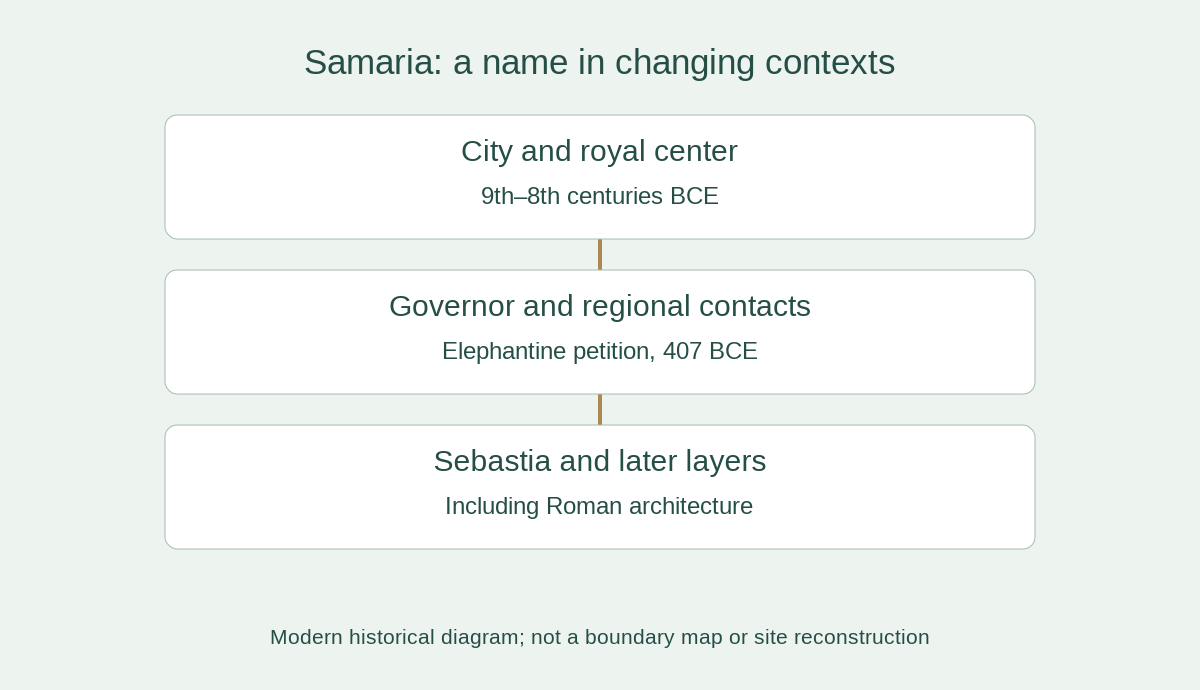
Samaria was an ancient city associated with Israel's kingdom in the ninth–eighth centuries BCE and a regional name used under Persian rule. Its site at Sebastia, northwest of Nablus in the West Bank, preserves several archaeological periods.[1][3]
The 407 BCE ElephantineElephantine / YebElephantine / Yeb, near Aswan at the Nile’s First Cataract, preserves a long-lived Egyptian town, temples of Khnum and Satet, and Persian-period garrisons. Aramaic papyri document several communities, including Judeans and Yaho’s temple, whose rebuilding was sought in 407 BCE; claims and archaeological interpretations must be distinguished.Glossary · Click to read the explanation petition names Samaria's governor and contacts with his sons. Here the name concerns administration and correspondence; city and region should be distinguished.[2]
References and notes
- UNESCO, Decision 48 COM 8B.3, Sebastia, 2026; location and successive archaeological periods. Brief synthesis and criterion (iii); Roman buildings are not Persian administration. Return to the text ↑
- Temple-rebuilding petition, TAD A4.7, translated by K. C. Hanson. Lines 1–30; senders, addressee and their contacts. Return to the text ↑
- University of Bern, The Ivory Carvings from Samaria. Project opening: royal capital in the ninth–eighth centuries BCE; project photographs not reused without a licence. Return to the text ↑
Suggest a correction · Suggest a source for this record
Cite this record
IL Archive, «Samaria: city and region», https://ilarchive.com/en/sites/samaria-ancient-city-region