Study
From a national god to the god of the universe
An extended study of a topic, with evidence and references.
Exclusive allegiance and denial of other gods: inscriptions, Assyrian/Babylonian crises and Second Isaiah, separating events from composition and disagreements over monotheism.
Estimated reading time: 16 min Published Last reviewed:
Share article
Text
Introduction
How did texts speaking for Israel’s god come to assert authority over the universe and deny divinity to rivals? This study follows evidence from the Iron Age kingdoms through the Assyrian and Babylonian crises to Isaiah 40–55, comparing scholarly explanations. It examines beliefs, worship and textual composition, not the truth or falsity of religious faith or an inevitable path followed by an entire society.
Two questions and a special relationship
If we asked someone in Iron Age Israel or Judah whom they should worship, and then whether other gods existed, the questions would not be identical. They could pledge allegiance to YahwehYahwehThe proper name of Israel’s deity, written יהוה (YHWH), the Tetragrammaton. Its exact ancient pronunciation is not directly preserved; texts and inscriptions witness its history.Glossary · Click to read the explanation alone while believing that other nations had their gods. Another text could go further and deny everyone else genuine divinity. Between exclusive worship and that denial lies a major problem in the history of Israelite religion. [1][4]
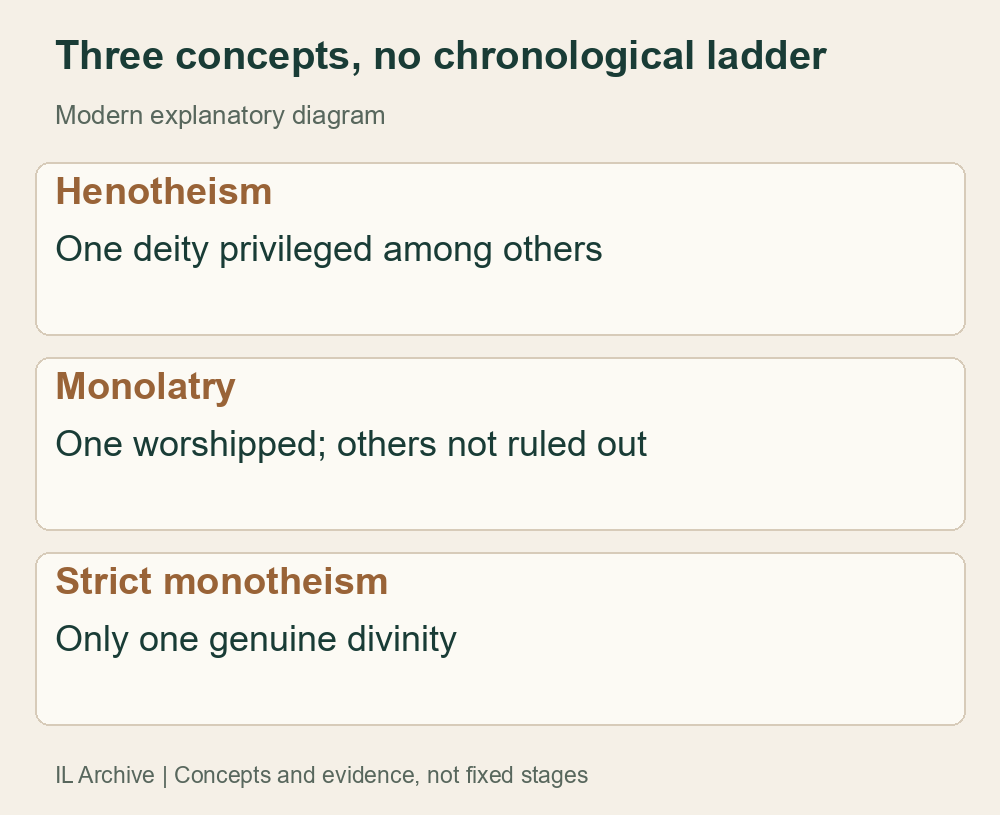
Here henotheismHenotheismHenotheism is a scholarly term for privileging or exalting one deity without necessarily excluding other gods. Its boundaries with monolatry and monotheism are debated; Vedic, Ugaritic, Moabite and Hebrew evidence is examined without assuming a universal sequence.Glossary · Click to read the explanation means privileging one deity within a world acknowledging others; monolatryMonolatry: Exclusive WorshipExclusive worship of one deity, without automatically denying the existence of others; a modern term for allegiance, not necessarily a dated religious stage.Glossary · Click to read the explanation means worshipping one deity without necessarily denying others. Strict monotheismMonotheismBelief that only one God possesses divinity in its fullest sense. Historically distinct from exclusively worshipping one deity without denying others; its theological forms vary.Glossary · Click to read the explanation recognizes only one genuine divinity. Scholars define these terms differently. They are not a staircase that every community climbed in the same order. [8][13]
Biblical scholar Baruch A. LevineBaruch A. LevineAmerican scholar of the Hebrew Bible and ancient Near East (1930–2021), who linked roots of global monotheism to Assyrian-period prophetic discourse.Glossary · Click to read the explanation uses “henotheism” for exclusive worship while acknowledging other gods, close to monolatry here. His comparison must be read with his own definition, not by assuming identical terminology. [8]
Yahweh had a special relationship with IsraelAncient IsraelName attested for a population on the Merneptah Stele around 1208 BCE, later for the northern Iron Age kingdom and for broader textual and religious identities; the senses are not identical.Glossary · Click to read the explanation and the kingdom of JudahKingdom of JudahJudah was an ancient southern Levantine kingdom centered on Jerusalem in the Iron AgeGlossary · Click to read the explanation in the southern LevantThe LevantThe Levant is a regional name for lands along the eastern MediterraneanGlossary · Click to read the explanation. “National” here describes a deity’s relation to an ancient people and kingdom, not a modern nation-state. In an environment of national and royal deities, a god protected a community and legitimized its king; land and victories could be attributed to him. “National god” does not mean worship automatically stopped at the border, that the god had no power beyond it, or that everyone in the kingdom worshipped him alone. [1][2]
The relationship with the people was central to his religious identity. A kingdom’s defeat therefore raised a painful question: how could a people protected by its god be defeated? Answers could differ within the same society, from blaming the people to questioning protection or rethinking divine sovereignty.
A chronological map: event, text and surviving copy
- Iron Age, especially ninth–eighth centuries BCE: blessing inscriptions are material witnesses broadly contemporary with their use, not late copies of historical narratives. Each inscription’s dating and reading still require assessment. [5]
- Around 722 and then 701 BCE: the northern kingdom’s fall and the campaign against Judah. These form the Assyrian horizon of Isaiah, not proof that every formulation in Isaiah 10 and 14 was composed then. Levine himself acknowledges uncertainty about their dates and the constituency behind them. [7][8]
- Late seventh century: Josiah’s period, in which the narrative places his reform; the narrative’s composition, editing and the reform’s implementation are separate questions. [6]
- 597 and 587/586, then 539 BCE: deportation and JerusalemJerusalemJerusalem is a city of religious importance in Judaism, Christianity and IslamGlossary · Click to read the explanation’s destruction, followed by Cyrus’s conquest of BabylonBabylonBabylon is an ancient city in central present-day Iraq, south of BaghdadGlossary · Click to read the explanation. A core of Isaiah 40–55 belongs to the late Babylonian/early Persian horizon; editing need not have ended at the conquest. [7][12][18]
- 407 BCE: a dated petition from a Jewish community on Egypt’s ElephantineElephantine / YebElephantine / Yeb, near Aswan at the Nile’s First Cataract, preserves a long-lived Egyptian town, temples of Khnum and Satet, and Persian-period garrisons. Aramaic papyri document several communities, including Judeans and Yaho’s temple, whose rebuilding was sought in 407 BCE; claims and archaeological interpretations must be distinguished.Glossary · Click to read the explanation island seeks restoration of Yahweh’s temple: independent evidence for a specific postexilic community’s practice, not the birth date of its belief. [22]
- Second century BCE: the Great Isaiah Scroll, approximately 125 BCE according to the Israel Museum, witnesses transmission centuries after the Babylonian setting. Deuteronomy’s “sons of God” reading comes from another witness, 4QDeutj; neither the manuscripts nor a copy’s date and its narrated setting should be confused. [19][24]
National gods: witness and reconstructed tradition
In Judges 11:24, Jephthah’s speech compares land granted by ChemoshChemoshMajor Moabite deity in the ninth-century BCE Mesha Stele, credited with restoring territory and receiving war booty; also named in Hebrew texts from another perspective.Glossary · Click to read the explanation with land granted by Yahweh. Yet it addresses the Ammonite king, whereas Chemosh is normally associated with Moab. It is not a straightforward chart matching every nation to its god, nor a census of popular belief. It attests this argument within the narrative. [2]
In Deuteronomy 32:8–9, Elyon, the Most High, divides the nations and Jacob is Yahweh’s portion. The textual dispute concerns a phrase in verse 8. We reproduce only the variant biblical textual scholar Emanuel Tov prints in his table for 4QDeutj, not an independent manuscript transcription or restoration of its gaps: [3][19]
The Masoretic tradition instead has בני ישראל, “sons of Israel.” Tov favours divine beings because the HebrewHebrewA Northwest Semitic language of the Canaanite group, encompassing Iron Age epigraphy, Biblical, Rabbinic, medieval and Modern Hebrew; its scripts and pronunciations changed over time.Glossary · Click to read the explanation witness and Greek support them and because the reading coheres with Yahweh receiving Jacob in 32:9; relating the division of nations to Jacob’s descendants needs further explanation. This is an evidentially stronger textual reading, not two equal options merely because both exist. It does not by itself establish whether the song preserves a layer distinguishing ElElEl is a senior deity in Late Bronze Age Ugaritic texts, portrayed as father of the divine family and a council authority, alongside his consort Athirat. This entry does not cover every linguistic use of El.Glossary · Click to read the explanation from Yahweh. Historian of ancient Israelite religion Mark S. SmithMark S. SmithScholar of the Hebrew Bible and Ugaritic religion whose work examines the divine family and biblical monotheism.Glossary · Click to read the explanation’s reconstruction explains the division as a trace of earlier divine plurality; biblical scholar Michael S. HeiserMichael S. HeiserScholar of the Bible and Semitic languages whose work examined the divine council and divine plurality in Hebrew texts.Glossary · Click to read the explanation appeals to Yahweh as father and ruler in the final song. One reconstructs a tradition’s history, the other interprets the final text’s coherence. Moving between those levels does not itself refute either argument. [1][17][19]
Exclusive allegiance, the Shema and reform
In Exodus 20:3 in common numbering, within verse 2 on Mechon-Mamre’s page, the Masoretic command reads: [4]
The command in Exodus 20 prohibits other gods before Yahweh. Its immediate concern is human allegiance and worship. The prohibition alone establishes neither that its author denied all other gods nor that the author accepted their existence. It must be read alongside other texts. [4]
Saying Yahweh is greater than others, or deserves exclusive loyalty, differs logically from saying that others possess no divinity at all. A text may combine superiority and exclusivity. These distinctions let us ask more precise questions than a single question about when monotheism began.
Deuteronomy 6:4, the Shema, becomes central to Jewish confession: Yahweh our God, Yahweh one. Scholarship discusses unity or uniqueness and the declaration that Yahweh alone is the community’s god. The Hebrew sentence does not offer one uncontested modern translation. [6][15]
Later liturgical readings should not be dismissed, but they alone do not date the emergence of every meaning. The text’s place in a later religion and what its wording and ancient setting allow us to infer are separate matters.
Deuteronomic and prophetic traditions strongly advocate worshipping Yahweh alone. Second Kings 23 depicts a reform attributed to Josiah, king of Judah, removing other cult equipment and binding the king to a covenant. The king’s late seventh-century setting, the narrative’s composition and editing, its programme and its actual implementation must be distinguished. [6]
Historical models place this movement within the late monarchy and disputes over identity and the centre of worship. Exclusivity need not have been one doctrine adopted by everyone, and each formulation need not deny others’ existence. Older traditions could persist within subsequently edited texts. [1]
Inscriptions and social practice
Blessings from Kuntillet ʿAjrudKuntillet ʿAjrudA Sinai site with blessings invoking Yahweh of Samaria/Teman and “his asherah” around 800 BCE; inscriptions illuminate religion and writing, while the site’s function and imagery remain debated.Glossary · Click to read the explanation in northeastern SinaiSinai: peninsula and biblical mountainSinai is a peninsula in eastern Egypt; in the Torah the name also denotes the mountain of revelation to MosesGlossary · Click to read the explanation, around the late ninth and early eighth centuries BCE, mention Yahweh of Samaria, Yahweh of Teman and “his asherah.” An eighth-century inscription from Khirbet el-QomKhirbet el-QomSite west of Hebron known for an eighth-century BCE funerary inscription commonly associating Yahweh with “his asherah”; damaged text and readings disputed.Glossary · Click to read the explanation, west of Hebron, is also commonly read as associating Yahweh with “his asherah.” Scholars discuss the goddess Asherah/AthiratAthiratA prominent goddess commonly understood as El’s consort in Ugaritic texts; she bears the progenitress epithet and intercedes for Baal’s palace.Glossary · Click to read the explanation, her cult symbol and other readings; the wording alone does not identify its referent. [5]
For the Kuntillet ʿAjrud formula, scholar of ancient Israelite religion Judith M. HadleyJudith M. HadleyScholar of ancient Israelite religion and inscriptions who taught theology and religious studies at Villanova; a specialist in the evidence for Asherah and el-Qom.Glossary · Click to read the explanation favours a wooden symbol associated with the goddess as the immediate referent of “his asherah”: possessive suffixes attached to divine proper names lack normal biblical-Hebrew parallels. This linguistic reason favours the symbol in the expression, not the elimination of its connection with a goddess. “Yahweh of Samaria” and “Yahweh of Teman” reveal local naming and blessing formulas; they do not alone prove that a writer counted two independent deities. The inscriptions resist a picture of uniform worship without becoming a census of Israel and Judah. [5]
Palace, temple, household and local shrine were not identical copies. Northern and southern traditions could differ, as could a family’s practices and the position of a writer condemning them. “The Israelites believed...” needs a specified source, setting and period. [1][5]
A religious command does not prove compliance. Polemic against BaalBaalUgaritic storm god and warrior king who defeats Yamm, builds his palace with El’s consent and confronts Mot. References to El and Dagan as fathers do not define a single genealogy.Glossary · Click to read the explanation or an asherah may reflect real competition, but it does not by itself measure the proportion of worshippers. Silence about a cult in an administrative document likewise does not establish its absence from everyday life.
Assyria and expanding sovereignty
The northern kingdom of Israel fell to Assyria in the late eighth century BCE, with approximately 722 serving as a major chronological reference. People were deported, while Judah did not end at the same moment. Judah then faced the Assyrian king SennacheribSennacherib, king of AssyriaAssyrian king, 704–681 BCE; part of Ahiqar’s story is set at his court.Glossary · Click to read the explanation’s campaign in 701, more than a century before the Babylonian catastrophe. [7]
This sequence prevents reducing the transformation to one exile. Jerusalem’s collapse followed prolonged engagement with a large empire and with rhetoric attributing victory and kingship to divine power. Questions about land, defeat and sovereignty existed before the sixth century.
Isaiah 10:5–15 depicts Assyria as an instrument of punishment and then condemns its king’s arrogance. Within the text’s logic, the seemingly dominant empire remains subject to Yahweh. This claims power beyond his people, without by itself settling the denial of every other god. [9]
Levine locates early roots of global monotheism in this prophetic horizon, from the late eighth and early seventh centuries. This is a proposed dating connecting thought with imperial challenges, not agreement that a complete doctrine had then spread throughout society. [8]
Levine’s argument is not that defeat automatically generated the idea. He compares Assyrian royal claims to world rule with Isaiah’s reversal: the king becomes an accountable instrument, while the plan encompasses “all the earth” in 14:24–27. This explains a mechanism of expanding divine sovereignty within the text. Early dating weakens if the decisive formulation is a later editorial addition; even an early formulation of worldwide power does not logically deny every other god. It is therefore a plausible root of the universal claim, not complete evidence for a monotheistic society. [8][9]
Babylon: defeat and power beyond the land
Babylon’s campaigns against Judah unfolded in stages. A major deportation occurred in 597 BCE; Jerusalem and its temple were destroyed in 587/586. Babylonian exileBabylonian exileJudean deportations to Babylonia and the kingdom’s collapse in the early sixth century BCE; several phases, not everyone removed or returned at once.Glossary · Click to read the explanation covers events and communities over time. It does not mean that everyone was removed from the land or sent to Babylon at once. [7]
The kingdom and its previous royal institutions collapsed. Deportees lost their homeland and a principal centre of worship. Yet people remained in the land, and families settled abroad. The experience should not be reduced to the exiles’ voice, nor should catastrophe be assumed to produce one religious response.
The catastrophe could be interpreted in several ways. Some surviving texts recast it as punishment initiated by Yahweh, making the conqueror an instrument of his decision. Jeremiah 25:9 calls the Babylonian king Nebuchadnezzar IINebuchadnezzar IIBabylonian king, 605–562 BCE, appearing in Daniel and independently attested in inscriptions and building remains.Glossary · Click to read the explanation Yahweh’s servant. This is a theological account of conquest, not independent historical proof of what caused it. [9]
Such a formulation lets the narrative retain divine sovereignty despite the people’s defeat. No historical law requires a defeated kingdom’s god to disappear, or makes monotheism the inevitable outcome. We study one preserved response among possible responses.
Deportation reopened questions about god, land and temple. In models such as Levine’s, roots of some claims to power beyond Judah belong to the Assyrian period, before the destruction of 587/586. But the setting depicted does not automatically date every surviving sentence: the tradition and its editorial layers require separate arguments. The exilic crisis can therefore be understood as a setting for reformulating earlier conceptions without assuming that every element in the final text predates it. [8][9]
Second Isaiah: how strong is the denial?
Scholars conventionally call Isaiah 40–55 Second IsaiahSecond IsaiahScholarly label for Isaiah 40–55, associated substantially with exile and Cyrus; neither an identified biography nor proof of a single author or date.Glossary · Click to read the explanation. The designation does not supply a secure biography of one person who wrote the whole collection. A substantial part relates to exile, the end of Babylonian rule and the Persian king Cyrus IICyrus IIFounder of the Achaemenid Empire; conquered Babylon in 539 BCE and died in 530 BCE.Glossary · Click to read the explanation’s rise in the sixth century BCE, with debate over layers and later editing. [12][18]
These texts combine hope of return, divine power over kings, creation and criticism of idols. A general sixth-century setting cannot date every verse or identify the day a particular idea was first formulated.
In Isaiah 43:10, the divine speaker denies a god before or after himself. In 44:6, being first and last accompanies denial of another god. Isaiah 45:5 explicitly identifies Yahweh as the only deity. These are clear references to the text’s statements, rather than merely comparisons of divine strength. [10]
Here is a short excerpt of the Masoretic textMasoretic TextThe Hebrew Bible’s transmission tradition combining its consonantal text, transmitted vocalization and accentuation, and Masorah notes. The consonantal text has ancient roots; surviving codices that bring these layers together in their Masoretic form are medieval.Glossary · Click to read the explanation of Isaiah 45:5, without restored missing letters, with an editorial translation: [10]
Kenneth Seeskin reads the denial as a genuine assertion of Yahweh’s exclusive divinity. Saul Olyan objects that Isaiah 40:25–26 retains the heavenly hostHeavenly HostA heavenly group whose meaning varies: celestial bodies in some texts, attendants around the throne deliberating in 1 Kings 22.Glossary · Click to read the explanation and 51:9–11 Rahab and dragon imagery; the innovation might restrict the name god to Yahweh while retaining heavenly beings. This objection, taken here from his abstract rather than a full reading of the article, prevents projecting a later metaphysics onto the collection. Yet a commanded host is not automatically rival gods, and a defeated dragon is not an independent creator. The stronger monotheistic reading rests on the cumulative denial of predecessors and successors in 43:10 and exclusive creation and salvation, not an isolated “one.” These passages are best described as a strong discourse reserving genuine divinity to Yahweh, while social practice and the status of heavenly beings remain distinct questions. [10][20][21]
Isaiah does not abandon Israel when speaking of the universe’s god. Chapter 45 itself identifies Jacob as servant and Israel as chosen, then speaks of creating earth, humanity and heavens. Election and universal sovereignty coexist within the text. [10]
The change does not remove the people from the relationship. It changes the claim’s scope: Israel’s god can also create everyone and govern other nations’ kings. Universal power does not imply that all nations had actually adopted one form of worship.
Cyrus and competing claims of sovereignty
Isaiah 45 portrays Cyrus as a conqueror chosen by Yahweh, although the king does not know him. This discourse can interpret a foreign ruler’s success as serving Israel’s god rather than escaping his authority. [10]
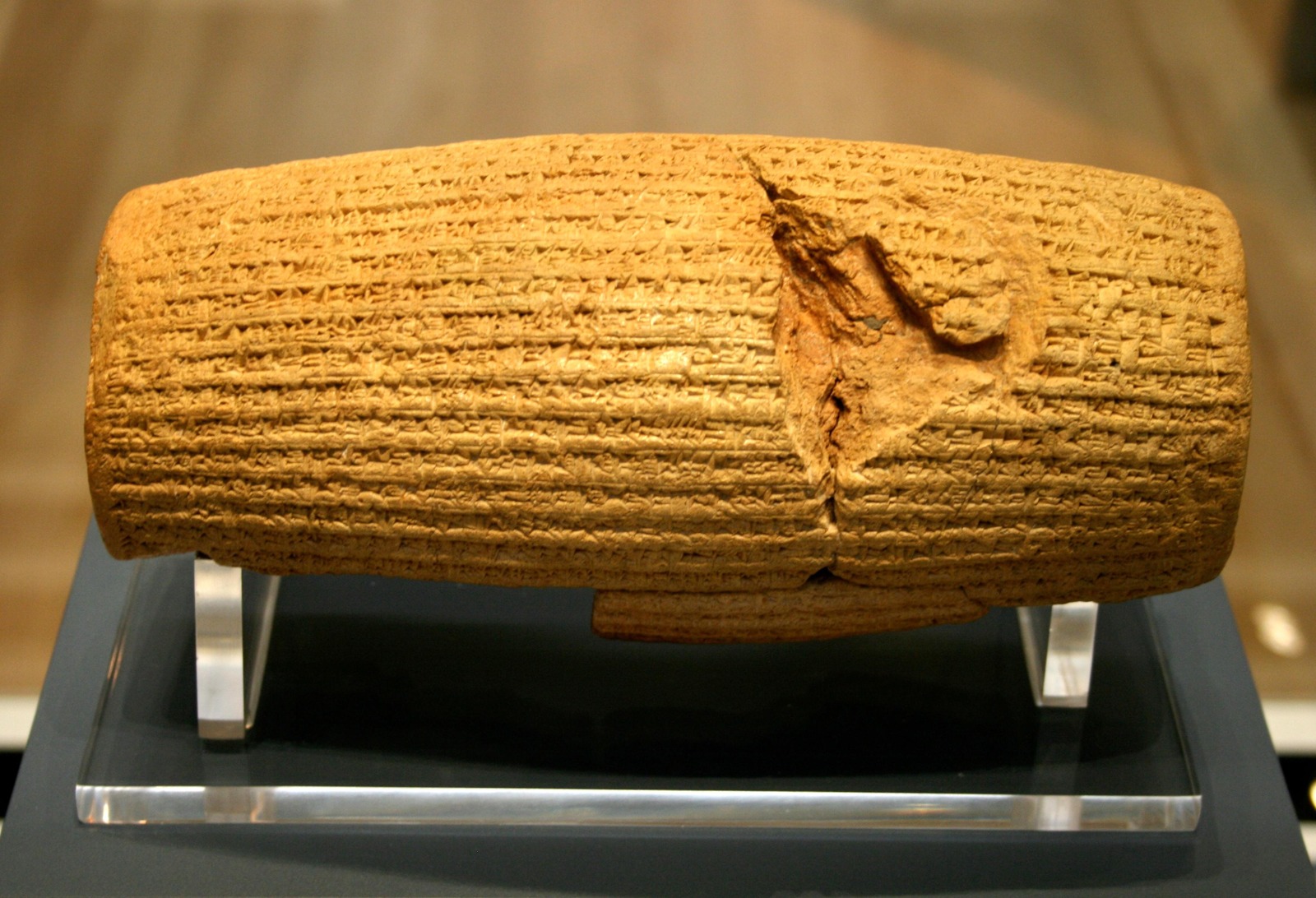
The Cyrus Cylinder, following Babylon’s conquest in 539 BCE, attributes his selection to MardukMardukBabylon’s leading god, worshipped at Esagil and elevated in the Akkadian Enūma eliš. His symbols include a spade and mušḫuššu dragon. His earliest origins remain obscure; Nibiru is no evidence of a planetary homeland.Glossary · Click to read the explanation, Babylon’s chief city god. It names neither Yahweh nor Judah and is not the specific text of a Jewish return decree. Comparison reveals two claims of sovereignty, not one royal creed. [11]
In the cylinder itself, lines 32–35 return several gods to their cult places and ask them to intercede for the king before Bel and Nabu. A universal title for Marduk or Cyrus therefore does not establish monotheism: the text’s structure affirms divine plurality, unlike Isaiah’s negation. Comparison reveals a shared language of royal legitimation while also identifying their difference. [11][25]
Old Testament scholar Matthias AlbaniMatthias AlbaniGerman Old Testament scholar (born 1960), studying Isaiah’s monotheism, its Babylonian context, ancient astronomy and Qumran texts.Glossary · Click to read the explanation discusses Isaiah’s claims within competition over the future and Cyrus’s rise. His interpretation connects Babylonian discourse about gods and destiny with religious conflicts near the end of the Neo-Babylonian kingdom. This contextual hypothesis helps explain the polemic; it does not establish that monotheism as a whole was borrowed from Babylon. [12]
The text can place heavens, stars and history under one creator’s power. Conquest no longer testifies only to one nation’s fortunes but enters a broader claim about governing the world. The actual transmission and reception of ideas remain harder to establish than this literary contrast.
Defining monotheism and the status of heaven
Biblical scholar Benjamin D. SommerBenjamin D. SommerHebrew Bible scholar at the Jewish Theological Seminary in New York; author of The Bodies of God and the World of Ancient Israel (2009).Glossary · Click to read the explanation argues for a preexilic presence of biblical monotheism and questions the adequacy of some modern contrasts between monotheism and polytheism. His position challenges models locating a single beginning in the sixth century, without entirely rejecting the explanatory value of distinguishing monotheism from polytheism. [13]
Historian of ancient Judaism Arnaud SérandourArnaud SérandourHistorian of ancient Judaism and maître de conférences émérite at EPHE–PSL, examining how definitions of monotheism affect its dating.Glossary · Click to read the explanation, in a study published in 2005, dates monotheism much later under his strict definition, attaching importance to Philo of AlexandriaPhilo of AlexandriaGreek-writing Jewish interpreter in Roman Alexandria (roughly first century CE), who read the Torah philosophically while defending its practices; his works survive through Greek copying and Armenian translation.Glossary · Click to read the explanation, a Jewish thinker of the Roman period. This is a dissenting position, not a consensus. Different criteria for “another god” yield different chronological answers. [14]
These two positions are presented here from publisher abstracts, not detailed readings of the book and article. They illustrate differences of question and definition; they do not alone arbitrate Isaiah’s verses. [13][14]
The heavenly councilDivine councilA divine council is a religious and literary scene in which divine beings gather before a superior authority for discussion, commissioning or judgment; it is not identical to a pantheon list.Glossary · Click to read the explanation survives in texts such as Job 1, where sons of GodSons of God“Bene elohim” is a Hebrew expression in Job and Genesis whose interpretation depends on context; it also appears in Qumran 4Q37 at Deuteronomy 32:8. It does not itself establish biological descent or a fixed divine roster.Glossary · Click to read the explanation appear before Yahweh, and Psalm 82, with judgement among beings called elohimElohimA Hebrew word with plural morphology, used for “gods” or for a singular deity according to context.Glossary · Click to read the explanation. Whether the latter are heavenly or human is debated; a ready-made translation should not conceal that. [16]
Later traditions could retain messengers, spirits and the heavenly hostHeavenly HostA heavenly group whose meaning varies: celestial bodies in some texts, attendants around the throne deliberating in 1 Kings 22.Glossary · Click to read the explanation while denying their entitlement to independent worship. Monotheism therefore need not empty heaven. Continuity does not prove that each angelAngel / Heavenly MessengerHebrew malʾakh (מַלְאָךְ) means “envoy,” human or heavenly according to the passage. Messenger roles vary; the word alone proves neither wings nor an earlier divine identity.Glossary · Click to read the explanation was a particular Canaanite deity renamed. It concerns classification and authority, not a list matching individuals.
The postexilic temple: Elephantine as a test
Understanding God as ruler of the world did not abolish land or temple. Projects of return and rebuilding themselves gave sacred space great weight. Dating exile’s end shows that Babylon’s conquest in 539, return and work on the temple were not one simultaneous event for everyone. [7]
Divine sovereignty and ways of maintaining identity could expand while particular places and ritualsRitualAn organised or distinguished practice meaningful to a community; it may leave traces, but its form alone does not reveal an associated doctrine.Glossary · Click to read the explanation remained central. A simple route from temple religion to religion without place misrepresents a history retaining tension between universality and attachment to place.
Elephantine’s documents test this picture beyond an intellectual sequence. In petition TAD A4.7, Berlin P13495, dated 407 BCE, Yedanyah and the priests ask Bagohi, governor of Judah, to assist in rebuilding Yahweh’s temple on their Egyptian island. Verso lines 1–2 mention earlier unanswered letters to Jerusalem; lines 6–11 seek renewed worship and offerings. Here is a Jewish community with a temple outside Jerusalem, not merely a possibility inferred from a writer’s polemic. [22]
But the story cannot stop with “they did not answer.” Memorandum TAD A4.9, Berlin P13497, preserves what Bagohi and Delaiah said about presenting reconstruction of the altar-house to Arsames, mentioning grain offerings and incense. Unlike the petition, it does not name animal burnt offerings; omission is not an explicit prohibition. Together the documents establish negotiation over local practice and interregional connections. They do not alone prove that the community denied other gods’ existence or that all Jews approved its temple. A discourse about the universe’s god therefore did not immediately homogenize institutions and rites. [23]
What the evidence supports and leaves open
Other environments praised supreme gods in comprehensive terms. Yet exalting a god among gods, or attributing their functions to him, does not automatically equal denying all other divinity. Each text needs examination rather than being classified as monotheistic merely because it calls a god one or incomparable. [15]
Research on empires, defeat and circulating ideas explains contexts of religious expression. It neither decides God’s existence nor reduces belief to a single psychological device. Historians study what communities said and practised and how it changed, recognizing that many voices are lost.
The story is not simply a local god growing when his people lost. Broader sovereignty traditions, demands for loyalty, varied worship and texts reinterpreting the past already existed. Empire and exile put new pressure on these questions. Some texts then articulated a powerful answer: Yahweh not only protects Israel but governs its conqueror and restorer and creates the whole world.
This process cannot be assigned to one year or made inevitable. Its changing claims can be traced through texts, inscriptions and chronology. In its clearest formulations, the question is no longer which god is stronger than the others, but who possesses genuine divinity at all. Israel’s relationship with its god remains, while the text asks that this god be understood as the world’s god.
References and notes (25)
- Mark S. Smith, The Origins of Biblical Monotheism: Israel’s Polytheistic Background and the Ugaritic Texts. Author’s overview of the 2001 book, Bible Interp. Author’s overview: religious diversity, Deuteronomy 32 and the social/imperial model; not the full book. Return to the text ↑
- Hebrew Bible, Judges 11:12–27, especially 11:24. Hebrew text and displayed English translation, Mechon-Mamre. Jephthah’s address to the king of Ammon and the Chemosh comparison. Return to the text ↑
- Israel Antiquities Authority, Leon Levy Dead Sea Scrolls Digital Library, image B-359054: manuscript 4Q37 (4QDeutʲ), plate 172, fragment 10. Witness identity only: 4Q37/4QDeutj, plate 172, fragment 10. Published reading and preference in note 19; no independent decipherment of the image. Return to the text ↑
- Hebrew Bible, Exodus 20. Hebrew text and English translation, Mechon-Mamre. Prohibition of other gods and their worship, Exodus 20:3–5 in common numbering; the prohibition begins at verse 2 in this Hebrew page’s numbering. Return to the text ↑
- Judith M. Hadley, “Evidence for Asherah,” Bible Interp, December 2008. Epigraphy sections: Khirbet el-Qom, the nature of Kuntillet ʿAjrud, and pithoi A and B; goddess, cult symbol and linguistic alternatives. Return to the text ↑
- Hebrew Bible, Deuteronomy 6:4–9; 2 Kings 23:1–7. Hebrew text and English translation, Mechon-Mamre. Shema and allegiance; the Josiah reform narrative. 2 Kings: https://mechon-mamre.org/p/pt/pt09b23.htm Return to the text ↑
- Rainer Albertz, Israel in Exile: The History and Literature of the Sixth Century B.C.E., translated by David Green, Society of Biblical Literature, 2003; German original 2001. Publisher excerpt p. 2, available indexed text: successive deportations and period boundaries. Not the whole book; conquest, return and temple rebuilding are not simultaneous. Return to the text ↑
- Baruch A. Levine, “Global Monotheism: The Contribution of the Israelite Prophets,” in Melammu: The Ancient World in an Age of Globalization, 2014. DOI: 10.34663/9783945561003-04. Introduction, §§ 2.1.1–2.1.2, selected 2.2.1, 2.2.2–2.2.3 and 2.3: terminology, imperial comparison, and acknowledged uncertainty dating Isaiah 10/14. Not all cited editions read. Return to the text ↑
- Hebrew Bible, Isaiah 10:5–15; 14:24–27; Jeremiah 25:8–12. Hebrew text and English translation, Mechon-Mamre. Assyria as instrument of punishment and Nebuchadnezzar as “my servant.” Jeremiah: https://mechon-mamre.org/p/pt/pt1125.htm Return to the text ↑
- Hebrew Bible, Isaiah 43:10–12; 44:6–10; 45:1–7, 12–13. Hebrew text and English translation, Mechon-Mamre. Denial of other divinity, Cyrus and creation. Chapter 43: https://mechon-mamre.org/p/pt/pt1043.htm ; chapter 44: https://mechon-mamre.org/p/pt/pt1044.htm Return to the text ↑
- Irving L. Finkel, “Translation of the Cyrus Cylinder,” Metropolitan Museum of Art, The Cyrus Cylinder and Ancient Persia exhibition dossier, 20 June 2013. Object: British Museum 90920, registration 1880,0617.1941. Lines 1–45, especially 12–17 on Cyrus’s selection and 30–35 on restoring gods and populations. The translation names neither Yahweh nor Judah. Return to the text ↑
- Matthias Albani, “Monotheism in Isaiah,” in The Oxford Handbook of Isaiah, edited by Lena-Sofia Tiemeyer, Oxford University Press, 2020, pp. 219–248. DOI: 10.1093/oxfordhb/9780190669249.013.22. Publisher’s abstract and chapter metadata; Isaiah 40–48, the late Neo-Babylonian kingdom, destiny and Cyrus’s rise. Return to the text ↑
- Benjamin D. Sommer, “Appendix: Monotheism and Polytheism in Ancient Israel,” The Bodies of God and the World of Ancient Israel, Cambridge University Press, 2009, pp. 145–174. DOI: 10.1017/CBO9780511596568.009. Cambridge summary of the appendix: the author’s position on preexilic monotheism and the limits of terminology, not the full appendix. Return to the text ↑
- Arnaud Sérandour, “On the Appearance of a Monotheism in the Religion of Israel (3rd Century BC or Later?),” Diogenes 52(1), February 2005, pp. 33–45. DOI: 10.1177/0392192105050601. Article abstract and issue metadata: strict definition, Philo and the Roman period. Cambridge’s 2024 date concerns online availability, not original publication. Return to the text ↑
- Daniel M. Zucker, “Shema Yisrael: In What Way Is ‘YHWH One’?”, TheTorah.com, 2017. Survey of Shema readings, sections 1–5: syntax, unity, allegiance and uniqueness. Return to the text ↑
- Hebrew Bible, Job 1:6–12; Psalm 82. Hebrew text and English translation, Mechon-Mamre. Presentation before Yahweh and judgment in the council. Psalm 82: https://mechon-mamre.org/p/pt/pt2682.htm ; compare the council interpretation in note 17. Return to the text ↑
- Michael S. Heiser, “Are Yahweh and El Distinct Deities in Deut. 32:8–9 and Psalm 82?”, Hiphil 3, 2006. Pp. 1–3, 6–8: objection to reading all denial formulas as ontological negations; Elyon interpreted as Yahweh’s title. An alternative to Smith’s reconstruction, not a resolution of the debate. Return to the text ↑
- Thomas C. Römer, “Yhwh, the Goddess and Evil: Is ‘monotheism’ an adequate concept to describe the Hebrew Bible’s discourses about the God of Israel?”, Verbum et Ecclesia 34(2), 2013. Introduction, “Yhwh, commander of the foreign nations,” and conclusion: Persian context, redaction and diverse discourses rather than one linear evolution. Return to the text ↑
- Emanuel Tov, “The Sons of Israel or God? – Deuteronomy 32:8,” TheTorah, 24 August 2023. Complete article and seven footnotes: table of 4QDeutj, Masoretic and Greek readings, and contextual argument. Excerpt follows Tov’s published reading, not independent damaged-letter inspection or direct DJD reading. Return to the text ↑
- Saul M. Olyan, “Is Isaiah 40–55 Really Monotheistic?”, Journal of Ancient Near Eastern Religions 12/2 (2012), pp. 190–201; DOI: 10.1163/15692124-12341237. Author’s abstract only: heavenly host, Rahab/dragon and restricting the designation god to Yahweh. Full article not read; biblical passages checked independently. Return to the text ↑
- Kenneth Seeskin, “When Did the Bible Become Monotheistic?”, TheTorah, 2019. Sections on numerical and philosophical monotheism and Isaiah/incomparability; the scholar’s own exposition, not a reading of his complete book. Return to the text ↑
- Elephantine project, Staatliche Museen zu Berlin, P13495, petition to Bagohi, TAD A4.7. Metadata, complete edited text and translation read; 407 BCE; verso 1–2 for unanswered letters and 6–11 for restoration request. No claim of independent papyrus decipherment. Return to the text ↑
- Elephantine project, Staatliche Museen zu Berlin, P13497, memorandum of Bagohi and Delaiah, TAD A4.9. Complete edited text and translation, lines 1–11: altar-house reconstruction, grain offerings and incense. Omission of animal burnt offerings is not an explicit ban. Return to the text ↑
- Israel Museum, Great Isaiah Scroll exhibition information. Introductory description: scroll dated approximately 125 BCE. This does not date the collection’s composition. Return to the text ↑
- R. J. van der Spek, “Cyrus the Great, Exiles, and Foreign Gods,” in Extraction & Control: Studies in Honor of Matthew W. Stolper, SAOC 68, University of Chicago, 2014, pp. 233–264. Pp. 261–263: cylinder appendix, witnesses/editions and complete translation 1–45, especially 12–17 and 32–35. Not the entire chapter or Schaudig’s cited edition. Return to the text ↑
Suggest a correction · Suggest a source for this record
Cite this record
IL Archive, «From a national god to the god of the universe», https://ilarchive.com/en/studies/israelite-monotheism
Continue reading