Site
Kuntillet ʿAjrud
A Sinai site with blessings invoking Yahweh of Samaria/Teman and “his asherah” around 800 BCE; inscriptions illuminate religion and writing, while the site’s function and imagery remain debated.
Estimated reading time: 6 min Published Last reviewed:
Share article
Text
Introduction
Kuntillet ʿAjrud is an archaeological site in the interior of the SinaiSinai: peninsula and biblical mountainSinai is a peninsula in eastern Egypt; in the Torah the name also denotes the mountain of revelation to MosesGlossary · Click to read the explanation Peninsula, in present-day eastern Egypt. Its pottery and plaster inscriptions associate YahwehYahwehThe proper name of Israel’s deity, written יהוה (YHWH), the Tetragrammaton. Its exact ancient pronunciation is not directly preserved; texts and inscriptions witness its history.Glossary · Click to read the explanation, the deity worshipped in ancient Israel and Judah, with “his asherah”. What do these blessings establish, and what remains disputed about their wording and the nearby drawings? Separating text, imagery and building function clarifies the discovery without making it a single answer about the religion of an entire region.
Site and date
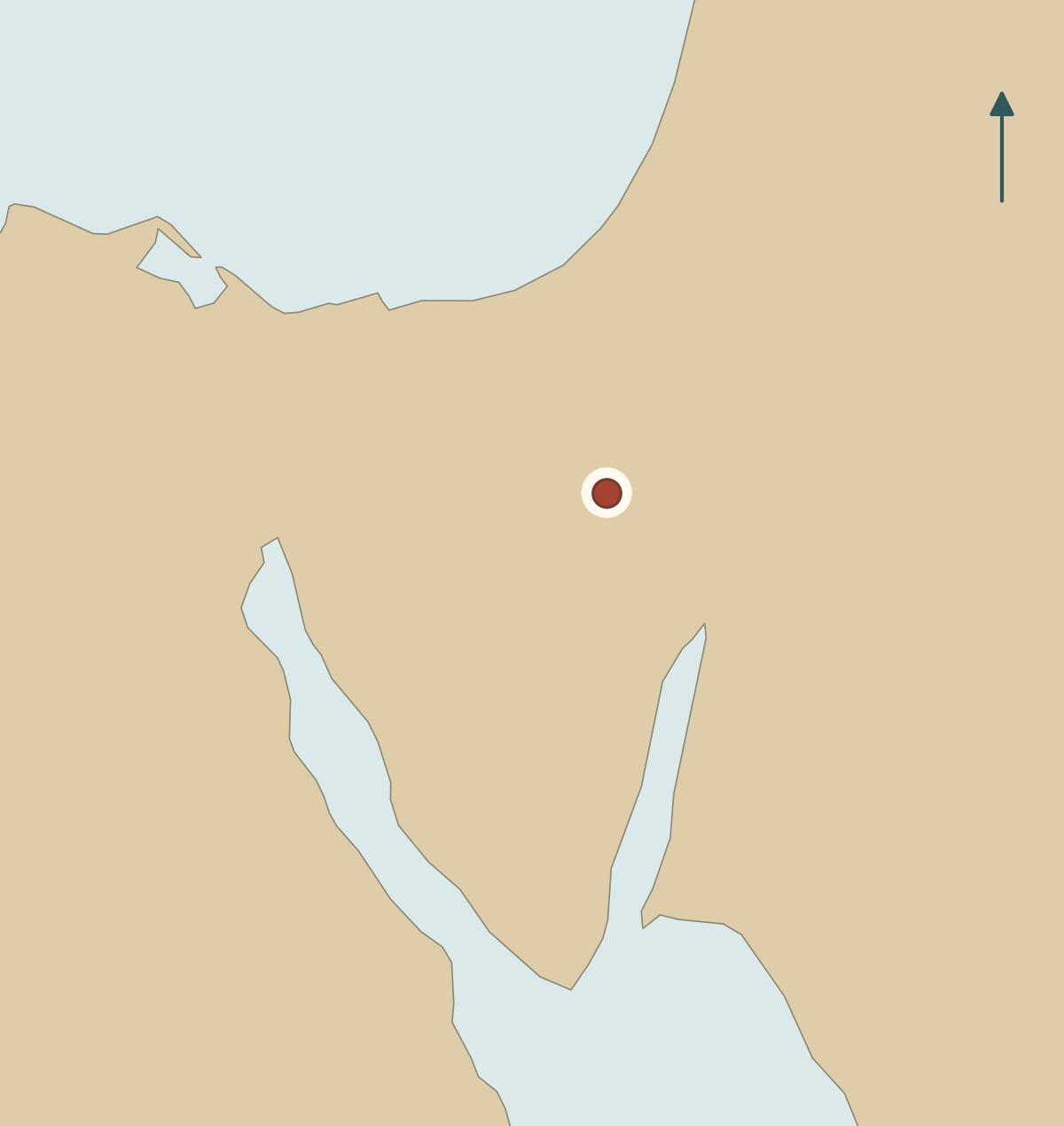
Excavations in 1975–1976 revealed two buildings, storage jars, inscriptions and drawings. The site occupies a hill near wells, about fifty kilometres south of Kadesh Barnea, the archaeological oasis in northeastern Sinai. Water mattered for travel between the Mediterranean coast and the Gulf of Aqaba area; the site lay near the Gaza Road rather than directly on its shortest course. [1][2]
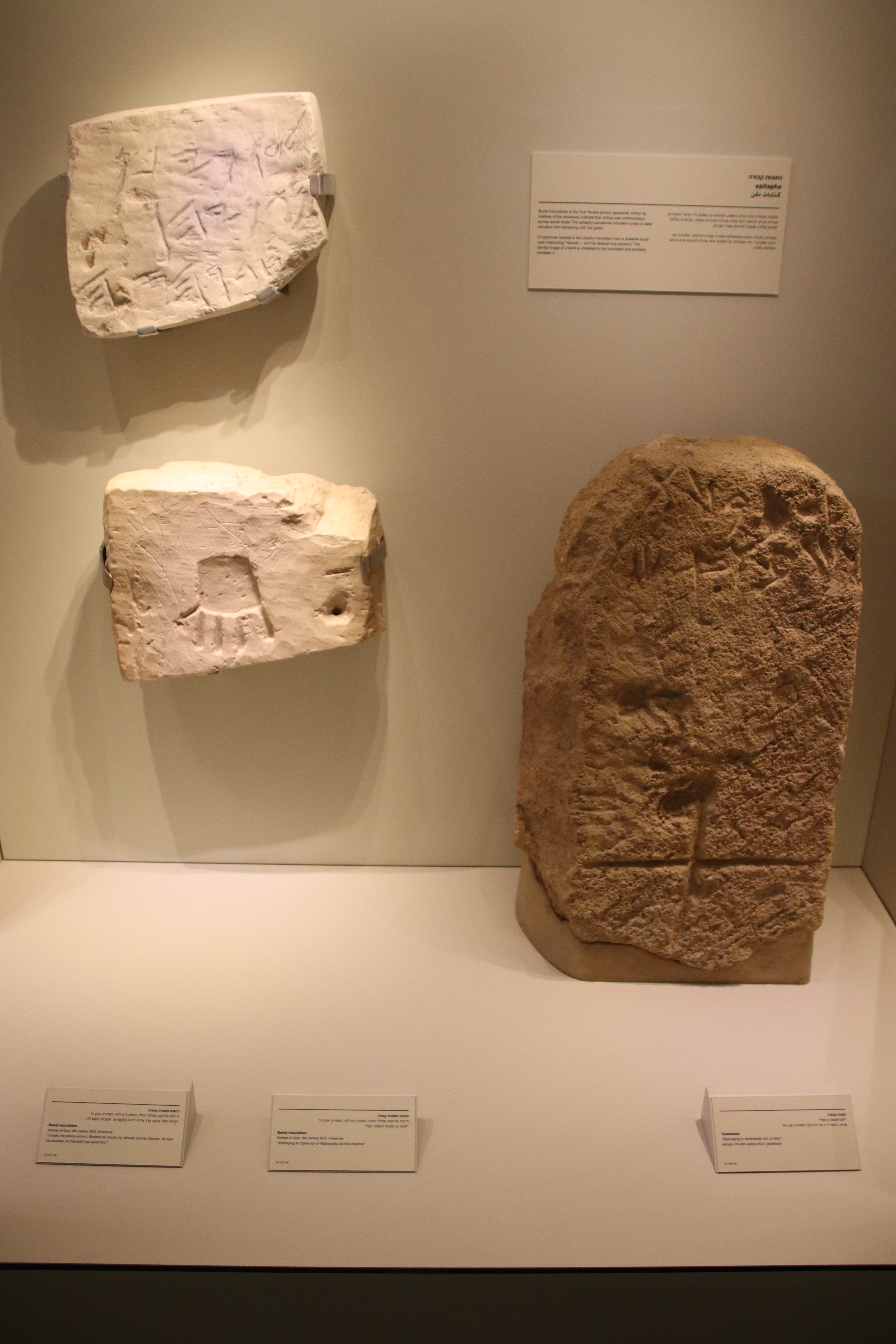
The main building contained a courtyard, storerooms and a plastered room with stone benches; important finds clustered in and around this room. The writing includes vessel marks and inscriptions on stone bowls, not just the two famous blessings. Personal names with northern forms and the mention of Samaria support connections with the northern Israelite kingdom; identifying the authority that managed the site and the extent of its control remains historical reconstruction. [1][3]
The short-lived occupation belongs to the Iron Age. “Around 800 BCE” summarizes the frequently used late ninth/early eighth-century dating, whereas the abstract of the final report published in 2012 places the site in the first half of the eighth century BCE. Pottery, letter forms and radiocarbon evidence underpin the estimate: it is not a date written in the blessings themselves. [1][3][4]
In a 2008 reassessment of the radiocarbon evidence, Israel Finkelstein and Eli Piasetzky proposed a longer span within the eighth century BCE; their abstract makes clear that the end of occupation is not agreed. The vessel and its inscription attest to a formula’s use at that time, not its first composition: a writer could reuse an older blessing. [1][7]
Blessings on two jars
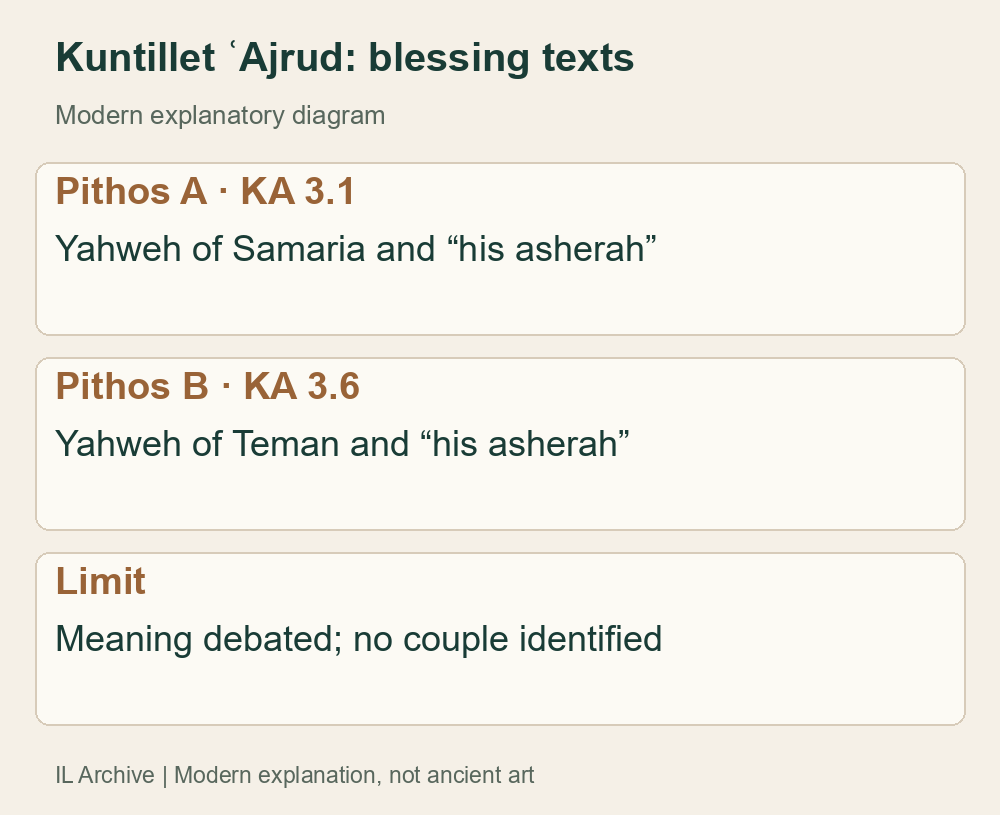
A pithos is a large storage jar. On Pithos A, inscription KA 3.1 includes a blessing invoking Yahweh of SamariaSamaria: city and regionAncient city and administrative region; the city’s site is at Sebastia, northwest of Nablus in the West Bank.Glossary · Click to read the explanation and “his asherah”; Samaria was the city that served as the northern Israelite kingdom’s capital. On Pithos B, KA 3.6 invokes Yahweh of Teman and “his asherah”, within a letter formula enquiring after the recipient’s welfare and requesting blessing and protection. Teman probably refers here to a southern area associated with Edom, in what is now southern Jordan, but its precise identification remains uncertain. These are geographical designations in religious formulas, not names identifying drawn figures. [1][2]
KA 3.1 and KA 3.6 are modern inscription numbers, not ancient numbering. Publications differ over damaged passages and detailed readings. The diagram therefore presents only the basic readable formulas: it does not reconstruct a complete letter or supply damaged letters. [1]
The words of the witnesses
The invocations can be read in Latin-letter transliteration, without reproducing the ancient letter shapes:
- KA 3.1, line 2: lyhwh šmrn wlʾšrth — “by Yahweh of Samaria and by his asherah”. The blessing verb and its recipients begin in the preceding line; this is an excerpt, not the whole message. [1][5]
- KA 3.6, lines 5–7: brktk lyhwh tmn wlʾšrth — “I have blessed you by Yahweh of Teman and by his asherah”. Yahweh’s name begins at the end of line 5 and continues in line 6; the word is joined here for readability. Singular verbs then ask that the recipient be blessed and guarded. [1][6]
The transliteration represents the consonants read in these excerpts, not a reconstruction of their pronunciation. The translations are editorial renderings following the common analysis of ʾšrth, discussed below. They do not restore the damaged names at the messages’ openings. The address formula shows blessing performing a social function between sender and recipient, even if the writing was an exercise rather than a message actually sent. [1]
What does “his asherah” mean?
The debate concerns the word’s reference to a goddess or to a cult symbolAsherah cult symbolAsherah as a cult object or symbol, often wooden in biblical contexts; relation to the goddess and inscriptional ʾšrth remains debated.Glossary · Click to read the explanation representing her. Judith M. HadleyJudith M. HadleyScholar of ancient Israelite religion and inscriptions who taught theology and religious studies at Villanova; a specialist in the evidence for Asherah and el-Qom.Glossary · Click to read the explanation, a scholar of ancient Israelite religion, favours a wooden object representing the goddess and regards the possessive suffix, meaning “his”, as an important linguistic clue. Understanding the relationship as a divine partnership requires an argument beyond simply translating the word as “his wife”. Nor does the symbol interpretation exclude a connection with a goddess: deity and material representation need not have been entirely separate alternatives for worshippers. [2]
The suffix itself, however, is disputed. In a 2025 study, Richard S. HessRichard S. HessOld Testament and Semitic-language scholar at Denver Seminary, studying ancient inscriptions, names and religion.Glossary · Click to read the explanation, a scholar of HebrewHebrewA Northwest Semitic language of the Canaanite group, encompassing Iron Age epigraphy, Biblical, Rabbinic, medieval and Modern Hebrew; its scripts and pronunciations changed over time.Glossary · Click to read the explanation and the ancient Near EastAncient Near EastModern scholarly label for ancient societies of Mesopotamia, the Levant, Anatolia and Iran, sometimes extending to Egypt and other neighbours depending on the study; not one civilization or religion.Glossary · Click to read the explanation, proposes “Asherata”, taking the final h as a vowel letter rather than a possessive pronoun. He draws on Bronze Age syllabic spellings and linguistic comparisons, including a bilingual tablet from a private collection without a documented excavation context. These witnesses strengthen the possibility of a longer divine name, but do not automatically bridge the chronological gap or determine the word’s function at ʿAjrud. [5]
The symbol reading draws strength from the possessive construction and singular verbs focusing the blessing on Yahweh; the goddess reading draws strength from the name’s history and its pairing with him in the invocation. Yet a singular verb need not exclude a goddess, while an earlier divine name does not prove that every later use refers directly to her person. We therefore retain “his asherah” as an explicit working translation. The strongest conclusion is that the inscription attests a religious association valued positively in blessing, not that this word alone defines the association or explicitly declares a divine marriage. [2][5]
Drawings and the establishment’s function
The drawings include animals, human or composite figures, and a player of a stringed instrument. Hadley favours identifying the famous standing pair on Pithos A as Bes-type figures—Bes being an Egyptian protective deity—rather than as an assured portrait of Yahweh and his wife. Her argument compares the forms and the differing, overlapping strokes of drawing and writing. Proximity on the jar does not establish that the blessing labels the figures. [2]
The excavator Ze’ev Meshel interpreted the site as a religious centre or wayside shrine, but explicitly stated in his 1986 report that its layout and lack of cultic vessels led him not to regard the building as a temple. Alternatively, Jeremy Smoak and William M. SchniedewindWilliam M. SchniedewindUCLA professor of Biblical Studies and Northwest Semitic Languages and author of The Finger of the Scribe.Glossary · Click to read the explanation, scholars of biblical studies and ancient Near Eastern languages, interpret letter formulas and exercises as evidence for scribal training in a state-associated establishment. These are competing contextual interpretations, not agreed descriptions. [1][3]
Storage arrangements, water and letter formulas support a setting connected with travel and administration; they do not by themselves establish the extent of scribal training or exclude ritualRitualAn organised or distinguished practice meaningful to a community; it may leave traces, but its form alone does not reveal an associated doctrine.Glossary · Click to read the explanation practice. Conversely, dedications and blessing language support the presence of religion without establishing that the building was a temple. A practical establishment with religion embedded in its users’ activities is the more persuasive synthesis; school and shrine models still require their details to be weighed. The site thus preserves practices of writing and blessing outside biblical texts, not a uniform creed shared by everyone in Israel and Judah. [1][3]
References and notes (7)
- Jeremy Smoak and William Schniedewind. Religion at Kuntillet ʿAjrud. Religions 10 (2019), 211. DOI: 10.3390/rel10030211. Introduction and sections 1–3 of the HTML article: location, function, imagery and blessing formulas KA 3.1 and KA 3.6. The article quotes these formulas from the 2012 edition, pp. 87 and 95; that edition was not read in full. Return to the text ↑
- Judith M. Hadley. Evidence for Asherah. Bible Interp, 2008. Sections “The Nature of the Site”, “Pithos A”, “Pithos B” and “Drawings from Kuntillet ʿAjrud”, including the lyre-player discussion. The author’s interpretation and distinction between text and images are not treated as consensus. Return to the text ↑
- Zev Meshel, “The Israelite religious centre of Kuntillet Ajrud, Sinai”, in A. Bonanno (ed.), Archaeology and Fertility Cult in the Ancient Mediterranean, University of Malta Press, 1986, pp. 237–240. All four pages read (PDF pages 1–4): buildings pp. 237–238; explicit qualification about calling the building a temple p. 238; drawings and conclusion p. 239. Return to the text ↑
- Ze’ev Meshel, Kuntillet Ajrud (Horvat Teman): An Iron Age II Religious Site on the Judah-Sinai Border, edited by Liora Freud, Israel Exploration Society, 2012; abstract published by Harvard’s Shelby White and Leon Levy Program. Publication metadata and institutional abstract only, especially the dating to the first half of the eighth century BCE; not a reading of the full report. Return to the text ↑
- Richard S. Hess, “New Evidence for Asherata/Asherah”, Religions 16/4 (2025), 397. Bronze Age and Iron Age evidence sections: name forms, final h and KA 3.1:2 locator. The author’s analysis, not an independent collation of the inscriptions. Return to the text ↑
- Michael R. Simone, On Fire: Preternatural and Hypostatic Fire in Ancient Israelite Religion, PhD dissertation, Johns Hopkins University, 2015. Printed p. 56, PDF page 65, note 159: KA 3.6:5–10 after Aḥituv, Eshel and Meshel 2012, p. 95. Used to verify line division; not a reading of the whole dissertation. Return to the text ↑
- Israel Finkelstein and Eli Piasetzky, “The Date of Kuntillet ʿAjrud: The 14C Perspective”, Tel Aviv 35/2 (2008), pp. 175–185. Publisher abstract only: construction between 820 and 795 BCE and abandonment after 745 BCE, with proposed historical narrowing to approximately 795–730/720; full statistical analysis not examined. Return to the text ↑
Suggest a correction · Suggest a source for this record
Cite this record
IL Archive, «Kuntillet ʿAjrud», https://ilarchive.com/en/sites/kuntillet-ajrud
Continue reading