Site · archaeological_site
Khirbet el-Qom
Site west of Hebron known for an eighth-century BCE funerary inscription commonly associating Yahweh with “his asherah”; damaged text and readings disputed.
Text
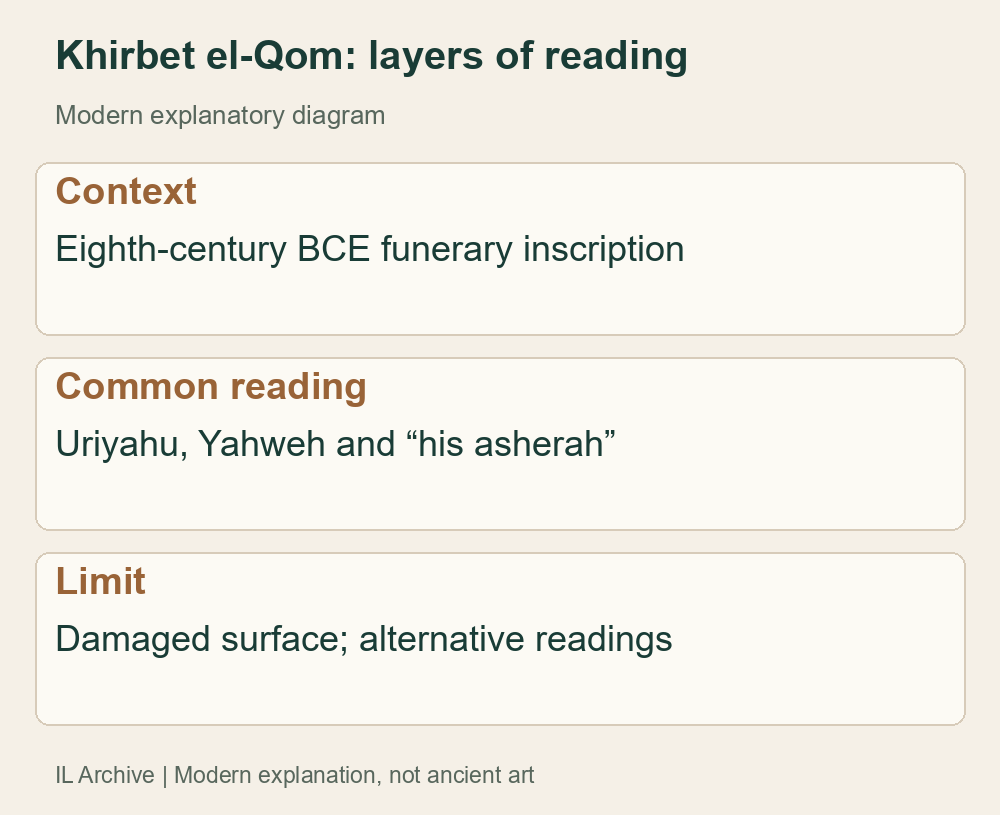
A common reading links Uriyahu with YahwehYahwehThe divine proper name written YHWH in the Hebrew Bible.Glossary · Click to read the explanation’s blessing and rescue through “his asherah.” Surface damage, cracks and removal from context complicate interpretation; marks do not automatically imply erasure or a tree. [1]
Puech’s 2015 abstract proposes shrine as the term’s meaning. Proposal reported, not consensus or full-article reading. Diagram separates evidential layers without reconstructing the tomb. [2]
References and notes
- Judith M. Hadley. Evidence for Asherah. Bible Interp, 2008. Read sections on Athirat, Kuntillet ʿAjrud/el-Qom inscriptions, drawings, figurines, biblical terminology and reform. Hadley favours a wooden symbol representing the goddess; not attributed an exclusively wife-based interpretation. Reported disagreements not treated as consensus. Return to the text ↑
- Émile Puech. L’inscription 3 de Khirbet el-Qôm revisitée et l’Ashérah. Revue Biblique 122 (2015), 5–25. DOI: 10.2143/RBI.122.1.3149557. Publisher abstract only: ʾšrh as shrine. Full revised decipherment not evaluated or presented as consensus. Return to the text ↑
Research history
Substantive changes are retained here. Minor copy edits remain in the internal operational log.
-
Substantive record update
Suggest a correction · Suggest a source for this record
Cite this record
IL Archive, «Khirbet el-Qom», Edition 2, https://ilarchive.com/en/sites/khirbet-el-qom