Entity · Concept
Asherah cult symbol
A reference page linking a name, group, or concept to the materials that discuss it.
Asherah as a cult object or symbol, often wooden in biblical contexts; relation to the goddess and inscriptional ʾšrth remains debated.
Estimated reading time: 5 min Published Last reviewed:
Share article
Text
Introduction
The cultic asherah is a worship-related symbol associated with wood or trees in several HebrewHebrewA Northwest Semitic language of the Canaanite group, encompassing Iron Age epigraphy, Biblical, Rabbinic, medieval and Modern Hebrew; its scripts and pronunciations changed over time.Glossary · Click to read the explanation texts about ancient Israel and Judah. The word is not a precise archaeological description of one object of known shape: witnesses describe an asherah being planted, made, cut down or burned, and sometimes refer to its image. This entry examines the material meaning, its relationship to the goddess Athirat/AsherahAthiratA prominent goddess commonly understood as El’s consort in Ugaritic texts; she bears the progenitress epithet and intercedes for Baal’s palace.Glossary · Click to read the explanation, and why a tree motif or female figurineFigurineA small shaped object depicting a human, animal or abbreviated form, in clay, stone or another medium. Its form alone does not establish its use; manufacture, handling traces and find context matter.Glossary · Click to read the explanation cannot alone identify the symbol.
One name need not mean one thing everywhere
The Hebrew word אֲשֵׁרָה is commonly transliterated ʾăšērāh; plural forms include asherim and asheroth. Athirat, ʾṯrt, is a goddess attested in the late-second-millennium texts of UgaritUgaritAncient city and kingdom at Ras Shamra on the Syrian coast, flourishing between the fourteenth and early twelfth centuries BCE and preserving multilingual archives.Glossary · Click to read the explanation, the ancient city on the Syrian coast. Linguistic kinshipLinguistic relatednessCommon linguistic descent demonstrated by systematic sound and morphological correspondences, unlike borrowing or accidental resemblance.Glossary · Click to read the explanation and religious background illuminate the relationship without making every later Hebrew occurrence a direct designation of the goddess. Here “asherah” designates a symbol where context warrants it; neither “goddess” nor “pole” is imposed on every occurrence. [1]
Translation also shaped its reception. The Greek SeptuagintSeptuagintA name for the varied ancient Greek translations and writings associated with Jewish scripture; beginning with the Torah, the texts differ across books and manuscripts.Glossary · Click to read the explanation often used a term for a grove or sacred precinct, followed by “sacred grove” in later translations. This witnesses how translators understood the word, not the surviving appearance of an Iron Age installation. [1]
What establishes a connection with wood or trees?
DeuteronomyBook of DeuteronomyTorah book presenting commandments in Moses’ discourse and grounding Sabbath rest in slavery and liberation from Egypt.Glossary · Click to read the explanation 16:21 prohibits an asherah beside the altar of YahwehYahwehThe proper name of Israel’s deity, written יהוה (YHWH), the Tetragrammaton. Its exact ancient pronunciation is not directly preserved; texts and inscriptions witness its history.Glossary · Click to read the explanation, Israel’s god. This excerpt is from the Masoretic Hebrew text, not an inscription contemporary with the events narrated in the book: [5]
“Plant” and the reference to a tree or wood establish a vegetal connection without deciding between a living tree and erected timber. The next verse distinguishes it from a massebah, an upright cultic stone: these are different elements, not two names for one object. Translations differ over how “any tree” relates to the preceding wording; a fluent translation should not itself become proof of an archaeological shape.
In Judges 6:25–26, Gideon is told to cut down the asherah associated with BaalBaalUgaritic storm god and warrior king who defeats Yamm, builds his palace with El’s consent and confronts Mot. References to El and Dagan as fathers do not define a single genealogy.Glossary · Click to read the explanation’s altar and use its wood for the burnt offering. The excerpt is from verse 26: [3]
This is stronger evidence for combustible material than resemblance to a goddess’s name. It nevertheless belongs to a religious story legitimizing destruction of a rejected cult. It specifies neither timber species nor dimensions, and alone cannot date a particular practice before the monarchy.
An object brought into and taken out of the temple
In 2 Kings 21:3,7, Manasseh makes an asherah and places its “image” in Yahweh’s house. Then 23:6 describes Josiah taking the asherah to the Kidron valley, burning and pulverizing it. These actions concern a movable material object, not an entire grove or building. Verse 23:4 mentions vessels made for Baal, Asherah and the heavenly hostHeavenly HostA heavenly group whose meaning varies: celestial bodies in some texts, attendants around the throne deliberating in 1 Kings 22.Glossary · Click to read the explanation. Placement among other recipients of worship strengthens a connection with a goddess or her representation; the symbol’s history cannot simply be severed from the religion giving it meaning. [7][4]
The narrative places Manasseh and Josiah in the seventh century BCE, but their lifetimes do not automatically date every sentence in Kings. Collection, editing and transmission intervene, and the text rejects the practices it describes. Nevertheless, attributing them to kings and the temple prevents reducing them to marginal household customs of “ordinary people” alone.
Inscriptions: is “his asherah” the same object?
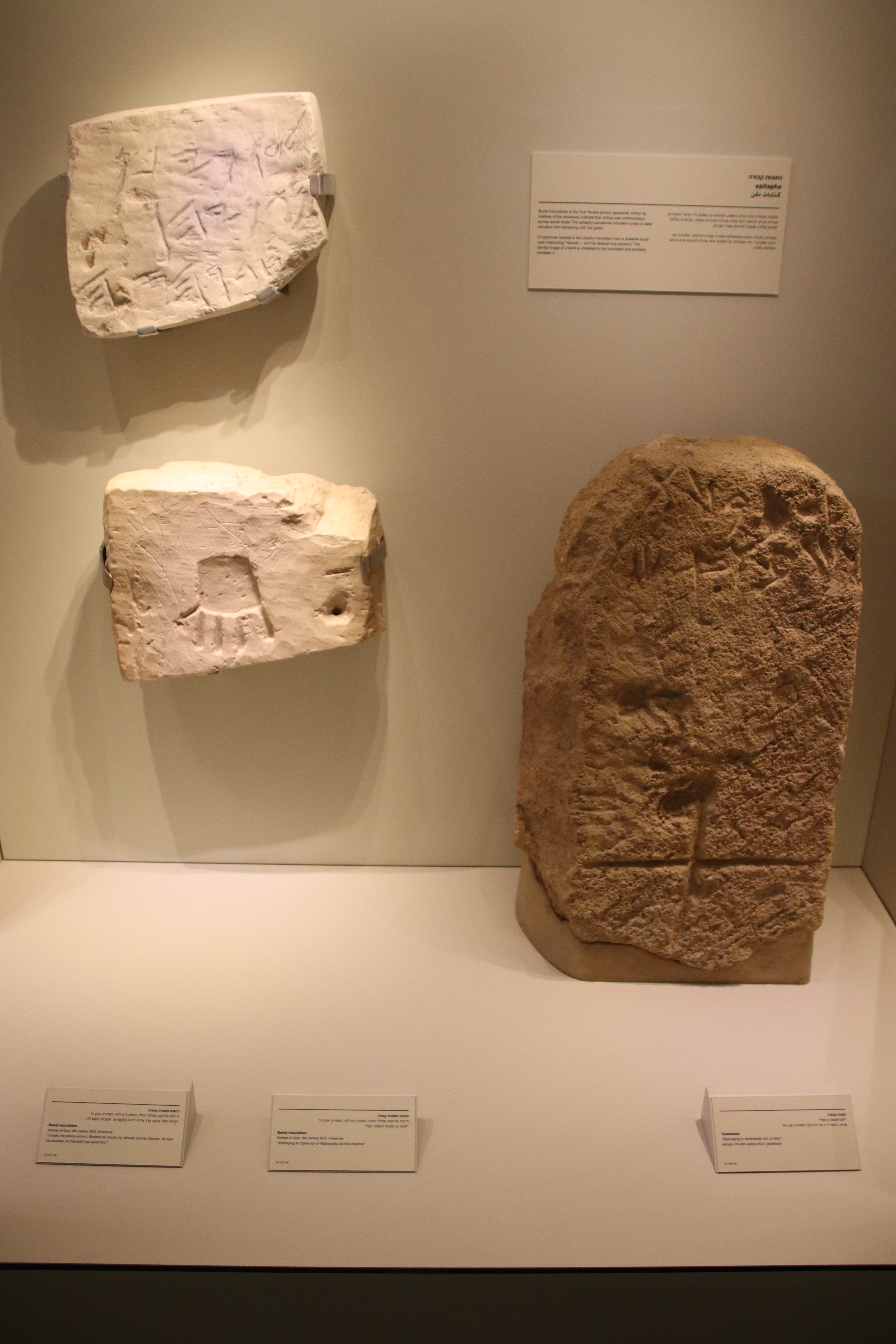
Blessings at Kuntillet ʿAjrudKuntillet ʿAjrudA Sinai site with blessings invoking Yahweh of Samaria/Teman and “his asherah” around 800 BCE; inscriptions illuminate religion and writing, while the site’s function and imagery remain debated.Glossary · Click to read the explanation in SinaiSinai: peninsula and biblical mountainSinai is a peninsula in eastern Egypt; in the Torah the name also denotes the mountain of revelation to MosesGlossary · Click to read the explanation, around 800 BCE, combine Yahweh with ʾšrth; the word also occurs in an eighth-century BCE funerary inscription from Khirbet el-QomKhirbet el-QomSite west of Hebron known for an eighth-century BCE funerary inscription commonly associating Yahweh with “his asherah”; damaged text and readings disputed.Glossary · Click to read the explanation, west of Hebron. These are contemporary witnesses to usage rather than later biblical condemnation. They describe no shape and name no wooden material. “His asherah” depends on reading final -h as a pronoun, a common but not exclusive analysis. [8][9]
Judith M. HadleyJudith M. HadleyScholar of ancient Israelite religion and inscriptions who taught theology and religious studies at Villanova; a specialist in the evidence for Asherah and el-Qom.Glossary · Click to read the explanation, a scholar of ancient Israelite religion, favours a wooden symbol representing the goddess: an object fits the possessive construction and can bear the represented deity’s name. By contrast, Richard S. HessRichard S. HessOld Testament and Semitic-language scholar at Denver Seminary, studying ancient inscriptions, names and religion.Glossary · Click to read the explanation, a scholar of Hebrew and the ancient Near EastAncient Near EastModern scholarly label for ancient societies of Mesopotamia, the Levant, Anatolia and Iran, sometimes extending to Egypt and other neighbours depending on the study; not one civilization or religion.Glossary · Click to read the explanation, argues for “Asherata”, the goddess’s name without a pronoun, drawing on older spellings and representations of endings. His objection prevents treating the grammatical analysis as a given, but requires continuity of the name’s form across different periods and dialects. The short inscriptions alone cannot settle the referent; they are less direct evidence for wooden objects than passages about cutting and burning. [1][9]
The abstract of a study by Émile PuechÉmile PuechSpecialist in Semitic inscriptions and the Dead Sea Scrolls, emeritus professor at Jerusalem’s École biblique; proposes a shrine reading at el-Qom.Glossary · Click to read the explanation, a specialist in Semitic inscriptions, offers another reading for el-Qom: “shrine”. This is not adopted as a ruling on every occurrence of the word. Its detailed argument was not read here, so it defines the range of disagreement rather than taking priority over directly examined interpretations. [2]
What can images establish?
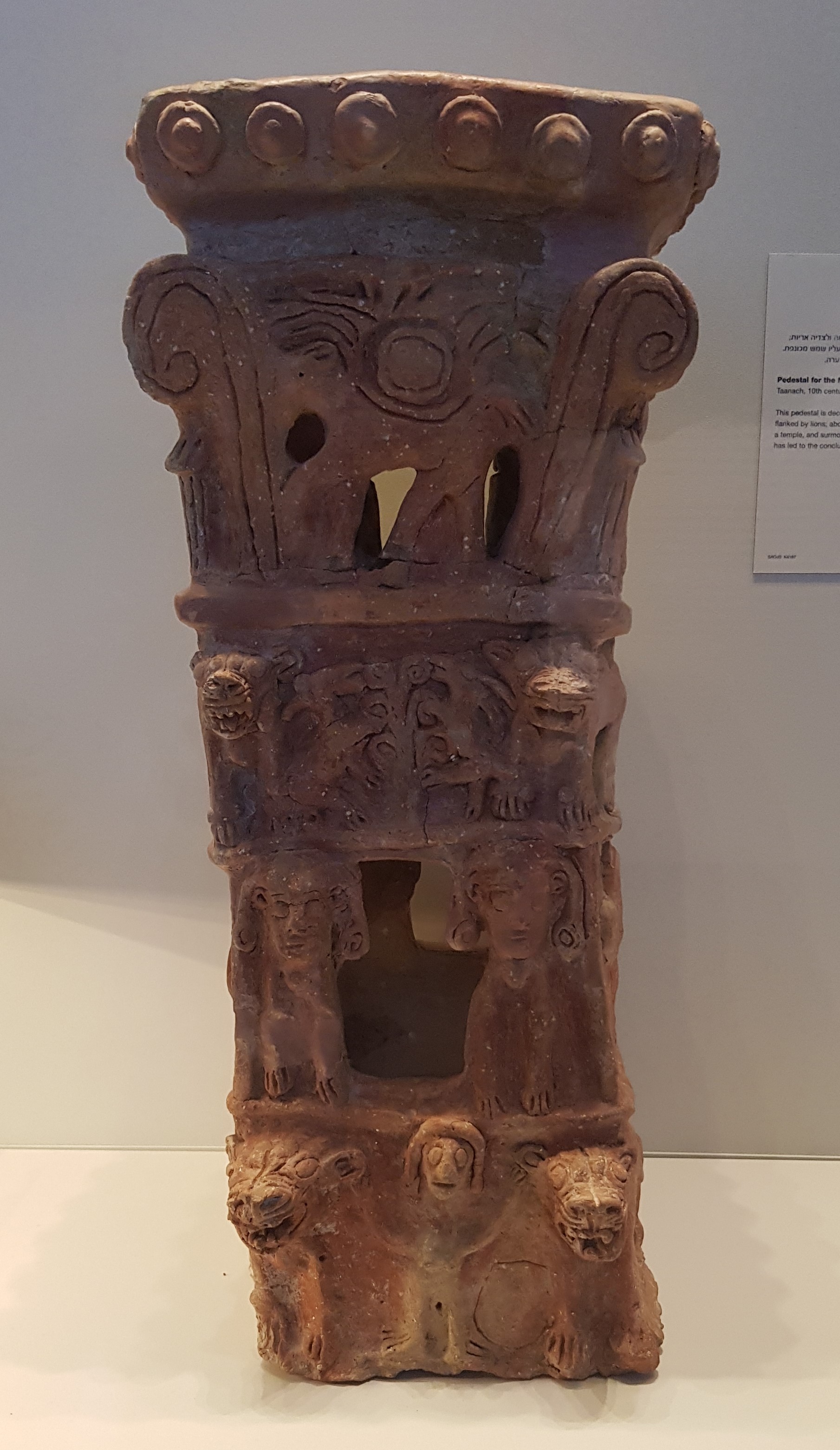
The ceramic stand from Taanach on the cover, dated in its catalogue to the tenth–ninth centuries BCE, bears a tree between two animals. It is a genuine artifact, but neither a wooden pole nor an inscription naming the tree Asherah. [6]
Trees flanked by animals, women holding branches and pillar-shaped female figurines are not exclusive signs of Asherah. Such motifs span different regions and periods. Attribution requires converging textual, contextual, chronological and visual evidence, not choosing an interpretation and using it to prove itself. [10]
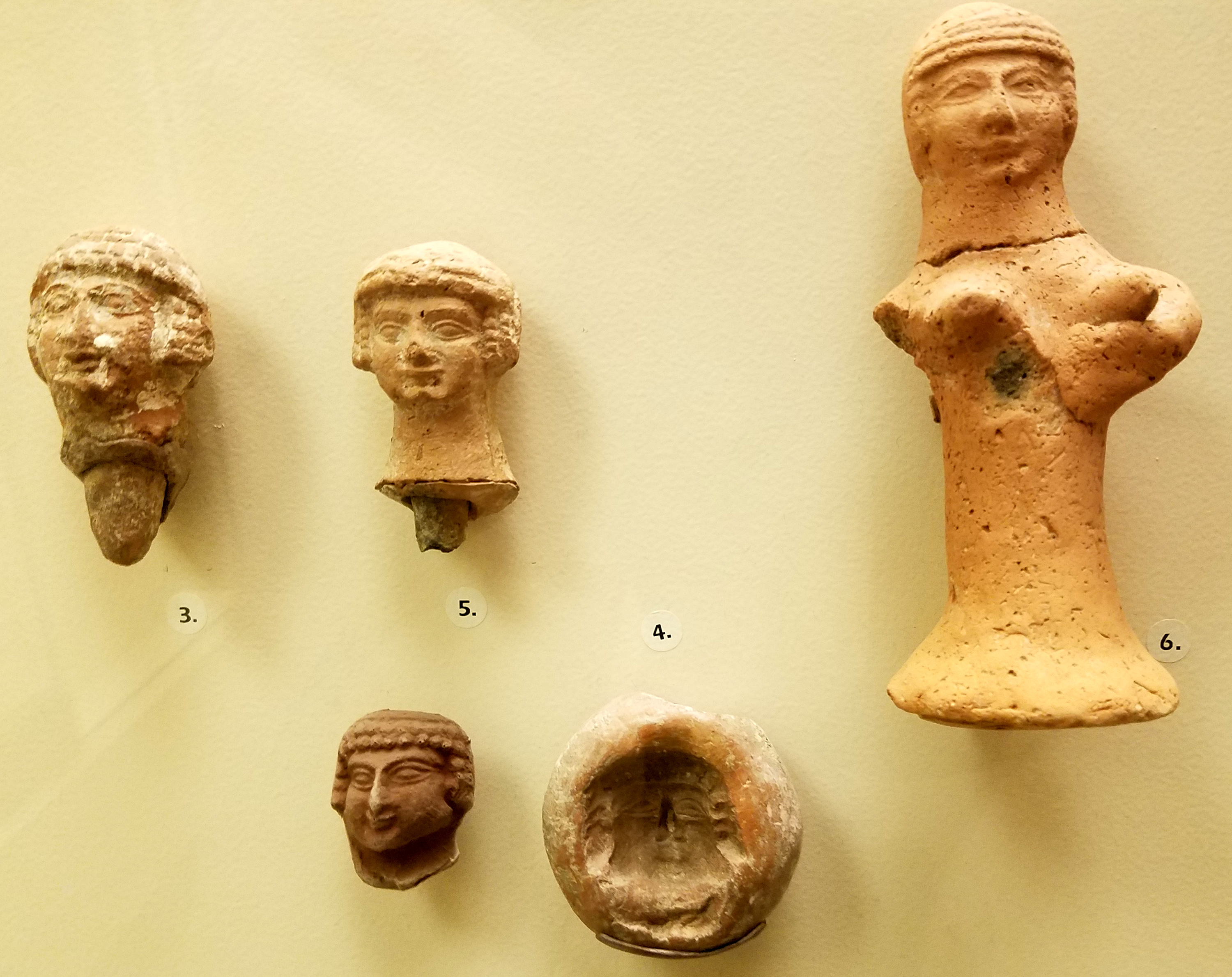
Judean pillar figurinesJudean pillar figurinesSmall late Iron Age terracotta female figures of Judah, with pillar-like bases and moulded or hand-shaped heads; neither their represented identity nor their ritual or protective use is settled.Glossary · Click to read the explanation are clay, whereas some textual asherim are wooden; an upright shape does not make them one archaeological category. A symbol might retain a connection with the goddess while used in Yahweh’s worship, and its interpretation might change over time. The choice is not always between “an actual goddess” and “religiously meaningless wood”.
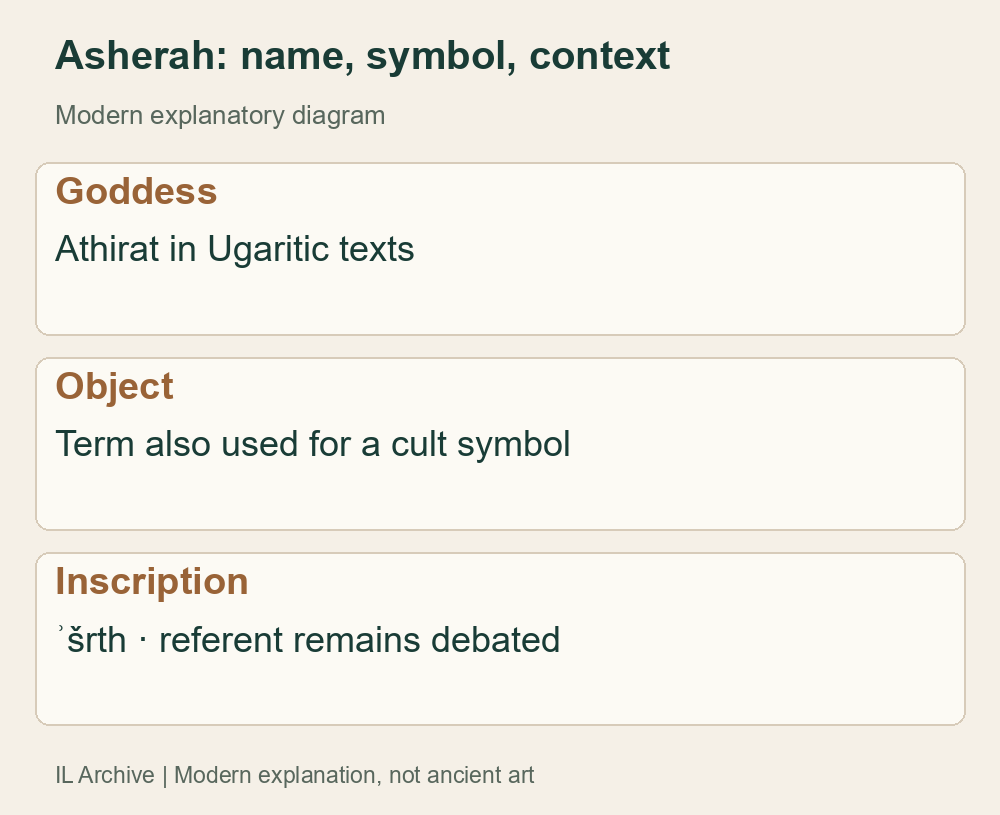
The following modern diagram explains relationships among name, symbol and inscription; it does not archaeologically reconstruct the asherah’s appearance.
A clear limit, and what lies beyond it
The strongest conclusion is a material use of asherah in texts describing planting, making, cutting and burning it. These descriptions do not yield one reconstruction for every form or location. Its relationship to the goddess and to blessings invoking “Yahweh and ʾšrth” must be examined case by case. The historical connection is substantial, but symbol, name and image do not automatically coincide. The asherah thus reveals changing practice and terminology rather than supplying a ready-made answer about an entire society’s religion.
References and notes (10)
- Judith M. Hadley. Evidence for Asherah. Bible Interp, 2008. Sections on Ugarit, el-Qom and Kuntillet ʿAjrud inscriptions, verbs used with asherah, and Deuteronomy; the wooden-symbol interpretation is distinguished from inscriptional wording. Return to the text ↑
- Émile Puech. L’inscription 3 de Khirbet el-Qôm revisitée et l’Ashérah. Revue Biblique 122 (2015), 5–25. DOI: 10.2143/RBI.122.1.3149557. Publisher abstract only: ʾšrh as shrine. Full revised decipherment not evaluated or presented as consensus. Return to the text ↑
- Judges, Hebrew text and English translation, Mechon Mamre. Judges 6:25–30; short Hebrew excerpt from 6:26 with an editorial translation; no manuscript collation. Return to the text ↑
- 2 Kings, Hebrew text and English translation, Mechon Mamre. 23:4–7, especially removal, burning and pulverizing in 23:6. Return to the text ↑
- Deuteronomy, Hebrew text and English translation, Mechon Mamre. 16:21–22: prohibition on planting an asherah, followed by a separate verse on a pillar. Note 1 discusses why planting alone does not determine form. Return to the text ↑
- Posen Library, “Ceramic Offering Stand from Taanach”. Public catalogue metadata and image description: tenth–ninth centuries BCE; Taanach/Tall Tiʿinnik, West Bank. Restricted content behind login not read. Return to the text ↑
- 2 Kings, Hebrew text and English translation, Mechon Mamre. 21:3–7: making the asherah and placing its image in the temple. Return to the text ↑
- Jeremy Smoak and William M. Schniedewind, “Religion at Kuntillet ʿAjrud”, Religions 10/3 (2019), 211. Section 3 and the asherah discussion in section 4: formulas, function and grammatical debate; not the whole article. Return to the text ↑
- Richard S. Hess, “New Evidence for Asherata/Asherah”, Religions 16/4 (2025), 397. Complete main text in the open publisher version: name, ending and inscription locators; no examination of archaeological originals. Return to the text ↑
- Paolo Merlo, “Asherah”, Iconography of Deities and Demons, electronic prepublication, 3 February 2010. Selected passages, pages 1–2 and 6–7: identification problems, trees and figurines; not the complete entry. Return to the text ↑
Suggest a correction · Suggest a source for this record
Cite this record
IL Archive, «Asherah cult symbol», https://ilarchive.com/en/entities/asherah-cult-symbol
Continue reading