Entity · Concept
Judean pillar figurines
A reference page linking a name, group, or concept to the materials that discuss it.
- Region
- Kingdom of Judah, southern Levant (Iron Age II)
Terracotta female figures with pillar bases from the kingdom of Judah in the late Iron Age; their links with Asherah, fertility, protection or healing are competing hypotheses that form alone cannot settle.
Estimated reading time: 7 min Published Last reviewed:
Share article
Text
Introduction
What can small, uninscribed clay images tell us about religious life in the kingdom of JudahKingdom of JudahJudah was an ancient southern Levantine kingdom centered on Jerusalem in the Iron AgeGlossary · Click to read the explanation? This entry examines the objects known as Judean pillar figurinesFigurineA small shaped object depicting a human, animal or abbreviated form, in clay, stone or another medium. Its form alone does not establish its use; manufacture, handling traces and find context matter.Glossary · Click to read the explanation: their forms, distribution and archaeological deposits. It then weighs the identification of the female figure with a goddess against interpretations involving protection, healing and other household practices. The question is not simply whom the figure depicts, but how far we can move from a surviving object to claims about its ancient users and their beliefs.
What is a Judean pillar figurine?
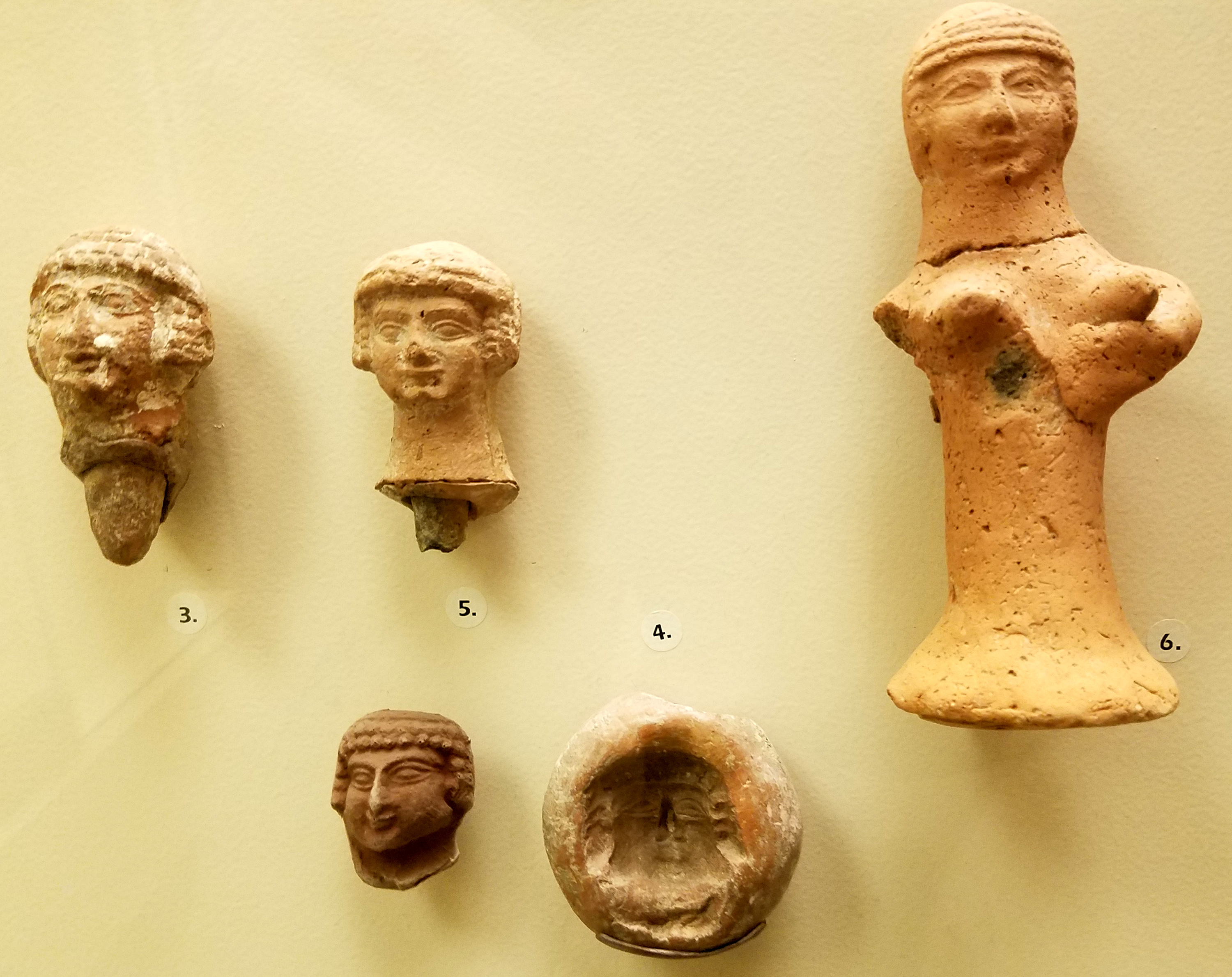
Archaeologists apply the name to a class of small terracotta female figures of Iron Age II, particularly widespread in the eighth and seventh centuries BCE. A represented upper body rises from a thick cylindrical or pillar-like base, sometimes broadened below, without separately modelled legs. The arms generally pass beneath or around the breasts. Some heads were moulded separately and attached, producing visible facial features and hairstyles; others were pinched into shape by hand, with simplified features. The pieces are not identical: details and gestures vary, and a few examples hold objects. The term designates a modern archaeological category, not a name recorded by their ancient makers. [1]
A specific example from Lachish
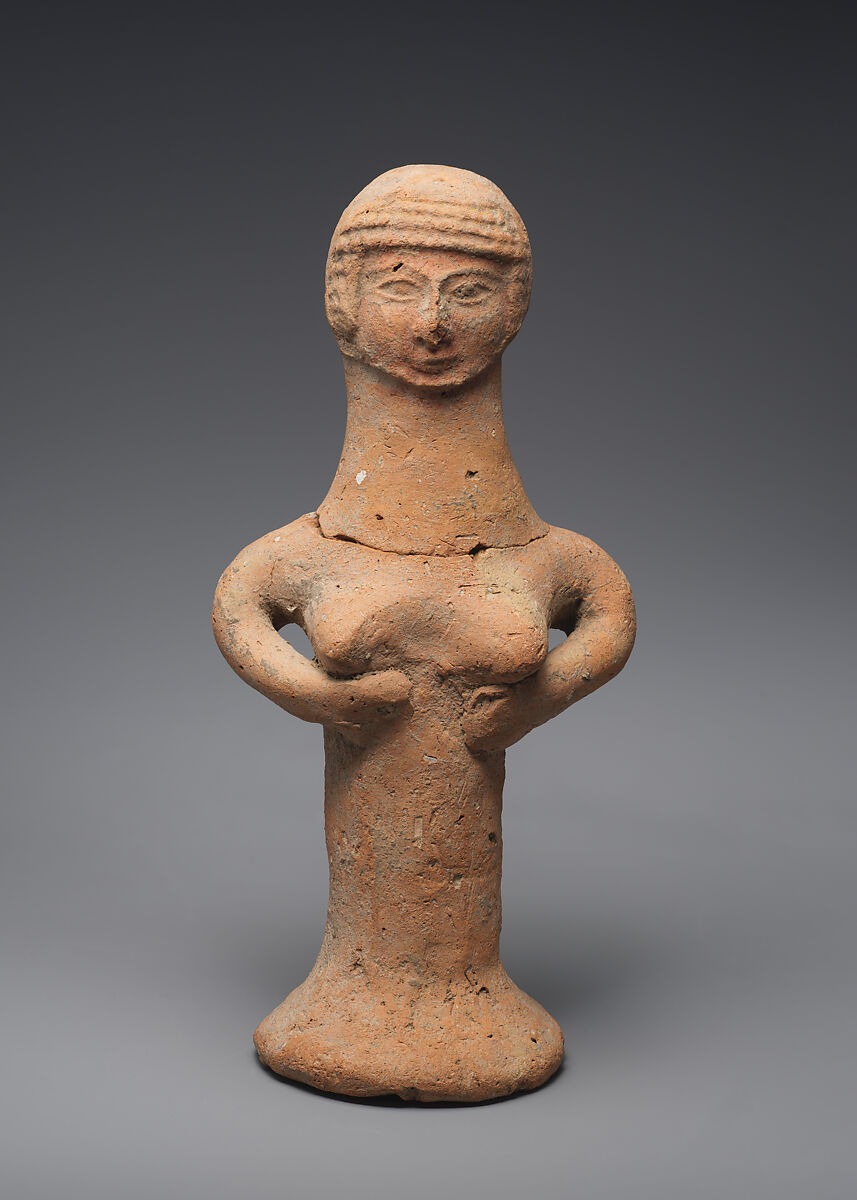
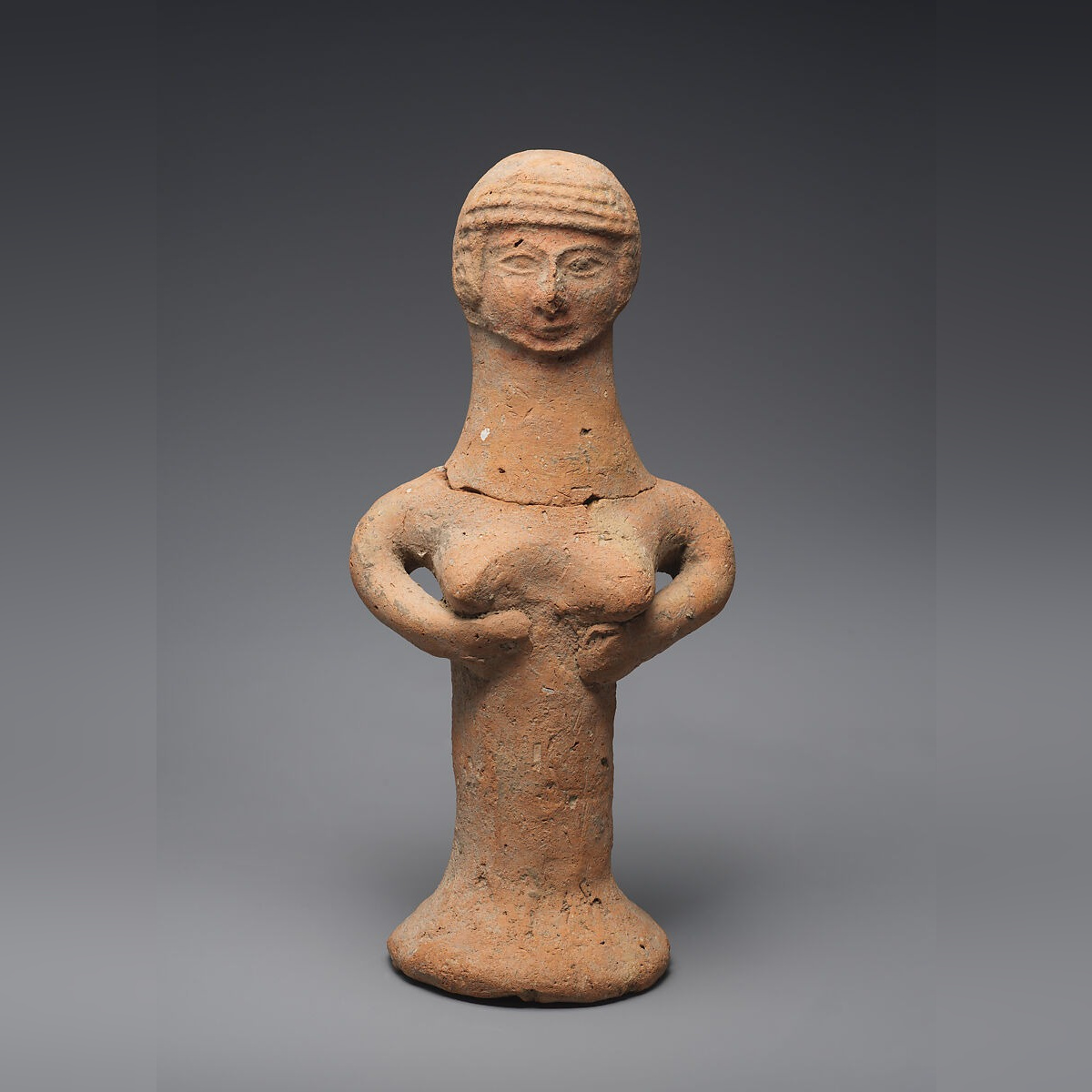
The photographed object belongs to the Metropolitan Museum of Art, accession 34.126.53, and comes from Lachish (Tell ed-Duweir), an important fortified town southwest of JerusalemJerusalemJerusalem is a city of religious importance in Judaism, Christianity and IslamGlossary · Click to read the explanation. The museum dates this ceramic figure approximately to the eighth–seventh centuries BCE and records a height of 18.4 cm. Its moulded facial features and coiffure, breasts supported by the hands, and widening base are visible. The artifact itself securely illustrates the type; the museum's suggested association with a mother or fertility goddess remains an interpretation, not a divine name inscribed on the figurine. Nor should its broad archaeological date be reduced to the single event of the Assyrian siege of Lachish in 701 BCE. [2]
When and where did they circulate?
The assemblage is concentrated at sites in the kingdom of Judah during the later Iron Age II, prominently Jerusalem, Tell en-Naṣbeh to its north, Lachish, Beth Shemesh and other towns. Raz Kletter's 1996 catalogue assembled approximately 850 figurines; subsequently published discoveries have enlarged the body of material, and totals differ depending on the definition of the type and treatment of fragments. A manufacture date is not necessarily the date at which an object was discarded or entered a later fill. The geographical concentration suggests a distinctive local material tradition, not that every household in Judah performed the same ritualRitualAn organised or distinguished practice meaningful to a community; it may leave traces, but its form alone does not reveal an associated doctrine.Glossary · Click to read the explanation. [3]
A house is not the same as a findspot of use
Many pieces were recovered from residential buildings, but others lay in refuse or in deposits reused as levelling material for floors and walls. Finding a broken figurine “in a house” does not show that it once stood on a domestic altar at the place of excavation: objects move between use, disposal and final archaeological deposition. Erin Darby's examination of Jerusalem stresses the absence of consistent associations with dedicated cultic rooms or equipment conventionally labelled women's work. Even a figurine found near a model horse or a pot need not have been used with it during a single rite. Petrographic research also illuminates production, but cannot reconstruct what users did with the objects. [4]
Was the figure the goddess Asherah?
A prominent proposal identifies these objects with Asherah/AthiratAthiratA prominent goddess commonly understood as El’s consort in Ugaritic texts; she bears the progenitress epithet and intercedes for Baal’s palace.Glossary · Click to read the explanation, a divine figure known from ancient West Semitic traditions, or more generally with female imagery related to nourishment and fertility. Supporters connect the emphasis on the breasts with breastfeeding and the figurines' prevalence in Judah with references to “Asherah” in inscriptions and the HebrewHebrewA Northwest Semitic language of the Canaanite group, encompassing Iron Age epigraphy, Biblical, Rabbinic, medieval and Modern Hebrew; its scripts and pronunciations changed over time.Glossary · Click to read the explanation Bible. Yet the figurines themselves do not name Asherah. A female body does not exclude a protective symbol or other household use, nor does it establish which divine personality, if any, was represented. Erin Darby's 2014 monograph challenges assumptions built on iconography alone by studying Jerusalem contexts and comparative texts; the goddess interpretation nevertheless remains part of the scholarly discussion. [5]
“His asherah” in inscriptions: a different kind of evidence
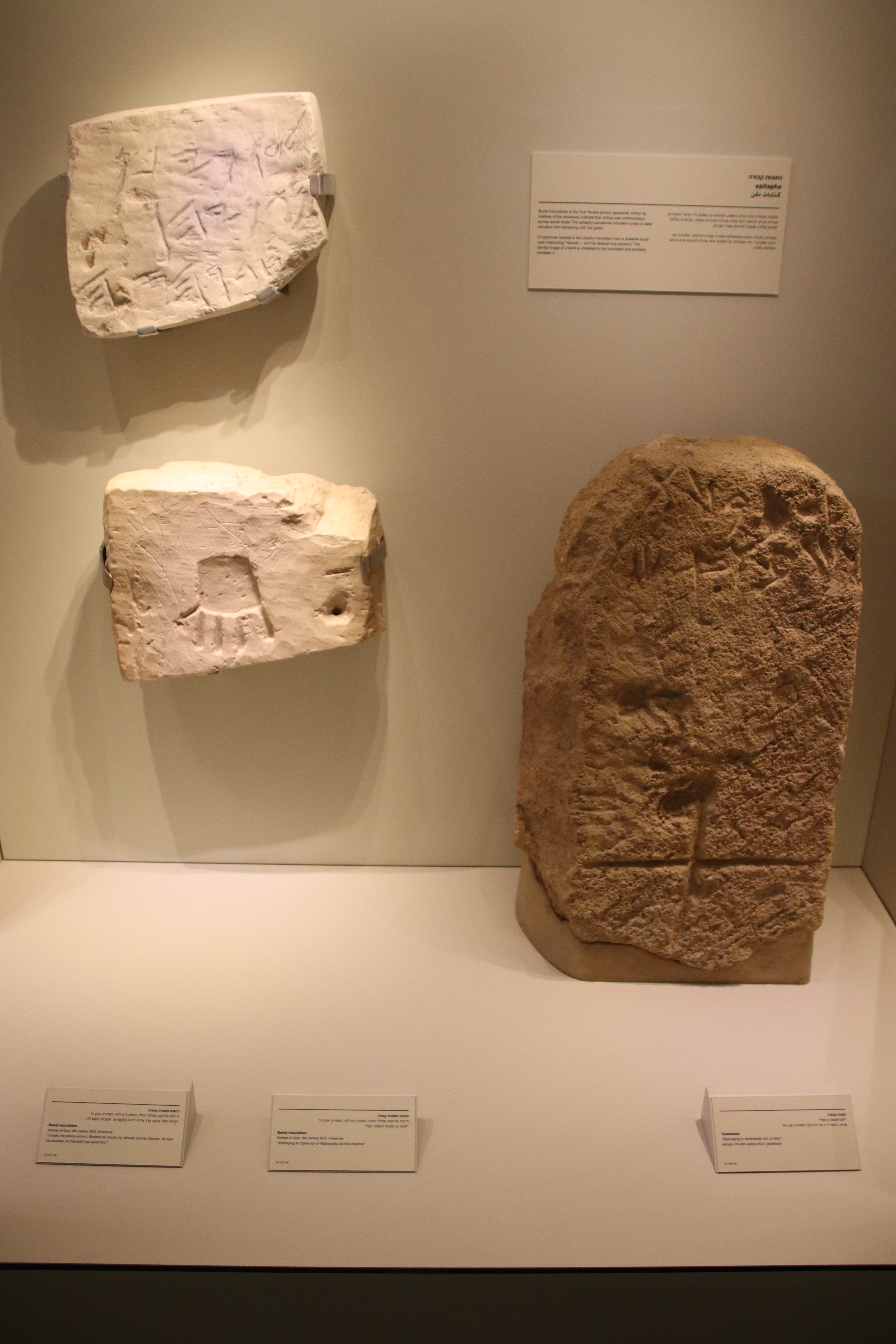
Blessings invoking YahwehYahwehThe proper name of Israel’s deity, written יהוה (YHWH), the Tetragrammaton. Its exact ancient pronunciation is not directly preserved; texts and inscriptions witness its history.Glossary · Click to read the explanation and what is often translated as “his asherah” occur at Kuntillet ʿAjrudKuntillet ʿAjrudA Sinai site with blessings invoking Yahweh of Samaria/Teman and “his asherah” around 800 BCE; inscriptions illuminate religion and writing, while the site’s function and imagery remain debated.Glossary · Click to read the explanation, a site on a desert route in northeastern SinaiSinai: peninsula and biblical mountainSinai is a peninsula in eastern Egypt; in the Torah the name also denotes the mountain of revelation to MosesGlossary · Click to read the explanation; a related formula occurs at Khirbet el-QomKhirbet el-QomSite west of Hebron known for an eighth-century BCE funerary inscription commonly associating Yahweh with “his asherah”; damaged text and readings disputed.Glossary · Click to read the explanation. Whether the possessive expression refers to a goddess, a cultic objectAsherah cult symbolAsherah as a cult object or symbol, often wooden in biblical contexts; relation to the goddess and inscriptional ʾšrth remains debated.Glossary · Click to read the explanation, or a sanctuary-related concept is debated. Jeremy Smoak and William Schniedewind examine the wording within the scribal and religious setting of Kuntillet ʿAjrud. Even the presence of this expression does not establish that the terracotta female figurines depicted the entity or object mentioned. An inscription documents a particular religious discourse; a figurine documents manufacture and use. Their identification with one another would require an additional connection. [6]
What do the narratives in Kings say?
2 Kings 21:7 describes King Manasseh placing an image of the asherah in Yahweh's temple. 2 Kings 23:4–7 narrates measures attributed to Josiah against cult objects, an asherah image and other practices. These passages are important witnesses to the authors' portrayals of acceptable and unacceptable worship, but they do not describe a specific pillar-shaped ceramic figurine of the museum type. Their composition and transmission histories are also not identical to the manufacturing date of every archaeological find. The distribution and breakage of the figurines cannot therefore be attributed wholesale to one reform without independent stratigraphic evidence. [7] [8]
Fertility, motherhood and women's ritual?
Prominent breasts are genuine iconographic features and could have communicated nurturing or maternity to at least some users. But the represented subject does not establish the gender of those who made, owned or handled the objects, nor does it confine their use to pregnancy and childbirth. Protection, household wellbeing, childcare, vows and fertility might have overlapped within some practices; assigning a single function to every piece calls for a recurrent association with rituals, inscriptions or secure activity areas. Darby's study of the modern construction of “female piety” warns that readings of these images can reflect researchers' expectations about women's roles more clearly than demonstrable facts about ancient users. [9]
Protection and healing as a hypothesis
Darby suggests that at least some figurines may have served an apotropaic purpose—warding off harm—or participated in domestic healing rites. The argument draws on Neo-Assyrian ritual texts describing figures deployed against many threats, as well as the possibility that human images represent guardians without themselves being the supreme deity addressed in prayer. These are comparisons between traditions whose artifacts and practices are not identical. No surviving instruction explains how an individual in Jerusalem handled, installed or disposed of this particular Judean type. Suggestions about displaying a figure near a doorway or manipulating it during a rite remain testable reconstructions, not established scenes of ancient Judean ritual. [10]
Clay fabrics, workshops and exchange
Petrography, the microscopic examination of minerals and inclusions in clay, provides a more directly testable question about production. A study of fifteen anthropomorphic figurines and five “bed models” from Tell en-Naṣbeh found that their fabrics generally differed from the usual local pottery, suggesting manufacture elsewhere, possibly near Jerusalem. David Ben-Shlomo's 2025 synthesis also finds predominantly local production for the Jerusalem material and movement of some figurines to Tell en-Naṣbeh. These findings concern materials and circulation, not the sex of a purchaser or the object's precise religious meaning; nor do they prove that a single central workshop supplied every settlement. [11]
Local identity under Assyrian expansion
Ian Douglas Wilson proposes that the popularity of the figurines in the eighth and seventh centuries BCE can be read in terms of Judean cultural identity during Neo-Assyrian imperial expansion. This explains a possible historical significance of their timing and distribution, not what every person thought as they handled one. The interpretation need not exclude protective or ritual functions: an object may be locally distinctive and simultaneously used in an individual household practice. The broader political context is clear; an intention to resist imperial power through these particular images is an interpretive proposal rather than an inscribed declaration. [12]
What remains secure?
The material evidence establishes a widespread type of small terracotta female figurine with pillar base, varied methods of forming heads and a strong presence in late Iron Age Judah, often in residential or secondary deposits. Individual objects can be identified, dated approximately and studied technically; clay analysis offers evidence about where some were made. Their precise divine identity, the people who used them and the ritual actions involved remain competing interpretations with different evidential strengths. The figurines should be read alongside inscriptions and biblical narratives, not as ready-made illustrations of them. Their physical survival allows us to ask questions about everyday religion that literary accounts frame differently.
References and notes (12)
- Erin Darby, “Fatal Attraction: Obsession, Aversion, and the Femme Fatale of Ancient Judah,” Bible Interpretation, February 2015. Entire article consulted: “What are Judean Pillar Figurines?”, “Ancient Near Eastern Figurine Ritual Texts”, “Jerusalem Archaeology”, “Naked Female Iconography”, “Clay and Idols”, “So, What are JPFs?”, and author reply of 28 September 2016. Not a reading of the complete 2014 book. Return to the text ↑
- The Metropolitan Museum of Art, “Nude female figure,” object 34.126.53, collection record 323163. Object page consulted: title, period, provenance, material, dimensions, gift credit, curatorial text, and Public Domain image label. Height 18.4 cm; no divine name recorded on the object. Return to the text ↑
- Raz Kletter, The Judean Pillar Figurines and the Archaeology of Asherah, BAR International Series 636 (Oxford, 1996). University of Helsinki bibliographic abstract only, reporting a catalogue of c. 850 objects and themes of dating, distribution and breakage. Book text and individual pages not accessed. Return to the text ↑
- David Ben-Shlomo, “Compositional Analysis of Cultic Clay Objects from the Iron Age Southern Levant,” Religions 16, no. 6 (2025): 661. HTML article consulted at abstract, §§1, 3.2.1–3.2.3 (samples and fabrics), §4 discussion, §5 conclusions and closing note. Darby 2015 is separate evidence for secondary deposits. Return to the text ↑
- Erin Darby, Interpreting Judean Pillar Figurines: Gender and Empire in Judean Apotropaic Ritual (Mohr Siebeck, 2014). Publisher description read; chapter/section contents separately checked in the Google Books listing. The full 608-page volume was not read and no findings from inaccessible pages are imputed. Return to the text ↑
- Jeremy Smoak and William Schniedewind, “Religion at Kuntillet ʿAjrud,” Religions 10, no. 3 (2019): 211. HTML introduction, passages on “Yahweh and his ʾasherah,” grammatical alternatives and §7 conclusions consulted. Study concerns inscriptions, not museum object 34.126.53. Return to the text ↑
- 2 Kings 21:7, Hebrew text and the translation displayed by Sefaria (the setting up of an asherah image). Verse 21:7 and immediate context read; literary witness to an asherah image, not a typological identification of pillar figurines. Return to the text ↑
- 2 Kings 23:4–7, Hebrew text and translation displayed by Sefaria (reform actions attributed to Josiah). Verses 23:4–7 read directly; no assumption that their objects are any particular archaeological figurine. Return to the text ↑
- Erin Darby, “Judean Pillar Figurines and the Making of Female Piety in Ancient Israelite Religion,” in Gods, Objects, and Ritual Practice (2017), 193–214. Chapter listing and opening excerpt only, not all pp. 193–214; limited to research framing, with details supported by Darby’s full public article [1]. Return to the text ↑
- Erin Darby, “Fatal Attraction,” Bible Interpretation (2015), sections “Ancient Near Eastern Figurine Ritual Texts” and “So, What are JPFs?”. Named sections read fully, together with Darby’s dated 28 September 2016 reply expressly calling doorstep placement and handling conjecture. Return to the text ↑
- David Ben-Shlomo and Lauren K. McCormick, “Judean Pillar Figurines and ‘Bed Models’ from Tell en-Naṣbeh: Typology and Petrographic Analysis,” Bulletin of the American Schools of Oriental Research 386 (2021): 23–46. Journal abstract only: 15 anthropomorphic figurines and five bed models, largely nonlocal clay. Full pp. 23–46 behind access restriction; details cross-checked against open 2025 synthesis [4]. Return to the text ↑
- Ian Douglas Wilson, “Judean Pillar Figurines and Ethnic Identity in the Shadow of Assyria,” Journal for the Study of the Old Testament 36, no. 3 (2012): 259–278. Publisher abstract only, not restricted pp. 259–278; local-identity reading under Assyrian expansion is explicitly the abstract’s proposal. Return to the text ↑
Suggest a correction · Suggest a source for this record
Cite this record
IL Archive, «Judean pillar figurines», https://ilarchive.com/en/entities/judean-pillar-figurines
Continue reading