Entity · Concept
Septuagint
A reference page linking a name, group, or concept to the materials that discuss it.
Traditional designation for ancient Greek translations of Jewish scriptures, whose readings sometimes differ from the Hebrew Masoretic Text.
Text
A Greek witness
Septuagint is the traditional designation for ancient Greek translations of Jewish scriptures. It contributes to comparison of the HebrewHebrewA Northwest Semitic language in the Canaanite group, with ancient and modern forms.Glossary · Click to read the explanation text’s history, but is not a single simple witness with identical wording across all manuscripts and books.[1]
Translation differences and source differences
A Greek difference may reflect another Hebrew wording, or an act of translation and interpretation. Translating Greek back into a modern language cannot establish the Hebrew original with certainty. Context, manuscripts and the translator’s practices must be considered.[1]
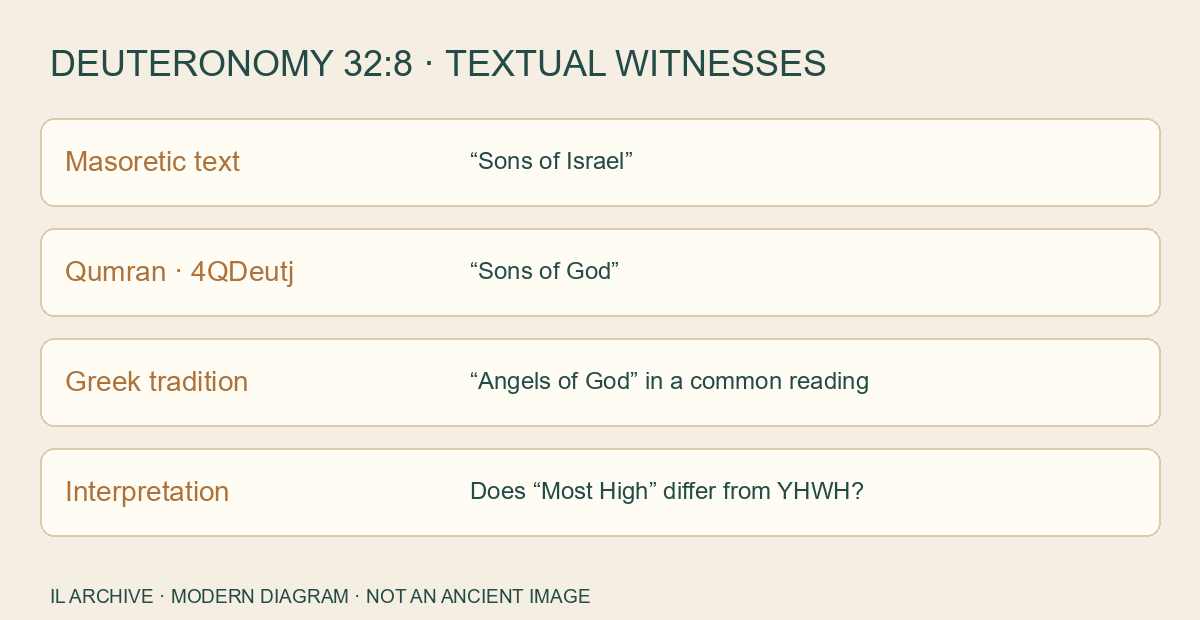
Deuteronomy 32:8
A common Greek reading has “angels of God” where Hebrew 4QDeutj preserves “sons of GodSons of GodA Hebrew expression for heavenly beings in texts such as Job; context determines its meaning, rather than biological descent or a fixed angelic roster.Glossary · Click to read the explanation,” against the Masoretic “sons of Israel.” The comparison supports a celestial background but does not settle the Most High’s identity or relationship to YahwehYahwehThe divine proper name written YHWH in the Hebrew Bible.Glossary · Click to read the explanation.[2]
The accompanying image is a modern witness diagram, not a photograph of an ancient Septuagint manuscript or tablet.
References and notes
- Eibert Tigchelaar (2012). Editing the Hebrew Bible: An Overview of Some Problems. In Editing the Bible: Assessing the Task Past and Present, ed. John S. Kloppenborg and Judith H. Newman, pp. 41–66, especially p. 46 n. 22. Selected pp. 41–46, especially p. 46 n. 22 identifying 4QDeutj for Deuteronomy 32:8. Page visually checked; not the whole volume. Witness identification does not prove El–Yahweh separation. Return to the text ↑
- NET Bible. Deuteronomy 32, textual note 14 on verse 8. Textual note 14: Qumran sons of God and common Greek angels of God against sons of Israel. Greek wording in the note read; not an independent collation of all Septuagint manuscripts. Identity interpretation is separate from textual preference. Return to the text ↑
Research history
Substantive changes are retained here. Minor copy edits remain in the internal operational log.
-
Substantive record update
Suggest a correction · Suggest a source for this record
Cite this record
IL Archive, «Septuagint», Edition 2, https://ilarchive.com/en/entities/septuagint