Entity · Concept
Sons of God
A reference page linking a name, group, or concept to the materials that discuss it.
- Names
- bene elohim · bene ha-elohim
A Hebrew phrase for beings at the heavenly court in Job, with another context in Genesis. The entry compares Ugaritic and Psalmic parallels and explains the 4Q37 variant at Deuteronomy 32:8 and its interpretive limits.
Estimated reading time: 7 min Published Last reviewed:
Share article

Text
Introduction
Who are the “sons of God” in HebrewHebrewA Northwest Semitic language of the Canaanite group, encompassing Iron Age epigraphy, Biblical, Rabbinic, medieval and Modern Hebrew; its scripts and pronunciations changed over time.Glossary · Click to read the explanation writings: a heavenly group, human beings, or angels in a sense developed later? This entry traces the Hebrew expressions in Job and Genesis, compares them with heavenly-council imagery in the Psalms and Ugaritic texts, and explains the reading of Deuteronomy 32:8 in a Qumran manuscript. It distinguishes what the witnesses actually say from unresolved interpretations.
Which Hebrew expression?
“Bene elohimElohimA Hebrew word with plural morphology, used for “gods” or for a singular deity according to context.Glossary · Click to read the explanation” is a transliteration of a Hebrew phrase literally meaning “sons of Elohim.” The Book of JobBook of JobHebrew wisdom text exploring suffering, justice and the limits of human knowledge through dialogue and poetry.Glossary · Click to read the explanation 1:6 and 2:1 has בְּנֵי הָאֱלֹהִים (bene ha-elohim), with the definite article; Job 38:7 has בְּנֵי אֱלֹהִים (bene elohim), without it. Although elohim is morphologically plural, Hebrew also uses it of Israel’s God with singular verbs. The identity of the “sons” therefore depends on the passage. The expression alone neither requires biological parentage nor provides a fixed roster of heavenly beings.[1]
The gathering in Job
The narrative frame of Job opens with the “sons of ha-elohim” coming to present themselves before YHWHYahwehThe proper name of Israel’s deity, written יהוה (YHWH), the Tetragrammaton. Its exact ancient pronunciation is not directly preserved; texts and inscriptions witness its history.Glossary · Click to read the explanation. Among them comes ha-satanHa-satan in Job: Title, Role, and InterpretationHebrew “the adversary” in Job 1–2, who challenges Job’s motives with Yahweh’s permission. “Accuser” is a common functional interpretation, but “enforcer” has been argued; later Satan traditions cannot simply be read back into the passage.Glossary · Click to read the explanation, “the adversary” or “the accuser,” acting in a specific narrative capacity. YHWH questions him about JobJobCentral figure of the Book of Job, introduced as upright and subjected to suffering after a heavenly discussion of his fidelity.Glossary · Click to read the explanation and permits a test within limits he himself sets (Job 1:6–12). A similar appearance occurs in 2:1–6. The story thus portrays a heavenly court whose participants are subordinate to YHWH, but it gives neither their individual names nor their number or origin. Nor should every attribute of Satan in later traditions be read back into the character of ha-satan in this narrative.[1]
The Ugaritic parallel: comparable structures, not identical members
Texts from UgaritUgaritAncient city and kingdom at Ras Shamra on the Syrian coast, flourishing between the fourteenth and early twelfth centuries BCE and preserving multilingual archives.Glossary · Click to read the explanation, a coastal city in present-day Syria during the Late Bronze AgeLate Bronze AgeAn archaeological period around 1600–1200 BCE in much of the Near East, with international diplomacy, exchange and religious diversity; its endpoints vary by region.Glossary · Click to read the explanation, portray a divine family around the god ElElEl is a senior deity in Late Bronze Age Ugaritic texts, portrayed as father of the divine family and a council authority, alongside his consort Athirat. This entry does not cover every linguistic use of El.Glossary · Click to read the explanation and use terms such as “sons of El” and “assembly of the sons of El.” Scholarly discussions cite Ugaritic expressions including mpḫrt bn ʾil (“assembly of the sons of El,” KTU 1.65:3) and dr bn ʾil (“circle of the sons of El,” KTU 1.40:25, 33–34). These shared patterns of kinship and assembly make comparison valuable for interpreting the divine councilDivine councilA divine council is a religious and literary scene in which divine beings gather before a superior authority for discussion, commissioning or judgment; it is not identical to a pantheon list.Glossary · Click to read the explanation. They do not establish that every figure in Job was an earlier named Ugaritic deity under a new name. Emanuel Tov also cites a reference to 'seventy sons' of El and Athirat at KTU 1.4 VI:46; it does not establish the number present in Job. The KTU references here follow published scholarly discussions, not an independent examination of the tablets.[2]
Deuteronomy 32:8: the witnesses differ
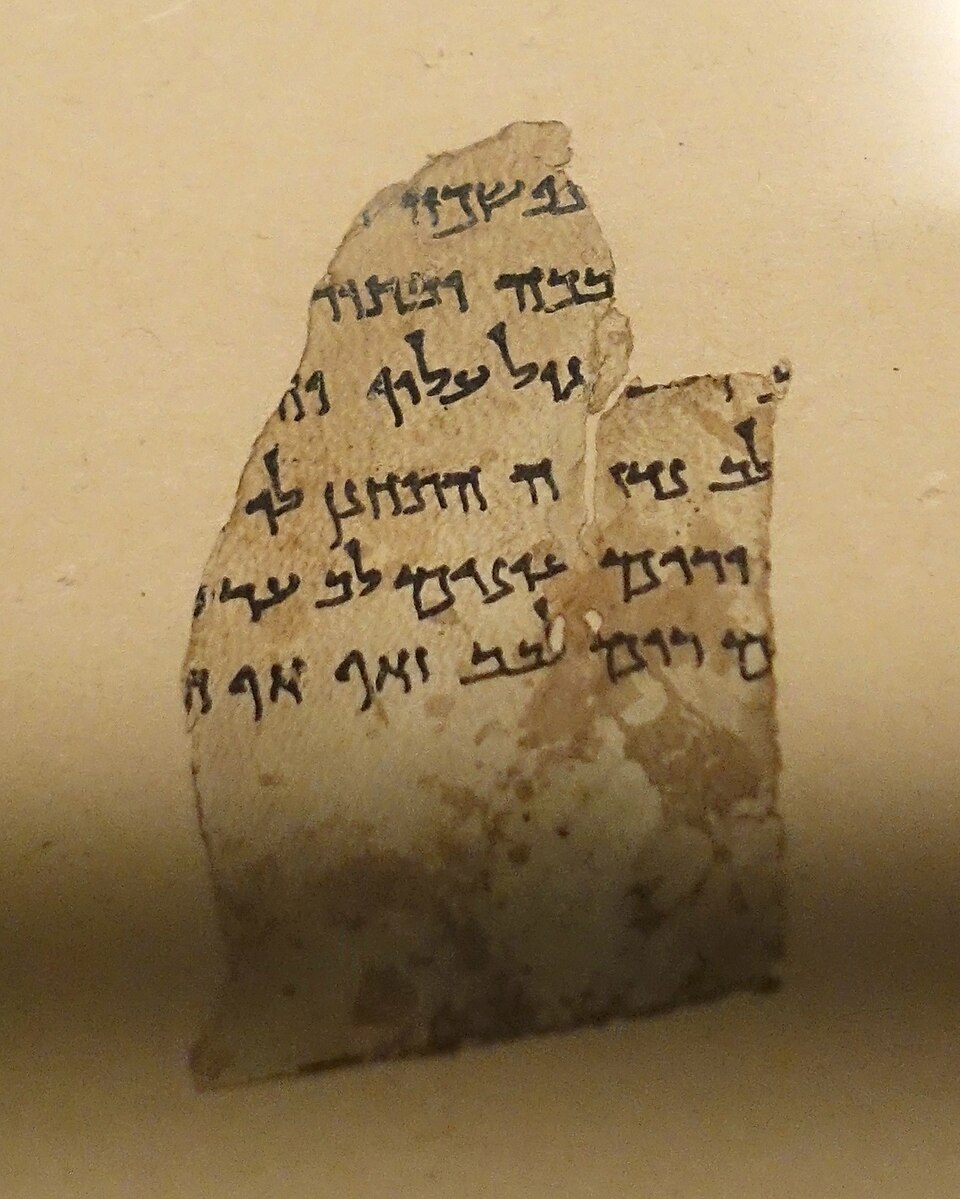
In DeuteronomyBook of DeuteronomyTorah book presenting commandments in Moses’ discourse and grounding Sabbath rest in slavery and liberation from Egypt.Glossary · Click to read the explanation 32:8, a poem describes the Most HighEl ElyonA Hebrew expression meaning “God Most High.” Genesis 14 identifies its bearer with Yahweh, while the Most High’s identity in Deuteronomy 32 remains debated separately from its manuscript readings.Glossary · Click to read the explanation setting the boundaries of the peoples. The Masoretic Hebrew text says “according to the number of the sons of Israel” (בני ישראל). Yet the Hebrew QumranQumranArchaeological site northwest of the Dead Sea near manuscript caves; its settlement and the groups who deposited the scrolls are studied together but not assumed identical. It is not synonymous with all Dead Sea Scrolls.Glossary · Click to read the explanation manuscript 4Q37 / 4QDeutʲ reads “sons of Elohim” (בני אלוהים). Greek witnesses differ too: “angels of God” is widespread, while some preserve “sons of God.” The contrast between “Israel” and “Elohim” is a real textual variant, not merely a stylistic preference in modern translation; identifying the earlier reading requires textual criticismTextual criticismComparison of written witnesses and ancient translations to explain variant readings and textual transmission, distinguishing attested text from restorations and inferred ancestors.Glossary · Click to read the explanation. Nor should 4Q44 be counted as a second verified witness: according to the published abstract of Mikhail Seleznev's 2026 study, an alleged fragment of Deuteronomy 32:8 once attributed to that manuscript does not in fact exist.[3]
Morning stars in Job 38
In Job 38:4–7, YHWH asks where Job was when the earth was founded. “Morning stars” then sing together, and “sons of Elohim” shout for joy. The poetic parallel associates heavenly figures with celebration at the founding of the world. It is neither a record of astronomical observations made by archaeologists nor an account of the birth of identifiable beings. Its function differs from Job 1–2: the first scenes portray attendance and dialogue; here the setting is a cosmic poem.[4]
Sons of God and daughters of humankind in Genesis
GenesisBook of GenesisHebrew book of the Torah containing Noah’s flood, survival offering and covenant with living creatures.Glossary · Click to read the explanation 6:1–4 relates that the “sons of ha-elohim” saw the daughters of humankind and took them as wives; it also refers to the NephilimNephilimHebrew name in Genesis 6:4 and Numbers 13:33, linked to ancient heroes and the scouts’ report; its identification with giants or heavenly offspring depends on interpretation.Glossary · Click to read the explanation and mighty men of renown. The brief account has received several readings: many scholars see heavenly beings joining human women; others have interpreted the “sons” as powerful human rulers, or as descendants of Seth in a later exegetical tradition. Its verbal resemblance to Job is significant, but its actions, setting and narrative purpose differ. The mention of the Nephilim does not warrant invented physical descriptions or family trees absent from the passage.[5]
Related expressions in the Psalms
The Book of PsalmsBook of PsalmsCollection of ancient Hebrew poems and prayers; Leviathan has different roles in Psalms 74 and 104.Glossary · Click to read the explanation 29:1 addresses בני אלים (bene elim), not the same Hebrew letters as “bene elohim”; it can be rendered “sons of gods/mighty ones,” with the translation depending on analysis. In Psalm 89:6–8 by Hebrew numbering, one finds the “assembly of holy ones,” “sons of elim” and “council of holy ones.” These verses picture a heavenly gathering praising YHWH, to whom none can be compared, without supplying a list of members. Verse numbering can differ among Psalter editions; the numbers here follow the Hebrew numbering displayed in the cited source.[6]
Psalm 82:1 places elohim in the “assembly of El”; 82:6 calls those addressed בני עליון, “sons of the Most High,” yet another wording. Readers who understand them as divine beings see a judgment of heavenly council members; readings that identify human authorities emphasize the rebuke of unjust judgment in verses 2–4. The judicial setting matters in either interpretation. Translating all these differing Hebrew phrases as though they were one expression would conceal the issue.[7]
A council without the word “sons”
Job portrays a gathering, but council imagery occurs elsewhere without the same label. In 1 Kings 22:19–23, the prophet Micaiah’s vision describes YHWH enthroned with “all the host of heavenHeavenly HostA heavenly group whose meaning varies: celestial bodies in some texts, attendants around the throne deliberating in 1 Kings 22.Glossary · Click to read the explanation” standing to his right and left, followed by a discussion about deceiving Ahab. This is a useful narrative parallel, although the passage does not call the host “sons of Elohim.” Similar scenery is not evidence that all the participants in these accounts are identical.[8]
Is the Most High identical with YHWH in Deuteronomy?
Deuteronomy 32:9 continues: “For YHWH’s portion is his people; Jacob is his allotted inheritance.” Textual critic Emanuel Tov and Hebrew Bible scholar Daniel McClellan, among others, read verses 8–9 as retaining a scheme in which a high deity allocates peoples to divine beings, possibly reflecting an older distinction between the Most High and YHWH. Hebrew Bible scholar Michael Heiser and other interpreters argue that “Most High” can instead be understood as a title of YHWH himself, particularly in light of verse 6, where YHWH is called his people’s father. The Qumran reading “sons of Elohim” is a manuscript fact; the relationship between the Most High and YHWH, and the direction of theological change among textual layers, are further historical interpretations.[9]
From “sons” to “angels” in translation and reception
The ancient Greek version of Job 1:6 and 2:1 renders the expression as “angels of God”; Greek witnesses of Deuteronomy 32:8 vary between “angels” and “sons.” A translation can thus document an interpretation, not necessarily a word-for-word reproduction of its Hebrew source. In 1 EnochFirst EnochA composite Second Temple Jewish apocalyptic collection on the Watchers, parables, celestial cycles, historical visions, and judgment, preserved complete in Geʽez.Glossary · Click to read the explanation, especially the Watchers narrative in chapters 6–11, a Second Temple Jewish tradition develops the story of heavenly beings descending and joining with human women. This is an interpretive expansion of Genesis 6, not a missing section of Genesis or a membership list for Job’s assembly. Textual history requires distinguishing the composition of the tradition, Aramaic and Greek fragments, and the Ethiopic text preserving the complete work.[10]
What can the term establish?
The texts attest familial language for heavenly beings in several Hebrew contexts, earlier comparanda in West Semitic literature, and changing ways of understanding such figures through copying and translation. Three questions remain distinct: what wording does a given witness preserve; what does it accomplish in its literary setting; and how have later readers reinterpreted it? Verbal similarity alone supplies neither biological descent, a fixed number, nor proof of one continuously identical group across all these texts.
The cover is a modern AI-generated conceptual illustration of heavenly assembly, not an ancient artefact, archaeological depiction or verified reconstruction of a manuscript scene.
References and notes (10)
- Hebrew Bible, Book of Job 1:6–12 and 2:1–6; Hebrew text with the Jewish Publication Society (1917) English translation, Mechon-Mamre. Job 1:6–12 read at linked page; Job 2:1–6 at https://mechon-mamre.org/p/pt/pt2702.htm. Not the entire book. Return to the text ↑
- Daniel O. McClellan (2022), YHWH’s Divine Images: A Cognitive Approach, Ancient Near East Monographs 29, SBL Press; cf. Emanuel Tov (2023) on KTU 1.4 VI:46. Search-index excerpt of pp. 125–126 only (KTU 1.65:3; 1.40:25, 33–34), plus UCA repository metadata. The book PDF was not downloaded. The seventy-sons reference is in note 6 of the Tov article actually read. Return to the text ↑
- Emanuel Tov (2023; updated 2026), “The Sons of Israel or God? – Deuteronomy 32:8,” TheTorah.com; Israel Antiquities Authority, Leon Levy Digital Library, 4Q37 record; Mikhail G. Seleznev (2026), study of an alleged Deut 32:8 fragment in 4QDeutq, Vestnik drevney istorii 86/3: 589–592 (abstract only). Tov article, variant table and notes 1–7 read; 4Q37 institutional metadata checked, not glyph images: https://www.deadseascrolls.org.il/explore-the-archive/manuscript/4Q37-1?locale=en_US. Seleznev abstract only: https://journals.rcsi.science/0321-0391/article/view/454457. No independent palaeographic reading. Return to the text ↑
- Hebrew Bible, Job 38:4–7, Hebrew text and JPS (1917) translation, Mechon-Mamre. Verses 4–7 read; article omission and the morning-stars/sons-of-Elohim parallel noted. Return to the text ↑
- Hebrew Bible, Genesis 6:1–8, Hebrew and JPS (1917) translation, Mechon-Mamre; NET Bible translation note on Gen 6:2 interpreting the “sons.” Genesis 6:1–8 read; NET Bible comment on Gen 6:2 only at https://classic.net.bible.org/passage.php?passage=Gen+6%3A2. Not a complete Genesis commentary. Return to the text ↑
- Hebrew Bible, Psalms 29:1–3 and 89:6–9 (Hebrew verse numbering), Hebrew and JPS (1917) translation, Mechon-Mamre. Read Ps 29:1–3 at https://mechon-mamre.org/p/pt/pt2629.htm and Ps 89:6–9 at linked page; neither complete psalm read. Return to the text ↑
- Hebrew Bible, Psalm 82:1–8, Hebrew text and JPS (1917) translation, Mechon-Mamre; phrase “sons of the Most High.” Read verses 1–8 in full; human-authority and heavenly-being readings are distinguished as competing interpretations. Return to the text ↑
- Hebrew Bible, 1 Kings 22:19–23, Hebrew text and JPS (1917) translation, Mechon-Mamre. Verses 19–23 read in Micaiah’s vision; the wording “sons of Elohim” does not occur there. Return to the text ↑
- Michael S. Heiser (2006), “Are Yahweh and El Distinct Deities in Deut. 32:8–9 and Psalm 82?,” Hiphil 3, Liberty University repository; compare Emanuel Tov (2023) and Daniel McClellan (2022). Heiser article bibliographic record only; his own explanation read at https://drmsh.com/dan-mcclellan-on-what-is-deity-in-septuagint-deuteronomy/; Tov article read as in [3], McClellan excerpt only as in [2]. Heiser paper itself not read in full. Return to the text ↑
- Siam Bhayro (2000), A Text-Critical and Literary Analysis of 1 Enoch 6–11, PhD thesis, University College London (UCL), repository abstract; Emanuel Tov (2023), note 4 on Greek and Hebrew versions. UCL repository abstract only; thesis full text not read. Tov’s relevant Septuagint note read; Ethiopic Enoch not collated independently. Return to the text ↑
Suggest a correction · Suggest a source for this record
Cite this record
IL Archive, «Sons of God», https://ilarchive.com/en/entities/sons-of-god
Continue reading