Entity · Concept
Sons of God
A reference page linking a name, group, or concept to the materials that discuss it.
A Hebrew expression for heavenly beings in texts such as Job; context determines its meaning, rather than biological descent or a fixed angelic roster.
Text
Expression and context
Bene elohimElohimA Hebrew word with plural morphology, used for “gods” or for a singular deity according to context.Glossary · Click to read the explanation, sons of God, is a plural expression used in Job for beings who appear before YahwehYahwehThe divine proper name written YHWH in the Hebrew Bible.Glossary · Click to read the explanation. The text neither names each member nor narrates the group’s birth. Sonship expresses heavenly membership, but each occurrence needs its own interpretation.[1]
Earlier parallels
UgaritUgaritAncient city and kingdom at Ras Shamra on the Syrian coast, flourishing between the fourteenth and early twelfth centuries BCE and preserving multilingual archives.Glossary · Click to read the explanation preserves sons of El, their assembly and their circle. Linguistic and structural kinship matters without making the HebrewHebrewA Northwest Semitic language in the Canaanite group, with ancient and modern forms.Glossary · Click to read the explanation scene’s members former Ugaritic individuals under alternative names.[2]
Deuteronomy 32
4Q37/4QDeutj preserves bene elohim where the Masoretic tradition has sons of Israel. This establishes textual variation, not the separation of the Most High and Yahweh. Translating the expression invariably as angels conceals the text’s own wording and context.[3]
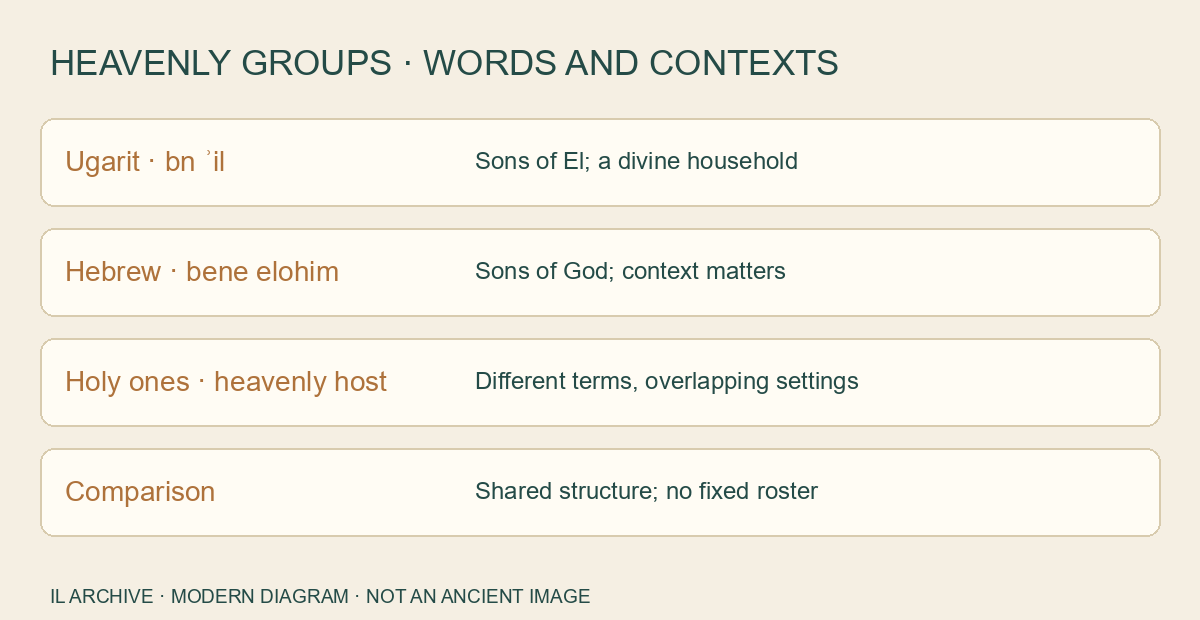
The image is a modern vocabulary diagram, not an ancient depiction of council members.
References and notes
- Hebrew Bible / Bible hébraïque — Job 1:6–12. Mechon-Mamre, Hebrew text and JPS 1917 English translation. Verses 6–12: sons of God, ha-satan and limited permission. Scene in the surviving narrative, not a fixed date for a religious stage. Return to the text ↑
- Joel S. Burnett (2022). The Persistence of El in Iron Age Israel and Ammon. In Biblical and Ancient Near Eastern Studies in Honor of P. Kyle McCarter Jr., selected pp. 300–301. Selected pp. 300–301, especially KTU 1.65.1–18, sons of El, household and Baal’s position. Selected passages read, not the whole volume; list translation follows the published discussion, not a new tablet examination. Return to the text ↑
- Eibert Tigchelaar (2012). Editing the Hebrew Bible: An Overview of Some Problems. In Editing the Bible: Assessing the Task Past and Present, ed. John S. Kloppenborg and Judith H. Newman, pp. 41–66, especially p. 46 n. 22. Selected pp. 41–46, especially p. 46 n. 22 identifying 4QDeutj for Deuteronomy 32:8. Page visually checked; not the whole volume. Witness identification does not prove El–Yahweh separation. Return to the text ↑
Research history
Substantive changes are retained here. Minor copy edits remain in the internal operational log.
-
Substantive record update
Suggest a correction · Suggest a source for this record
Cite this record
IL Archive, «Sons of God», Edition 2, https://ilarchive.com/en/entities/sons-of-god