Entity · Concept
Elohim
A reference page linking a name, group, or concept to the materials that discuss it.
A Hebrew divine noun plural in form but singular or plural in context; this entry examines syntax, Genesis, Psalms, supernatural beings, and competing accounts of its linguistic history.
Estimated reading time: 8 min Published Last reviewed:
Share article

Text
Introduction
Elohim (אֱלֹהִים) is among the most frequent divine designations in the HebrewHebrewA Northwest Semitic language of the Canaanite group, encompassing Iron Age epigraphy, Biblical, Rabbinic, medieval and Modern Hebrew; its scripts and pronunciations changed over time.Glossary · Click to read the explanation Bible, yet it does not have one translation in every passage. Its ending looks plural, while many sentences use it for a single deity and others for several gods or divine beings. To understand the difference we must read the word with its verbs, modifiers and narrative setting rather than isolate its ending. [1]
This entry examines evidence from Genesis, Psalms and Samuel and compares the explanations offered by historical linguists. Three related questions are kept distinct: what a word means in one sentence, how its form developed across Semitic languages, and how religious beliefs changed over time.
The word and its form
The Biblical HebrewHebrewA Northwest Semitic language of the Canaanite group, encompassing Iron Age epigraphy, Biblical, Rabbinic, medieval and Modern Hebrew; its scripts and pronunciations changed over time.Glossary · Click to read the explanation form is אֱלֹהִים, conventionally transcribed ʾĕlōhīm. Its ending, -īm, is recognizable as a masculine plural ending. It is therefore accurate to say that the word is morphologically plural. But morphology by itself does not determine the number of its referent: inherited words can retain forms whose grammatical appearance and contextual sense are not identical. [2]
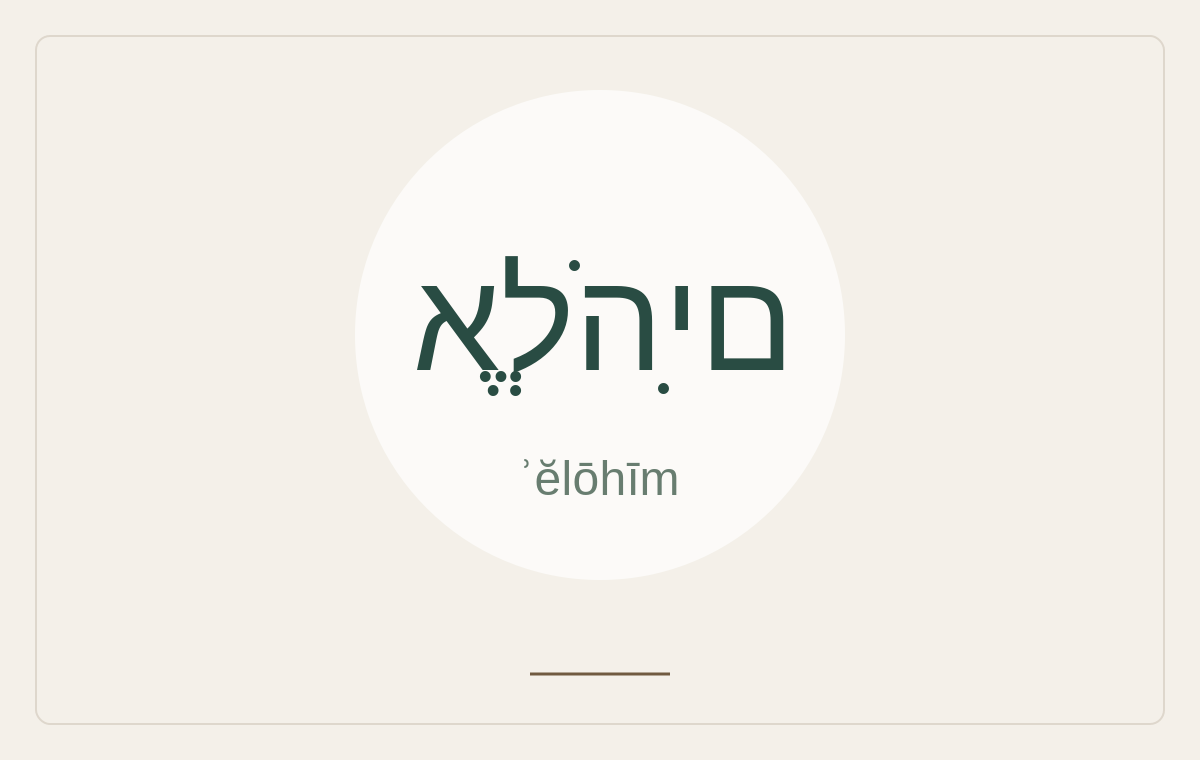
Depending on the passage, the word may mean “god” in the singular, “gods” in the plural, or sometimes a being perceived as superhuman. The first test is the surrounding syntax—verbs, adjectives, pronouns and modifiers—followed by the literary situation, its textual witnesses and the choices made by translators. Neither an invariably plural nor an invariably singular translation is justified.
Genesis opens with plural morphology and a singular verb
At the opening of Genesis, a book of the TorahTorah / PentateuchThe first five books of the Jewish and Christian Bible: Genesis, Exodus, Leviticus, Numbers and Deuteronomy. They combine narrative and law from creation to Moses’ death; in Jewish usage, “Torah” can also encompass a wider body of authoritative teaching.Glossary · Click to read the explanation, בָּרָא אֱלֹהִים (bārāʾ ʾĕlōhīm) combines the singular masculine verb “created” with a noun of plural form. Subsequent predicates such as “said” and “saw” also have singular agreement. In this narrative the acting subject is presented as one, which is why translators ordinarily write “God,” not “gods.” This is a syntactic observation about the extant text, not a complete history of religious ideas behind its composition. [3]
Genesis 1:26 then has the first-person plural invitation “Let us make humankind in our image”; verse 27 returns to singular verbs and pronouns in narrating the act itself. Explanations of the plural include speech in a heavenly council and forms of self-deliberation, while later theological traditions read the words in other ways. The single form of this invitation does not establish a universal rule for the meaning of elohim. [4]
When the meaning really is plural
The commandments in the Book of ExodusBook of ExodusTorah book recounting Israel’s departure from Egypt and containing different formulations of seventh-day rest.Glossary · Click to read the explanation refer to “other gods,” ʾĕlōhīm ʾăḥērīm, an expression with an explicitly plural modifier. In Genesis 35:2–4, Jacob orders his household to remove foreign gods; the scene also describes the objects they hand over and bury. Here the plurality emerges from the modifier and the story, unlike the singular verbal agreement in Genesis 1. [5]
Deuteronomy 32:17 likewise speaks poetically of gods unfamiliar to the people. The biblical writers do not reserve separate, mechanically distinct words for Israel's deity and all other deities: the same lexical form may appear with different referents. [6]
Exceptions to the usual agreement
Singular agreement is usual where elohim refers to one deity, but there are noteworthy exceptions. In Genesis 20:13 Abraham uses the plural verb הִתְעוּ (hitʿû, “caused to wander”) for the agent of his journey away from his father's house, even though translations normally render that agent “God.” In Genesis 35:7 another plural verb, נִגְלוּ (niglû, “were revealed”), stands in the account of God appearing to Jacob. [7]
These examples do not overturn the predominance of singular agreement, nor do they by themselves demonstrate that the speaker imagined a company of gods. Rather, the dominant rule has exceptions whose grammar, textual traditions and interpretation must be assessed in their individual contexts.
Not always simply “God”: a scene in Samuel
In 1 Samuel 28:13 the woman consulted by Saul reports seeing אֱלֹהִים rising from the earth. Translators sometimes use “a godlike being” or “a supernatural being” in this scene. When she describes an old man wearing a robe, Saul takes the figure to be Samuel. The passage illustrates the breadth of the word's semantic field; it does not assert that Samuel was a deity receiving worship. [8]
This is one reason a fixed theological equivalent will not work at every occurrence. The speaker, the narrator and the narrative function of the expression all affect its contextual translation.
The tribunal in Psalm 82
Psalm 82Book of PsalmsCollection of ancient Hebrew poems and prayers; Leviathan has different roles in Psalms 74 and 104.Glossary · Click to read the explanation begins with elohim standing in the assembly of El and judging “in the midst of elohim.” On a divine-councilDivine councilA divine council is a religious and literary scene in which divine beings gather before a superior authority for discussion, commissioning or judgment; it is not identical to a pantheon list.Glossary · Click to read the explanation reading, the word first designates the figure who presides and then the beings addressed or judged; the sixth verse calls those addressed “gods.” [9]
A longstanding interpretation instead understands the addressees as human judges, pointing to the subsequent denunciation of unjust decisions. Other scholars prefer divine beings in view of the council language and the description “sons of the Most High.” Both interpretations deserve to be identified: disagreement over who is addressed should not be concealed by an English rendering that makes one interpretation appear compulsory. [10]
Elohim, Yahweh, El and Eloah
Elohim does not serve precisely the same linguistic function as the proper nameProper nameA name that identifies a particular person, place, group, or entity in context, unlike a common noun denoting a class. Spelling alone may not settle the distinction.Glossary · Click to read the explanation YahwehYahwehThe proper name of Israel’s deity, written יהוה (YHWH), the Tetragrammaton. Its exact ancient pronunciation is not directly preserved; texts and inscriptions witness its history.Glossary · Click to read the explanation. The former can function as a general divine noun or designation, whereas the latter is the particular name used for Israel's deity. Genesis 2:4 joins them as יְהוָה אֱלֹהִים, commonly rendered “the LORD God.” Their combination in that passage does not describe two separate protagonists, but it also does not prove that the two words share the same linguistic history. [11]
The word belongs to the lexical family of Hebrew EloahEloahEloah (אֱלוֹהַּ) is a singular Hebrew noun meaning “a god” or “God,” common in Job but also used for other gods. It is not the proper name of a separate deity.Glossary · Click to read the explanation and El, which may be the common nounCommon nounA noun referring to a member of a class, such as “city” or “god”, unlike a proper name designating a particular entity. Semitic il/El may fulfill either function in context.Glossary · Click to read the explanation “god” or, in a specific West Semitic context, the god El known from UgaritElEl is a senior deity in Late Bronze Age Ugaritic texts, portrayed as father of the divine family and a council authority, alongside his consort Athirat. This entry does not cover every linguistic use of El.Glossary · Click to read the explanation. Other biblical expressions include El ShaddaiEl ShaddaiA compound El name or title associated with ancestral narratives and identified with Yahweh in Exodus 6; Shaddai’s meaning and etymology remain uncertain.Glossary · Click to read the explanation and El ElyonEl ElyonA Hebrew expression meaning “God Most High.” Genesis 14 identifies its bearer with Yahweh, while the Most High’s identity in Deuteronomy 32 remains debated separately from its manuscript readings.Glossary · Click to read the explanation. Questions about how names, traditions and worship came to be associated require their own historical evidence; they cannot be answered from the plural ending alone. [12]
Comparisons across Semitic languages
Historical linguists compare Hebrew with related Semitic languagesSemitic languagesA branch of the Afroasiatic language family, including Akkadian, Ugaritic, Hebrew, Aramaic, Arabic, Ethio-Semitic and South Arabian languages; a linguistic, not racial or religious, classification.Glossary · Click to read the explanation, among them ancient forms of ʾil- (“god”), a reconstructed ʾilāh-, and the later Aramaic and Arabic words for a deity. Such correspondences help explain the development of forms and roots. They do not show that every community worshipped the very same divine personality or inherited identical beliefs. [13]
The contrast between singular Eloah and the plural-looking Elohim is thus more complicated than adding a regular plural suffix to a familiar modern noun. Some poetic texts preserve or imitate older grammatical patterns that differ from classical prose, requiring attention to genre as well as linguistic period before a prehistoric paradigm can be reconstructed.
Why does a singular meaning have a plural form?
Several explanations have been advanced: a plural of majesty or intensity, an abstract noun acquiring a concrete sense, or an inherited plural expression that developed a singular meaning. These are hypotheses about historical origin, not replacements for sentence-level interpretation. In a peer-reviewed study published in 2025, Benjamin D. Suchard proposes that the reconstructed Semitic ʾilāh- began as a type of internal (“broken”) plural, was reinterpreted as singular, and later acquired generalized external plural marking in Hebrew elohim. [14]
The proposal relies on comparative morphology and reconstruction. It is not a universally agreed historical fact, and it is not direct evidence of a particular ancient Israelite religious system. It does, however, show why simple claims that the word is either a relic of a pantheon or merely a “royal we” are inadequate.
Textual variants and the “sons of God”
Elohim must also be distinguished from phrases such as “sons of GodSons of God“Bene elohim” is a Hebrew expression in Job and Genesis whose interpretation depends on context; it also appears in Qumran 4Q37 at Deuteronomy 32:8. It does not itself establish biological descent or a fixed divine roster.Glossary · Click to read the explanation” or “sons of the gods.” Deuteronomy 32:8 has different textual witnesses: the Masoretic reading refers to “sons of Israel”; a manuscript from Qumran reads “sons of God”; witnesses to the Greek translation speak of “sons of God” or “angels of God.” Emanuel Tov compares these readings and their implications for a picture of the nations apportioned among heavenly beings. [15]
The variant may contribute to reconstructing conceptions of a pantheonPantheonThe deities recognized within a given religious tradition, city or period, as reflected in texts and cult. Broader than a divine council, an assembly within a narrative.Glossary · Click to read the explanation or heavenly entourage. But it concerns the wording of a particular verse, not the etymology of the plural ending in elohim. The presumed age of a tradition must also be distinguished from the date of a surviving manuscript that transmits it.
Grammar and the history of monotheism
Where a biblical passage uses elohim for a single actor, it establishes the referent of that occurrence. It does not by itself establish whether the community behind the text recognized other deities or denied their existence. The status of a high godHigh godA deity represented as holding superior authority among other gods in a specified source or tradition; the rank alone does not establish exclusive worship or monotheism.Glossary · Click to read the explanation, exclusive devotion to one deity and monotheismMonotheismBelief that only one God possesses divinity in its fullest sense. Historically distinct from exclusively worshipping one deity without denying others; its theological forms vary.Glossary · Click to read the explanation—the denial of other gods—are different questions. Texts such as Isaiah 45:5–6 explicitly deny another deity, while other biblical passages address the gods of other peoples. [16]
The distinction matters: grammatical number is linguistic evidence; depictions of councils or gods are literary and religious evidence; a history of changing belief requires broader comparison. The letters -im are not, by themselves, evidence for either polytheism or a specific later theological doctrine.
A responsible translation
“God” or “the deity” is normally appropriate when the passage refers to one agent with singular agreement; “gods” when multiple deities are meant; and sometimes “a divine/supernatural being” where a scene demands it. In contested passages such as Psalm 82, the translator should make the choice clear in a note rather than silently erase the alternatives.
A careful reading begins with the word in its sentence, follows the verbs and pronouns and the surrounding episode, and then consults manuscript variants and the history of interpretation. That allows elohim to retain its genuine range without turning its plural form into a shortcut for determining a religion's beliefs.
References and notes (16)
- Heath D. Dewrell & Andrew M. Garbarino, Names of God in the Hebrew Bible, Oxford Bibliographies (2023) Available introduction: El as common noun or proper name, and Elohim and Yahweh. The cited literature was not read in full. Return to the text ↑
- Benjamin D. Suchard, “Semitic *ʾilāh- and Hebrew אלהים: From plural ‘gods’ to singular ‘God’,” Journal for the Study of the Old Testament 49, no. 4 (2025), 460–474. Open-access HTML: abstract, introduction and opening morphological argument; the PDF edition was not separately checked. Return to the text ↑
- Hebrew text with English Jewish translation, Genesis 1:1–5, Mechon-Mamre. Compared bārāʾ, wayyōmer and wayyarʾ in verses 1–5; consulted the published digital Hebrew text, not a manuscript. Return to the text ↑
- Genesis 1:26–27, Hebrew text on Mechon-Mamre. Compared plural naʿăśeh (1:26) with singular wayyibrāʾ (1:27); theological explanations remain debated. Return to the text ↑
- Genesis 35:2–4, Mechon-Mamre; compare Exodus 20:2 in Hebrew verse numbering (20:3 in many other traditions). Directly read “foreign gods” in Genesis 35:2–4 and “other gods” in Exodus at https://mechon-mamre.org/p/pt/pt0220.htm; verse numbering differs across editions. Return to the text ↑
- Benjamin D. Suchard, above, “Levelling in two directions,” on Deuteronomy 32:17. Read his discussion of plural usage in Deuteronomy 32:17 and the poetic corpus; no Qumran manuscript was inspected here. Return to the text ↑
- Genesis 20:13 and 35:7, Mechon-Mamre, comparing the verbs and their translations. Compared hitʿû (20:13) and niglû (35:7); second text at https://mechon-mamre.org/p/pt/pt0135.htm. No comprehensive collation of manuscript variants. Return to the text ↑
- 1 Samuel 28:11–16, Hebrew and English text at Mechon-Mamre. Read 28:13 (elohim rising), 28:14 (the old man) and narrative context; translation is contextual rather than a lexical identity. Return to the text ↑
- Psalm 82:1–8, Hebrew text with English translation, Mechon-Mamre. Read both occurrences of elohim in verse 1, the judgment language of verses 2–5 and “you are gods” in verse 6; the identity of those addressed remains disputed. Return to the text ↑
- Cambridge Bible for Schools and Colleges, notes on Psalm 82 reproduced at BibleHub. Consulted the commentary excerpt on verses 1–2, including a human-judges reading and the possibility of a heavenly assembly; not the printed commentary in full. Return to the text ↑
- Genesis 2:4–9 at Mechon-Mamre, especially יְהוָה אֱלֹהִים. Checked the combination of the two designations in 2:4–9 and “the LORD God” in the English translation; not a source for each name’s ultimate origin. Return to the text ↑
- Heath D. Dewrell and Andrew M. Garbarino, “Names of God in the Hebrew Bible,” Oxford Bibliographies (2023). Only the freely visible introduction on El, Elohim, Yahweh and El Shaddai was read, not the subscriber-only full bibliography. Return to the text ↑
- Benjamin D. Suchard (2025), comparative Semitic argument concerning ʾilāh-. Read the introduction and morphological reconstruction involving Aramaic and Arabic; the dictionaries and manuscripts he cites were not independently collated. Return to the text ↑
- Benjamin D. Suchard (2025), “Why singular *ʾilāh-?” and “Conclusion.” Read his reassessment of majesty, abstract-noun and older-plural explanations and his conclusion; the reconstruction is his proposal, not a demonstrated consensus. Return to the text ↑
- Emanuel Tov, “The Sons of Israel or God? – Deuteronomy 32:8,” TheTorah.com (2023, updated 2026). Read the published comparison of MT, 4QDeutj and Greek witnesses with accompanying discussion and selected notes; did not inspect the original Qumran fragment. Return to the text ↑
- Isaiah 45:5–6, Hebrew text and English Jewish translation at Mechon-Mamre. Examined the explicit negation of any other deity; the historical comparison goes beyond this isolated passage. Return to the text ↑
Suggest a correction · Suggest a source for this record
Cite this record
IL Archive, «Elohim», https://ilarchive.com/en/entities/elohim
Continue reading