Entity · Concept
El Shaddai
A reference page linking a name, group, or concept to the materials that discuss it.
- Names
- El Shaddai · אֵל שַׁדַּי
A compound El name or title associated with ancestral narratives and identified with Yahweh in Exodus 6; Shaddai’s meaning and etymology remain uncertain.
Estimated reading time: 5 min Published Last reviewed:
Share article
Video
The Night the Gods Closed the Sky: Balaam and the Council of the Gods
More than twenty-seven centuries ago, someone wrote a vision on a plastered wall at Deir ʿAlla: the gods come to Balaam son of Beor at night, and a council orders the sky shut. We read the wall line by line, then set it beside Ugarit, the Book of Numbers and later traditions, and settle neither reading. Some scenes are AI-generated illustrations.
The YouTube player loads only when you press play. Watch on YouTube
Text
Introduction
El Shaddai is a divine name or title in the HebrewHebrewA Northwest Semitic language of the Canaanite group, encompassing Iron Age epigraphy, Biblical, Rabbinic, medieval and Modern Hebrew; its scripts and pronunciations changed over time.Glossary · Click to read the explanation Bible. This entry explains its textual setting, its identification with YahwehYahwehThe proper name of Israel’s deity, written יהוה (YHWH), the Tetragrammaton. Its exact ancient pronunciation is not directly preserved; texts and inscriptions witness its history.Glossary · Click to read the explanation, and why a familiar translation does not settle its etymology.
The name in the texts
El Shaddai combines Shaddai with El, which can mean “god” or name ElElEl is a senior deity in Late Bronze Age Ugaritic texts, portrayed as father of the divine family and a council authority, alongside his consort Athirat. This entry does not cover every linguistic use of El.Glossary · Click to read the explanation, a deity known in ancient West Asian traditions.[1] In GenesisBook of GenesisHebrew book of the Torah containing Noah’s flood, survival offering and covenant with living creatures.Glossary · Click to read the explanation, the first book of the Torah, the compound occurs in God's address to AbrahamAbrahamCentral figure in Genesis, the Qur'an and Jewish, Christian and Islamic traditions; the sacrifice study compares what each text says about him.Glossary · Click to read the explanation, an ancestral figure of Israel in the narrative, when announcing a covenant in 17:1–2.[4] Shaddai also occurs alone in poetry, including JobBook of JobHebrew wisdom text exploring suffering, justice and the limits of human knowledge through dialogue and poetry.Glossary · Click to read the explanation, the wisdom book exploring suffering and justice; 5:17 associates it with human chastening.[5]
The distribution can be specified without reducing the functions to one meaning. The Hebrew text has 48 occurrences of Shaddai, seven in the compound El Shaddai. This counts the compound in the Masoretic TextMasoretic TextThe Hebrew Bible’s transmission tradition combining its consonantal text, transmitted vocalization and accentuation, and Masorah notes. The consonantal text has ancient roots; surviving codices that bring these layers together in their Masoretic form are medieval.Glossary · Click to read the explanation, not automatically the emended reading “El” in Genesis 49:25.[8]
- Genesis 17:1; 28:3; 35:11; 48:3: covenant, offspring and reproductive blessing; 43:14 seeks mercy and the safe return of children, not fertility in the abstract.
- Exodus 6:3 identifies the ancestors’ God with the speaker Yahweh; Ezekiel 10:5 compares the sound of the cherubim’s wings to El Shaddai speaking.
- Shaddai alone occurs 31 times in Job; Numbers 24:4,16 concerns receiving a vision, and Ruth 1:20–21 the bitterness of loss. Context determines blessing, awe or complaint: the name does not supply one fixed function.[8][9]
The relationship to Yahweh
In ExodusBook of ExodusTorah book recounting Israel’s departure from Egypt and containing different formulations of seventh-day rest.Glossary · Click to read the explanation 6:2–3 the speaker identifies himself as YahwehYahwehThe proper name of Israel’s deity, written יהוה (YHWH), the Tetragrammaton. Its exact ancient pronunciation is not directly preserved; texts and inscriptions witness its history.Glossary · Click to read the explanation, Israel's God, then says he appeared to the ancestors as El Shaddai without making himself known by his name Yahweh.[2] This wording identifies the divine referent within the narrative. Reconstructing the historical relationship between divine names and cults requires wider evidence: the verse is not a contemporary record of a decision to merge two cults, nor does the compound name alone prove an independent deity in every earlier use.[1]
The decisive wording in Exodus 6:2–3 follows the received Hebrew text. The ellipsis abbreviates the quotation; it does not mark a manuscript break.[2]
The two stages of appearance belong to one speaker’s discourse. The passage therefore establishes literary identification in its received form; this discourse alone does not settle the history of any earlier convergence of traditions. Literary criticism places the passage within the Priestly tradition, a narrative layer identified by its features and vocabulary: it orders revelation from the ancestors’ God to the people’s God. Yahweh’s occurrence elsewhere in Genesis shows that the final form combines traditions whose distribution of names is not identical.[8][11]
The meaning of Shaddai
“Almighty,” including in the JPS translation cited here, is an inherited rendering, not a settled etymology. Greek Job 5:17 in the SeptuagintSeptuagintA name for the varied ancient Greek translations and writings associated with Jewish scripture; beginning with the Torah, the texts differ across books and manuscripts.Glossary · Click to read the explanation has Παντοκράτορος, “of the ruler of all,” whereas Exodus 6:3 renders the compound as θεὸς ὢν αὐτῶν, “being their God.” Even the Greek translation does not use one equivalent throughout the books.[10]
The linguistic proposals have different strengths. Relating Shaddai to AkkadianAkkadianAn ancient East Semitic language written in cuneiform from the third millennium BCE; its varieties include Babylonian and Assyrian, and it served in international diplomacy.Glossary · Click to read the explanation šadû, “mountain,” offers a religious and linguistic comparison worth examining, but semantic resemblance alone does not account for the Hebrew form, doubled d and ending.[3][8] Genesis 49:25 supplies evidence closer to the biblical context: blessings of “breasts and womb” beside Shaddai. This explains the name’s suitability for reproductive blessings, but historian David Biale himself distinguishes poetic wordplay from derivation and acknowledges the difficulty of the doubled d.[9]
Semitic-language scholar Aren Wilson-WrightAren Wilson-WrightNorthwest Semitic scholar studying ancient Israel and its neighbours, and coauthor of a linguistic study of Lotan and Leviathan.Glossary · Click to read the explanation proposes derivation from sdy, “help,” compared with Arabic and Ethio-Semitic languages. Its strength is its account of the consonants and doubled d, together with its fit with granting offspring. However, its treatment of the ending requires the name to preserve a form irregular by comparison with ordinary nouns, drawing an analogy with Sarai.[8] We therefore favor a demonstrable association between Genesis usage and blessing or offspring, not a definitive etymological translation. That usage alone proves neither the meaning “breasts” nor that the bearer was a goddess.
Three different times
- Narrative time: first the ancestors, then MosesMosesCentral figure in Exodus, Torah traditions and the Qur’an; childhood accounts differ in detail.Glossary · Click to read the explanation and Israel’s departure from Egypt. This is the story’s sequence, not dates of contemporary documents recording the name’s first use.
- Literary formation: the priestly base narrative is often dated to the late sixth or early fifth century BCE. Its layers and dates remain debated; that dating does not automatically date the origin of Shaddai or Job’s poems.[11]
- Surviving witness: the complete Masoretic Leningrad Codex dates to 1008–1009 CE. It is an example of an extant copy, not the date of Exodus’s composition. The Greek passages cited here come from a modern edition of an older translation tradition, not from the Leningrad Codex.[10][12]
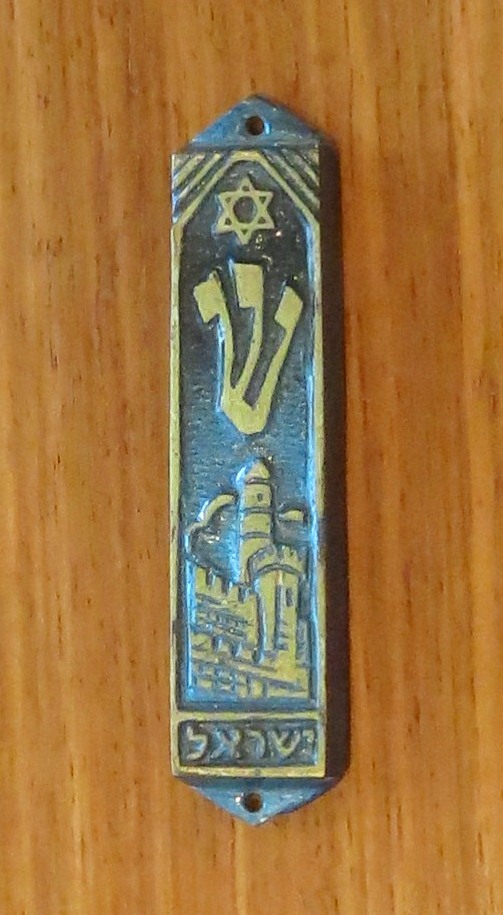
The name also has a later Jewish reception: the letter ש, shin, on some mezuzah cases abbreviates Shaddai.[6] These cases contain a scroll with Torah passages and are affixed to a doorpost.[7] The photograph illustrates this reception, not the period narrated in the ancestral stories.
References and notes (12)
- Heath D. Dewrell & Andrew M. Garbarino (2023). Names of God in the Hebrew Bible. Oxford Bibliographies. doi:10.1093/obo/9780195393361-0318. Open introductory extract: El as noun or deity, compound El names, convergence and local-manifestation models. Full article and bibliography not read. Return to the text ↑
- Hebrew Bible, Exodus 6:2–3. Mechon-Mamre, Hebrew text and JPS 1917 English translation. Verses 2–3 in the context of 1–8: the speaker, appearance to the ancestors and distinction of names within the narrative. Return to the text ↑
- Yoel Elitzur, “The Names of God and the Dating of the Biblical Corpus,” in The Believer and the Modern Study of the Bible, edited by Tova Ganzel, Yehudah Brandes and Chayuta Deutsch, Academic Studies Press, 2019. Pp. 431–433 and note 9, pp. 439–440. The mountain proposal is reported through his survey, not through independent reading of every work he cites; his dating conclusions are not adopted. Return to the text ↑
- Hebrew Bible, Genesis. Mechon-Mamre, Hebrew text and JPS English translation, 1917. 17:1–2; context 1–8 consulted. Return to the text ↑
- Hebrew Bible, Job. Mechon-Mamre, Hebrew text and JPS English translation, 1917. 5:17–18; Shaddai, chastening and healing. Return to the text ↑
- North Carolina Museum of Art, Mezuzah, Ludwig Yehuda Wolpert, 1951, G.81.14.1. Museum label explains shin as an abbreviation of Shaddai. This is not the object photographed in the entry cover. Return to the text ↑
- POLIN Museum collections, “Mezuzah text,” Lublin Open Air Village Museum object MWL/19226. Description of the scroll, its Torah passages and mounting the case on the doorpost; not identification of the cover photograph’s object. Return to the text ↑
- Aren M. Wilson-Wright, “The Helpful God: A Reevaluation of the Etymology and Character of (ˀēl) šadday,” Vetus Testamentum 69 (2019), pp. 149–166. Pp. 149–163 read: distribution p. 150 and n. 2; etymological criticism pp. 154–158; sdy proposal pp. 158–160; blessing functions pp. 161–163. Return to the text ↑
- David Biale, “The God with Breasts: El Shaddai in the Bible,” History of Religions 21/3 (1982), pp. 240–256. Pp. 240–248, especially pp. 247–248 and n. 22: blessing, wordplay and the doubled d. Modern annotations on the PDF were excluded; his early dating of poems is not adopted. Return to the text ↑
- Septuagint, Henry Barclay Swete edition, Job 5:17; Greek text reproduced by Bible Hub. Job 5:17–18, compared with Exodus 6:3 in the same digital edition: https://biblehub.com/sepd/exodus/6.htm . Short extracts, not reproduction of the edition. Return to the text ↑
- Axel Bühler et al., “Exploring the Stylistic Uniqueness of the Priestly Source in Genesis and Exodus Through a Statistical/Computational Lens,” authors’ version hosted at Tel Aviv University. Pp. 3–4 and the divine-names discussion: a common late-sixth/early-fifth-century BCE dating of the priestly base narrative, not a computational date for the manuscript or name. Return to the text ↑
- National Library of Israel, Ktiv catalogue: Leningrad Codex, National Library of Russia, EVR I B 19a. Ktiv catalogue directly read: Date field 1008–1009 CE and the catalogue’s transcription of the colophon. No manuscript image or original colophon inspected. An example of a complete Masoretic witness, not the earliest witness to every word. Return to the text ↑
Suggest a correction · Suggest a source for this record
Cite this record
IL Archive, «El Shaddai», https://ilarchive.com/en/entities/el-shaddai
Continue reading