Entity · Concept
El Shaddai
A reference page linking a name, group, or concept to the materials that discuss it.
A compound El name or title associated with ancestral narratives and identified with Yahweh in Exodus 6; Shaddai’s meaning and etymology remain uncertain.
Text
The name in the narratives
El Shaddai is a compound name or title containing El, which can be a deity’s name or the common nounCommon nounA word naming a class of things, such as “god”, rather than one particular individual.Glossary · Click to read the explanation “god.” It is particularly associated with ancestral narratives; Shaddai also occurs alone in poetry.[1]
What does Exodus 6 establish?
In Exodus 6:2–3 the speaker identifies himself as YahwehYahwehThe divine proper name written YHWH in the Hebrew Bible.Glossary · Click to read the explanation and says he appeared to the ancestors as El Shaddai. The surviving narrative identifies the divine referent, but does not record a contemporary decision to merge two cults. The name alone cannot prove every earlier occurrence referred to an independent deity.[2]
Meaning and interpretive limits
Shaddai’s etymology remains unresolved, so one translation should not be offered as a definitive definition. Yoel Elitzur discusses the names’ distribution and the etymological difficulty; citing these observations does not adopt his conclusions about dating biblical books.[3]
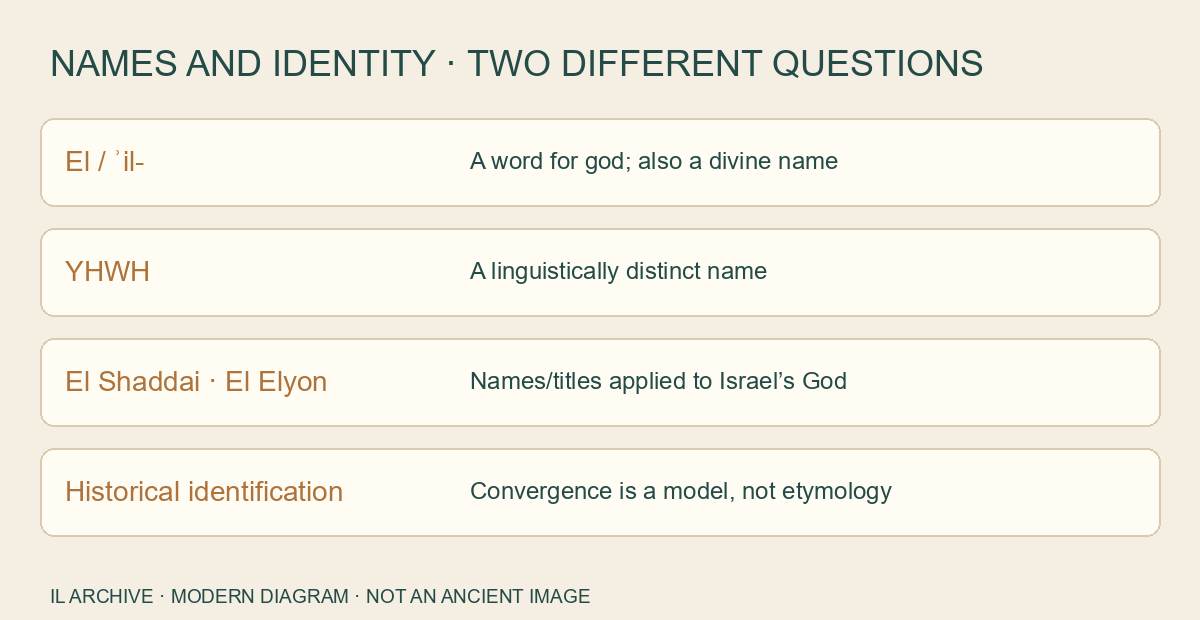
The accompanying image is a modern names-and-identity diagram, not an ancient Shaddai inscription or divine portrait.
References and notes
- Heath D. Dewrell & Andrew M. Garbarino (2023). Names of God in the Hebrew Bible. Oxford Bibliographies. doi:10.1093/obo/9780195393361-0318. Open introductory extract: El as noun or deity, compound El names, convergence and local-manifestation models. Full article and bibliography not read. Return to the text ↑
- Hebrew Bible / Bible hébraïque — Exodus 6:2–3. Mechon-Mamre, Hebrew text with JPS 1917 English translation. Verses 2–3: Yahweh as speaker, identified with El Shaddai. Evidence for the received literary formulation, not a contemporary account of cultic convergence. Return to the text ↑
- Yoel Elitzur (2019). The Names of God and the Dating of the Biblical Corpus. In The Believer and the Modern Study of the Bible, ed. Tova Ganzel, Yehudah Brandes and Chayuta Deutsch, selected pp. 431–433. Pp. 431–433: distribution of El Shaddai/Shaddai and unresolved etymology; p. 431 visually checked. The article does not adopt the author’s dating conclusions or cite this passage as proof of “mountain god.” Return to the text ↑
Research history
Substantive changes are retained here. Minor copy edits remain in the internal operational log.
-
Substantive record update
Suggest a correction · Suggest a source for this record
Cite this record
IL Archive, «El Shaddai», Edition 2, https://ilarchive.com/en/entities/el-shaddai