Study
How Did El and Yahweh Become One God?
An extended study of a topic, with evidence and references.
From El traditions to Israel’s god: ancestral names, the heavenly council and Deuteronomy 32 variants, separating textual evidence from hypotheses of convergence and monotheism.
Share article
Dates
Dates have distinct roles. The timeline uses creation, composition or historical coverage, rather than publication or discovery dates.
- Historical coverage
- Approximately From 1400 BCE to 500 BCE
Text
How did the distinction between the names disappear?
In the HebrewHebrewA Northwest Semitic language in the Canaanite group, with ancient and modern forms.Glossary · Click to read the explanation Bible’s received form, readers can encounter ElEl at UgaritA deity prominent in West Semitic traditions, especially as head of the divine family in Ugaritic texts.Glossary · Click to read the explanation, ElohimElohimA Hebrew word with plural morphology, used for “gods” or for a singular deity according to context.Glossary · Click to read the explanation and YahwehYahwehThe divine proper name written YHWH in the Hebrew Bible.Glossary · Click to read the explanation as names or titles referring to the same deity. Most such passages do not signal a move from one god to another. Comparison with earlier West Semitic religion raises a different question: how did older traditions of El become part of the image of YahwehYahwehThe divine proper name written YHWH in the Hebrew Bible.Glossary · Click to read the explanation?
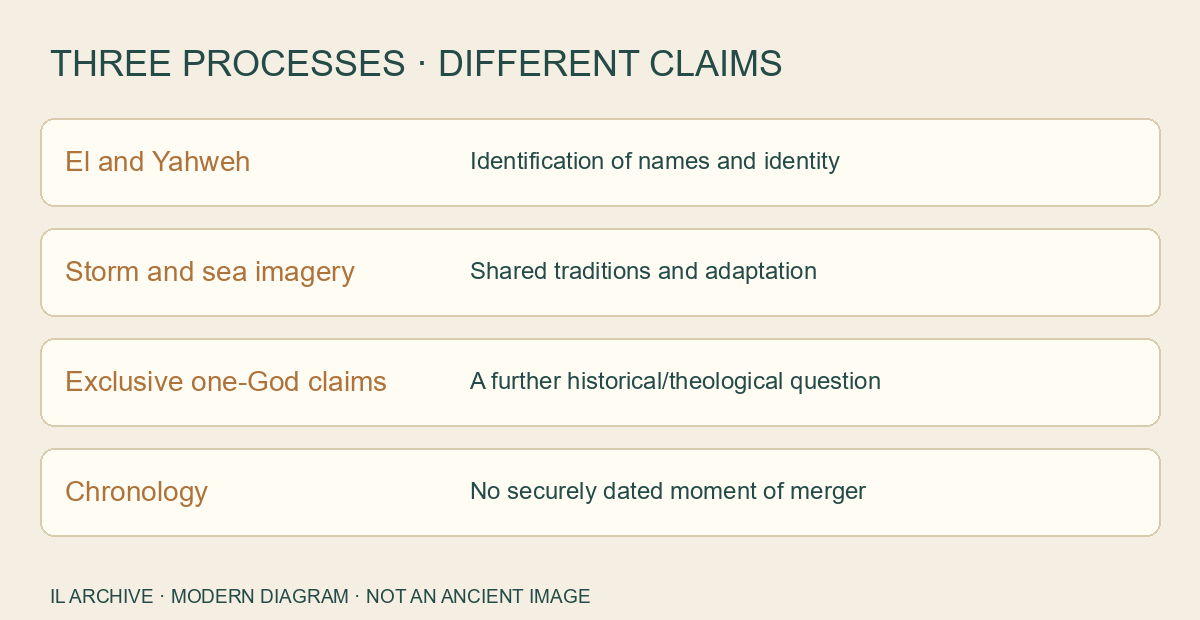
At UgaritUgaritAncient city and kingdom at Ras Shamra on the Syrian coast, flourishing between the fourteenth and early twelfth centuries BCE and preserving multilingual archives.Glossary · Click to read the explanation, El is clearly a father, king and head of the divine community. Yahweh has a different name, and some Hebrew traditions associate him with the south. An influential historical model therefore proposes that two divine identities converged until Israelites understood them as one god. This is a reconstruction, not an event documented by a declaration of merger. Other models remain possible, including an early understanding of Yahweh as a local manifestation of El.[1]
Different names do not settle the identity question
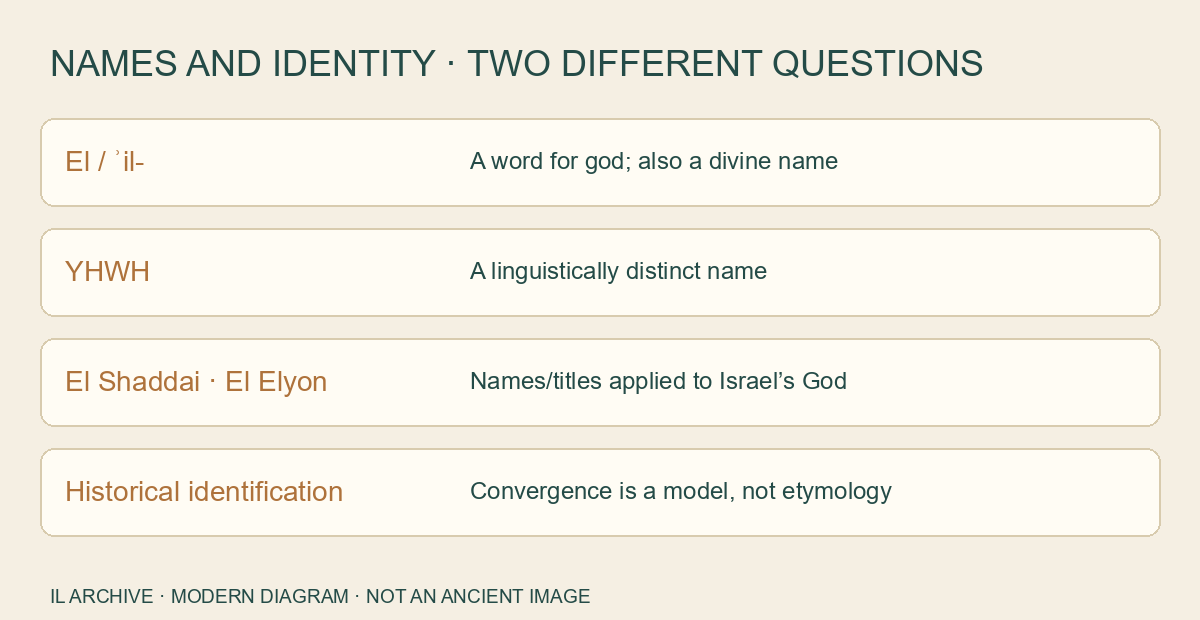
El and Yahweh are linguistically distinct. El belongs to the Semitic vocabulary for “god”; YHWH is a different name, not the result of changing the pronunciation of El. Yet different names alone cannot prove that two communities always worshipped separate deities. One deity can have several names and titles.
The historical question requires comparison of roles, texts and settings, rather than etymology alone. Conversely, applying El to Yahweh does not give the two words the same linguistic origin. Religious identities can converge while their names remain different.[1]
El before Israel
The element il / ilumAkkadian iluThe Akkadian word for “god”; its occurrence does not automatically identify the deity El.Glossary · Click to read the explanation appears in Eblaite and Amorite personal names centuries before Israel, but these occurrences do not all necessarily name the later Ugaritic deity: some may simply mean “the god.” At Ugarit the evidence is clearer. El speaks and decides, bears the titles father, king and bull, and presides over a divine household and council.
El thus provides an older West Semitic model for a high godHigh godA deity with a senior position among other gods; this does not itself mean monotheism.Glossary · Click to read the explanation. If early Israelite communities inherited this tradition, Yahweh’s rise occurred in an already developed religious world. A vocabulary of fatherhood, kingship, creation and leadership of the divine community was available.[2]
Israel’s name preserves El
The earliest secure external reference to Israel is the Merneptah SteleMerneptah SteleAn Egyptian royal inscription containing an early external attestation of the name Israel.Glossary · Click to read the explanation, around 1208 BCE. The name IsraelAncient IsraelA name for an ancient population and later historical traditions, attested on the Merneptah Stele.Glossary · Click to read the explanation contains El rather than an element of Yahweh’s name. The meaning of the name as a whole remains debated; a history of religion should not rest on one preferred translation.[3]
This is an important clue, but it does not state that every Israelite worshipped El without Yahweh. Names can survive changes in belief. The clue gains weight alongside ancestral names, El titles and Yahweh’s later attributes. Ronald Hendel discusses names in the patriarchal narratives as religious memory preserving El traditions, while recognizing the overlap between a common nounCommon nounA word naming a class of things, such as “god”, rather than one particular individual.Glossary · Click to read the explanation and a proper nameProper nameA name identifying a particular individual, place or other entity.Glossary · Click to read the explanation.[4]
Yahweh and southern traditions
Passages in Judges 5, Deuteronomy 33 and Habakkuk 3 portray Yahweh arriving from Seir, Edom, SinaiSinai: peninsula and biblical mountainSinai is a peninsula in eastern Egypt; in the Torah the name also denotes the mountain of revelation to MosesGlossary · Click to read the explanation, Paran and Teman. This pattern has made a southern origin an important model for his early history. The dating of the poetry and the significance of its geography remain contested, however. A deity’s appearance from a sacred place does not by itself establish where his worship began.[5]
One group participating in Israel’s formation may have brought Yahweh’s worship with it, or worship may have spread through relations between communities. We cannot map a specific journey. “The southern god meets El” is therefore a useful summary of a hypothesis, rather than a scene that can be narrated as a documented event.
Convergence: an influential model and its limits
Mark Smith investigates the relationship between El and Yahweh and the question of Israel’s original god, emphasizing El’s deep impact on the biblical image of Yahweh. In this model, the older deity need not be defeated or expelled. His roles and titles become applicable to Yahweh, and distinctions between the identities eventually dissolve.[6]
The model connects several clues rather than relying on a single name. Its limitation is the absence of an Israelite religious archive from the twelfth or eleventh century BCE comparable to Ugarit’s. We cannot identify the first community to equate the gods, assign a year to the merger, or assume an identical process in every region.
Exodus 6: the same god, a different name
Exodus 6:2–3 presents continuity of identity explicitly: the speaker is Yahweh, the deity who appeared to the ancestors as El ShaddaiEl ShaddaiA compound El name or title associated with ancestral narratives and identified with Yahweh in Exodus 6; Shaddai’s meaning and etymology remain uncertain.Glossary · Click to read the explanation. In the text’s final structure these are not competing gods, but the same deity within a history of revelation of his name.[7]
This is a literary and religious statement, not contemporary minutes of a decision to merge cults. Other Genesis traditions also use the name Yahweh before MosesMosesCentral figure in Exodus, Torah traditions and the Qur’an; childhood accounts differ in detail.Glossary · Click to read the explanation. Such differences belong to the composition and interpretation of the narratives; Exodus 6 cannot be turned into a simple chronology of all earlier Israelite beliefs.
El Shaddai: identity is clearer than etymology
El Shaddai is particularly associated with ancestral narratives, while Shaddai also occurs on its own in poetry. The meaning of Shaddai remains uncertain. Proposed derivations differ, and neither a traditional translation nor a single linguistic hypothesis establishes its original sense.[8]
What matters here is that the text applies a compound El name to the speaker identifying himself as Yahweh. This directly demonstrates equivalence within the surviving narrative. Inferring that every earlier occurrence named an independent deity later merged with Yahweh requires further evidence. A clear final identification does not remove uncertainty about its previous history.
El Elyon in Genesis 14
In Genesis 14:18–22, Melchizedek appears as priest of El ElyonEl ElyonA name or title meaning “God Most High,” joined to Yahweh in Hebrew Genesis 14. Elyon does not always designate an independent deity.Glossary · Click to read the explanation, “God Most High,” associated with heaven and earth. Abraham’s oath in the Hebrew text then combines Yahweh and El Elyon. In this passage the names describe one divine referent.[9]
The title may preserve an older El tradition, but Elyon can also mean “Most High” as an epithet; it does not always name a separate god. The expression concerning heaven and earth likewise allows a semantic range involving making and possessing. We should first read the text, then distinguish a reconstruction of its history from the fact that the received wording identifies the names.
Father and creator
Deuteronomy 32:6 addresses Yahweh as Israel’s father who made and established it. Ugaritic El is also associated with fatherhood and origins. This comparison helps explain how Yahweh could occupy the position of the supreme paternal deity.[10]
Religious fatherhood is widespread, however, and a shared title alone does not prove direct borrowing. Creating Israel is also not, within this particular statement, a detailed account of creating the cosmos. The argument rests on fatherhood together with names, kingship, the council and creation. Even if El’s influence is accepted, Yahweh’s profile as creator has a broader history than the wholesale transfer of one earlier personality.
A heavenly council that remained
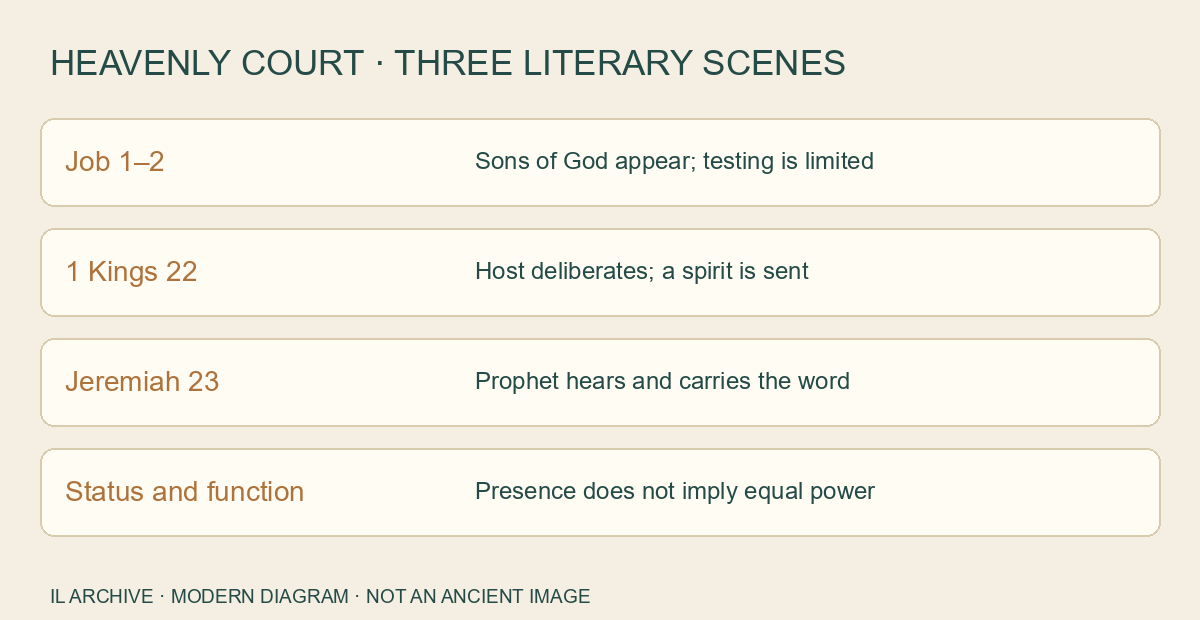
Hebrew poetry retains the language of a heavenly community. Psalm 82 speaks of El’s assembly and judgment among elohim; Psalm 89 describes holy ones and sons of gods. Interpretations of these beings differ between traditions. Not every reading treats elohim here as independent gods in the same way.[11]
In Job 1:6 the sons of elohim present themselves before Yahweh. First Kings 22:19–22 depicts him enthroned with the heavenly hostHeavenly HostA heavenly group whose meaning varies: celestial bodies in some texts, attendants around the throne deliberating in 1 Kings 22.Glossary · Click to read the explanation around him. These are clearer scenes of his presidency over a celestial council.[12][13]
West Semitic religion provides an important parallel to this structure. Its survival does not alone establish the history of El–Yahweh convergence, nor make every biblical passage a statement of one unchanging doctrine.
Deuteronomy 32:8: what do the witnesses say?
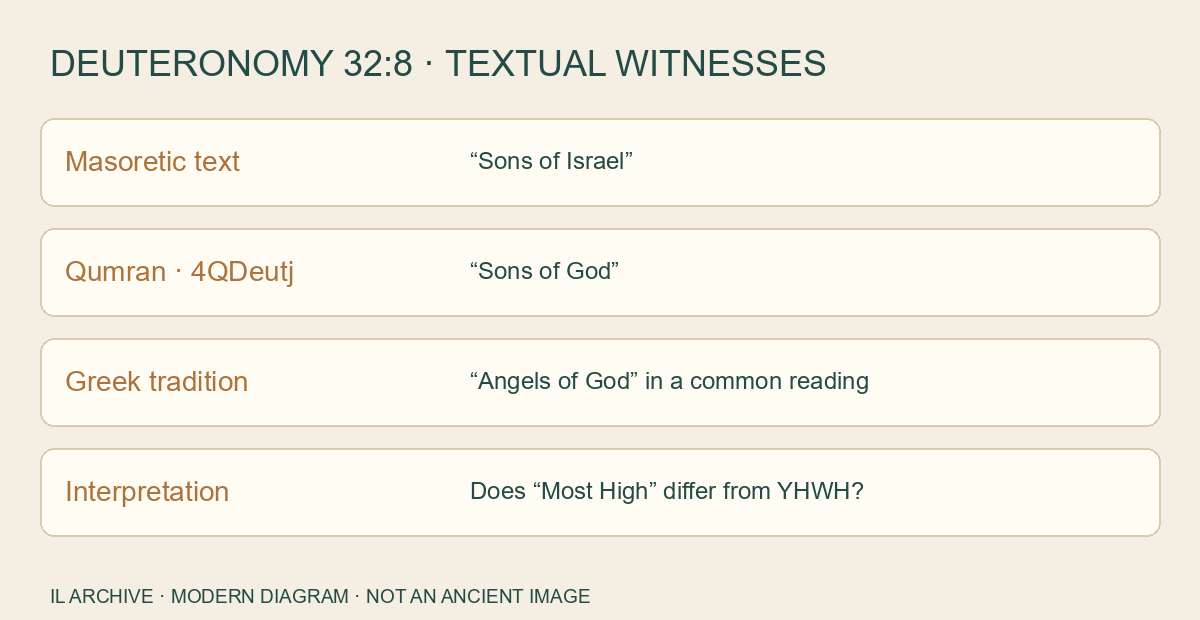
When the nations are divided in Deuteronomy 32:8, the Masoretic TextMasoretic TextA Hebrew textual transmission and reading tradition, compared in textual criticism with ancient manuscripts and translations.Glossary · Click to read the explanation reads “sons of Israel.” The QumranDead Sea ScrollsJudaean Desert manuscripts, especially Qumran cave finds. Biblical copies and other works reveal textual diversity; a copy’s age is not the work’s initial date.Glossary · Click to read the explanation manuscript 4QDeutj preserves “sons of GodSons of GodA Hebrew expression for heavenly beings in texts such as Job; context determines its meaning, rather than biological descent or a fixed angelic roster.Glossary · Click to read the explanation.” Eibert Tigchelaar identifies this manuscript witness while discussing problems in editing the Hebrew Bible.[14]
A common Greek reading in the SeptuagintSeptuagintTraditional designation for ancient Greek translations of Jewish scriptures, whose readings sometimes differ from the Hebrew Masoretic Text.Glossary · Click to read the explanation has “angels of God.” Its wording is not identical to the Hebrew phrase, but supports a background involving the heavenly community. Textual criticismTextual criticismComparing witnesses to explain variation and infer earlier readings or editions, distinguishing preserved from reconstructed text.Glossary · Click to read the explanation favors the reading involving divine beings over “sons of Israel” here.[15]
This is a conclusion about the history of the text. It does not by itself date the song’s composition or identify when two divine identities merged.
Was the Most High distinct from Yahweh?
After the division, Deuteronomy 32:9 describes Yahweh’s people as his portion and Jacob as his inheritance. An influential historical reading understands the Most High to distribute nations among divine beings, with Israel allotted to Yahweh. If the Most High here is El distinct from Yahweh, the scene could preserve an older conception of Israel’s god within a larger system. Daniel McClellan explicitly presents this interpretation.[16]
Separation is not a necessary consequence of the manuscript variant, however. MichaelMichael / MīkālTheophoric name asking who is like God; borne by humans and a heavenly figure in Daniel. It establishes no former Canaanite deity.Glossary · Click to read the explanation Heiser argues that the Most High may be Yahweh’s title, and that the song’s context, including Yahweh’s fatherhood in verse 6, permits an understanding of the same deity.[17]
There is therefore strong evidence for a textual difference, followed by disagreement over historical interpretation. “Sons of God” must not become a standalone proof that El and Yahweh are distinct figures in this passage.
Converging identities is not the whole of monotheism
Identifying El and Yahweh does not mean that a society immediately declared no other divine being to exist. Two identities can merge within a world that still recognizes a heavenly council and multiple cults.
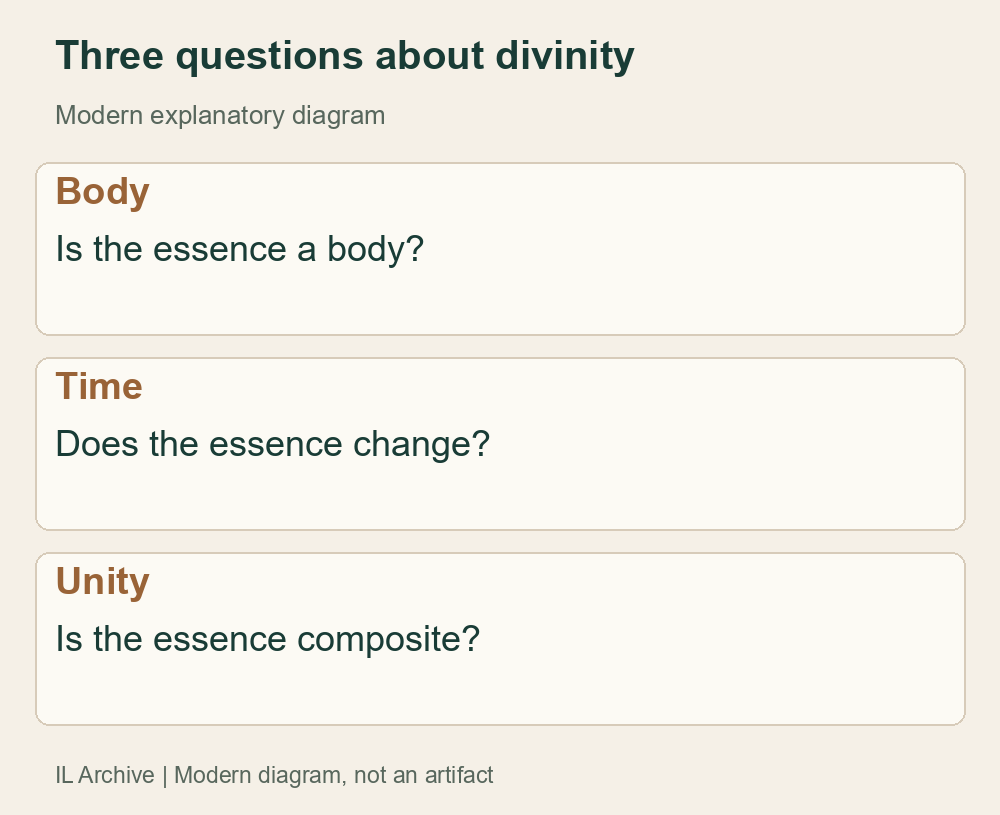
We should distinguish equating names, restricting worship to Yahweh, and believing that he alone exists as god. These developments may overlap without being identical. Smith places Yahweh’s history within a broader religious environment and investigates the emergence of Israelite distinctiveness and monotheismMonotheismBelief in a single God as the only deity, rather than merely the highest among several gods.Glossary · Click to read the explanation, rather than treating everything as the result of one decision.[18]
Baal: a rival whose name remained distinct
With BaalBaalStorm god and protagonist of Ugarit’s Baal Cycle; exercises active kingship while El retains importance and authorizes the palace.Glossary · Click to read the explanation, the picture differs. First Kings 18:21 presents choosing Yahweh or Baal as an explicit conflict. The broad biblical presentation contains no comparable campaign against El as an independent rival.[19]
This contrast fits the convergence model, but an argument from silence cannot prove it alone. Opposition to Baal did not prevent descriptions of Yahweh from sharing imagery with storm-god traditions. Here it is more accurate to discuss the appropriation or adaptation of roles and images while Baal remained a rival, rather than a simple identification of the two figures.[20]
Thunder and clouds
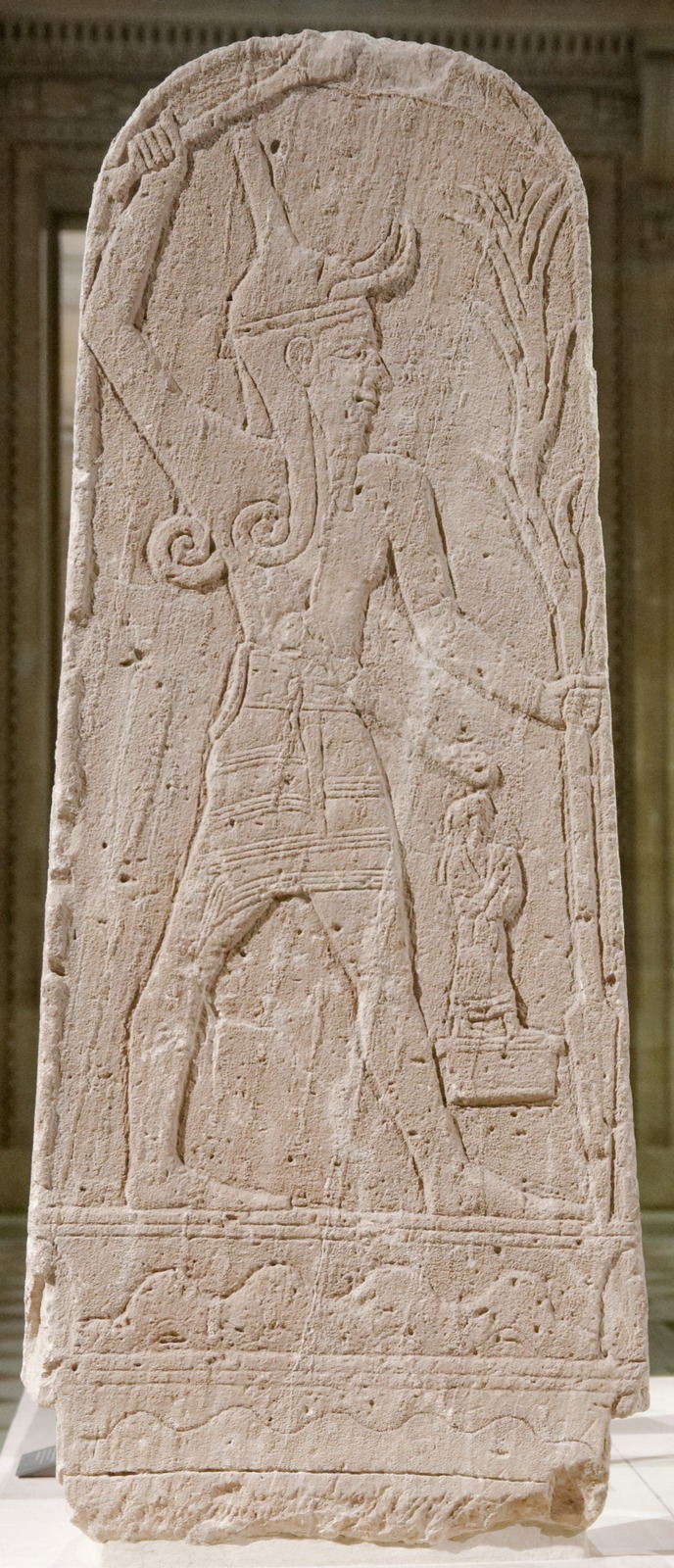
In Psalm 29, Yahweh’s voice sounds over water, breaks cedars and shakes the wilderness. His imagery involves Lebanon, Sirion and kingship. This language strongly overlaps with Levantine storm-god traditions.[21]
Psalm 68 requires care. The expression in Hebrew verse 5, corresponding to verse 4 in many translations, is interpreted as clouds or wilderness regions depending on the analysis. It should not be presented as an unanimously accepted translation of Baal’s “Rider on the Clouds” title. Hebrew verse 34, often numbered 33, more clearly describes riding on the ancient heavens.[22]
The comparison draws its force from the combination of thunder, water and heavenly riding, rather than from a claim that every Hebrew phrase reproduces a Ugaritic title word for word.
Sea and dragon
Ugaritic traditions describe Baal’s conflict with Yamm and know Lotan, the many-headed serpent. In Hebrew poetry, Psalm 74:13–14 attributes the breaking of the sea and crushing of LeviathanLeviathanA poetic sea being in Hebrew texts, related to Ugaritic ltn; its role varies between combat and creation imagery.Glossary · Click to read the explanation’s heads to the deity. McClellan discusses the relationship between these traditions and biblical images of storm and divine warfare.[20]
This does not require a psalmist to have read and copied a tablet from Ugarit. A broader West Semitic tradition can explain images transmitted and reshaped in different communities. Nor does conflict with water operate identically in every creation account. Biblical traditions are diverse, and a terrifying being can elsewhere become a creature subject to the deity.
Why might El have been easier to integrate?
El’s double use offers an important possibility. It is a deity’s name and the common noun “god.” An expression associating Yahweh with El can therefore identify the high god while carrying an older religious tradition in the background.[1]
The roles of father, king and council head may also have been easier to incorporate into Yahweh’s identity than preserving a rival over rain and fertility. This is a possible explanation for the contrasting trajectories of El and Baal, not a cause documented by an ancient declaration. Even within this model, Yahweh cannot be reduced to a numerical mixture of El and Baal. Southern, Exodus and Israelite traditions also belong to his history.
What is established, and what is inferred?
The names are linguistically distinct; El is clearly attested at Ugarit; and Hebrew texts apply El-related titles to Yahweh and depict him presiding over a heavenly council. Deuteronomy 32:8 survives in different readings, with strong support for wording involving divine beings.
The convergence model proposes that Yahweh absorbed El’s position and important traditions. Yet the figures’ originally separate identities, the mechanism of convergence, and interpreting the Most High and Yahweh as different gods in Deuteronomy 32 remain questions with different degrees of certainty. We possess neither a precise date nor a single location for their first identification.[1][6][17]
A deity carrying layers of history
The convergence model explains how multiple names and roles came together in Israel’s god. In the received text, the deity known to the ancestors as El Shaddai is Yahweh; Abraham’s oath joins Yahweh to El Elyon; and the heavenly council stands around Yahweh’s throne.
El did not change phonetically into YHWH. What changed, according to this model, was how communities understood the relationship between their traditions. Names, titles and poetic images retained traces of that history even when readers could apply them to the same deity without sensing a shift between identities.
Belief in one god alone is a later and broader question. El–Yahweh convergence helps explain the route toward it, but does not contain the whole journey.
References and notes
- Heath D. Dewrell & Andrew M. Garbarino (2023). Names of God in the Hebrew Bible. Oxford Bibliographies. doi:10.1093/obo/9780195393361-0318. Open introductory extract: El as noun or deity, compound El names, convergence and local-manifestation models. Full article and bibliography not read. Return to the text ↑
- Joel S. Burnett (2022). The Persistence of El in Iron Age Israel and Ammon. In Biblical and Ancient Near Eastern Studies in Honor of P. Kyle McCarter Jr., selected pp. 297–303. Selected passages, pp. 297–303: El, Israelite names, paternal and royal titles, and Ugaritic divine community. Not the entire volume; common-noun/proper-name ambiguity also follows the introduction cited in [1]. Return to the text ↑
- National Museum of Egyptian Civilization. Merenptah (Baenre Merinetjeru). Merenptah paragraph: Israel Stele and earliest recorded mention. Later mixed-in Ramesses III paragraphs not used. Approximate 1208 BCE agrees with the archive’s existing stele entry; page is not a detailed object record. Return to the text ↑
- Ronald Hendel (2005). Historical Memories in the Patriarchal Narratives, “Patriarchal Names and El.” Remembering Abraham, chapter 3, pp. 45–56. doi:10.1093/0195177967.003.0003. Accessible indexed subsection on patriarchal names and El, plus chapter metadata and abstract. Not the full chapter; narrative names are evidence of memory, not contemporary patriarchal documents. Return to the text ↑
- Juan Manuel Tebes (2018). The Southern Home of YHWH and Pre-Priestly Patriarchal/Exodus Traditions from a Southern Perspective. Biblica 99(2), 166–188. doi:10.2143/BIB.99.2.3284919. Selected pp. 169–172 on lists, poetry, dating and transmission problems; p. 183 on Qos. P. 170 visually checked. Southern origin is the author’s model, not consensus. Full article and all place identifications not verified. Return to the text ↑
- Mark S. Smith (2001). El, Yahweh, and the Original God of Israel and the Exodus. The Origins of Biblical Monotheism, chapter 7, pp. 135–148. doi:10.1093/019513480X.003.0008. Indexed publisher abstract and metadata: El’s deep impact, the complex El–Yahweh relationship and Israel’s original god. Full chapter not read; this reference alone does not establish a detailed interpretation of Deuteronomy 32. Return to the text ↑
- Hebrew Bible / Bible hébraïque — Exodus 6:2–3. Mechon-Mamre, Hebrew text with JPS 1917 English translation. Verses 2–3: Yahweh as speaker, identified with El Shaddai. Evidence for the received literary formulation, not a contemporary account of cultic convergence. Return to the text ↑
- Yoel Elitzur (2019). The Names of God and the Dating of the Biblical Corpus. In The Believer and the Modern Study of the Bible, ed. Tova Ganzel, Yehudah Brandes and Chayuta Deutsch, selected pp. 431–433. Pp. 431–433: distribution of El Shaddai/Shaddai and unresolved etymology; p. 431 visually checked. The article does not adopt the author’s dating conclusions or cite this passage as proof of “mountain god.” Return to the text ↑
- Hebrew Bible / Bible hébraïque — Genesis 14:18–22. Mechon-Mamre, Hebrew text with JPS 1917 English translation. Verses 18–22, especially YHWH and El Elyon together in v. 22. Received Hebrew text, not proof that Elyon always names an independent deity. Return to the text ↑
- Hebrew Bible / Bible hébraïque — Deuteronomy 32:6. Mechon-Mamre, Hebrew text with JPS 1917 English translation. Verse 6: fatherhood and Israel’s formation. Not a complete cosmogony or standalone proof of borrowing from El. Return to the text ↑
- Hebrew Bible / Bible hébraïque — Psalms 82:1, 6; 89:6–9 (Hebrew numbering). Mechon-Mamre, Hebrew text with JPS 1917 English translation. Psalm 82:1, 6; also Psalm 89:6–9 checked at https://mechon-mamre.org/p/pt/pt2689.htm . Displayed English interprets some Psalm 82 words as judges; comparison uses Hebrew with interpretive differences acknowledged. Return to the text ↑
- Hebrew Bible / Bible hébraïque — Job 1:6. Mechon-Mamre, Hebrew text with JPS 1917 English translation. Verse 6: sons of elohim before Yahweh; no specific composition date assumed. Return to the text ↑
- Hebrew Bible / Bible hébraïque — 1 Kings 22:19–22. Mechon-Mamre, Hebrew text with JPS 1917 English translation. Verses 19–22: throne, heavenly host and deliberation. Literary celestial council, not historical meeting minutes. Return to the text ↑
- Eibert Tigchelaar (2012). Editing the Hebrew Bible: An Overview of Some Problems. In Editing the Bible: Assessing the Task Past and Present, ed. John S. Kloppenborg and Judith H. Newman, pp. 41–66, especially p. 46 n. 22. Selected pp. 41–46, especially p. 46 n. 22 identifying 4QDeutj for Deuteronomy 32:8. Page visually checked; not the whole volume. Witness identification does not prove El–Yahweh separation. Return to the text ↑
- NET Bible. Deuteronomy 32, textual note 14 on verse 8. Textual note 14: Qumran sons of God and common Greek angels of God against sons of Israel. Greek wording in the note read; not an independent collation of all Septuagint manuscripts. Identity interpretation is separate from textual preference. Return to the text ↑
- Daniel O. McClellan (2022). YHWH’s Divine Images: A Cognitive Approach. Ancient Near East Monographs 29, selected pp. 87–88, 125–126. Selected pp. 87–88, 125–126: national allotment, Yahweh/Elyon and restructuring of the council. P. 88 visually checked. An attributed interpretation, not consensus or a full-book reading. Return to the text ↑
- Michael S. Heiser (2006). Are Yahweh and El Distinct Deities in Deut. 32:8–9 and Psalm 82? Hiphil 3, pp. 1–9; selected pp. 6–7. Repository metadata and pp. 6–7 read in the open reprint: https://www.dburnett.com/wp-content/uploads/2011/07/Heiser-on-Deut-32-Ps-82.pdf . Context and Elyon-title objections to necessary separation. Not presented as consensus. Return to the text ↑
- Mark S. Smith (2002). The Early History of God: Yahweh and the Other Deities in Ancient Israel, second edition. Eerdmans. Publisher description and second-edition metadata: Yahweh among broader cults and the development of distinctiveness and monotheism. Full book not read in this review; convergence also supported by [1] and [6]. Return to the text ↑
- Hebrew Bible / Bible hébraïque — 1 Kings 18:18–21. Mechon-Mamre, Hebrew text with JPS 1917 English translation. Verses 18–21: explicit Baal rivalry and choice between Baal and Yahweh. Not a standalone proof of El convergence. Return to the text ↑
- Daniel O. McClellan (2022). YHWH’s Divine Images: A Cognitive Approach. Selected pp. 117–119; Psalm 74:13–14. Pp. 117–119 read on storm deity, war, Yamm/Lotan and Leviathan. Psalm 74:13–14 checked at https://mechon-mamre.org/p/pt/pt2674.htm . Traditional comparison, without assuming direct copying from Ugaritic tablets or dating every image. Return to the text ↑
- Hebrew Bible / Bible hébraïque — Psalm 29:1–11. Mechon-Mamre, Hebrew text with JPS 1917 English translation. Psalm: water, thunder, cedars, Lebanon, Sirion and kingship. Storm-god comparison also supported by [20]; no specific tablet claimed as the psalm’s source. Return to the text ↑
- NET Bible. Psalm 68, translation note 8; Hebrew Psalm 68:5, 34 (often English 4, 33). Note 8 favors clouds and explains the traditional steppe/desert reading. Compared with Hebrew/JPS at https://mechon-mamre.org/p/pt/pt2668.htm, especially vv. 5, 34. Cloud translation not presented as unanimous. Return to the text ↑
Media
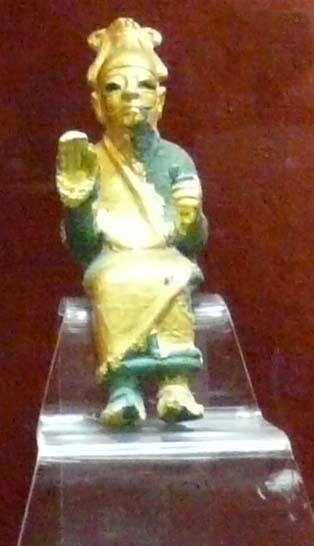
Original photograph
Seated god from Ugarit, bronze and gold, about 1400–1300 BCE; Damascus Museum S 3573 / RS 23.394. Possibly El. Evidence of the Ugaritic setting, not an image of Yahweh or a dated merger.
Public domain · ywpark2003 · CC0 1.0 · CC0 1.0 · https://creativecommons.org/publicdomain/zero/1.0/ · display resized only; original preserved
Suggest a correction · Suggest a source for this record
Cite this record
IL Archive, «How Did El and Yahweh Become One God?», Edition 1, https://ilarchive.com/en/studies/el-yahweh-convergence
Continue reading