Entity · People
Ancient Israel
A reference page linking a name, group, or concept to the materials that discuss it.
- Region
- The southern Levant — Canaan and its highlands (ancient historical context)
Name of a group attested by the Merneptah Stele around 1208 BCE, later of the northern kingdom and of a wider historical and religious memory; this entry examines the evidence and its limits.
Estimated reading time: 8 min Published Last reviewed:
Share article
Text
Introduction
What does “ancient Israel” mean in different periods? The historical answer changes with the evidence: a group named in an Egyptian inscription in the late thirteenth century BCE; the emergence of communities in the highlands of Canaan; the later northern kingdom called Israel and the southern kingdom of JudahKingdom of JudahJudah was an ancient southern Levantine kingdom centered on Jerusalem in the Iron AgeGlossary · Click to read the explanation; and literary and religious identities preserved and reshaped in texts from later centuries. This entry traces those distinct uses and separates archaeological testimony from the interpretation of biblical narratives. It does not concern the modern state or reduce the history of the region's inhabitants to one community. [2]
One name, several historical meanings
In the earliest external evidence, “Israel” identifies a human group somewhere in CanaanCanaanRegional name in the Mediterranean Levant, associated with Canaanite cities and cultures in the second millennium BCE and with Abraham’s family’s destination in Genesis.Glossary · Click to read the explanation, not a securely identifiable unified state with known borders. In later Iron Age records the name clearly designates the northern kingdom, while JudahKingdom of JudahJudah was an ancient southern Levantine kingdom centered on Jerusalem in the Iron AgeGlossary · Click to read the explanation appears to its south. The HebrewHebrewA Northwest Semitic language of the Canaanite group, encompassing Iron Age epigraphy, Biblical, Rabbinic, medieval and Modern Hebrew; its scripts and pronunciations changed over time.Glossary · Click to read the explanation scriptures also use “the children of Israel” for an ancestral community, a collective memory and a covenantal identity. These meanings should not be assumed to have existed together in the same form from the beginning. [10]
The Merneptah Stele: the earliest widely accepted attestation
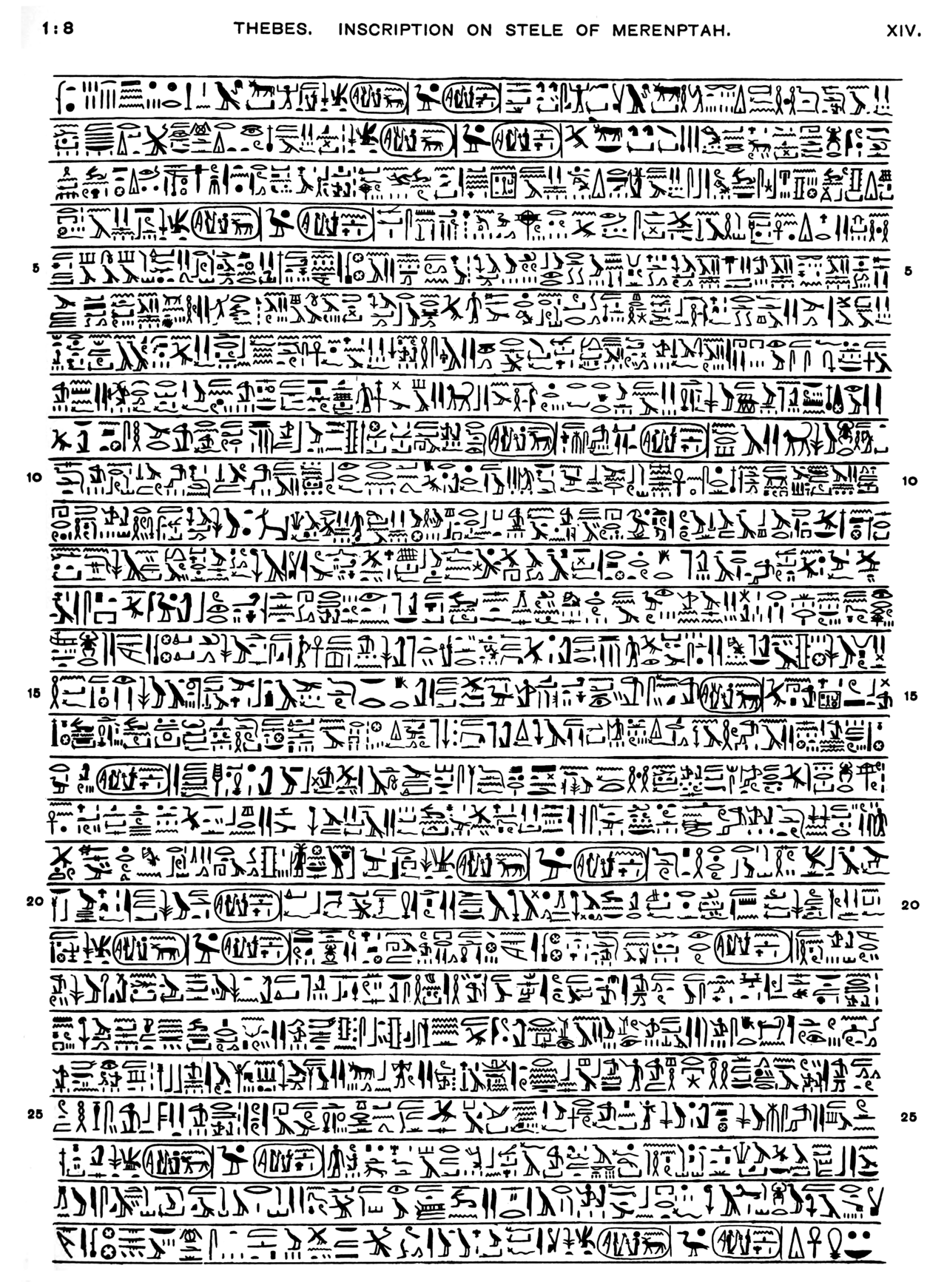
The Merneptah SteleMerneptah SteleAn Egyptian royal victory inscription of c. 1208 BCE on the reverse of a monument of Amenhotep III; it contains the earliest widely accepted external attestation of the name Israel.Glossary · Click to read the explanation was discovered at Thebes in Egypt in 1896. Inscribed on the reverse of an older monument, this royal victory text dates to the fifth regnal year of the pharaoh Merneptah, around 1208 or 1207 BCE depending on the chronology adopted. Its closing lines mention Canaan, Ashkelon, Gezer, Yenoam and then “Israel”. An excerpt published by the Posen Library boasts that Israel was devastated and that its “seed” or “grain” was no more. This is the rhetoric of a royal triumph, not an independent casualty count. [2][3]
Unlike the city designations in the passage, the hieroglyphic writing of “Israel” uses signs classifying a group of people. This strengthens the conclusion that the Egyptian scribe did not mean a fortified city called Israel. But the signs establish neither population size nor precise location, degree of political organization or the identity of the group's deity. Scholars have also debated the nuances of “seed/grain” and the character of the group being described. [4]
The name Israel and the story of Jacob
The West Semitic name Yiśrāʾēl ends with the divine element ElSemitic ilAn ancient Semitic word meaning “god,” with cognates across several languages. It may function as a common noun or a proper name according to context; it is not always Ugaritic El.Glossary · Click to read the explanation, familiar in the languages of the region. In the PentateuchTorah / PentateuchThe first five books of the Jewish and Christian Bible: Genesis, Exodus, Leviticus, Numbers and Deuteronomy. They combine narrative and law from creation to Moses’ death; in Jewish usage, “Torah” can also encompass a wider body of authoritative teaching.Glossary · Click to read the explanation, Genesis 32:29 and 35:10 explain the name within the story of JacobJacob in GenesisGenesis figure, son of Isaac and brother of Esau; he encounters heavenly messengers and sends human envoys.Glossary · Click to read the explanation's renaming, following an encounter involving struggle or blessing. This explanation belongs to a literary and religious narrative; it is not a document contemporary with the population identified by Egyptian scribes. The precise linguistic analysis of the name's first element—whether involving struggle, rule or an appeal to El—cannot be established merely by retelling the episode. A divine element in a name does not, by itself, prove exclusive worship of one deity. [5]
Highland communities in Iron Age I
Between approximately 1200 and 1000 BCE, the number of small rural settlements increased in portions of the southern Levantine highlands. Surveys show houses, storage facilities, terraces, pottery and mixed agricultural and pastoral activities. A substantial part of this development has been associated with the emergence of early Israel, but the evidence does not require the arrival of a single population all at once. Interpretations emphasize continuity with local Canaanite society and changing patterns of settlement and mobility, while leaving room for other groups to have joined these communities. [6][7]
The growth of villages did not mean that every Canaanite city had disappeared. Yuval Gadot argues that urban culture recovered and continued to interact with upland settlement during the twelfth to tenth centuries BCE. Thus “Canaanites in cities” versus “Israelites in the hills” is too simple a contrast. The research question is how a new collective identity took shape amid connected demographic, economic and political changes. [8]
Can pots and diets identify an ethnic group?
Collared-rim storage jars, house layouts and the distribution of pig bones have all been used to investigate social and dietary differences. None operates as an ethnic identity card: pots circulate, practices respond to ecology and economy, and local settlement histories differ. David Wengrow specifically challenged treating the collared-rim jar as a sufficient ethnic or chronological marker. A reconstruction therefore depends on combinations of indicators studied in context, not on one artefact alone. [9]
Models of emergence weigh local continuity, settled pastoralists, newcomers, and memories of migration and warfare differently. The Book of ExodusBook of ExodusTorah book recounting Israel’s departure from Egypt and containing different formulations of seventh-day rest.Glossary · Click to read the explanation and DeuteronomyBook of DeuteronomyTorah book presenting commandments in Moses’ discourse and grounding Sabbath rest in slavery and liberation from Egypt.Glossary · Click to read the explanation cannot on their own serve as dated field records of the thirteenth century BCE. Historical inquiry compares their literary layers with inscriptions and archaeology. Kenton Sparks likewise observes that not every element of the biblical migration-and-conquest narrative is confirmed by independent evidence. [10]
From communities to kingdoms
Political formations emerged in the southern LevantThe LevantThe Levant is a regional name for lands along the eastern MediterraneanGlossary · Click to read the explanation during the tenth and ninth centuries BCE. It is crucial to distinguish the earlier group named “Israel” from the later northern kingdom and from southern Judah. The extent of tenth-century authority and the precise sequence of state formation remain disputed; ninth-century and later documents supply much clearer evidence of rulers, alliances, tribute and conflicts. These records neither verify every detail of the biblical accounts nor make a lack of contemporary inscriptions proof that a particular event never happened. [11]
The northern kingdom: Samaria, Omri and its neighbours
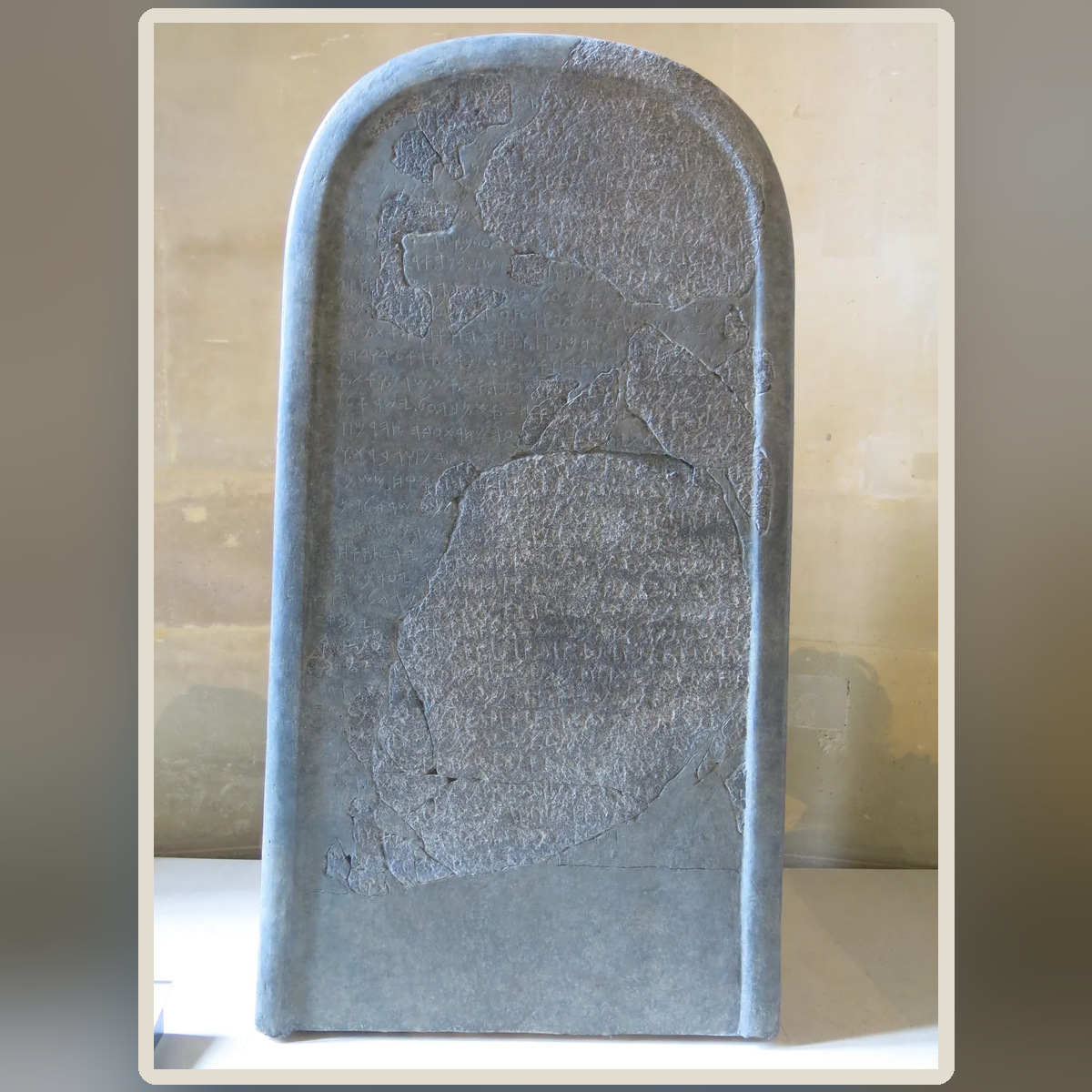
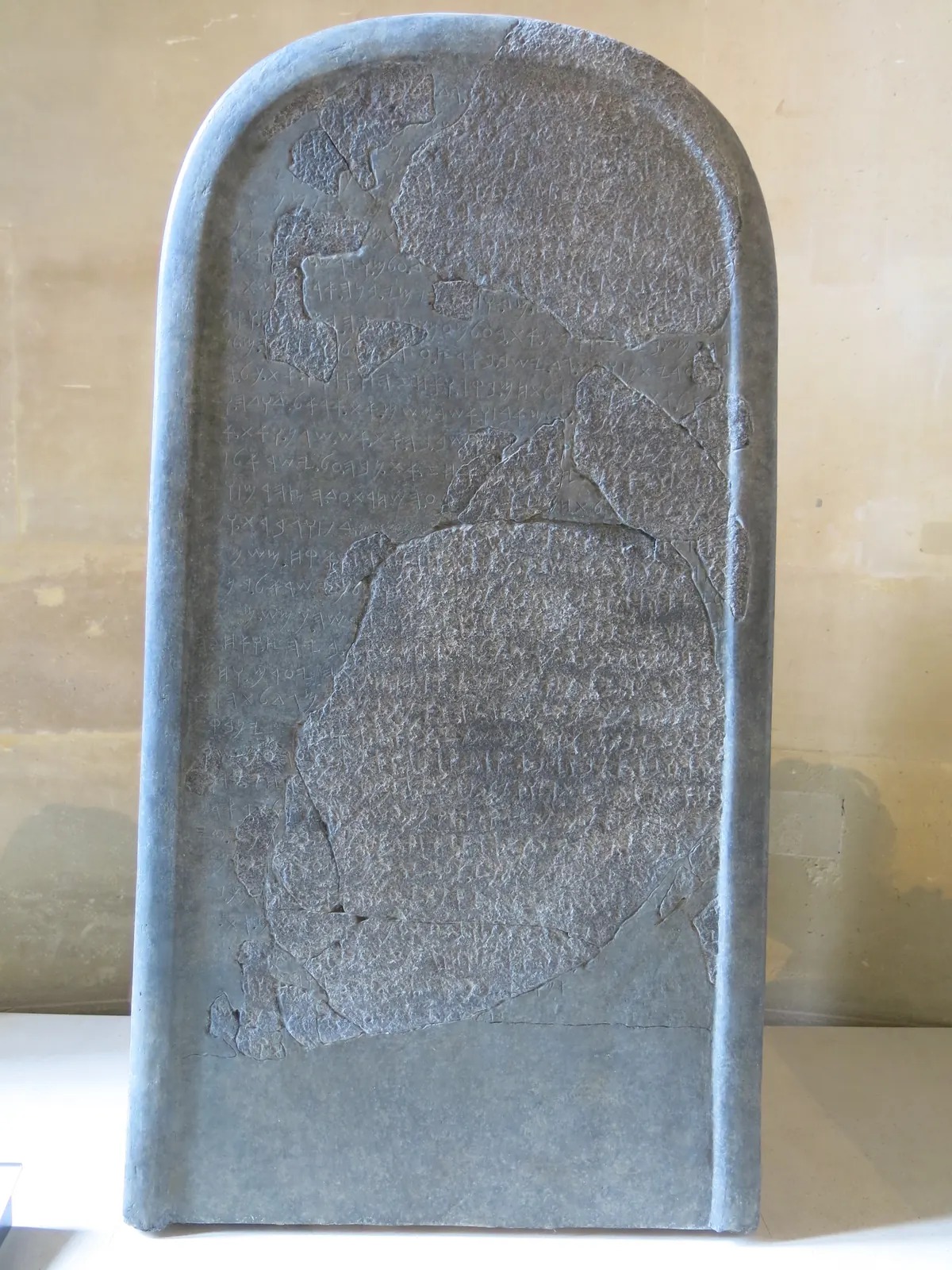
The northern kingdom established its capital at SamariaSamaria: city and regionAncient city and administrative region; the city’s site is at Sebastia, northwest of Nablus in the West Bank.Glossary · Click to read the explanation under Omri and developed political and commercial connections with Phoenician, Aramaean and Moabite neighbours. The Moabite Mesha SteleMesha SteleA ninth-century BCE Moabite royal basalt stele at the Louvre (AO 5066; KAI 181). Its inscription names Chemosh, Omri, Israel and YHWH (line 18). A proposed “House of David” reading in damaged line 31 is disputed.Glossary · Click to read the explanation, preserved at the Louvre as AO 5066, presents King MeshaMesha, king of MoabNinth-century BCE king of Moab whose inscription recounts conflict, territorial recovery and construction.Glossary · Click to read the explanation's account of conflict with Israel and the house of Omri over territory east of the Jordan. It is an adversary's inscription crediting victory to ChemoshChemoshMajor Moabite deity in the ninth-century BCE Mesha Stele, credited with restoring territory and receiving war booty; also named in Hebrew texts from another perspective.Glossary · Click to read the explanation. Its value in confirming the kingdom and its regional competition is considerable, but it is not a neutral battle chronicle. [12]
Architecture and carved ivories from Samaria also show exchanges of styles and skills with neighbouring communities. This is not necessarily a one-way “foreign influence”: Levantine courts shared trade routes, craft practices and elite imagery while remaining politically distinct. [16]
Judah, the house of David and archaeological debate
The southern kingdom's royal memory centres on JerusalemJerusalemJerusalem is a city of religious importance in Judaism, Christianity and IslamGlossary · Click to read the explanation, DavidDavid, the biblical kingRoyal figure in Samuel and Kings, cited here in an instance of “adversary” applied to a human.Glossary · Click to read the explanation and Solomon. A ninth-century BCE Aramaic inscription from Tel Dan, in the collection of the Israel Antiquities Authority, includes an expression widely read as “house of David” in a context of conflict with Israel and Judah. It supports the attestation of a southern dynasty's name in an enemy's account. Alone, however, it cannot establish the territorial extent of David's rule or all the biographical details preserved in biblical books. [13]
Khirbet Qeiyafa, a fortified site dated by radiocarbon evidence to the early tenth century BCE, is central to arguments about political organization in early Judah. Its excavators interpret the fortifications as evidence of early central authority; identifying the place with a particular king and reconstructing an extensive “united monarchy” still require comparison with other sites and remain debated. [14]
Religious practice and change
The name Israel does not disclose the worship of people living around 1208 BCE. Later Iron Age inscriptions attest the worship of YHWHYahwehThe proper name of Israel’s deity, written יהוה (YHWH), the Tetragrammaton. Its exact ancient pronunciation is not directly preserved; texts and inscriptions witness its history.Glossary · Click to read the explanation alongside the presence of names such as El and BaalBaalUgaritic storm god and warrior king who defeats Yamm, builds his palace with El’s consent and confronts Mot. References to El and Dagan as fathers do not define a single genealogy.Glossary · Click to read the explanation and other West Semitic religious language. Blessing formulas at Kuntillet ʿAjrudKuntillet ʿAjrudA Sinai site with blessings invoking Yahweh of Samaria/Teman and “his asherah” around 800 BCE; inscriptions illuminate religion and writing, while the site’s function and imagery remain debated.Glossary · Click to read the explanation, including a much-discussed expression commonly rendered “his asherah”, raise questions about deities, symbols and devotional practice. Jeremy Smoak and William Schniedewind argue that the inscriptions may reflect scribal learning and everyday religion; their existence does not by itself prove that the site was a temple. [15]
It is therefore misleading either to project a fully developed exclusive monotheismMonotheismBelief that only one God possesses divinity in its fullest sense. Historically distinct from exclusively worshipping one deity without denying others; its theological forms vary.Glossary · Click to read the explanation back onto every period of Israelite history or to describe all religious practice as one unchanging polytheistic system. Court, household, sanctuary and regional practice differed, while later literary strata articulated increasingly explicit demands for exclusive worship and reinterpreted earlier traditions. [15]
Conquests, displacement and continuity
Assyrian campaigns ended the northern kingdom's rule with the capture of Samaria around 722/721 BCE, deportations and population transfers; these events did not remove every local inhabitant. Southern Judah continued on a different trajectory under Assyrian and then Babylonian domination, culminating in the destruction of Jerusalem and deportation of part of its population in 587/586 BCE, depending on the chronology used. These are separate events, not one undifferentiated “fall of Israel”, and displacement is not equivalent to the extinction of a population or its traditions. [11][17]
In subsequent centuries the name Israel acquired literary, liturgical and communal meanings extending beyond both the group named by Merneptah and the northern kingdom. Such continuities must be traced through sources of their own periods without presuming that a later use denotes the same population, borders or beliefs as a thirteenth-century BCE inscription. [10]
Weighing the evidence
The Egyptian inscription attests a name in royal rhetoric; Mesha and Tel Dan offer the perspectives of opponents of Iron Age kingdoms; surveys and excavations reveal settlement patterns without always naming their occupants; biblical texts preserve memory but are not all contemporary reports of the events they narrate. The status of modern research must also be stated accurately. Richard C. Steiner's chapter on “Merenptah's Israel” appears in the contents of a scholarly volume published in 2024, but its full argument was not read for this revision and is not presented here as independently verified evidence for a new location of the group. [1]
References and notes (17)
- Richard C. Steiner, “Merenptah’s Israel, His Shasu Militiamen, His Copper Caravan Route, and the Watering Stations Bearing His Name at Kadesh-barnea and Me-nephtoah: Part One,” in Foy D. Scalf and Brian P. Muhs (eds.), A Master of Secrets in the Chamber of Darkness, Studies in Ancient Cultures 3 (Chicago, 2024). Volume contents, chapter 20 only; the chapter itself was not read and no detailed claim is attributed to it. Return to the text ↑
- University College London, Digital Egypt for Universities, “Israel stela” (museum teaching entry). Complete short entry: monument description, translated clause and reference to Petrie 1897, pp. 26–28. Return to the text ↑
- Posen Library of Jewish Culture and Civilization, “Stela of Merneptah,” translated public excerpt and editorial description. Public extract of the closing lines and introductory analysis of the people-determinative; the remaining text requires login. Return to the text ↑
- Michael G. Hasel, “Israel in the Merneptah Stela,” Bulletin of the American Schools of Oriental Research 296 (1994), pp. 45–61. Published abstract only, notably the interpretation of the name, context and “seed/grain.” Return to the text ↑
- Genesis 32:29 and 35:10, Hebrew text and translation displayed by the Sefaria Library. The two passages and their narrative setting in Genesis 32 and 35:10; textual witness, not event dating. Return to the text ↑
- Avraham Faust, “The Emergence of Israel and Theories of Ethnogenesis,” research chapter (2015). Published abstract discussing ethnicity, the highlands and the late Egyptian presence. Return to the text ↑
- Israel Finkelstein, “Ethnicity and Origin of the Iron I Settlers in the Highlands of Canaan,” The Biblical Archaeologist 59/4 (1996), pp. 198–212. Published abstract: highland settlement cycles and competing approaches to ethnic identity. Return to the text ↑
- Yuval Gadot, “The Iron I Settlement Wave in the Samaria Highlands and Its Connection with the Urban Centers,” Near Eastern Archaeology 82/1 (2019), pp. 32–41. Published abstract on urban recovery and relations with highland villages, twelfth–tenth centuries BCE. Return to the text ↑
- David Wengrow, “Egyptian Taskmasters and Heavy Burdens: Highland Exploitation and the Collared-Rim Pithos,” Oxford Journal of Archaeology 15/3 (1996), pp. 307–326. Published abstract contesting an ethnic or chronological reading of a single jar type. Return to the text ↑
- Kenton L. Sparks, “Religion, Identity and the Origins of Ancient Israel,” Religion Compass 1/6 (2007), pp. 587–614. Published abstract contrasting the Exodus/conquest narrative with the independent evidence. Return to the text ↑
- The Metropolitan Museum of Art, Heilbrunn Timeline of Art History, “The Eastern Mediterranean and Syria, 1000 B.C.–1 A.D.” Museum chronology and overview, especially kingdom formation and the periods 1000–500 BCE. Return to the text ↑
- Musée du Louvre, collections catalogue, “Stèle de Mesha,” inv. AO 5066 (KAI 181), ninth-century BCE Moabite inscription. Complete museum object record: identification, dating, medium, inscription and its conflict with Israel. Return to the text ↑
- The Jewish Museum, “Tel Dan Stele,” 2024–25 exhibition entry for a ninth-century BCE Aramaic inscription. Full exhibition entry: discovery in 1993–94, attribution to an opponent and “house of David” reading. Return to the text ↑
- Yosef Garfinkel et al., “King David’s City at Khirbet Qeiyafa: Results of the Second Radiocarbon Dating Project,” research article. University abstract: burnt olive-pit dates around 1000 BCE; association with David is an interpretation. Return to the text ↑
- Jeremy Smoak and William Schniedewind, “Religion at Kuntillet ʿAjrud,” Religions 10/3 (2019), article 211. Abstract, introduction, section on the site’s function and discussion of blessings and “asherah”; not the complete article. Return to the text ↑
- The Metropolitan Museum of Art, “Phoenicia and the Bible,” museum essay on Phoenician and Israelite contacts. Search-index excerpts on Samaria, ivories and Phoenician exchange; the full page returned HTTP 429. Return to the text ↑
- The Metropolitan Museum of Art, Heilbrunn Timeline of Art History, “Mesopotamia, 1000 B.C.–1 A.D.” Chronology passage on Sargon II and deportations connected with Samaria, 722/721 BCE. Return to the text ↑
Suggest a correction · Suggest a source for this record
Cite this record
IL Archive, «Ancient Israel», https://ilarchive.com/en/entities/israel
Continue reading