Entity · Deity
Chemosh
A reference page linking a name, group, or concept to the materials that discuss it.
- Names
- Chemosh · Kemosh
- Region
- Ancient Moab, plateau east of the Dead Sea (present-day Jordan)
Chemosh, a major Moabite god: Mesha’s ninth-century BCE stele links his anger and favor to loss and recovery of land; Hebrew sources depict him differently.
Estimated reading time: 9 min Published Last reviewed:
Share article
Text
Introduction
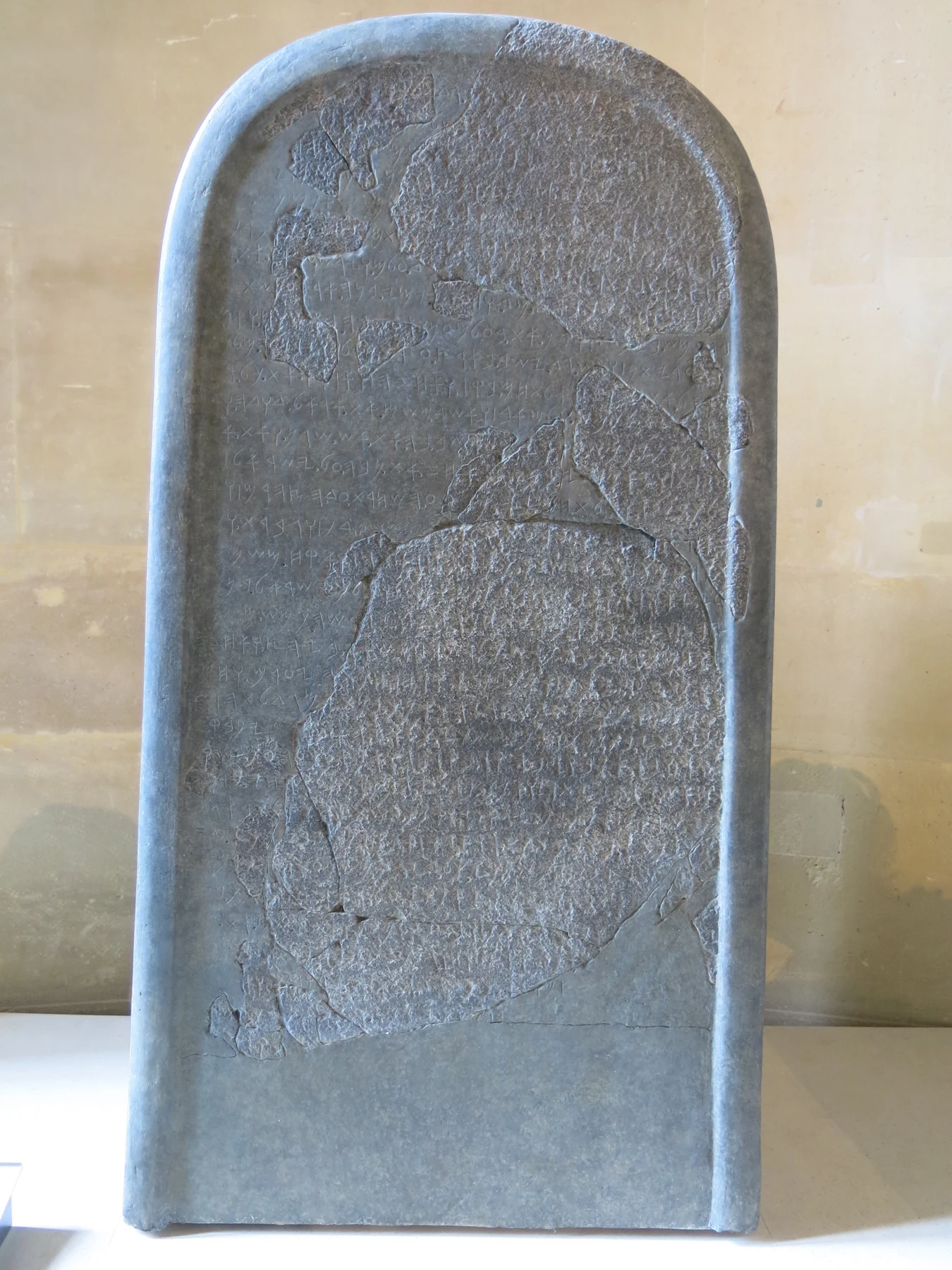
Chemosh was the foremost deity in surviving evidence from ancient MoabAncient MoabAn ancient land and kingdom in present-day Jordan, with Mesha's ninth-century BCE inscription a major local witness.Glossary · Click to read the explanation, east of the Dead SeaDead SeaThe Dead Sea is a salt lake in the Jordan Rift Valley, near sites where ancient manuscripts were foundGlossary · Click to read the explanation in present-day Jordan. His association with kingship, warfare and worship is known chiefly from the Mesha SteleMesha SteleA ninth-century BCE Moabite royal basalt stele at the Louvre (AO 5066; KAI 181). Its inscription names Chemosh, Omri, Israel and YHWH (line 18). A proposed “House of David” reading in damaged line 31 is disputed.Glossary · Click to read the explanation, erected by a Moabite king in the ninth century BCE, and from scattered references in the HebrewHebrewA Northwest Semitic language of the Canaanite group, encompassing Iron Age epigraphy, Biblical, Rabbinic, medieval and Modern Hebrew; its scripts and pronunciations changed over time.Glossary · Click to read the explanation Bible. This article examines what those sources actually say and distinguishes the king's crafted memory of victory from a historical reconstruction of the war.[1][2]
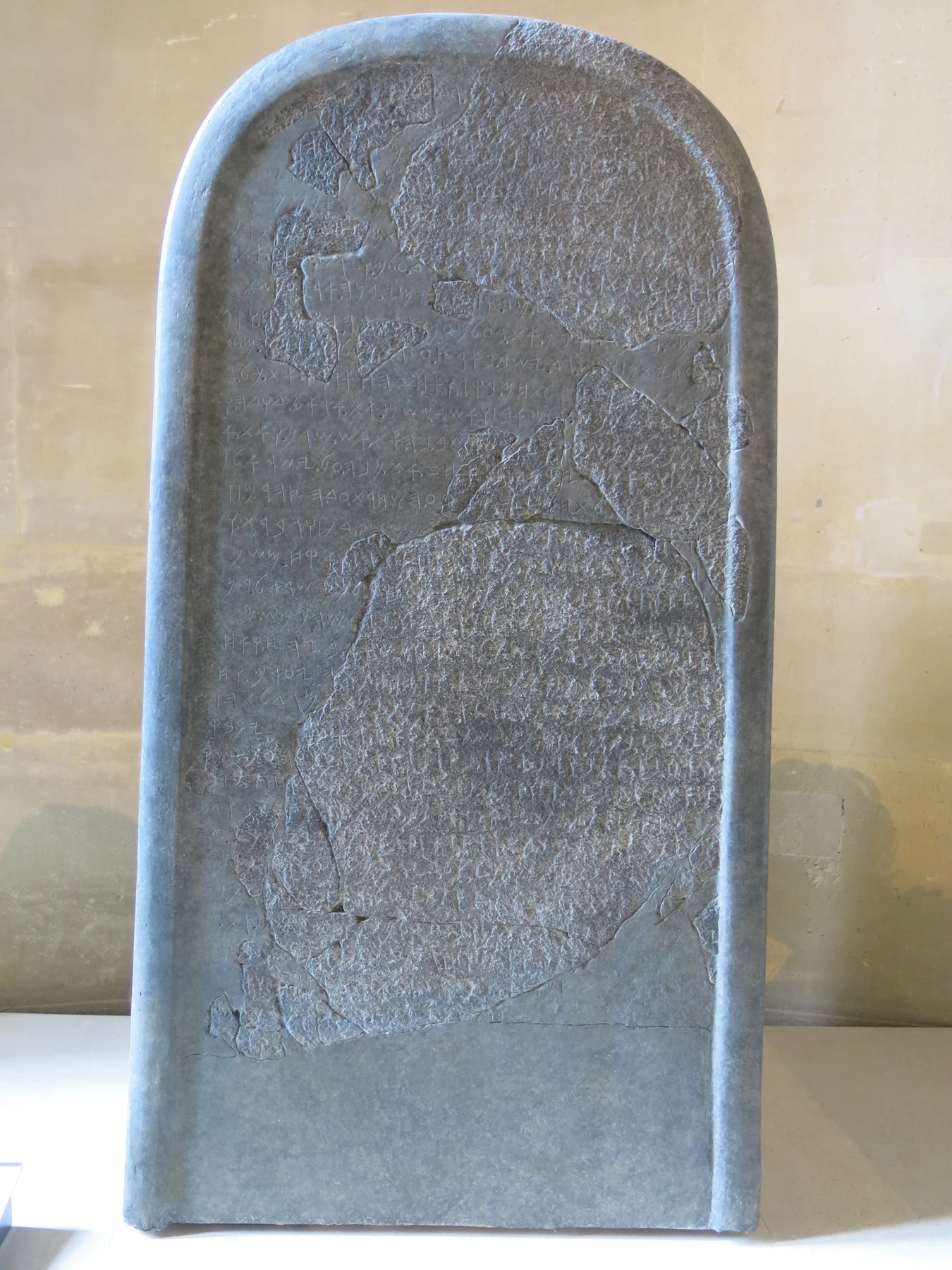
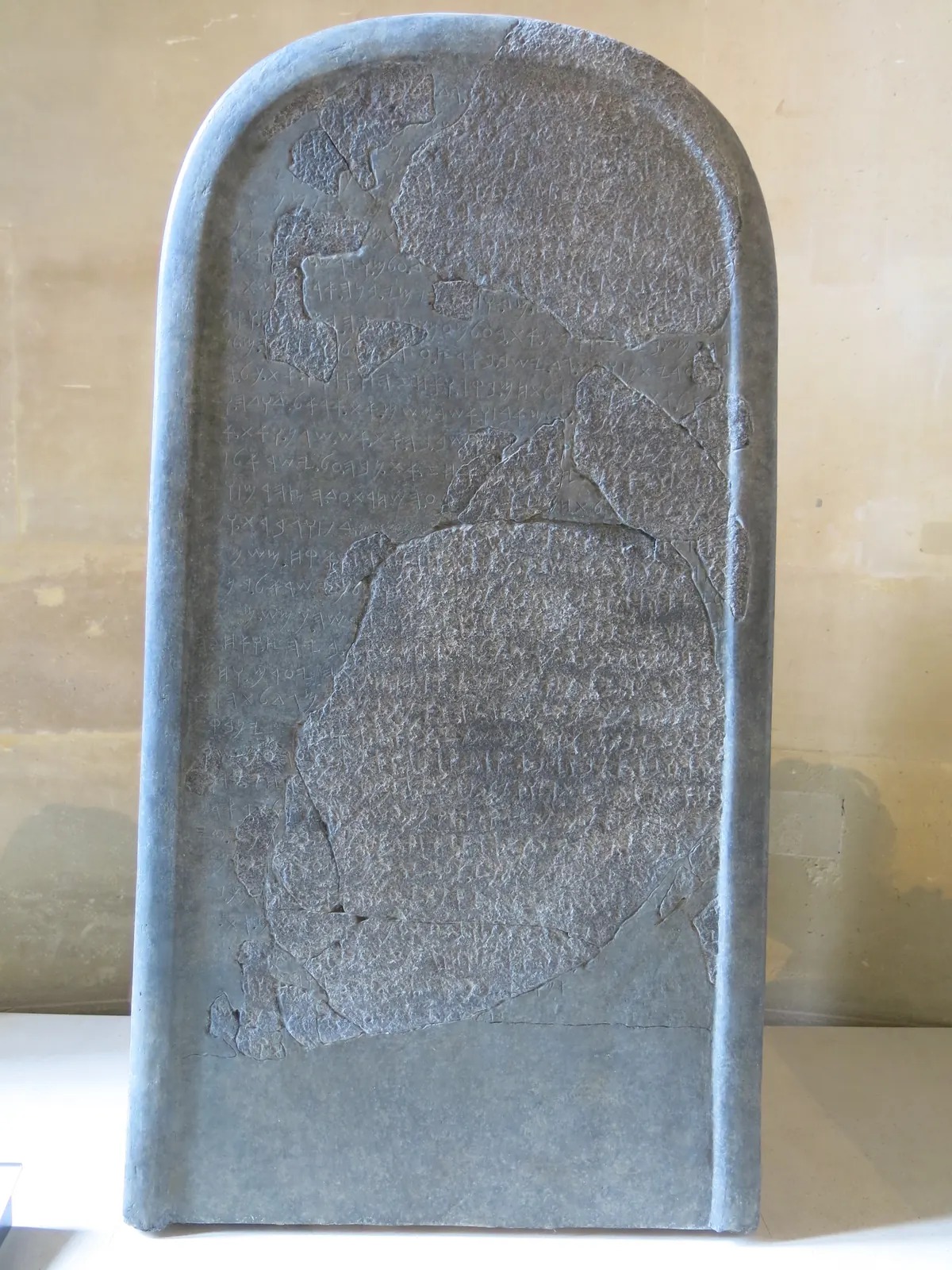
It considers the divine name and its functions, scenes of anger, commands and captured objects in the inscription, and relevant biblical and archaeological evidence. The main photograph shows the stele that names Chemosh: it is neither a statue of the deity nor an authenticated depiction of his appearance.
Contents
- The name and its Moabite setting
- The Mesha Stele: the object and its preservation
- Divine anger and favor in the royal account
- Warfare, commands and spoils
- Ashtar-Chemosh and names containing the divine name
- Other Moabite evidence
- Chemosh in the Hebrew Bible
- The campaign and the sacrifice of the royal son
- Comparing competing accounts of victory
- Damaged writing and contested readings
- What the evidence establishes, and what remains open
The name and its Moabite setting
The Moabite inscriptions give a name commonly represented as Chemosh or Kemosh; French scholarship also uses Kamosh. Biblical writings describe Moab as the “people of Chemosh,” while the inscription of King MeshaMesha, king of MoabNinth-century BCE king of Moab whose inscription recounts conflict, territorial recovery and construction.Glossary · Click to read the explanation presents him as the recipient of a constructed cult place and as the divine agent through whom control of territory is explained. This is a central place in the surviving textual representations, not a complete inventory of Moabite religious practices in every town or period.[8][2]
Moab was a kingdom and society on the plateau east of the Dead Sea, not merely the name of a religious group. Its rulers' policies unfolded amid border disputes with ancient IsraelAncient IsraelName attested for a population on the Merneptah Stele around 1208 BCE, later for the northern Iron Age kingdom and for broader textual and religious identities; the senses are not identical.Glossary · Click to read the explanation. Chemosh consequently appears differently according to the writer: as the land's protector in Mesha's inscription and as a foreign god whose worship is condemned in Hebrew writings. The religious judgement expressed by one voice must not be silently attributed to the other.
The Mesha Stele: the object and its preservation
The stele was discovered in 1868 at DhibanDhiban: town and archaeological siteTown and archaeological site in west-central Jordan, findspot of the Mesha Stele in 1868, with several periods of settlement.Glossary · Click to read the explanation, ancient Dibon. It is a round-topped basalt monument bearing 34 lines of Moabite written in an alphabetic script related to Phoenician. The Louvre catalogues it as AO 5066 and dates it to the ninth century BCE. The displayed monument combines surviving original fragments with reconstructed areas. The museum places the inscription after 842 BCE, though more exact chronological estimates differ among scholars.[1]
The monument was broken during a nineteenth-century dispute over its possession. A paper squeeze—an impression made from the incised letters before the breakage—subsequently helped scholars retrieve portions of a text missing from the stone. A photograph of the restored monument does not display every letter in the form originally carved; one must distinguish surviving surface, reconstruction and the early paper impression when discussing disputed readings.[4][3]
Divine anger and favor in the royal account
Mesha begins by identifying his family, his father's reign and his construction of a cultic high place for Chemosh. He says that OmriOmri, king of IsraelNinth-century BCE ruler of ancient Israel, named in the Mesha inscription's account of Moab's subjection.Glossary · Click to read the explanation, king of Israel, subjected Moab for a long time because Chemosh had been “angry with his land,” then claims that Chemosh restored the territory in Mesha's own days. Subjection and military recovery thus become two phases in an account of divine displeasure and restored favor. What we directly possess is the belief publicly expressed by the king, not an independent historian's observation of supernatural intervention.[2][5]
The inscription likewise credits Chemosh with delivering Mesha from enemies, then recounts seized settlements, fortifications, reservoirs and roads. Reducing it to a narrative of “warring gods” would miss important features: building works, mobilized labor and the relocation of people proclaim royal power alongside religious thanksgiving.
Warfare, commands and spoils
In Mesha's account, Chemosh commands him to take the town of NeboNebo, the town in Mesha's inscriptionTown named in Mesha's conflict with Israel, from which he reports taking Yahweh's vessels before Chemosh.Glossary · Click to read the explanation, and the king presents victory over his opponents as the deity's work. He describes killing inhabitants of captured towns and dedicating killings or spoils to the god. This is violent royal victory language, not a neutral census of what happened to every inhabitant. At Nebo he also reports taking “vessels of YahwehYahwehThe proper name of Israel’s deity, written יהוה (YHWH), the Tetragrammaton. Its exact ancient pronunciation is not directly preserved; texts and inscriptions witness its history.Glossary · Click to read the explanation” and placing them before Chemosh, rare testimony to contact between the religious establishments on opposing sides of the conflict.[2][5]
The passage attests that the inscription's author understood objects associated with YahwehYahwehThe proper name of Israel’s deity, written יהוה (YHWH), the Tetragrammaton. Its exact ancient pronunciation is not directly preserved; texts and inscriptions witness its history.Glossary · Click to read the explanation to be part of the king's booty and considered their presentation before Chemosh significant. It does not specify their appearance or any later ritualRitualAn organised or distinguished practice meaningful to a community; it may leave traces, but its form alone does not reveal an associated doctrine.Glossary · Click to read the explanation, nor does it prove that a particular practice characterized every Moabite sanctuary.
Ashtar-Chemosh and names containing the divine name
The compound “Ashtar-Chemosh” occurs when the text speaks of placing Nebo under a war ban or dedication. Translations explain this as the town being devoted to that name in the rhetoric of victory. The compound itself occurs in the inscription; its precise relationship to Chemosh—whether epithet, combination of divine names or cultic fusion—remains an interpretive question that the passage alone cannot settle.[2][5]
The name Chemosh also appears within personal names. A name commonly represented as Chemosh-yat or Chemosh-yatti has been linked to an inscribed fragment from Kerak and to Moabite royal genealogy, although damaged letters and restorations require care. A theophoric nameTheophoric nameA personal name including a deity’s name or another divine element, often as part of a short sentence or invocation, interpreted in its original language and context.Glossary · Click to read the explanation witnesses the use of a deity's name in human naming; it is not evidence that we possess an identifiable ancient image of Chemosh.[10]
Other Moabite evidence
A fragmentary inscribed statue from Kerak carries Moabite royal writing. A specialist study assessed its artistic form against possible Egyptian parallels. The statue's art-historical origin and the identity of the person associated with the inscription are separate from its preservation of a divine name: the fragment cannot simply be labelled a “statue of Chemosh”; it may be a statue used to carry a royal inscription.[10]
Excavations at Khirbat Ataruz in central Jordan revealed a cult building and an altar bearing two short Moabite inscriptions, paleographically dated to the late ninth or early eighth century BCE. Both texts are fragmentary and difficult to interpret; the published study does not in itself establish that the altar belonged to a sanctuary dedicated specifically to Chemosh. A local sanctuary and altars at Khirbat al-Mudayna likewise show varied cult architecture without allowing the name of each building's deity to be derived from its plan alone.[11][12][13]
Chemosh in the Hebrew Bible
Numbers 21:29 and JeremiahBook of JeremiahProphetic book addressing Judah and the Babylonian crisis; chapter 34 recounts liberation followed by renewed subjection.Glossary · Click to read the explanation 48:46 designate the Moabites the “people of Chemosh” in poetic contexts of lament and judgement. Jeremiah 48:7 imagines Chemosh going into exile alongside his priests, turning the language of divine national protection into a rhetorical picture of the land's defeat. These passages belong to their own literary and editorial settings, not to a transcription of Moabite temple records.[8][9]
The Books of Kings attribute to SolomonSolomonSolomon is the biblical king, David’s son, associated in Kings with Jerusalem and building the templeGlossary · Click to read the explanation the construction of a high place for Chemosh near JerusalemJerusalemJerusalem is a city of religious importance in Judaism, Christianity and IslamGlossary · Click to read the explanation, and describe its desecration under Josiah. The hostile epithets attached to Chemosh express the biblical narrators' religious assessment; that wording alone cannot establish the precise dates or physical continuity of any shrine. Judges 11:24 names Chemosh in a speech addressed to the king of Ammon, a contextual difficulty that makes the verse unsuitable as an unambiguous independent catalogue of Ammonite gods.[7][8]
The campaign and the sacrifice of the royal son
In 2 Kings 3, the Books of KingsBooks of KingsBiblical books narrating the kingdoms' history, including the campaign against Mesha in 2 Kings 3.Glossary · Click to read the explanation recount Mesha's revolt after Ahab's death and a joint campaign by Israel, Judah and Edom. The story ends with the Moabite king's failed attempt to break the siege, his offering of his firstborn son and heir as a burnt offering on the city wall, a “great wrath” coming upon Israel and the withdrawal of the coalition. Verse 3:27 does not explicitly identify the deity to whom the offering was made or the source of the wrath. Attributing either with certainty to Chemosh, Yahweh or the besieging army goes beyond what the sentence says.[6]
Scholars have offered different explanations for the withdrawal, including the psychological effect of the sacrifice and religious interpretations within the narrative's own framework. In 2020 Drew Holland proposed another reading, treating the passage as a condemnation of alleged Israelite participation in a cultic act. This is the author's hypothesis, known here from the study's abstract, not a consensus interpretation or an externally verified event.[14]
Comparing competing accounts of victory
Mesha portrays the recovery of Moabite settlements as a victory given by Chemosh; the narrative in 2 Kings 3 describes Israelite success during the campaign followed by an abrupt withdrawal. The accounts broadly agree that Israel and Moab were in conflict and that Mesha was involved. They do not permit an automatic alignment of every battle, its sequence or its outcome: Mesha commissioned an inscription of victory and construction, while the editors of Kings shaped a narrative with different historical and religious interests.[2][6][5]
A comparison may set Chemosh's alleged restoration of Moabite land alongside Kings' portrayal of Yahweh's authority over military events. This compares two religious and political languages; it does not claim that a modern historian witnessed two gods fighting, nor that the rites of the opposing populations were identical.
Damaged writing and contested readings
Some scholarly disagreements concern missing or indistinct letters on the stone and its pre-destruction impression. The most discussed case is line 31: André Lemaire and Jean-Philippe Delorme defend a reading referring to the “House of David,” whereas Matthieu Richelle and Andrew Burlingame argue that the evidence cannot make it certain; Israel Finkelstein, Nadav Na'aman and Thomas RömerThomas RömerScholar of Hebrew Bible history and composition, holding the Biblical Milieux chair at the Collège de France.Glossary · Click to read the explanation cautiously proposed an alternative connected with the name “Balak.” This debate does not undermine the clear passages about Chemosh. It illustrates how an extant letter differs from a proposed restoration.[18][15][16][17]
Sound epigraphic arguments must state whether they rely on visible grooves, the early paper impression or a modern reconstruction. The present review has not independently collated the Moabite lettering or spectral photographs: its textual conclusions are grounded in the explicitly identified publications and translations.
What the evidence establishes, and what remains open
Our strongest evidence is that a ninth-century BCE Moabite king publicly grounded his authority in Chemosh's favor, linked the god to war, recovery of land and a cult place, and described captured objects from a Yahweh-associated setting. Later Hebrew writings attest that Chemosh remained prominent in neighboring depictions of Moab. The god's exact appearance, the rites of every sanctuary and the definitive interpretation of each sacrifice or compound divine name remain far less certain. The damaged but carefully documented stele is a key window onto the history of worship—not a portrait of Chemosh himself.[1][2]
References and notes (18)
- Musée du Louvre, “Stèle de Mesha” collection record: basalt from Dhiban, 34 Moabite lines, dated to the ninth century BCE; the incomplete monument was reassembled and restored. The notice also places inscription after 842 BCE and records a catalogue dating range of 830–805 BCE. Louvre AO 5066 / KAI 181; object, dating and inscription notice Return to the text ↑
- K. C. Hanson, authorized English translation of the Mesha inscription on a Bethel University webpage. The complete page translation was read; it is a mediated English rendering rather than an independent collation of Moabite letters. Used for anger, commands, dedication, Yahweh vessels and construction without extended quotation. Mesha inscription; published K. C. Hanson translation, especially lines 1–9, 11–18, 21–34 Return to the text ↑
- Wikimedia Commons, file page for Tangopaso’s photograph taken 16 May 2018; the photographer releases this particular image of Louvre AO 5066 to the public domain. The license applies to the individual file, not inferred from a museum gallery policy. Commons file page: photographer, public-domain dedication and original image Return to the text ↑
- Collège de France, “Mésha et la Bible” exhibition notice (15 September 2018), paragraphs on discovery, destruction, pre-breakage squeeze and reconstruction; the institution marks its English page as an automatic translation. Collège de France 2018 Mesha exhibition notice, discovery and reconstruction paragraphs Return to the text ↑
- Jona Lendering, “The Stela of Mesha,” Livius: historical introduction and English translation adapted from Klaas Smelik. The whole displayed translation was read; its unqualified “House of David” restoration is treated here as contested rather than established. Jona Lendering, Mesha translation in sections 1–14 of the web text Return to the text ↑
- Second Kings, chapter 3, NRSVUE English translation at Bible Gateway: the campaign narrative through its conclusion was examined. Verse 27 does not explicitly name the burnt offering’s recipient or the source of wrath; this is a translation-based reading, not a new collation of Hebrew. 2 Kings 3:4–27, esp. 3:26–27 (NRSVUE) Return to the text ↑
- English Standard Version, passages in 1 Kings and 2 Kings about the high place and its desecration; the condemnatory epithets are attributed to the biblical narrators, not treated as independent evidence for a surviving shrine. 1 Kings 11:7; 2 Kings 23:13, Chemosh references (ESV) Return to the text ↑
- Specified verses in the NRSVUE English version: Moab called the “people of Chemosh” and the name appearing in Judges within a speech to the king of Ammon, requiring contextual caution. Numbers 21:29; Judges 11:24; Jeremiah 48:46 (NRSVUE) Return to the text ↑
- Jeremiah 48:7 in the NRSVUE: poetic portrayal of Chemosh departing with his priests; used to explain the prophetic rhetoric, not as evidence that a particular Moabite cult statue was transported. Jeremiah 48:7, Chemosh and priests exiled (NRSVUE) Return to the text ↑
- Heather Dana Davis Parker and Ashley Fiutko Arico, “A Moabite-Inscribed Statue Fragment from Kerak: Egyptian Parallels,” BASOR 373 (2015), 105–120; published abstract only, describing a royal-inscribed statue fragment and proposed Egyptian artistic parallels; full article not read. Parker and Arico, BASOR 373 (2015), pp.105–120; abstract only Return to the text ↑
- Adam L. Bean, Christopher A. Rollston, P. Kyle McCarter and Stefan J. Wimmer, “An inscribed altar from the Khirbat Ataruz Moabite sanctuary,” Levant 50/2, 211–236: publisher abstract only, describing two fragmentary Moabite inscriptions dated by script to the late ninth or early eighth century BCE. Bean et al., Levant 50/2 (2019), pp.211–236; abstract only Return to the text ↑
- Chang-Ho Ji, “A Moabite sanctuary at Khirbat Ataruz, Jordan,” Levant 50/2, 173–210; available publisher abstract only, on sanctuary stratigraphy and finds, without naming a deity for every room. Chang-Ho Ji, Levant 50/2 (2019), pp.173–210; abstract only Return to the text ↑
- P. M. Michèle Daviau and Margreet Steiner, “A Moabite Sanctuary at Khirbat al-Mudayna,” BASOR 320 (2000), 1–21; only the Wilfrid Laurier University repository abstract was read, documenting a local sanctuary and stone altars. Daviau and Steiner, BASOR 320 (2000), pp.1–21; university abstract only Return to the text ↑
- Drew Holland, “An Alternative Approach to the Dilemma of 2 Kgs 3:27” (2020): abstract only; the suggested Israelite participation in Mesha’s offering is attributed to Holland rather than treated as a historical finding. Drew Holland, Journal of Inductive Biblical Studies 7/2 (2020), pp.7–31; abstract only Return to the text ↑
- André Lemaire and Jean-Philippe Delorme, “Defending the ‘House of David’,” 26 May 2023, open rejoinder; passages defending the reading and the damaged letters of line 31 were examined. Their paywalled 2022 study was not read in full. Lemaire and Delorme, published reply of 26 May 2023; argument on line 31 Return to the text ↑
- Matthieu Richelle and Andrew Burlingame, “Why Mesha’s ‘House of David’ Remains Hypothetical,” 25 August 2023; the rejoinder’s framing and central argument about unconfirmed letters were examined; the related paywalled journal article was not read in full. Richelle and Burlingame, reply of 25 August 2023; limits of line-31 reading Return to the text ↑
- Israel Finkelstein, Nadav Na’aman and Thomas Römer, “Restoring Line 31 in the Mesha Stele,” Tel Aviv 46/1 (2019), 3–11; university-published abstract only, rejecting an earlier reading and cautiously proposing “Balak.” Finkelstein, Na’aman and Römer, Tel Aviv 46/1 (2019), pp.3–11; abstract only Return to the text ↑
- André Lemaire, “Notes d’épigraphie nord-ouest sémitique,” Syria 64 (1987), 205–216; only the opening page exposed by Persée and its remarks on breakage and readings were examined, not the complete article. Lemaire, Syria 64 (1987), p.205 and opening of lines 11–12 discussion; first-page excerpt only Return to the text ↑
Suggest a correction · Suggest a source for this record
Cite this record
IL Archive, «Chemosh», https://ilarchive.com/en/entities/chemosh
Continue reading