Study
Mesha and Chemosh: How a King Narrates Sacred War
An extended study of a topic, with evidence and references.
- Timeline
- From 900 BCE to 800 BCE
- Region
- Moab / Dibon
A reading of the Moabite inscription through divine anger, Yahweh’s vessels, violence and construction, separating evidence from royal rhetoric.
Share article
Text
A king recounting victory does more than record troop movements. He explains an earlier defeat and makes his own success deserved. In the inscription of Mesha, king of Moab, ChemoshChemoshProminent Moabite deity whose anger and favor explain defeat and recovery in Mesha’s royal inscription.Glossary · Click to read the explanation supplies that explanation: foreign domination expresses divine anger, while recovery marks renewed favor. The stone preserves a Moabite voice whose significance does not depend on agreement with the Bible.
An ancient inscription on a restored object
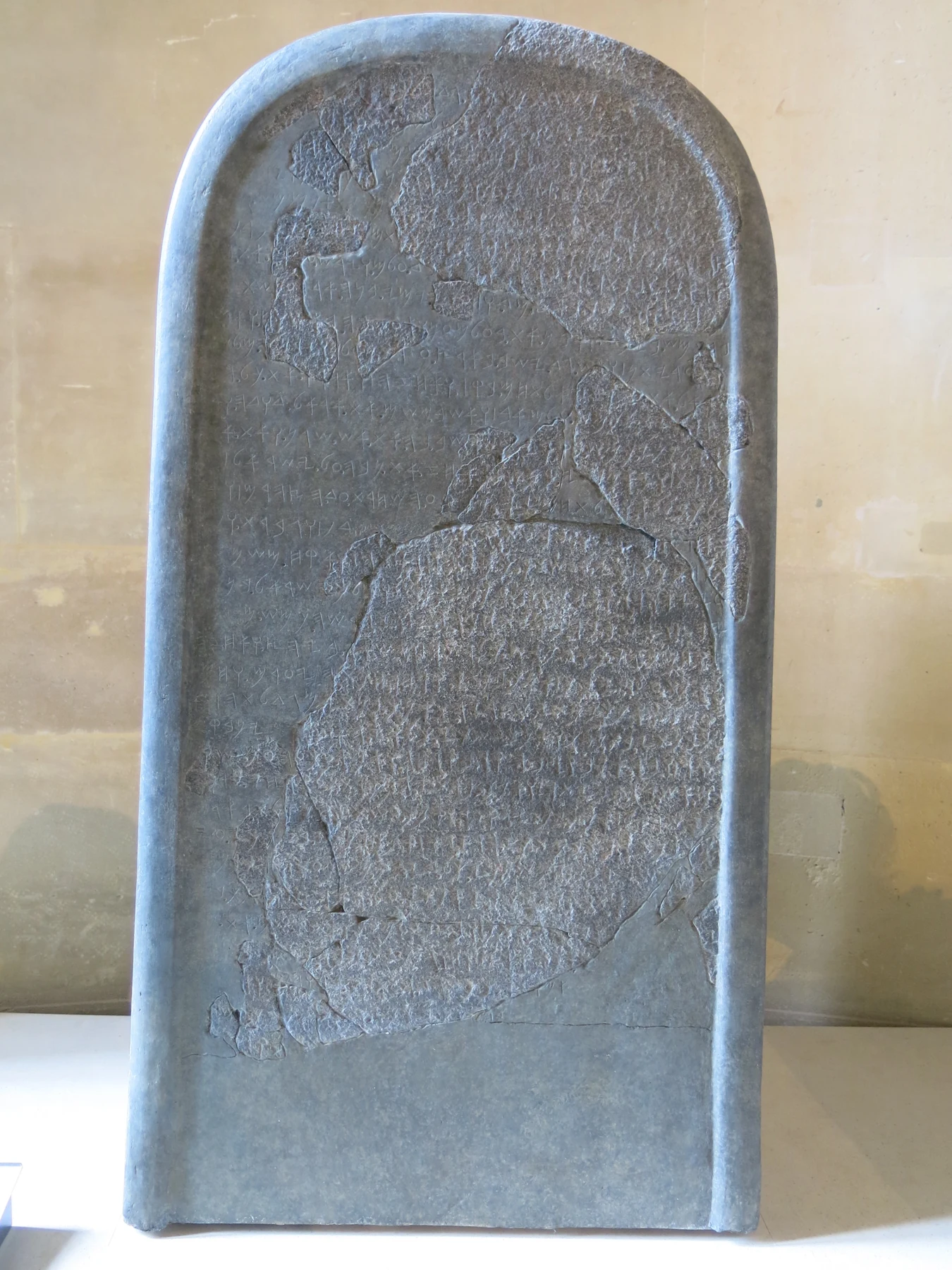
The Mesha SteleMesha SteleNinth-century BCE inscription of King Mesha of Moab; line 18 mentions Yahweh’s vessels, clear external evidence for the deity associated with Israel.Glossary · Click to read the explanation dates to the ninth century BCE and was discovered at Dhiban, Jordan, in 1868. It is Louvre AO 5066, a basalt monument with thirty-four lines in Moabite. The displayed object is fragmented, reassembled and completed; not every visible black surface is intact ancient stone.[1]
Authenticity and present condition are different questions. Some letters survive clearly, while damaged passages require fragments, early copies and competing restorations. A proposed reconstruction of a damaged ending should not receive the same confidence as a plainly preserved phrase.
Defeat does not abolish Chemosh
Mesha explains Omri’s subjugation of Moab through ChemoshChemoshProminent Moabite deity whose anger and favor explain defeat and recovery in Mesha’s royal inscription.Glossary · Click to read the explanation’s anger, then presents recovery as the god’s gift.[2] Defeat is interpreted within the relationship with the deity rather than treated as proof of his nonexistence.
This royal explanation can maintain trust through alternating punishment and protection. It gives the present meaning, but it is not an independently testable military cause. We learn how the writer justified events; divine anger itself is not external corroboration of his account.
Yahweh’s vessels before Chemosh
In the episode concerning Nebo, the king attributes an attack order to Chemosh and reports carrying YahwehYahwehThe divine proper name written YHWH in the Hebrew Bible.Glossary · Click to read the explanation’s vessels before him. This is an especially important early external attestation of Yahweh in an Israelite context.[2]
Cult equipment suggests worship associated with the place. It does not reveal a building plan or the names of priests. Nor should vessels become, through retelling, a securely attested captured statue of Yahweh. Displaying an opponent’s sacred equipment makes the victory visible before the victor’s god, but the objects must remain what the inscription calls them.
Violence represented as consecration
The text connects killing with dedicating a conquered population to a deity. This is royal religious language legitimizing violence, not an innocuous metaphor. Conversely, reported casualty totals and total extermination cannot simply be accepted as a neutral census.[2]
The secure finding is that Mesha wished to represent the violence as legitimate and sacred. Verifying its full historical extent requires additional evidence. Similar war language in two texts does not alone establish copying; both may draw on related traditions.
A king who builds
Walls, gates, reservoirs and construction projects accompany the conquests; the text also mentions Israelite prisoners used in work at the city.[2] Mesha presents himself as deliverer and builder. The deity restores territory, the king organizes it and visible infrastructure gives the reign a durable public presence.
The monument participates in the management of memory. Its object is not only to enumerate battles, but to make this reign remembered as restoration and renewal.
Comparing 2 Kings
Second Kings 3 describes Mesha’s rebellion and a campaign against him, ending with the sacrifice of his son, great wrath and the army’s withdrawal.[3] Names, kingdoms and conflict overlap, but the accounts do not narrate identical sequences. The inscription does not describe the son’s sacrifice in that chapter.
Comparison should preserve two voices and their purposes. The stele does not validate every biblical detail, and the biblical narrative is not a ready-made interpretation of every damaged letter.
Mesha places kingship within relationships among ruler, people, land and deity. The monument does not prove the god’s intervention. It does preserve how a human ruler shaped a history in which Chemosh could punish and then restore his community.
Connected readings
Yahweh’s origins · Israelite monotheism · Similarity and borrowing
References and notes
- Louvre catalog: basalt, Dhiban, ninth century BCE, and a fragmented, reassembled and completed object. Louvre AO 5066 / KAI 181 Return to the text ↑
- Inscription and K. C. Hanson’s translation hosted by Bethel University; analysis of the royal testimony, without reproducing the translation. Mesha inscription, lines 1–9, 14–18, 21–26 Return to the text ↑
- Biblical account of Mesha’s revolt and the campaign; a separate literary witness, not an automatic match to the inscription. 2 Kings 3:4–27 Return to the text ↑
Suggest a correction · Suggest a source for this record
Cite this record
IL Archive, «Mesha and Chemosh: How a King Narrates Sacred War», Edition 1, https://ilarchive.com/en/studies/mesha-chemosh-and-war
Continue reading