Entity · Concept
Heavenly Host
A reference page linking a name, group, or concept to the materials that discuss it.
A heavenly group whose meaning varies: celestial bodies in some texts, attendants around the throne deliberating in 1 Kings 22.
Text
A context-dependent expression
Heavenly host is collective language, not a fixed list of angels. Deuteronomy 4:19 places it alongside sun, moon and stars; Psalm 89 joins divine sons and holy ones in a context of divine supremacy. Celestial vocabulary is not automatically interchangeable.[1]
The court in 1 Kings
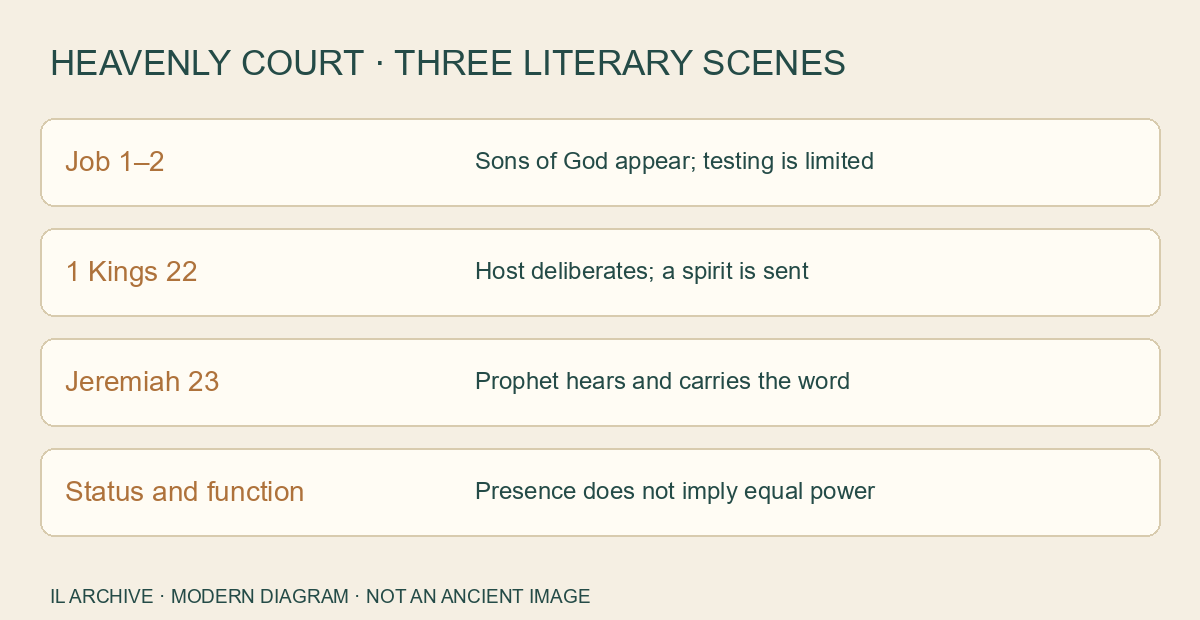
In 1 Kings 22:19–23, Micaiah sees YahwehYahwehThe divine proper name written YHWH in the Hebrew Bible.Glossary · Click to read the explanation enthroned with the host to his right and left. Participants offer proposals, then a spirit receives a commission. The scene defines attendance, deliberation and execution without calling each figure an angel or establishing independence from the ruler.[2]
Comparative limits
The council is a widespread ancient Near Eastern model. A continuing host and throne do not establish transfer of every Ugaritic god into this text. The accompanying diagram explains literary scenes; it is not an ancient image of the court.[3]
References and notes
- Hebrew Bible / Bible hébraïque — Psalm 89:6–9 (Hebrew numbering); Deuteronomy 4:19; 14:1. Mechon-Mamre, Hebrew text and JPS 1917 English translation. Hebrew Psalm 89:6–9 (5–8 in other translations): bene elim and holy council. Heavenly host checked at https://mechon-mamre.org/p/pt/pt0504.htm v.19, human children at https://mechon-mamre.org/p/pt/pt0514.htm v.1. Context prevents treating all terms as identical. Return to the text ↑
- Hebrew Bible / Bible hébraïque — 1 Kings 22:19–23. Mechon-Mamre, Hebrew text and JPS 1917 English translation. Verses 19–23: throne, host, proposals, spirit and dispatch. Text says spirit, not a particular named angel; reading concerns the literary vision’s structure. Return to the text ↑
- Bryan D. Spinks (1991). The Old Testament Background and Setting. The Sanctus in the Eucharistic Prayer, chapter 1, pp. 11–24. doi:10.1017/CBO9780511520242.003. Accessible Summary excerpt on Yahweh’s council, Psalm 82 and prophecy; not the full chapter. The excerpt prints Jeremiah 22:18; the passage checked here is 23:18,22. Return to the text ↑
Research history
Substantive changes are retained here. Minor copy edits remain in the internal operational log.
-
Substantive record update
Suggest a correction · Suggest a source for this record
Cite this record
IL Archive, «Heavenly Host», Edition 2, https://ilarchive.com/en/entities/heavenly-host