Entity · Concept
High god
A reference page linking a name, group, or concept to the materials that discuss it.
A descriptive rank within a pantheon, not inherently monotheism: textual examples from Mesopotamia, Ugarit and Greece distinguish supremacy, worship and exclusivity.
Estimated reading time: 6 min Published Last reviewed:
Share article
Text
Introduction
What does it mean to call a deity a “high god” in a tradition that recognizes other gods? This entry examines rank within the divine world: who grants authority, which titles signal seniority, and how a god’s standing is articulated in particular sources, places and periods. Such rank must be distinguished from exclusive worship and from denying that other gods exist; one claim does not prove the others.
A position of precedence, not a single creed
“High god” is a descriptive scholarly term for a deity who occupies a superior position in a pantheonPantheonThe deities recognized within a given religious tradition, city or period, as reflected in texts and cult. Broader than a divine council, an assembly within a narrative.Glossary · Click to read the explanation. Texts may portray this deity as the father of the gods, the grantor of kingship, or the authority behind decisions about fate. None of these attributes necessarily makes the deity the only legitimate object of worship, nor does the same god have to remain supreme in every city or period of a broader tradition. Research on West Semitic divine structures illustrates why these distinctions matter. [2]
The term is also different from a divine councilDivine councilA divine council is a religious and literary scene in which divine beings gather before a superior authority for discussion, commissioning or judgment; it is not identical to a pantheon list.Glossary · Click to read the explanation: a pantheon is the set of deities acknowledged in a tradition; a council is an assembly or scene of deliberation; and the high god describes an office or position of authority that may figure in either. Poetic praise such as “none is your equal” can exalt its addressee without serving as a comprehensive theological declaration about the existence of every other god. [3]
What evidence establishes the highest rank?
We must compare kinds of evidence: ordered god listsGod ListsTexts collecting divine names for preservation, teaching and classification, with varying theological organization.Glossary · Click to read the explanation, titles in epics, royal inscriptions, offering accounts, and personal names. God listsGod ListsTexts collecting divine names for preservation, teaching and classification, with varying theological organization.Glossary · Click to read the explanation systematize scribal learning and divine names, but they do not directly measure which gods people worshipped most. The bilingual scholarly list An = Anum arranges Sumerian names alongside AkkadianAkkadianAn ancient East Semitic language written in cuneiform from the third millennium BCE; its varieties include Babylonian and Assyrian, and it served in international diplomacy.Glossary · Click to read the explanation correspondences and associated figures; moving from the list’s order to lived cult requires independent evidence. [6]
Likewise, the collective name AnunnaAnunna / AnunnakiAnunna/Anunnaki is a collective designation for Mesopotamian gods whose scope varies by text and period; it is not a group with one fixed membership or number.Glossary · Click to read the explanation changes by context and date: it can denote great gods or a local divine group, and in later texts it has special underworld associations. Its occurrences cannot all be treated as references to one unchanging institution. Nor is the title “father of the gods” by itself enough to identify the head of every pantheon. [13]
Mesopotamia: An and Enlil are not a fixed table of ranks
An/AnuAn / AnuAn is the Sumerian sky god, called Anu in Akkadian. The sign AN by itself does not identify him: it also denotes sky or divinity.Glossary · Click to read the explanation, the sky god, appears in Sumerian and Akkadian material as an ancient authority who can assign divine offices and grant kingship. Yet early seniority is not a monopoly over all functions: An remained distinguished as other gods became prominent, while genealogies differed across sources. The cuneiformCuneiformWriting with wedge-shaped signs, developed from Mesopotamian recording traditions and used for several languages from the third millennium BCE.Glossary · Click to read the explanation sign AN is not in every context an unambiguous reference to the deity, because it has other written functions. [4]
EnlilEnlilEnlil/Ellil: a major Mesopotamian god associated with destinies, kingship, and Ekur at Nippur, already prominent in third-millennium god lists. His name’s origin and cult beginnings remain debated.Glossary · Click to read the explanation, associated with Nippur and the EkurEkur: Enlil’s Temple at NippurEkur (“Mountain House”) was Enlil’s chief sanctuary at Nippur, present-day Iraq; the name may extend to its precinct. Hymns and royal inscriptions attest to its prestige and rebuilding across periods; it is not simply the ziggurat.Glossary · Click to read the explanation temple, is especially prominent as the one who determines destinies and grants sovereignty. His practical authority could be paramount while An retained ancestral and celestial prestige. This is not a universal ladder on which religions ascend, but a changing set of ritualRitualAn organised or distinguished practice meaningful to a community; it may leave traces, but its form alone does not reveal an associated doctrine.Glossary · Click to read the explanation, political and literary claims over centuries. [5]
Marduk: a rise to supremacy among many gods
MardukMardukBabylon’s leading god, worshipped at Esagil and elevated in the Akkadian Enūma eliš. His symbols include a spade and mušḫuššu dragon. His earliest origins remain obscure; Nibiru is no evidence of a planetary homeland.Glossary · Click to read the explanation grew in importance alongside BabylonBabylonBabylon is an ancient city in central present-day Iraq, south of BaghdadGlossary · Click to read the explanation’s political fortunes. In Enūma elišEnuma ElishA seven-tablet Babylonian creation poem in Akkadian, recounting Marduk’s rise, victory over Tiamat, cosmic ordering and human creation, and culminating in praise through fifty names. Its composition date is debated; later manuscripts and recitation traditions preserve it.Glossary · Click to read the explanation, his triumph over TiamatTiamatTiamat is a primeval divine mother and watery figure in Enūma eliš who later opposes Marduk; he divides her body in making the cosmos. No Babylonian portrait of her is securely identified.Glossary · Click to read the explanation is part of a story in which other gods confer supremacy upon him. In passages in Tablets III and IV, he requires effective power before confronting her, and the gods then declare his preeminence. This is a narrative statement of authority among deities, not a declaration that they have ceased to exist. [7] [8]
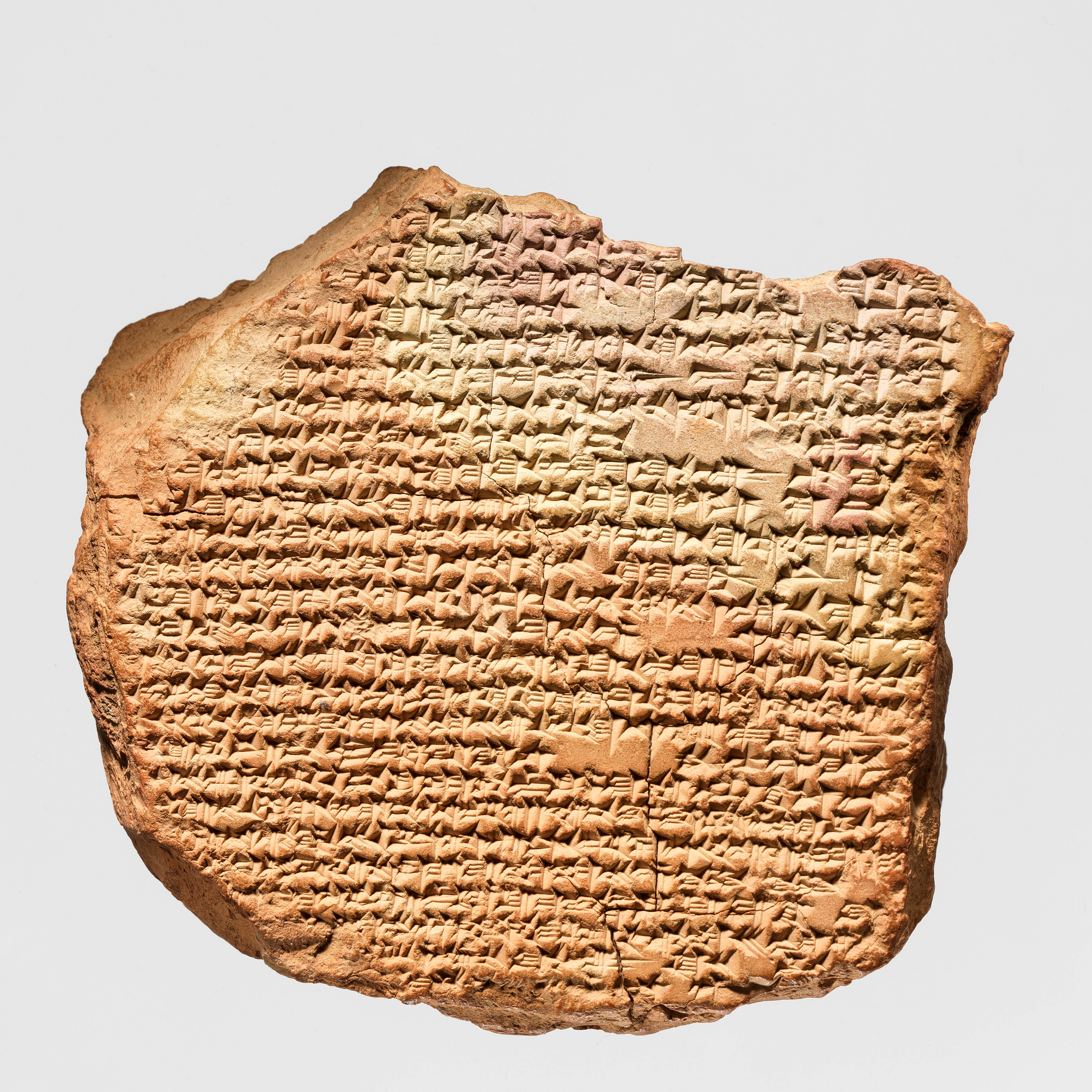
A separately identifiable artifact provides another kind of evidence: a Hymn to Marduk at the Metropolitan Museum of Art, accession 86.11.313, dated to the first millennium BCE. Its preserved middle section alternates Sumerian lines with Akkadian translation and exalts Marduk as ruler of the universe. The museum suggests, but does not establish, a possible relation to royal coronation. The photograph documents a hymnic text, not a portrait of the god or proof of monotheismMonotheismBelief that only one God possesses divinity in its fullest sense. Historically distinct from exclusively worshipping one deity without denying others; its theological forms vary.Glossary · Click to read the explanation. [9]
El and Baal: fatherhood and active kingship are not identical
Late Bronze AgeLate Bronze AgeAn archaeological period around 1600–1200 BCE in much of the Near East, with international diplomacy, exchange and religious diversity; its endpoints vary by region.Glossary · Click to read the explanation texts from UgaritUgaritAncient city and kingdom at Ras Shamra on the Syrian coast, flourishing between the fourteenth and early twelfth centuries BCE and preserving multilingual archives.Glossary · Click to read the explanation depict ElElEl is a senior deity in Late Bronze Age Ugaritic texts, portrayed as father of the divine family and a council authority, alongside his consort Athirat. This entry does not cover every linguistic use of El.Glossary · Click to read the explanation as father of the gods and patriarch of the divine family, whereas BaalBaalUgaritic storm god and warrior king who defeats Yamm, builds his palace with El’s consent and confronts Mot. References to El and Dagan as fathers do not define a single genealogy.Glossary · Click to read the explanation, the storm god, acts as a powerful champion in struggles over authority and a palace. Patriarchal standing and dramatic or military power do not always belong to the same figure. Those roles must be read in the specific compositions, not made into an all-purpose hierarchy for every Levantine city. [1] [10]
There is a linguistic complication as well. El can be a proper divine name or the common nounCommon nounA noun referring to a member of a class, such as “city” or “god”, unlike a proper name designating a particular entity. Semitic il/El may fulfill either function in context.Glossary · Click to read the explanation “god” in Semitic languages. Its occurrence in a personal name or inscription cannot automatically be taken as a reference to the particular mythological El known from Ugarit. [1]
A comparison from Greek literature
ZeusZeusZeus is the sky god and leading deity in many Greek traditions. In the Iliad he presides over divine gatherings while others can still speak and object.Glossary · Click to read the explanation can be presented as markedly stronger than the other gods in Greek poetry without those other gods disappearing from myth or cult. An academic overview of monotheism in classical antiquity treats Zeus’s increasing supremacy as something other than a straightforward denial of additional deities. This is a comparison of ranking, not proof of a single historical origin or transmission from MesopotamiaMesopotamiaHistorical region associated with the Tigris and Euphrates: Uruk, Ur, Eridu, cuneiform, Sumer, Akkad, Babylon and Assyria, their languages and cults, and the limits of archaeological evidence.Glossary · Click to read the explanation to Greece. [11]
High rank, exclusive worship, and monotheism
Four claims need separating: multiple gods with one as chief; singling out a god in praise or ritual; declaring that worship must be confined to one deity without necessarily resolving the existence of others; and monotheismMonotheismBelief that only one God possesses divinity in its fullest sense. Historically distinct from exclusively worshipping one deity without denying others; its theological forms vary.Glossary · Click to read the explanation understood as denying other gods’ existence. Modern labels such as henotheism and monolatryMonolatry: Exclusive WorshipExclusive worship of one deity, without automatically denying the existence of others; a modern term for allegiance, not necessarily a dated religious stage.Glossary · Click to read the explanation overlap or shift in scholarly usage. They should not be turned into compulsory successive stages. The critical question is what a particular text commands or denies, not simply whether it calls a deity “greatest.” [3]
In the HebrewHebrewA Northwest Semitic language of the Canaanite group, encompassing Iron Age epigraphy, Biblical, Rabbinic, medieval and Modern Hebrew; its scripts and pronunciations changed over time.Glossary · Click to read the explanation Bible YahwehYahwehThe proper name of Israel’s deity, written יהוה (YHWH), the Tetragrammaton. Its exact ancient pronunciation is not directly preserved; texts and inscriptions witness its history.Glossary · Click to read the explanation is a proper divine name alongside other terms and epithets, including El and ElohimElohimA Hebrew word with plural morphology, used for “gods” or for a singular deity according to context.Glossary · Click to read the explanation. El may be a common noun or a proper nameProper nameA name that identifies a particular person, place, group, or entity in context, unlike a common noun denoting a class. Spelling alone may not settle the distinction.Glossary · Click to read the explanation, an important distinction when tracing names and traditions. Mark S. Smith studies exclusivity and monotheistic language in Israel’s history and argues against reducing it to a universal evolutionary stage. For that specific claim, we have read the published chapter abstract, not the full book. [1] [12]
What the title alone cannot establish
“King of the gods” does not show that the figure was worshipped in every city. The mention of several gods does not document a uniform belief shared by a whole population. Shared titles such as “father” are not enough to establish that two gods were identical or that one cult was transmitted to another. We must also separate the mythic time of a narrated event, the composition of a version, the date of a surviving tablet, and the date of a modern translation. Sound comparison begins with the attested words, their genre, date and state of preservation, and limits its conclusion accordingly. [2] [8]
Conclusion
“High god” is a tool for analyzing authority within a particular tradition, not the name of a cross-cultural deity or independent proof of monotheism. An, Enlil and Marduk in Mesopotamia; El and Baal at Ugarit; and Zeus in Greek literature illustrate different configurations of seniority, kingship and cult. Questions about the existence or legitimate worship of other gods must be answered by evidence that actually addresses those questions. [3]
References and notes (13)
- Heath D. Dewrell and Andrew M. Garbarino, “Names of God in the Hebrew Bible,” Oxford Bibliographies in Biblical Studies (2023). Read the publicly available “Introduction” only: El as common noun or proper name; Elohim and Yahweh; uncertainty in compound divine names. Full article and its bibliography not read. Return to the text ↑
- Mark S. Smith, The Origins of Biblical Monotheism: Israel’s Polytheistic Background and the Ugaritic Texts, Oxford University Press (2001). Read the public book abstract and table of contents, concerning divine structures and exclusive rhetoric. Paywalled chapters not read; no direct Ugaritic quotation attributed to the book. Return to the text ↑
- Dan McClellan, “Monotheism,” Oxford Research Encyclopedia of Religion (published 16 April 2025). Read the accessible abstract on the contested definitions of monotheism, henotheism, monolatry and progressive-stage models; full text not accessible. Return to the text ↑
- Kathryn Stevens, “An/Anu (god),” Ancient Mesopotamian Gods and Goddesses, ORACC. Read Functions, Divine Genealogy, Time Periods and Name and Spellings: An’s authority and the ambiguity of the AN sign. Return to the text ↑
- Adam Stone, “Enlil/Ellil (god),” Ancient Mesopotamian Gods and Goddesses, ORACC. Read the functions and historically situated prominence sections, on destiny and kingship; not evidence for an inevitable linear succession. Return to the text ↑
- ORACC, Digital Corpus of Cuneiform Lexical Lists, “An Anum 1,” Q000264. Read the digital text, particularly the opening lines 1–24 and selected dependent names; not an examination of the original tablets. Return to the text ↑
- Nicole Brisch, “Marduk (god),” Ancient Mesopotamian Gods and Goddesses, ORACC. Read overview, rise to prominence, Enūma eliš discussion, Babylonian cult and chronological cautions. Return to the text ↑
- Enūma eliš, early English translation by L. W. King in The Seven Tablets of Creation (London, 1902). Read parts of Tablets II–IV in King’s 1902 English rendering, especially the assembly and conferral of rank in III–IV. Not collated against Akkadian or a modern critical edition; old translation has lacunae. Return to the text ↑
- The Metropolitan Museum of Art, “Cuneiform tablet: hymn to Marduk,” accession 86.11.313, collection record and Open Access policy. Read catalog details: 1st millennium BCE, Neo-Babylonian (?) status, fragmentary bilingual hymn, coronation relation only proposed; inspected photograph and Public Domain indicator on its page. Return to the text ↑
- Michael T. Wingert, The “God of the Fathers” and Self-Identification in the Hebrew Bible, PhD dissertation, UCLA (2017). Read abstract and indexed excerpts around pp. 112–113 on El’s fatherhood and “sons of El,” plus short passages on names; not the full thesis or the original Ugaritic editions. Return to the text ↑
- Herbert J. Rose, Herbert W. Parke and John Dillon, “Monotheism,” Oxford Classical Dictionary (entry published 2016). Read publicly available extract on Zeus’s poetic supremacy and the continuing acknowledgment of other gods; no fresh collation of the Greek Iliad. Return to the text ↑
- Mark S. Smith, “The Emergence of Monotheistic Rhetoric in Ancient Judah,” chapter 8 of The Origins of Biblical Monotheism (2001). Read the chapter’s published abstract only on exclusive rhetoric and socio-political context; book pages 149–166 were not accessible/read. Return to the text ↑
- Nicole Brisch, “Anunna (Anunnaku, Anunnaki),” Ancient Mesopotamian Gods and Goddesses, ORACC. Read the functions and changing meanings sections; the group name does not specify invariant membership or number. Return to the text ↑
Suggest a correction · Suggest a source for this record
Cite this record
IL Archive, «High god», https://ilarchive.com/en/entities/high-god
Continue reading