Entity
Zeus
A reference page linking a name, group, or concept to the materials that discuss it.
Zeus is the sky god and leading deity in many Greek traditions. In the Iliad he presides over divine gatherings while others can still speak and object.
Text
Zeus is the sky god and a leading deity of ancient GreeceAncient Greek worldGreek-speaking communities and cities around the Aegean and beyond, extending across the borders of modern Greece.Glossary · Click to read the explanation. He appears in the IliadIliadGreek epic attributed to Homer, narrating a phase of the Trojan War.Glossary · Click to read the explanation, the epic traditionally attributed to HomerHomerThe name to which Greek tradition attributes the Iliad and Odyssey.Glossary · Click to read the explanation, whose familiar form took shape around the eighth century BCE from older poetic traditions. Zeus presides over gatherings of the gods in the story, although others speak and object to some of his decisions. [13]
In Iliad 8 he prohibits the gods from intervening in the Trojan War; in book 20 he summons them and allows them to support either side. The changed decision shows how the poet uses a divine gathering to move the story. A paternal title does not make every participant Zeus's child or deprive them of agency. [2][3]
In book 15 PoseidonPoseidonSea god in Greek traditions and an influential figure in the Iliad and Odyssey.Glossary · Click to read the explanation, the sea god, says that he, Zeus and HadesHadesUnderworld god in Greek narratives, and brother of Zeus and Poseidon in the Iliad exchange.Glossary · Click to read the explanation, ruler of the underworld, are three brothers who allotted their domains by lot. This is a character's claim within the epic, expressing his demand for equal standing, not a genealogy of every Greek god. [12]
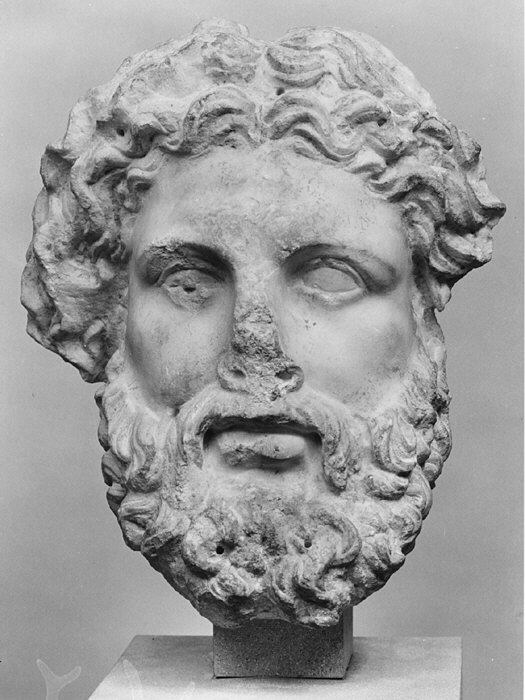
The cover shows a Greek marble head from the third or second century BCE, identified by the Metropolitan Museum as probably Zeus. A vase in the media gallery, later than the epic's formation, depicts a divine gathering. Both are later artistic witnesses, not direct illustrations of a particular Homeric scene. [14][11]
References and notes
- Specified opening passage; modern synopsis is not part of the ancient poem. Iliad 8, first seven paragraphs including modern chapter synopsis; council proper first three primary paragraphs Return to the text ↑
- Themis summons, permission and divided sides; no fixed count of twelve. Iliad 20, first seven paragraphs; invocation of council through division of divine sides Return to the text ↑
- Vase identity, front scene and image rights; later than the compared texts. Met 254922;56.171.63; attributed Capodimonte Painter; ca 320–310 BCE; public-domain photograph Return to the text ↑
- Complete specified exchange; Poseidon’s claim within the narrative. Iliad 15; Iris addresses Poseidon, three-brothers/domain-lots speech, Iris reply and Poseidon withdrawal; Butler public-domain translation Return to the text ↑
- Colette and Seán Hemingway, ‘Greek Gods and Religious Practices’ (Metropolitan Museum, 2003); only the opening passages on Zeus and Homer were read. Opening two paragraphs on Zeus and the Homeric poems. Return to the text ↑
- Metropolitan Museum, marble head of a god, probably Zeus, 26.60.46; object date, uncertain identification and image rights checked in the catalogue and collection API, not its entire bibliography. Met collection object 252511; third or second century BCE; public-domain image. Return to the text ↑
Research history
Substantive changes are retained here. Minor copy edits remain in the internal operational log.
-
Substantive record update
-
Substantive record update
-
Substantive record update
Suggest a correction · Suggest a source for this record
Cite this record
IL Archive, «Zeus», Edition 4, https://ilarchive.com/en/entities/zeus