Entity · Concept
God Lists
A reference page linking a name, group, or concept to the materials that discuss it.
- Timeline
- 2600 BCE
- Region
- Mesopotamia (present-day Iraq; later circulation of copies in neighbouring regions)
Cuneiform lists in which Mesopotamian scribes recorded divine names from the third millennium BCE on, revealing scribal training and the classification of the divine world, not a direct census of gods worshipped at once.
Estimated reading time: 5 min Published Last reviewed:
Share article
Text
Introduction
How did scribes in MesopotamiaMesopotamiaHistorical region associated with the Tigris and Euphrates: Uruk, Ur, Eridu, cuneiform, Sumer, Akkad, Babylon and Assyria, their languages and cults, and the limits of archaeological evidence.Glossary · Click to read the explanation collect divine names, and what does their order tell us? This entry follows cuneiformCuneiformWriting with wedge-shaped signs, developed from Mesopotamian recording traditions and used for several languages from the third millennium BCE.Glossary · Click to read the explanation god lists from Fara and Abu Salabikh through later school traditions and Babylonian compilations. It distinguishes a record of names from a scribal effort to organize the divine world, rather than treating one list as a complete portrait of belief in every city at the same moment.
What a god list is and what a scribe did
God lists are thematic lexical texts, usually inscribed on clay tablets in the tradition of cuneiform writingCuneiformWriting with wedge-shaped signs, developed from Mesopotamian recording traditions and used for several languages from the third millennium BCE.Glossary · Click to read the explanation. They are not prayers or myths narrating the deeds of gods; they are sequences of names copied by scribes. Some later copies add pronunciations, equivalent divine names, or explanations of family relationships and standing. Lists helped teach writing and transmit knowledge while also reflecting the theological choices of their compilers.[3]
Divine names are often preceded by a sign called the divine determinativeThe divine determinative in cuneiformA cuneiform sign used mostly before a divine name to classify it without being spoken independently; shown as raised d or {d} in transliteration. Usage depends on language and context.Glossary · Click to read the explanation, represented in transliteration by a superscript d and not pronounced as part of the name. The sign AN itself has several uses, including the name An/AnuAn / AnuAn is the Sumerian sky god, called Anu in Akkadian. The sign AN by itself does not identify him: it also denotes sky or divinity.Glossary · Click to read the explanation, “heaven,” and the indicator of divinity. A solitary sign therefore cannot establish a particular divine identity without context.[8]
Fara: a verifiable starting sequence
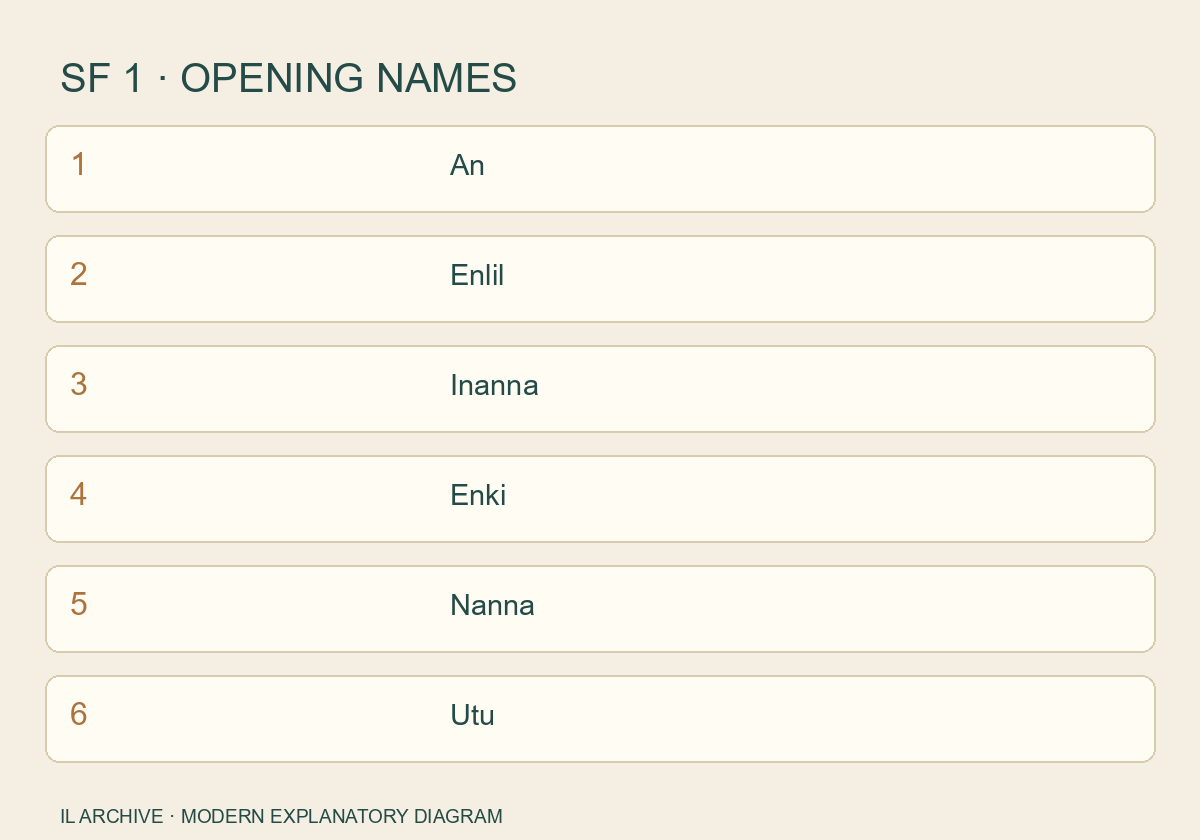
The Cuneiform Digital Library Initiative (CDLI) records a tablet from ancient Shuruppak, modern Fara, as SF 001 / P010566. It is dated to Early Dynastic IIIa, approximately 2600–2500 BCE, and held by the Vorderasiatisches Museum in Berlin as VAT 12760 +. On its obverse, column 1, lines 1–6, the published transliteration reads: An, EnlilEnlilEnlil/Ellil: a major Mesopotamian god associated with destinies, kingship, and Ekur at Nippur, already prominent in third-millennium god lists. His name’s origin and cult beginnings remain debated.Glossary · Click to read the explanation, InannaInanna / IshtarA prominent Mesopotamian goddess whose Sumerian name Inanna became associated with Akkadian Ishtar across diverse traditions. She was associated with desire, war, royal authority and Venus, while local forms and genealogies varied among texts.Glossary · Click to read the explanation, EnkiEnkiMesopotamian deity also known as Ea, linked with Eridu and the Abzu (deep fresh waters), wisdom, incantations, and narratives of creation and cosmic order. Later written attestations do not identify the deity of Eridu’s earliest layers.Glossary · Click to read the explanation, NannaNanna / Su’en / SinMesopotamian moon god known as Nanna, Su’en and Sîn/Sin. Worshipped especially at Ur and Harran, he is associated with the crescent and lunar cycle; names and myths have different histories.Glossary · Click to read the explanation, and Utu. This is an attested order in one specific witness, not an invariant hierarchy across all god lists.[1]
Less familiar names follow, including a long succession beginning with the written element nin-. Damaged signs and uncertain readings occur elsewhere on the tablet. Such passages illustrate the importance of spelling and grouping for scribes, as well as the limits of turning the whole list into a precise ranking of divine power.[1]
Abu Salabikh and the limits of a composite text
Other third-millennium tablets attest god lists associated with Abu Salabikh, of approximately the same period. CDLI labels its P499260 / Q000036 as a composite text: an editorially assembled text associated with multiple witnesses, not one physical tablet carrying that number as a museum inventory number. The database also marks the provenance as uncertain; the heading alone does not establish the findspot of every fragment.[2]
Nippur: another order in the Old Babylonian period
In the Old Babylonian school tradition of NippurNippur / NuffarAncient Nippur (modern Nuffar, Iraq), major cult centre of Enlil and Ekur; excavations revealed sanctuaries, houses and thousands of cuneiform tablets across many periods.Glossary · Click to read the explanation, approximately 1900–1600 BCE, the composite P499940 / Q000261 opens with An, Antum, Uraš, Enlil, Nunamnir, NinlilNinlilMesopotamian goddess and consort of Enlil, associated with Nippur, Tummal, destinies and royal ritual. Identified with Sud in literary tradition and known as Mulliltu/Mullissu in Akkadian and Assyrian contexts; her genealogies and roles vary by text and period.Glossary · Click to read the explanation, and other names. Nanna, Enki, and Inanna appear farther on. This is not a copy of Fara’s first six names. The variation reveals historically situated scribal organization; establishing a precise rank for each deity requires corroborating evidence.[4]
The Weidner list across the schools
Another tradition is called Weidner’s God List, after its modern editor Ernst Weidner, and is also known from its incipit Anum. Scholars have proposed an origin in the late third millennium BCE, although the first formation of the list must be distinguished from the dates of surviving manuscripts. Copies circulated in Mesopotamia and reached places including UgaritUgaritAncient city and kingdom at Ras Shamra on the Syrian coast, flourishing between the fourteenth and early twelfth centuries BCE and preserving multilingual archives.Glossary · Click to read the explanation and AmarnaAmarna / AkhetatenAmarna is the archaeological site of Akhetaten, Akhenaten’s fourteenth-century BCE capital in Middle Egypt, preserving royal boundary stelae, temples, houses and cemeteries.Glossary · Click to read the explanation. Some Assyrian witnesses provide phonetic readings and equivalences beside divine names instead of presenting a plain single-column list.[5]
A consistent ordering principle cannot be discerned throughout. Shana Zaia regards a pedagogical function as plausible, supported in part by a copy apparently written by a student; she also emphasizes the unresolved arrangement of many passages. Scribal training is thus an evidence-based interpretation, not a demonstrably exclusive function of every exemplar.[5]
From Proto-An to An = Anum
An Old Babylonian forerunner known as Proto-An = Anum survives most importantly on tablet AO 5376 at the Louvre. The editors of the 2023 edition explain its close structural relationship to the later An = Anum, while allowing for lost intermediate stages. As lexical scholarship became increasingly standardized in the second millennium BCE, the An = Anum series emerged in a systematic form. Its reconstructed text contains approximately 2,000 entries and organizes divine names through status, households, associated figures, equivalents, and linguistic explanations.[3][7]
Those are textual entries, not a reliable count of two thousand distinct deities simultaneously worshipped. A modern scholarly edition combines readings from numerous manuscripts and records their variants; its reconstructed text should not automatically be attributed to a single surviving tablet.[7]
A surviving tablet and a modern cover image
The Metropolitan Museum of Art in New YorkNew York CityNew York City is in the United States and houses the Metropolitan Museum of ArtGlossary · Click to read the explanation holds a fragment of Weidner’s God List, accession 86.11.357, dated to the late first millennium BCE. Its catalogue notes a reference to Gilgamesh accompanied by a divine sign. The tablet documents the continued copying of god lists and their capacity to classify figures from different traditions; on its own, it cannot date the list’s first composition or prove simultaneous cults for every name.[6]
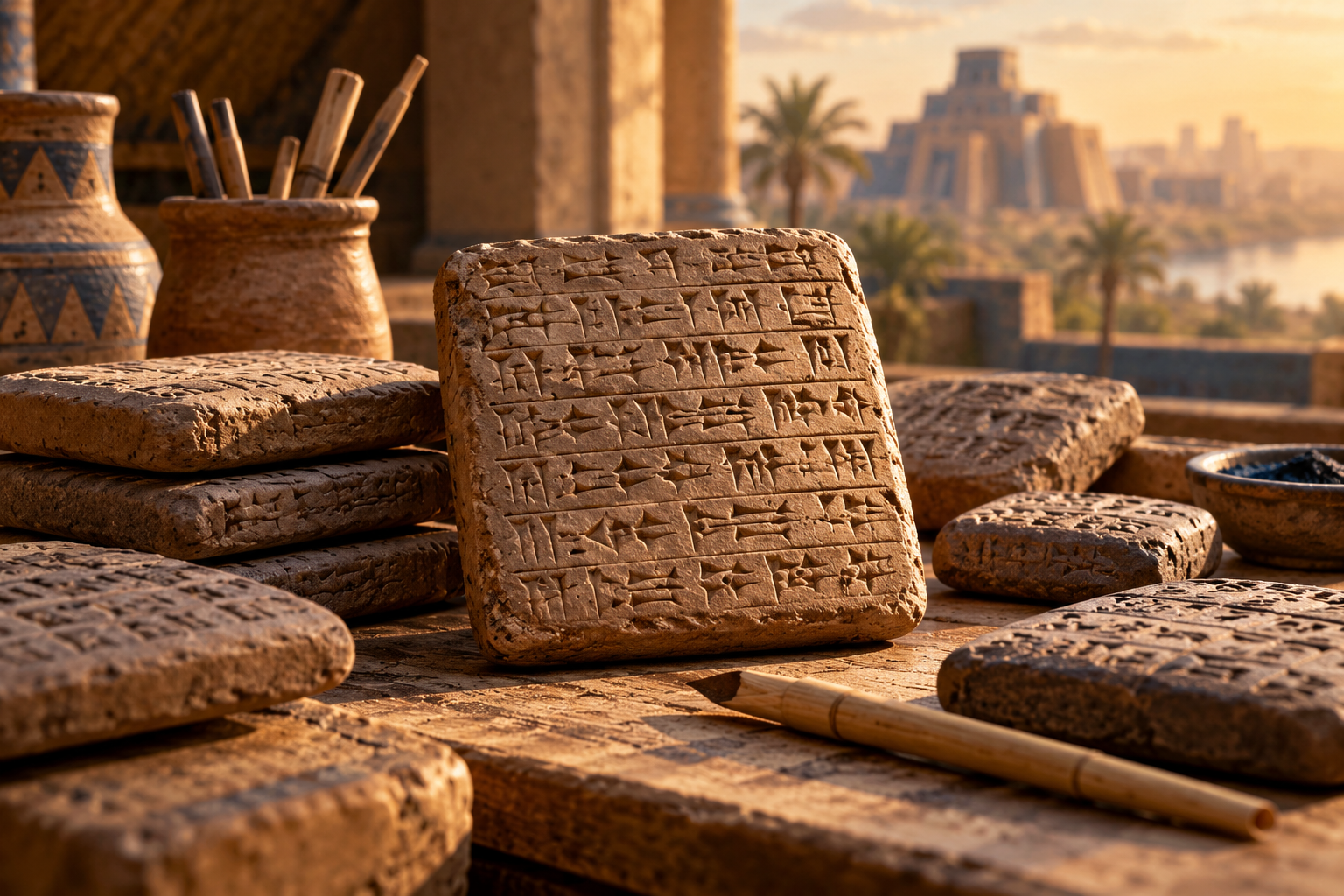
The cover here is an AI-generated modern imaginative illustration of clay-tablet writing. It is neither a photograph of that fragment nor a verified archaeological reconstruction. The educational figure above shows names in transcription, not the wedge signs of the Fara tablet.
What these lists establish—and what they leave open
God lists demonstrate how scribes preserved names and sometimes privileged major gods, households, or groups with similar written forms. Their arrangements vary by period, document, and city; alternate names and titles may refer to the same figure. To reconstruct the prominence of a cult or a historical shift in divine standing, we must compare them with literary works, prayers, and temple records. Above all, they directly document scribal classification and provide important—but not exhaustive—evidence for religious history.[3][5]
References and notes (8)
- Cuneiform Digital Library Initiative. SF 001 (P010566), VAT 12760+, Shuruppak/Fara. Obverse, column 1, lines 1–28, and artifact metadata; other columns inspected selectively for nin- groups. Return to the text ↑
- Cuneiform Digital Library Initiative. CDLI Lexical 000036 (Abu Salabikh God List) composite, P499260 / Q000036. Composite-record metadata: period, provenance and witnesses; not a reading of every fragment. Return to the text ↑
- W. G. Lambert & Ryan D. Winters (2023). An = Anum and Related Lists: God Lists of Ancient Mesopotamia, Vol. I. Edited by A. R. George & M. Krebernik. Mohr Siebeck. doi:10.1628/978-3-16-161383-8. PDF preview only, printed introductory pp. 3–5 (§§1.1–1.3); not the entire volume. Return to the text ↑
- Cuneiform Digital Library Initiative (CDLI), “Old Babylonian Nippur God List, composite,” P499940 / Q000261. Record metadata and composite lines 1–65; not treated as one physical tablet. Return to the text ↑
- Shana Zaia, “Commentary on Weidner’s God List (CCP 6.7.B),” Cuneiform Commentaries Project, Yale, 2017. Introduction, witness VAT 10173, and obverse col. i, ll. 1–16; not the full edition line by line. Return to the text ↑
- The Metropolitan Museum of Art, “Cuneiform tablet: fragment of the Weidner God List,” accession 86.11.357, late first millennium BCE, public-domain image. Object description, date, accession number, and public-domain statement; image not reproduced here. Return to the text ↑
- W. G. Lambert and Ryan D. Winters, An = Anum and Related Lists, God Lists of Ancient Mesopotamia I, ed. Andrew George and Manfred Krebernik, Mohr Siebeck, 2023; publisher’s description. Publisher’s description only for c. 2,000 entries and edition method; full volume not read. Return to the text ↑
- Kathryn Stevens, “An/Anu (god),” Ancient Mesopotamian Gods and Goddesses, Oracc, “Name and Spellings” section. Search-index extract of “Name and Spellings” and contextual “Functions” passage only; direct page access timed out. Return to the text ↑
Suggest a correction · Suggest a source for this record
Cite this record
IL Archive, «God Lists», https://ilarchive.com/en/entities/god-list
Continue reading