Entity · Deity
Nanna / Su’en / Sin
A reference page linking a name, group, or concept to the materials that discuss it.
- Names
- Dilimbabbar · Nanna · Su’en
- Region
- Mesopotamia: Ur in southern Iraq and Harran in its historical north
Nanna/Su’en/Sîn was the Mesopotamian moon god, attested in early names and worshipped especially at Ur and Harran. The entry distinguishes written forms, lunar symbolism, myths and the dates of their transmission.
Estimated reading time: 6 min Published Last reviewed:
Share article
Text
Introduction
Do Nanna, Su’en and Sîn name three gods, or historically different names of a single Mesopotamian moon deity? This entry examines early writing, places of worship, inscriptions, hymns and narratives, distinguishing what the surviving evidence directly attests from scholarly interpretation. The earliest occurrence of a name does not date every later myth associated with it.
Identity and names
Nanna is the moon god known in Sumerian tradition; Su’en and Sîn/Sin are names used for him in Mesopotamian traditions, not automatically evidence for separate deities. The ORACC Ancient Mesopotamian Gods and Goddesses profile describes the early written names as roughly contemporary and interchangeable. The original etymologies of both Nanna and Su’en remain uncertain. Dilimbabbar is another literary name or epithet, once read differently by scholars.[1]
What does early writing actually establish?
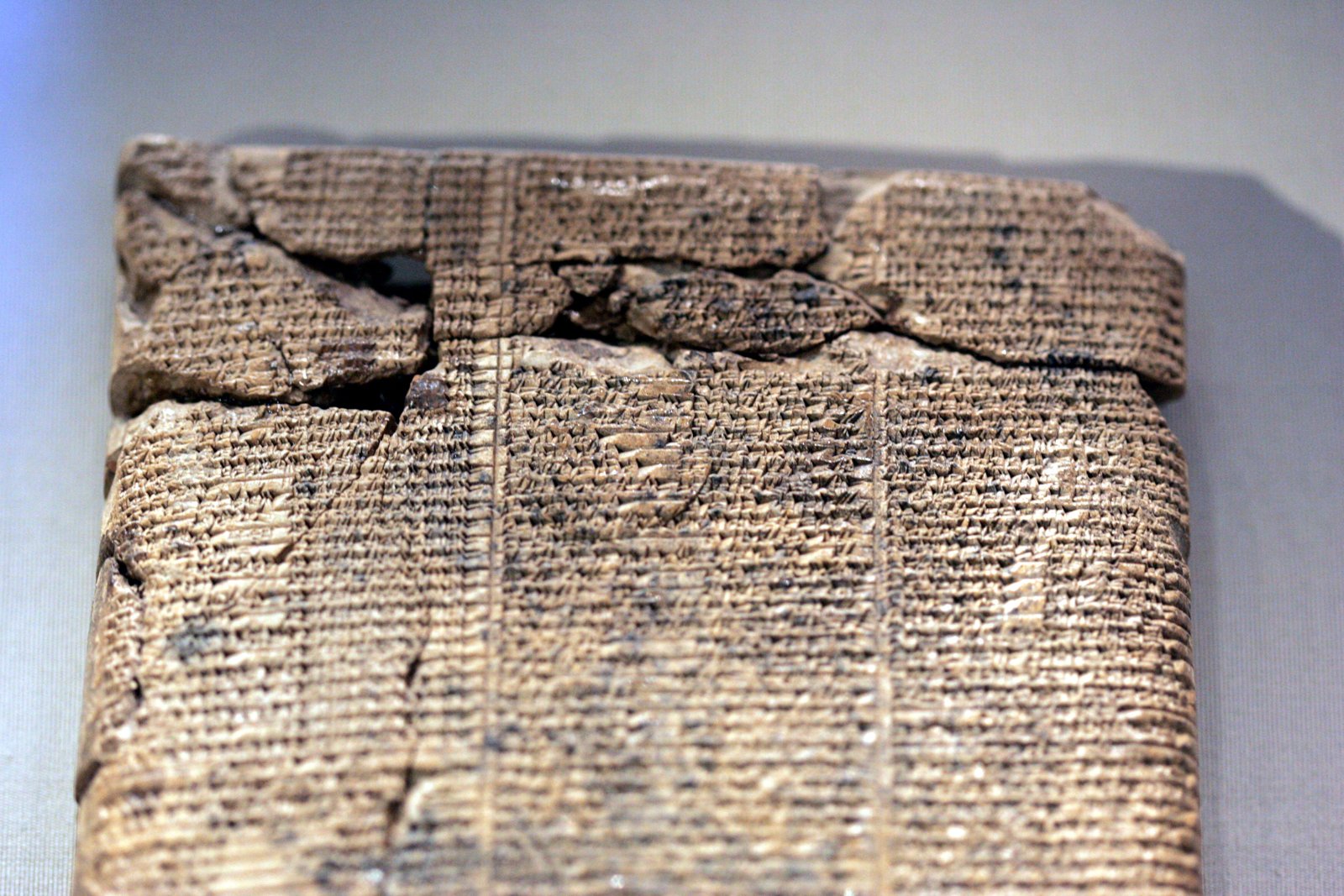
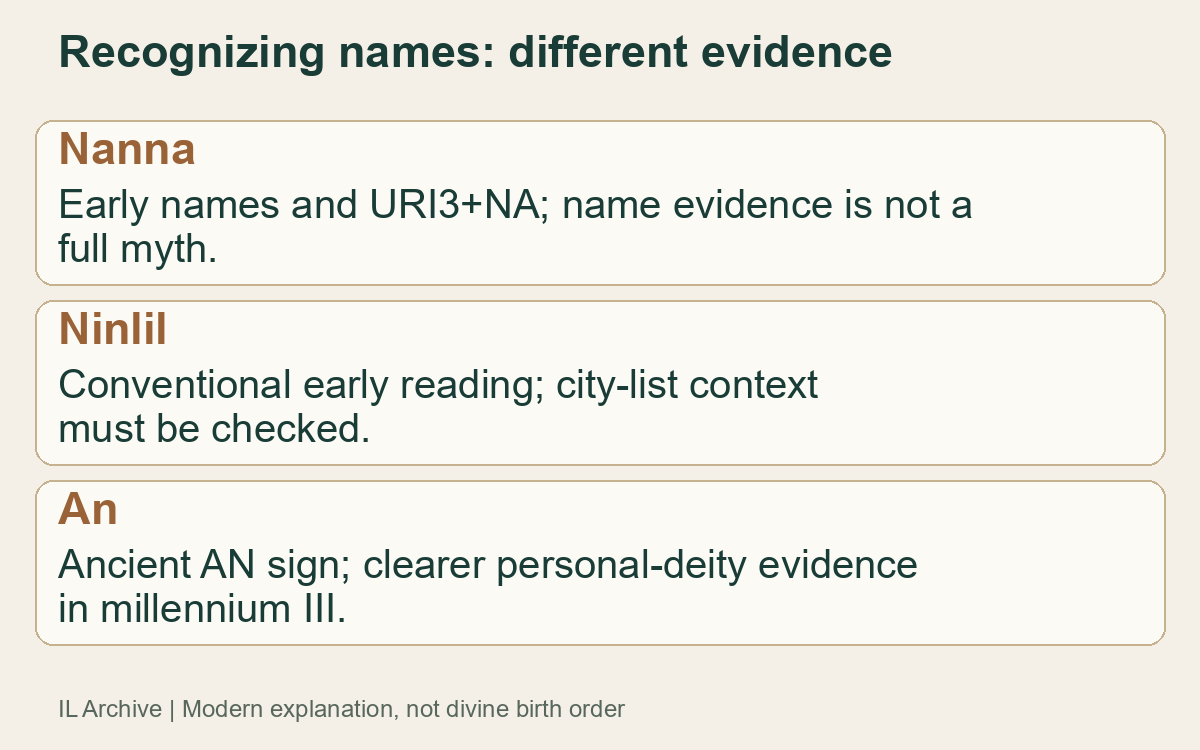
In his study of the earliest Mesopotamian writing, Christopher Woods cites URI₃+NA as an uncommon instance of a phonetic complement: the NA sign helps indicate how Nanna’s name should be read. This does not imply that proto-cuneiformProto-cuneiformEarly southern Mesopotamian script (c. 3350–3000 BCE): clay tablets with counting systems and signs for commodities, people and offices, as well as lexical lists; not yet a full rendering of speech.Glossary · Click to read the explanation consistently spelled spoken language as later cuneiformCuneiformWriting with wedge-shaped signs, developed from Mesopotamian recording traditions and used for several languages from the third millennium BCE.Glossary · Click to read the explanation did. Early signs were chiefly logographic; identifying a name is more secure than inferring which narratives accompanied its first attestations.[2]
Different periods produced different spellings: dŠEŠ.NA in the Early Dynastic period, later dŠEŠ.KI and syllabic na-an-na; Su’en/Sîn was also written dEN.ZU, and later the divine number 30 could stand for the moon god. ORACC notes a form at EblaEblaAncient city at Tell Mardikh, southwest of Aleppo, Syria. Its Palace G archives illuminate third-millennium BCE administration, language, and cult; the site has later occupation phases.Glossary · Click to read the explanation around 2400 BCE. These are not all parts of one early inscription, and the shape of a sign does not settle the name’s etymology.[3]
His place among the gods
An early god listGod ListsTexts collecting divine names for preservation, teaching and classification, with varying theological organization.Glossary · Click to read the explanation from Fara places the lunar deity after several prominent gods, including AnAn / AnuAn is the Sumerian sky god, called Anu in Akkadian. The sign AN by itself does not identify him: it also denotes sky or divinity.Glossary · Click to read the explanation, EnlilEnlilEnlil/Ellil: a major Mesopotamian god associated with destinies, kingship, and Ekur at Nippur, already prominent in third-millennium god lists. His name’s origin and cult beginnings remain debated.Glossary · Click to read the explanation, InannaInanna / IshtarA prominent Mesopotamian goddess whose Sumerian name Inanna became associated with Akkadian Ishtar across diverse traditions. She was associated with desire, war, royal authority and Venus, while local forms and genealogies varied among texts.Glossary · Click to read the explanation and EnkiEnkiMesopotamian deity also known as Ea, linked with Eridu and the Abzu (deep fresh waters), wisdom, incantations, and narratives of creation and cosmic order. Later written attestations do not identify the deity of Eridu’s earliest layers.Glossary · Click to read the explanation. This establishes a position within a particular textual arrangement, not the birthdate of a god or an order of mythical births. Lexical and onomastic databases register other attestations, whose contexts may differ between divine designations and elements of personal names.[4]
Moon, crescent and bull
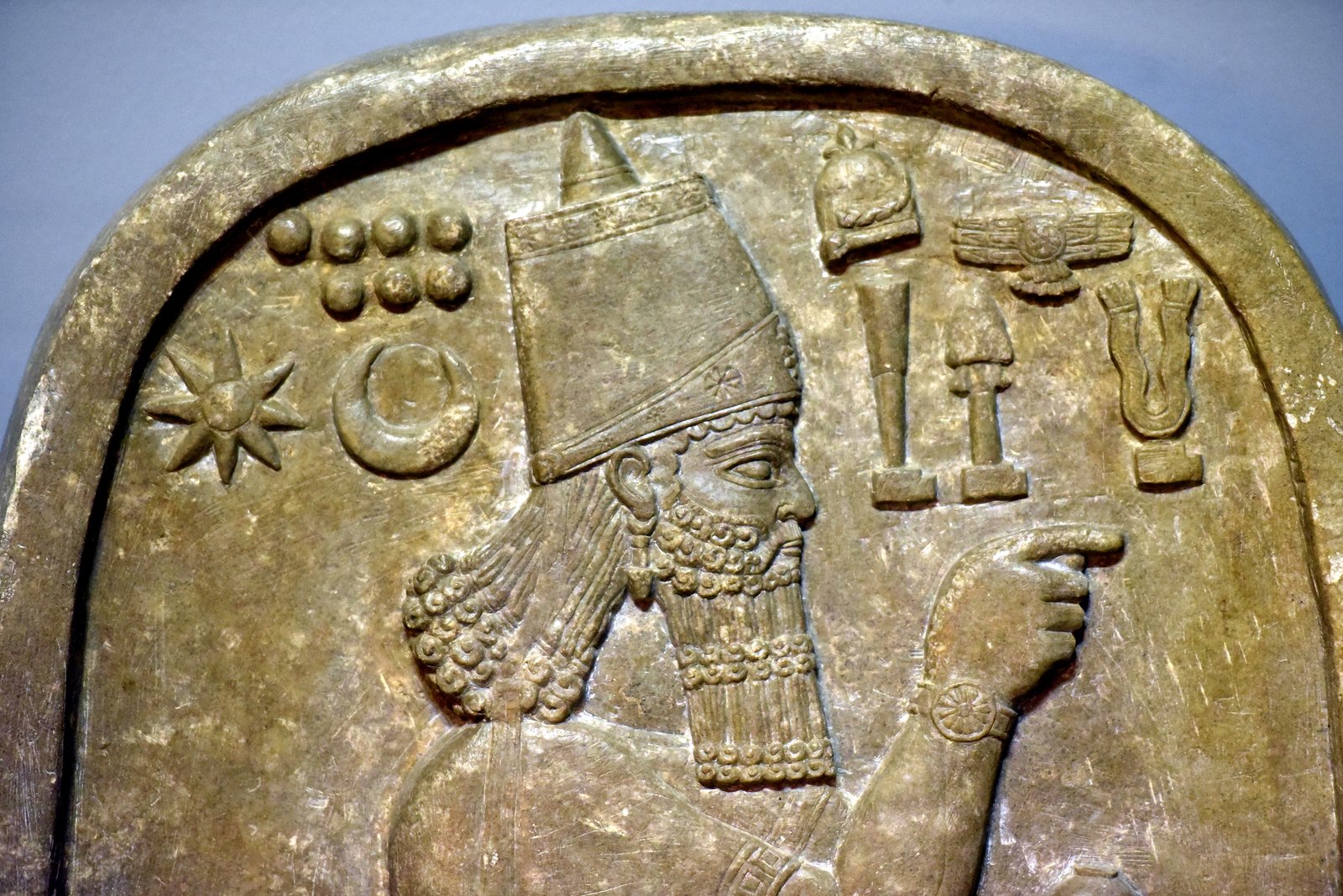
The most familiar sign associated with Nanna is the crescent moon. Its horns invite comparisons with a bull’s horns, while hymns praise the deity as a cattle-keeper or herdsman. Yet a crescent near a figure in a seal does not by itself identify every figure. His sphere also encompasses the night’s illumination and the succession of months. The written number 30 is a conventional lunar number, not an exact count of the days of every astronomical lunar month.[1]
Later omen literature follows the moon’s appearance and phases, and prayers associate the god with judgments and the determination of destinies. An omen series, a ritualRitualAn organised or distinguished practice meaningful to a community; it may leave traces, but its form alone does not reveal an associated doctrine.Glossary · Click to read the explanation prayer and an early royal inscription belong to distinct genres and periods; they should not all be dated to the earliest written occurrence of Nanna’s name.[9]
Family relationships in particular texts
The composition Enlil and NinlilNinlilMesopotamian goddess and consort of Enlil, associated with Nippur, Tummal, destinies and royal ritual. Identified with Sud in literary tradition and known as Mulliltu/Mullissu in Akkadian and Assyrian contexts; her genealogies and roles vary by text and period.Glossary · Click to read the explanation presents Nanna/Su’en as a son of EnlilEnlilEnlil/Ellil: a major Mesopotamian god associated with destinies, kingship, and Ekur at Nippur, already prominent in third-millennium god lists. His name’s origin and cult beginnings remain debated.Glossary · Click to read the explanation and NinlilNinlilMesopotamian goddess and consort of Enlil, associated with Nippur, Tummal, destinies and royal ritual. Identified with Sud in literary tradition and known as Mulliltu/Mullissu in Akkadian and Assyrian contexts; her genealogies and roles vary by text and period.Glossary · Click to read the explanation, in a narrative involving sexual violence against Ninlil, Enlil’s expulsion from the city, and the destinies of their children. This is religious literature, not a record of a historical incident or a means of dating Nanna’s first cult. Other textual formulations occasionally describe a paternal connection with An, so a single genealogy should not be imposed on every era.[5]
Hymns and cult traditions identify Ningal as his consort. Among their children, several accounts include the sun god Utu/ShamashShamashMesopotamian god of the sun and justice, shown before Hammurabi on an eighteenth-century BCE stele preserved in the Louvre.Glossary · Click to read the explanation and Inanna/IshtarInanna / IshtarA prominent Mesopotamian goddess whose Sumerian name Inanna became associated with Akkadian Ishtar across diverse traditions. She was associated with desire, war, royal authority and Venus, while local forms and genealogies varied among texts.Glossary · Click to read the explanation. God lists also provide other names. Each relationship must be attributed to its particular composition or list rather than projected unchanged onto every local theology.[1][6]
Ur, the sanctuary and the ziggurat
Ur in southern IraqIraqIraq is a modern country encompassing much of ancient MesopotamiaGlossary · Click to read the explanation was his principal cult centre. His sanctuary was known as E-kiš-nu-gál. The monumental zigguratZigguratZiggurat: a monumental stepped or terraced cult structure of ancient Mesopotamia. Not every raised temple platform was a ziggurat, and the form and specific use of lost upper stages often remain uncertain.Glossary · Click to read the explanation at Ur was built during the reign of Ur-Namma, founder of the Third Dynasty of Ur near the end of the third millennium BCE, and underwent later work and restoration. The surviving structure is archaeological evidence for a major cult complex, not a portrait of its patron deity.[1]
The institution was also economic and ceremonial: building inscriptions, year names and offerings document royal patronage. An Early Old Babylonian royal inscription available as a CDLI composite text refers to Nanna and Su’en in Kudur-mabuk’s account of sanctuary support and restoration and his request for enduring rule. A royal building inscription is political and devotional testimony, not a version of the god’s creation myth.[10]
Enheduanna and disputed literary attributions
Enheduanna, a daughter of Sargon of Akkad, served as high priestess of the moon god at Ur around the twenty-third century BCE. The Disc of Enheduanna, held by the Penn Museum as B16665, preserves an inscription naming her and linking her with Nanna; its carved face represents a cult scene involving a priestess. The physical object and inscription are real evidence. Attribution of the much later transmitted poems to Enheduanna remains debated and cannot be settled from the disc alone.[8]
Nanna’s journey to Nippur
The Sumerian poem Nanna-Suen’s Journey to NippurNippur / NuffarAncient Nippur (modern Nuffar, Iraq), major cult centre of Enlil and Ekur; excavations revealed sanctuaries, houses and thousands of cuneiform tablets across many periods.Glossary · Click to read the explanation describes the preparation of a boat, gifts and offerings, travel to Enlil and Ninlil, and a welcome involving food, drink and blessings. Its narrative interweaves waterways, cult economy and divine kinship. These episodes illuminate how a literary tradition imagined authority and offerings; they are not an excavation report or proof of the earliest historical performance of a journey.[7]
Hymns and the king of the night
A Hymn to Nanna (Nanna E) praises the crescent and the horned crown, and describes sanctuary architecture, purification and ritual meals. Lines 56–60 present Ningal in connection with the sacred precinct. Poetic and theological claims of this kind are different from the bare presence of a divine name in an administrative record. The published corpus is an edited literary text, not a single intact tablet from the invention of writing.[6]
From Ur to Harran
The worship of Su’en/Sîn was not confined to Ur. HarranHarranHistoric city in southeastern Türkiye, south of Şanlıurfa; Genesis places Abraham’s family there on its journey towards Canaan.Glossary · Click to read the explanation, in northern MesopotamiaMesopotamiaHistorical region associated with the Tigris and Euphrates: Uruk, Ur, Eridu, cuneiform, Sumer, Akkad, Babylon and Assyria, their languages and cults, and the limits of archaeological evidence.Glossary · Click to read the explanation, was another important cult centre from the Old Babylonian period onwards; its temple was called E-ḫul-ḫul, the ‘House of Rejoicing’. Later inscriptions, including those associated with Adda-guppi, mother of the Neo-Babylonian ruler Nabonidus, celebrate the god and the rebuilding of his sanctuary. This attests to continuing and politically reframed worship across centuries, not identical ritual practices in Ur and Harran.[9]
Identifying images and representations
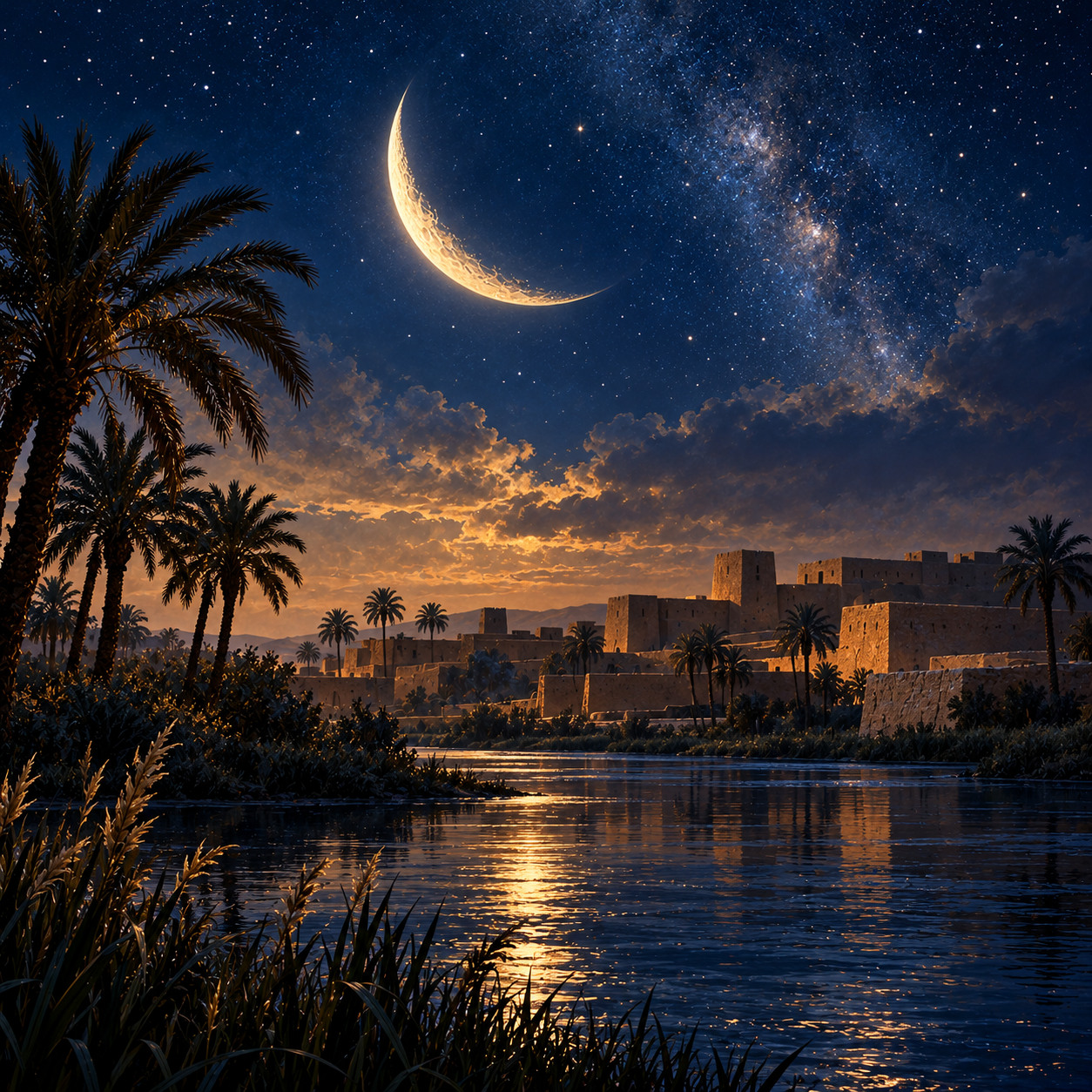
Seals and images of the crescent offer important evidence for lunar symbolism, but the identification of human-shaped figures can be tentative. A modern depiction cannot be presented as an excavated image of the god, and the date of a seal must not be transferred to an unrelated myth. The cover used for this entry is an expressly modern, AI-generated conceptual scene evoking moonlight, not an archaeological photograph, a reconstruction of Ur or an established portrait of Nanna.[1]
Conclusion: separate kinds of evidence
What can be demonstrated is the antiquity and changing spellings of the name, well-attested worship at Ur and elsewhere, and the variety of associated narratives, symbols and divine kinships. What remains unresolved includes the definitive linguistic derivation of the names and the dates at which all the myths developed. Sound historical interpretation must therefore distinguish a name in a document, an iconographic proposal, a literary narrative, and a modern scholarly reconstruction rather than silently combining their chronologies.[1][2]
References and notes (10)
- Adam Stone, “Nanna/Suen/Sin (god),” Ancient Mesopotamian Gods and Goddesses, ORACC/AMGG (2019): functions, kinship, cult centres and iconography. Full accessible entry, about 11,450 extracted characters, including names, functions, family, cult centres, history and iconography; its cited secondary works were not read. Return to the text ↑
- Christopher Woods, “The Earliest Mesopotamian Writing,” in Visible Language: Inventions of Writing in the Ancient Middle East and Beyond, OIMP 32 (2010; corrected reprint 2015). Indexed excerpt of printed p. 43 on URI₃+NA and phonetic complementation, plus publisher metadata; neither the full chapter/book nor a rendered PDF page was read in this review. Return to the text ↑
- Adam Stone, ORACC/AMGG, “Nanna/Suen/Sin,” “Name and Spellings” section. Entire “Name and Spellings” section (dŠEŠ.NA, dEN.ZU, (d)30; Ebla about 2400 BCE); no direct examination of the underlying Ebla tablets. Return to the text ↑
- Adam Stone, ORACC/AMGG, god-list discussion (Fara SF 1); ePSD2, Nanna[1] lexical entry. The Fara-god-list paragraph and selected ePSD2 entry references; the complete god-list tablets and photographs were not examined. Return to the text ↑
- University of Oxford ETCSL, “Enlil and Ninlil,” composite Sumerian composition 1.2.1, English translation. Read the published English translation, lines 1–64 and the relevant kinship/exile episodes in lines 65–142; not all cuneiform witnesses. Return to the text ↑
- Oxford ETCSL, “A Hymn to Nanna (Nanna E),” composition 4.13.05, English translation. Read the complete displayed translation, lines 1–69, especially 5–19, 27–40 and 56–68; individual source tablets not inspected. Return to the text ↑
- Oxford ETCSL, “Nanna-Suen’s Journey to Nibru,” composition 1.5.1, composite English translation. Displayed English translation (about 14,900 extracted characters), with 1–16 and boat/offering/reception episodes through the end; individual Sumerian manuscripts not collated. Return to the text ↑
- Penn Museum, “Disc of Enheduanna,” object B16665; Morgan Library & Museum, explanatory inscription text. Museum record metadata (findspot, date, material), plus Morgan commentary on the inscription, cult scene and attribution; no scientific examination of the object or all its photos. Return to the text ↑
- Adam Stone, ORACC/AMGG, “Cult Places”, “Functions” and “History” (Harran, celestial functions and Nabonidus). Read the full relevant sections of the online profile; the primary Harran inscriptions cited there were not independently transcribed or read. Return to the text ↑
- Cuneiform Digital Library Initiative, composite royal text RIME 4.02.13.10, P448397, Early Old Babylonian period. Read the displayed text and translation, lines 1–50, especially 1–13, 22–42 and 48–50; the edition is composite of numerous witnesses, not one tablet; photographs not collated. Return to the text ↑
Suggest a correction · Suggest a source for this record
Cite this record
IL Archive, «Nanna / Su’en / Sin», https://ilarchive.com/en/entities/nanna
Continue reading
Related readings