Study
The Pleiades and the Seven Gods: Stars, Seven Dots and Assyrian Symbols
An extended study of a topic, with evidence and references.
- Timeline
- From 1000 BCE to 100 BCE
- Region
- Mesopotamia
Why do Assyrian monuments show seven dots among the gods' emblems? What the cuneiform sources actually call the Pleiades, and how the cluster came to be linked with the Seven gods.
Estimated reading time: 10 min Published Last reviewed:
Share article
Video
Why Is Seven Sacred? What the Clay Tablets of Ancient Iraq Reveal
Our fourth documentary follows the number seven through the clay tablets of ancient Iraq and its neighbours, then reads the scriptures in their own words and with respect. Some scenes are AI-generated illustrations.
The YouTube player loads only when you press play. Watch on YouTube
Text
Introduction
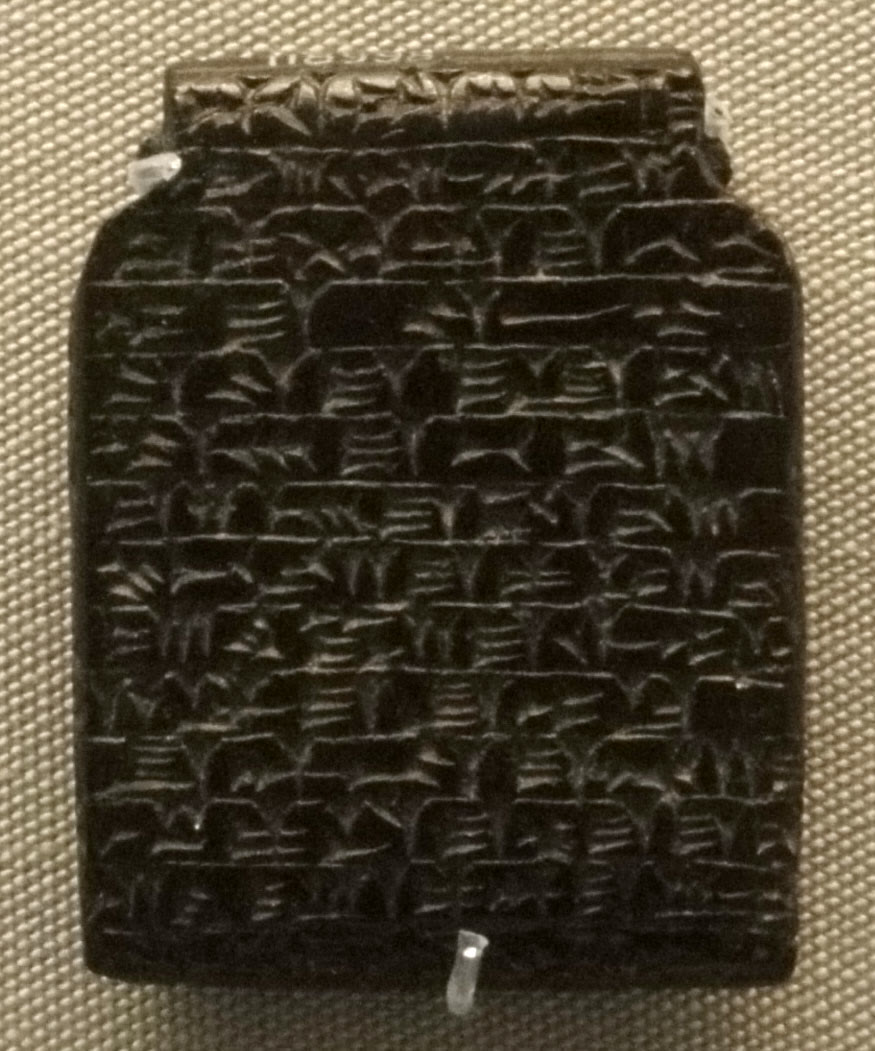
On many Assyrian monuments a small cluster of seven dots sits among the emblems of the great gods, next to a crescent, a star and a winged disk. Popular books often explain that these dots are the Pleiades and that the Babylonians simply called this star cluster "the Seven". The cuneiformCuneiformWriting with wedge-shaped signs, developed from Mesopotamian recording traditions and used for several languages from the third millennium BCE.Glossary · Click to read the explanation sources tell a more careful story. The cluster's ordinary name meant "the Stars"; the number seven came through scholars who identified the cluster with groups of seven gods.
This study follows that link through the names of the Pleiades, the star compendium MUL.APIN, the calendar, and the seven-dot symbol on seals, boundary stones and stelae, including the stele of Adad-nirari III from Tell al-Rimah in northern IraqIraqIraq is a modern country encompassing much of ancient MesopotamiaGlossary · Click to read the explanation. At each step it asks what the source states, and whether the identification of the dots with the Pleiades is confirmed, probable or still open.
A cluster called "the Stars"
The Pleiades are a compact group of stars in Taurus. In cuneiformCuneiformWriting with wedge-shaped signs, developed from Mesopotamian recording traditions and used for several languages from the third millennium BCE.Glossary · Click to read the explanation texts the cluster is usually written MUL.MUL. MUL is the Sumerian sign for "star", and the doubled form is simply a plural: "the Stars", or more freely "the Star Cluster". [1] [2] The name is known mainly from Assyrian and Babylonian sources of the first millennium BCE; Sumerian literature itself says very little about the cluster. [1]
Lexical lists, the ancient bilingual word lists, equate MUL.MUL with the AkkadianAkkadianAn ancient East Semitic language written in cuneiform from the third millennium BCE; its varieties include Babylonian and Assyrian, and it served in international diplomacy.Glossary · Click to read the explanation word zappu, "bristle" or "mane". The Akkadian name is not a translation of the Sumerian. It places the cluster as the tuft of hair on the hump of the Bull of Heaven, the constellation that corresponds to our Taurus. [2] This is the celestial counterpart of the bull that the goddess IshtarInanna / IshtarA prominent Mesopotamian goddess whose Sumerian name Inanna became associated with Akkadian Ishtar across diverse traditions. She was associated with desire, war, royal authority and Venus, while local forms and genealogies varied among texts.Glossary · Click to read the explanation sends down against Gilgamesh in the Sumerian tale and in Tablet VI of the Epic of GilgameshEpic of GilgameshA Babylonian literary work with multiple recensions, preceded by separate Sumerian poems on Uruk’s king and Enkidu. Its standard form explores friendship, death, the flood and the limits of seeking eternal life.Glossary · Click to read the explanation. [1]
A tablet from UrukUrukAncient city at Warka in southern Iraq, a major urban centre around 3200 BCE that preserved early writing and accounting tablets.Glossary · Click to read the explanation of the Seleucid period (late fourth to first century BCE), now in Berlin as VAT 7851, shows both ideas side by side. One drawing is a group of seven stars with the sign MUL.MUL written in their middle; another is a charging bull whose bristle, the Pleiades, is visible on its back. [1]
Most people see about six stars with the naked eye, and Greek and Roman writers spoke of a "lost" seventh Pleiad. [1] [2] The Mesopotamian sources tie the cluster to the number seven not through its everyday name, but through the gods with whom scholars identified it.
"The seven great gods" in MUL.APIN
MUL.APIN, named after its opening words, the star called "the Plough", is the main Babylonian compendium of star lore. It runs to two tablets and survives in copies from the seventh century BCE onwards; most specialists think it was compiled around 1000 BCE, with some parts possibly older. [3] Its first tablet lists the stars in the three "paths" of the sky assigned to the gods EnlilEnlilEnlil/Ellil: a major Mesopotamian god associated with destinies, kingship, and Ekur at Nippur, already prominent in third-millennium god lists. His name’s origin and cult beginnings remain debated.Glossary · Click to read the explanation, AnuAn / AnuAn is the Sumerian sky god, called Anu in Akkadian. The sign AN by itself does not identify him: it also denotes sky or divinity.Glossary · Click to read the explanation and EaEnkiMesopotamian deity also known as Ea, linked with Eridu and the Abzu (deep fresh waters), wisdom, incantations, and narratives of creation and cosmic order. Later written attestations do not identify the deity of Eridu’s earliest layers.Glossary · Click to read the explanation. Among the stars of Anu, the fifth entry reads:
MUL.APIN tablet I, column i, line 44: transliteration after the All Skies Encyclopaedia, translation after Verderame. [1] [2]
The middle group is the sign for "seven" preceded by the divine determinativeThe divine determinative in cuneiformA cuneiform sign used mostly before a divine name to classify it without being spoken independently; shown as raised d or {d} in transliteration. Usage depends on language and context.Glossary · Click to read the explanation, the sign that marks a divine name; another rendering is "the Star Cluster, the seven gods, the great gods". [2] The same formula appears in Astrolabe B, a late bilingual star calendar, under the month Ayyaru, [1] and in a catalogue of thirty stars, which adds that the cluster is "favorable for grain prices". [4]
The sign group ᵈ7.BI, "the Seven (gods)", thus served as a second, learned name: a secondary identification of the cluster rather than its own name. [1] [4] The careful formulation is that the Pleiades were "the Stars", and scholars identified them with seven gods.
Which seven gods? The texts do not list them. Lorenzo Verderame argues that the phrase "the seven great gods" refers to gods in the full sense, first of all to the leading gods of the pantheon: Anu, Enlil and EnkiEnkiMesopotamian deity also known as Ea, linked with Eridu and the Abzu (deep fresh waters), wisdom, incantations, and narratives of creation and cosmic order. Later written attestations do not identify the deity of Eridu’s earliest layers.Glossary · Click to read the explanation/Ea, the three astral deities of moon, sun and Venus, and a seventh, often the mother goddess Ninhursag or the underworld queen EreshkigalEreshkigalMesopotamian goddess ruling the netherworld; Inanna’s sister in descent texts, with varying accounts of her relationship with Nergal.Glossary · Click to read the explanation. In his reading, only part of the references to groups of seven linked with the Pleiades point to the demonic Seven discussed below. [1] An Assyrian astrological report shows this positive, council-like side of the cluster:
Report to the Assyrian king, Hunger 1992 (State Archives of Assyria 8) no. 275, as translated by Verderame; brackets mark restored text. [1]
The calendar: Ayyaru, oxen and leap years
Mesopotamian scholars valued the Pleiades above all as a clock. MUL.APIN states that "on the 1st day of Ayyaru the Star Cluster becomes visible" (I ii 38), that is, it reappears at dawn after a season of invisibility. [2] Ayyaru is the second month of the Babylonian year, roughly April to May. Its Sumerian name, gu₄.si.sá, means "driving the oxen", and Astrolabe B describes the month in farming terms: "the earth is open and the oxen are driven, the field is open, the ploughs are washed". [1]
The same star helped to decide whether a year needed an extra month. The Babylonian months followed the moon, so from time to time a thirteenth month had to be added to keep them in step with the seasons. MUL.APIN's second tablet gives a rule based on the Pleiades:
MUL.APIN II Gap A 8–11, translation after Verderame. The month names at the start of the lines are partly restored in the edition. [1] [2]
Verderame stresses that this was not the only such scheme, and that the final decision to add a month belonged to the king. In the scholars' reports to the Assyrian kings, "the Pleiades" also served as a learned name for the planet Mars. [1]
The warrior Seven: a short note on the Sebettu
A second group of seven was tied to the Pleiades: the Sebettu, "the Seven" (older reading Sibitti). Born of Anu and the Earth, they serve the underworld gods Erra and Nergal in war. In the Babylonian poem of Erra and Ishum they goad Erra back to battle; in the incantation series of the "evil spirits" (Udug-hul) they attack the moon and cause an eclipse. [1] Gina Konstantopoulos stresses their double identity, demonic and divine, and their representation as the Pleiades. [5] In Neo-Assyrian state texts they stand among the great gods. A land grant of Adad-nirari III swears "by Ashur, ShamashShamashMesopotamian god of the sun and justice, shown before Hammurabi on an eighteenth-century BCE stele preserved in the Louvre.Glossary · Click to read the explanation and [Enlil], the Assyrian Ishtar, Adad, Nergal, Ninurta and the Sebetti (Pleiades), all these great gods of Assyria", [6] and EsarhaddonEsarhaddon, king of AssyriaSennacherib’s son and successor, Assyrian king in 680–669 BCE, named in Ahiqar and Tobit.Glossary · Click to read the explanation's treaty with Baal, king of TyreTyreTyre is a city on the coast of present-day southern Lebanon and an important ancient Phoenician centerGlossary · Click to read the explanation, curses the oath-breaker: "May the Pleiades, the heroic gods, [smi]te you [down] with their [fierce] weapons." [7] In both passages the cuneiform writes "the Seven" and the modern translators render it "Pleiades". The Seven also had a temple at Dur-Sharrukin (Khorsabad). [1] Their double nature deserves a study of its own; here it matters because it gives the Pleiades a second, warlike face.
Seven dots on seals, boundary stones and stelae
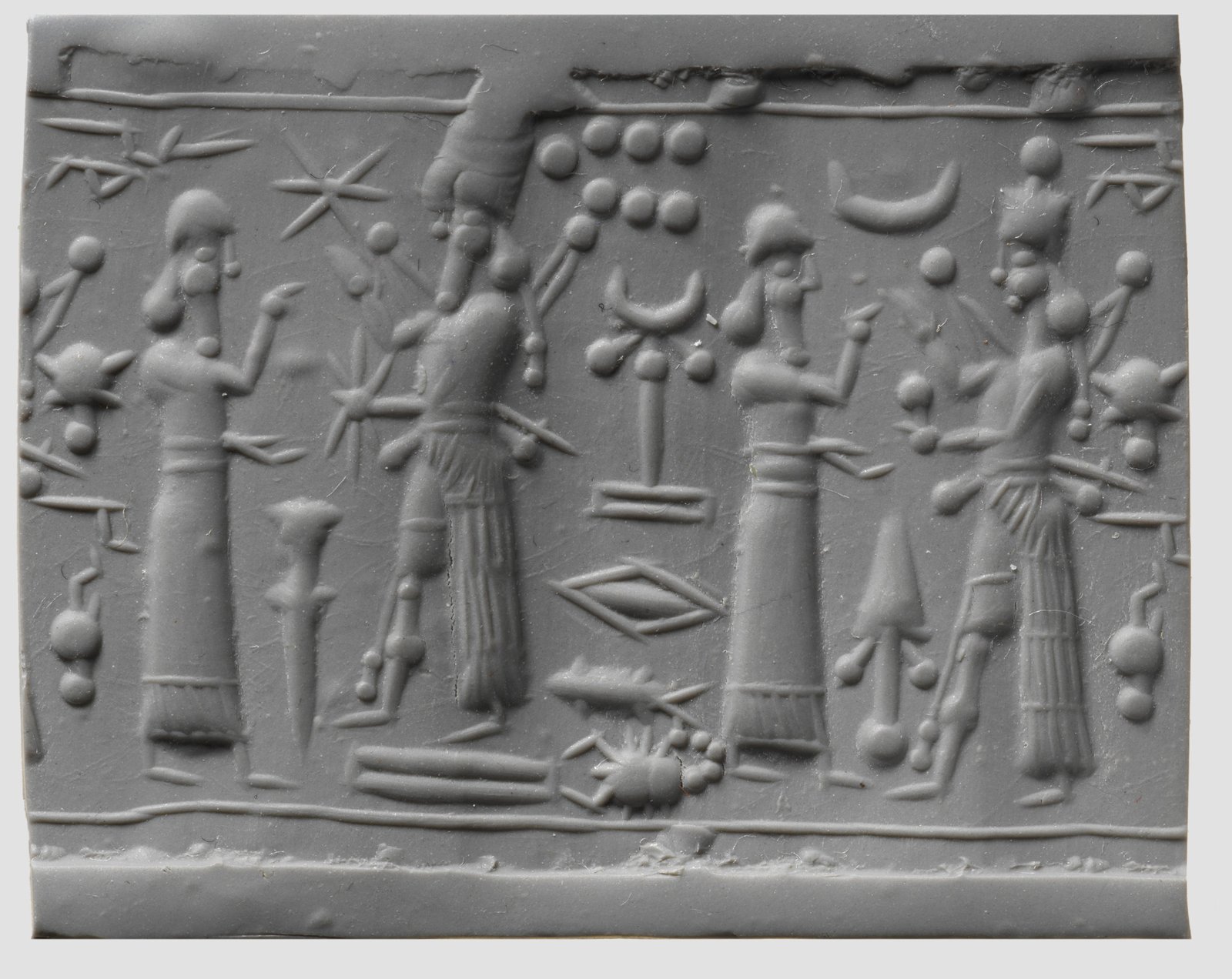
In art, the Seven were usually shown not as figures but as a cluster of seven dots or small globes. Verderame describes the motif as frequent, particularly on cylinder sealsCylinder sealSmall engraved cylinder rolled over soft clay to leave an extended image. Used to secure, document and identify administrative actions; its pictures do not automatically constitute writing.Glossary · Click to read the explanation, and as a protective symbol on stelae and royal grants of the Neo-Assyrian period; his illustration is a detail of Esarhaddon's stele found at Zincirli (ancient Sam'al) in south-eastern TurkeyTurkeyTurkey is a modern country including Anatolia and territory in southeastern EuropeGlossary · Click to read the explanation. [1] The star-name catalogue by Gennady Kurtik, as presented in the All Skies Encyclopaedia, adds that on boundary stones (kudurrus) and seals the seven dots or stars usually stand in the same row as the symbols of SinNanna / Su’en / SinMesopotamian moon god known as Nanna, Su’en and Sîn/Sin. Worshipped especially at Ur and Harran, he is associated with the crescent and lunar cycle; names and myths have different histories.Glossary · Click to read the explanation, ShamashShamashMesopotamian god of the sun and justice, shown before Hammurabi on an eighteenth-century BCE stele preserved in the Louvre.Glossary · Click to read the explanation and Ishtar, the crescent, the sun and the star. [4]
The firm anchor for reading the dots as the Pleiades is late: the Seleucid tablet VAT 7851, where seven stars surround the written name MUL.MUL. Verderame therefore speaks of the identification "at least in the late first millennium tradition", following studies by Elizabeth Douglas van Buren (1939) and Peter van der Veen (2008). [1] For Assyrian monuments of the ninth to seventh centuries BCE, reading the seven dots as the Seven, whose astral form was the Pleiades, is the standard interpretation and is probable; the monuments discussed here do not name the dots in writing.
The Tell al-Rimah stele: seven dots above a king
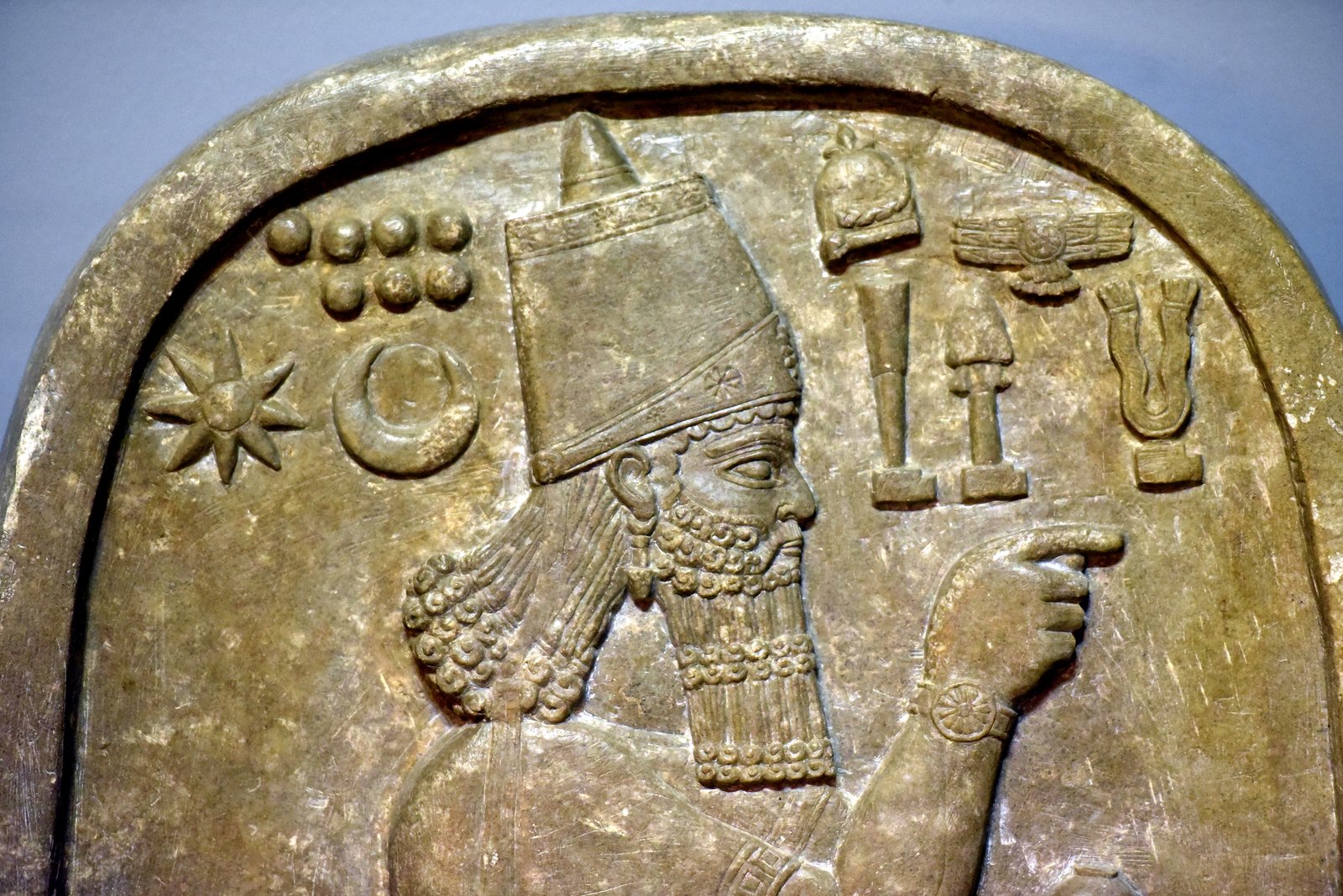
The clearest example of this study is a stele of Adad-nirari III, king of Assyria (810–783 BCE). It comes from Tell al-Rimah, near Jebel Sinjar in northern IraqIraqIraq is a modern country encompassing much of ancient MesopotamiaGlossary · Click to read the explanation, where it was found beside the podium of a shrine, and was first published by Stephanie Page in 1968. It shows the king in profile with his head flanked by divine symbols, and the inscription is carved below his waist. [8] The text is dedicated to the storm god AdadAdad: storm godAdad is the storm god in Mesopotamian traditions, associated with rain, thunder and powers of fertility or destruction.Glossary · Click to read the explanation, records a western campaign and the tribute of "Joash of the land of SamariaSamaria: city and regionAncient city and administrative region; the city’s site is at Sebastia, northwest of Nablus in the West Bank.Glossary · Click to read the explanation", and then turns to the governor Nergal-ereš; the part concerning him was deliberately erased in antiquity. [8] The stele is now in the Iraq Museum in Baghdad (IM 70543, according to the photographer's description). [9]
On the photograph, behind the king's tall crown, above an eight-pointed star and a crescent, is a cluster of seven round dots in two rows, four above and three below. In front of his face stand other emblems, among them a winged disk and a forked lightning symbol. The photographer's description identifies the set as the symbols of Ishtar, Sin, the Sibitti, Nabu, MardukMardukBabylon’s leading god, worshipped at Esagil and elevated in the Akkadian Enūma eliš. His symbols include a spade and mušḫuššu dragon. His earliest origins remain obscure; Nibiru is no evidence of a planetary homeland.Glossary · Click to read the explanation, Adad, Anu and Ashur. [9] Page's own description of the symbols was not accessible for this study.
The seven dots are clearly present; that they stand for the Seven is the standard reading and is probable. The inscription itself does not mention the Seven. Yet the same king's land grant swears by the Sebetti among "all these great gods of Assyria", so the Seven belonged to the divine company that Adad-nirari III invoked. [6] Whether the sculptor had in mind the warrior Seven, the star cluster, or both cannot be read from the stone; in Neo-Assyrian scholarship the two were closely joined. [1]
What the evidence shows and where it stops
Confirmed by the texts: the usual name of the Pleiades was MUL.MUL, "the Stars", and their Akkadian name zappu, "the Bristle"; MUL.APIN and Astrolabe B identify the cluster with "the seven great gods"; the cluster's rising in Ayyaru and its conjunction with the moon served the calendar. Confirmed by inspection: the seven dots on the Tell al-Rimah stele.
Debated: which seven gods the scholars meant. Verderame sees two groups behind the Pleiades: the great gods who meet in council and decide the fate of the land, behind favourable omens about harvests, and the destructive Sebettu, behind omens of war and siege. [1] Probable: the identification of the seven dots with the Pleiades in Assyrian art, which is firm for the Seleucid period.
Unproven: that the Pleiades are the reason why seven became a special number. Verderame notes that in MesopotamiaMesopotamiaHistorical region associated with the Tigris and Euphrates: Uruk, Ur, Eridu, cuneiform, Sumer, Akkad, Babylon and Assyria, their languages and cults, and the limits of archaeological evidence.Glossary · Click to read the explanation seven already expressed perfection and completeness, and that many divine groups were counted as seven, such as seven mother goddesses or seven brothers of Ishtar. [1] The star cluster may have been drawn into this pattern rather than having created it. His suggestion that the rising of the Pleiades marked the start of both the farming and the campaigning season is offered as a remark "that would need further investigation". [1] The stars, the seven dots and the Seven gods were closely bound together in Assyrian thought, but the sources do not tell us which came first.
References and notes
- Lorenzo Verderame, "Pleiades in Ancient Mesopotamia", Mediterranean Archaeology and Archaeometry 16/4 (2016), pp. 109-117 (open access) Whole article read, pp. 109-117: names (MUL.MUL, zappu, VAT 7851), the number seven and the 'seven great gods' (MUL.APIN I i 44, Astrolabe B, Hunger 1992 no. 275), the Sebettu, the calendar (MUL.APIN I ii 38, II Gap A 8-11), references in letters, prayers and treaties, fig. 4 and conclusions Return to the text ↑
- Susanne M. Hoffmann, Gennady E. Kurtik et al., "MUL.MUL", All Skies Encyclopaedia (CC BY 4.0), with MUL.APIN references after Hunger and Pingree 1989 and Hunger and Steele 2018 Entry read: meaning of MUL.MUL and zappu, lexical equivalences, the six visible stars, and the MUL.APIN passages with transliteration (I i 44, I ii 38, II Gap A 8-11); the MUL.APIN editions themselves were not consulted Return to the text ↑
- "MUL.APIN", Wikipedia, citing H. Hunger and D. Pingree, MUL.APIN: An Astronomical Compendium in Cuneiform (1989) and H. Hunger and J. M. Steele, The Babylonian Astronomical Compendium MUL.APIN (2018) Lead and dating section read (two tablets, incipit, copies from the 7th century BCE, compilation around 1000 BCE according to most specialists); used only for this general dating Return to the text ↑
- Gennady E. Kurtik, Susanne M. Hoffmann et al., "dIMIN.BI (the Seven Gods)", All Skies Encyclopaedia (CC BY 4.0) Entry read: the Seven Gods as a secondary identification of the Pleiades; Astrolabe B and the catalogue of thirty stars ("favorable for the price of grain"); section "Symbol" on seven dots on kudurrus and seals (after Kurtik 1998 and Seidl 1968) Return to the text ↑
- Gina Konstantopoulos, "Migrating Demons, Liminal Deities, and Assyria's Western Campaigns", Advances in Ancient, Biblical, and Near Eastern Research 1/1 (2021), pp. 129-148, DOI 10.35068/aabner.v1i1.788 Passages on the Sebettu's dual divine and demonic identity and their representation as the Pleiades, read in the open republication on Brewminate (the journal server was unreachable); the article was not read in full Return to the text ↑
- L. Kataja and R. M. Whiting, Grants, Decrees and Gifts of the Neo-Assyrian Period (State Archives of Assyria 12), Helsinki 1995, no. 10 "Adad-nerari III Makes a Grant", Oracc SAAo edition Reverse, oath by the great gods of Assyria including "the Sebetti (Pleiades)" (written d7.BI), translation and transliteration read on Oracc Return to the text ↑
- S. Parpola and K. Watanabe, Neo-Assyrian Treaties and Loyalty Oaths (State Archives of Assyria 2), Helsinki 1988, no. 5 "Esarhaddon's Treaty with Baal, King of Tyre", Oracc SAAo edition Column iv line 5, curse by the Pleiades (written dsi-bit-te), translation and transliteration read on Oracc Return to the text ↑
- A. K. Grayson, Assyrian Rulers of the Early First Millennium BC II (858-745 BC) (RIMA 3), Toronto 1996, A.0.104.7, as presented in Oracc RIAo (Adad-narari III 07); first edition S. Page, "A Stela of Adad-nirari III and Nergal-ereš from Tell al Rimah", Iraq 30 (1968), pp. 139-153 Oracc introduction to text no. 7 (find-spot beside the podium of a shrine, relief, erasure) and translation of lines 1-9 read; Page 1968 was not accessible Return to the text ↑
- Osama Shukir Muhammed Amin, descriptions of the photographs "Stele of Adad-nirari III" and "Upper part, Tell el-Rimah Stele of Adad-nirari III at the Iraq Museum", Wikimedia Commons (2019) File descriptions read (list of divine symbols; museum number IM 70543); the symbols were also checked on the full-resolution photograph Return to the text ↑
Suggest a correction · Suggest a source for this record
Cite this record
IL Archive, «The Pleiades and the Seven Gods: Stars, Seven Dots and Assyrian Symbols», https://ilarchive.com/en/studies/pleiades-and-seven-gods-in-mesopotamia
Continue reading