Study
Seven in Sumerian Poetry: Gates, Terrors, Mountains and Judges
An extended study of a topic, with evidence and references.
- Timeline
- From 2200 BCE to 1600 BCE
- Region
- Mesopotamia
Seven gates, seven judges, seven helpers, seven mountains: a line-by-line reading of how Sumerian poems count to seven, and what the number does in each story.
Estimated reading time: 10 min Published Last reviewed:
Share article
Video
Why Is Seven Sacred? What the Clay Tablets of Ancient Iraq Reveal
Our fourth documentary follows the number seven through the clay tablets of ancient Iraq and its neighbours, then reads the scriptures in their own words and with respect. Some scenes are AI-generated illustrations.
The YouTube player loads only when you press play. Watch on YouTube
Text
Introduction
Sumerian poets liked to count, and they often stopped at seven. A goddess crosses seven gates, a hero crosses seven mountain ranges, a monster gives up seven terrors, and seven judges pass sentence. These scenes are often retold from summaries that add details the tablets do not contain.
This study asks a narrow question: what does the number seven actually do in Sumerian literary texts? We read the passages in the Oxford Electronic Text Corpus of Sumerian Literature (ETCSL), with line numbers, compare the Sumerian wording, and check the word for seven in a dictionary and a grammar. Later sevens in AkkadianAkkadianAn ancient East Semitic language written in cuneiform from the third millennium BCE; its varieties include Babylonian and Assyrian, and it served in international diplomacy.Glossary · Click to read the explanation, Ugaritic or biblical texts belong to other studies; nothing here claims that they came from Sumer.
The texts and their dates
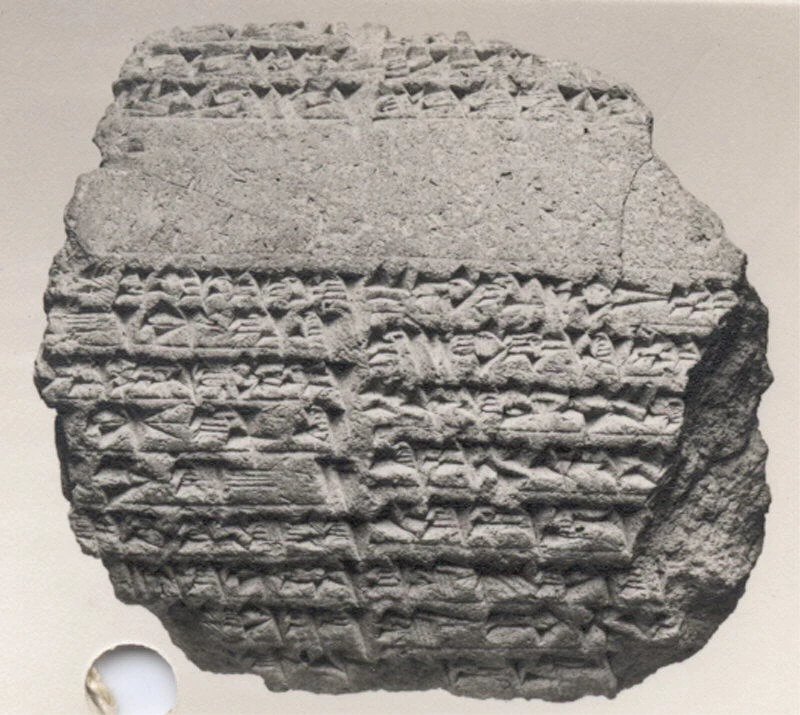
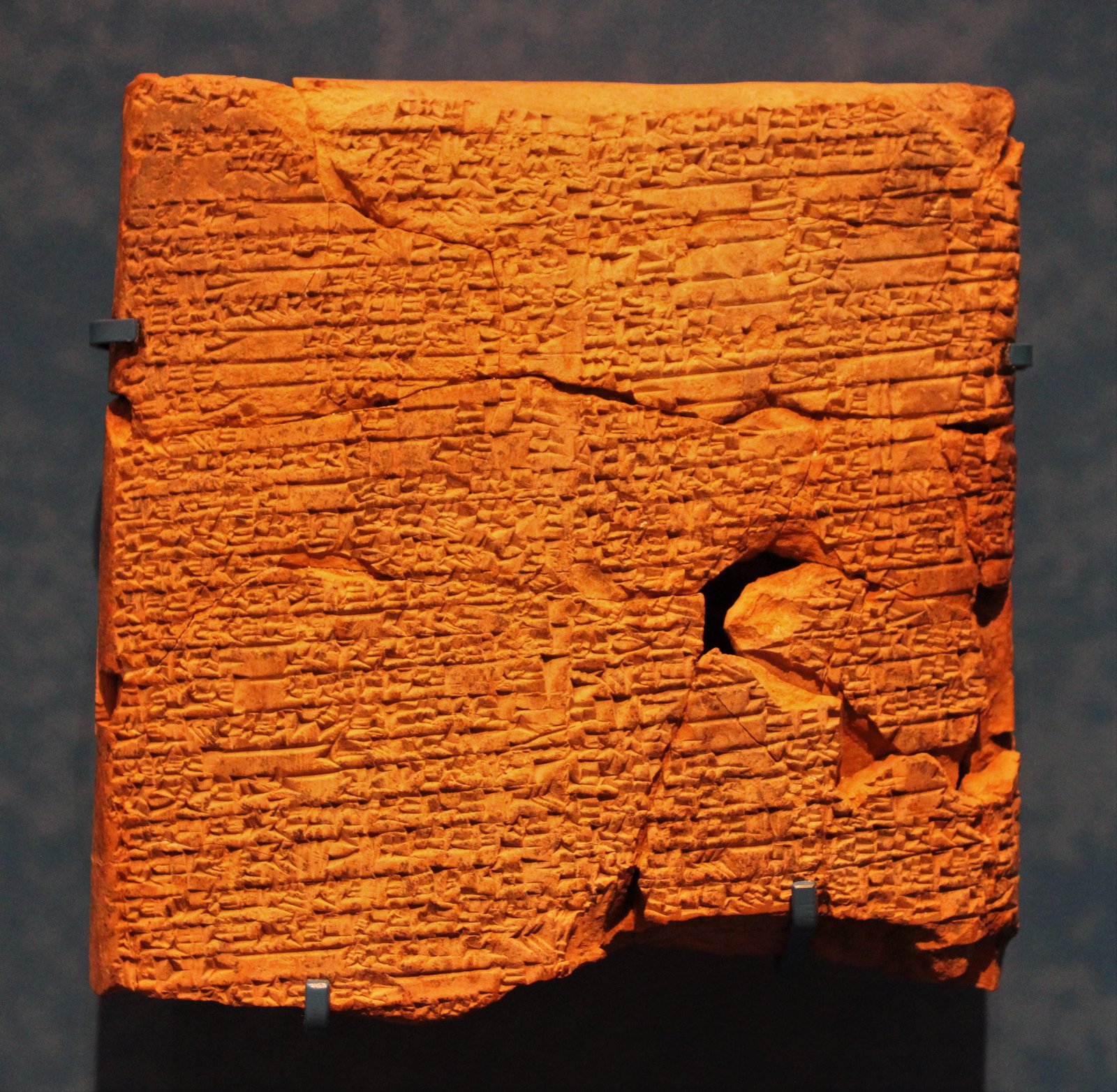
The poems discussed here are known from clay tablets. According to the ETCSL project, Sumerian literature is the oldest readable poetry, and its main corpus dates from about 2100 to about 1650 BCE. [1] The tablet of Gilgamesh and Huwawa shown below, for example, is dated by the Ashmolean Museum to about 1900–1600 BCE. [2] A copy's date is not the date of composition, and manuscripts often differ in wording, order and length. ETCSL publishes a composite text that combines them and reports their variants; the line numbers below are ETCSL's. (ETCSL spells InanaInanna / IshtarA prominent Mesopotamian goddess whose Sumerian name Inanna became associated with Akkadian Ishtar across diverse traditions. She was associated with desire, war, royal authority and Venus, while local forms and genealogies varied among texts.Glossary · Click to read the explanation, Erec-ki-gala and Gilgamec where this site writes Inanna, EreshkigalEreshkigalMesopotamian goddess ruling the netherworld; Inanna’s sister in descent texts, with varying accounts of her relationship with Nergal.Glossary · Click to read the explanation and Gilgamesh.)
The word for seven: imin
The Sumerian numeral for seven is written with a sign read imin, now often read umin. In his grammar of SumerianSumerian languageAncient language of southern Mesopotamia, clearly attested in third-millennium BCE texts and maintained in learning and ritual after its spoken use declined.Glossary · Click to read the explanation, Bram Jagersma explains it, following earlier scholars, as an additive compound, "five plus two" (i-min). Its first vowel, u, is explained as copying the start of ussu, "eight". He also notes that a numeral always expresses a number, unlike nouns for "all". [3]
Popular websites often say that imin also meant "many" or "all". The sources checked here do not support that as a separate meaning. The electronic Pennsylvania Sumerian Dictionary (ePSD2) gives one sense, "seven", for all 327 instances it counts. [4] The same entry records a first-millennium word list from NinevehNineveh and KuyunjikNineveh is an ancient Assyrian city near Mosul in northern Iraq; Kuyunjik is one of its archaeological moundsGlossary · Click to read the explanation (K 2054) that sets imin beside several Akkadian equivalents: the ordinary word for seven, but also kiššatu, "totality", the word for "star", the cities UrukUrukAncient city at Warka in southern Iraq, a major urban centre around 3200 BCE that preserved early writing and accounting tablets.Glossary · Click to read the explanation and Kish and the land of Yamutbal. [4] So at least one later scholarly list linked the sign with totality. That does not show that a Sumerian poet using imin meant "everything".
Grammar gives a more useful clue. When imin is followed by the demonstrative -bi, the phrase is always definite: not "seven harps" but "the seven harps". Jagersma's examples include an administrative entry, "of the seven harps", and a court record of the Ur III period (late third millennium BCE) that mentions "the seven royal judges". [3] Several of the poetic sevens below use exactly this form.
Inanna's Descent: seven powers, seven gates, seven judges
The site's study of Inanna and Ishtar's descent compares the Sumerian and Akkadian stories as wholes; here we follow only the counting. In the Sumerian poem (ETCSL 1.4.1), InannaInanna / IshtarA prominent Mesopotamian goddess whose Sumerian name Inanna became associated with Akkadian Ishtar across diverse traditions. She was associated with desire, war, royal authority and Venus, while local forms and genealogies varied among texts.Glossary · Click to read the explanation prepares for the underworld in three steps.
First, she leaves her temples. In the main text she abandons seven temples in seven cities, from the E-ana in UrukUrukAncient city at Warka in southern Iraq, a major urban centre around 3200 BCE that preserved early writing and accounting tablets.Glossary · Click to read the explanation to the E-Ulmaš in Agade. One manuscript adds eight more (lines 6–13). The poem does not state this number; it comes from counting, and the manuscripts disagree. [5]
Second, "she took the seven divine powers" (lines 14–19). The Sumerian has me 7-bi, "the seven me", using the definite form described above. [6] ETCSL renders me as "divine powers". The poem does not list these seven.
Third, she dresses. Lines 14–25 describe nine items: a turban, a wig, small lapis-lazuli beads, twin egg-shaped beads, the pala dress, mascara, a pectoral, a golden ring, and a lapis-lazuli measuring rod and line. [5]
EreshkigalEreshkigalMesopotamian goddess ruling the netherworld; Inanna’s sister in descent texts, with varying accounts of her relationship with Nergal.Glossary · Click to read the explanation then orders: "Let the seven gates of the underworld be bolted" (lines 114–122; Sumerian abul kur-ra 7-bi, "the seven gates of the netherworld"). [5][6] At each gate one item is taken (lines 129–163):
The list is summarised from ETCSL 1.4.1, lines 129–163. [5] After every removal Inanna asks "What is this?" and is told that "a divine power of the underworld has been fulfilled".
Three details matter. Nine items go on but only seven come off: the wig and the mascara are not mentioned at the gates. One manuscript removes the measuring rod at the first gate, so the order was not fixed. And the poem never pairs a garment with one of the seven me. The popular claim that Inanna "gave up one me at each gate" is a modern reading. The text's own link is subtler. The refrain uses the same word: each time she loses something, a me of the underworld (me kur-ra, line 132) "has been fulfilled". The powers she brought from above meet the powers of the world below. [5][6]
Once she is stripped, "the AnunaAnunna / AnunnakiAnunna/Anunnaki is a collective designation for Mesopotamian gods whose scope varies by text and period; it is not a group with one fixed membership or number.Glossary · Click to read the explanation, the seven judges, rendered their decision against her" (lines 164–172; Sumerian a-nun-na di-kud 7-bi). [5][6] The site's records on the AnunnaAnunna / AnunnakiAnunna/Anunnaki is a collective designation for Mesopotamian gods whose scope varies by text and period; it is not a group with one fixed membership or number.Glossary · Click to read the explanation and on what the Anunna texts actually say already explain that this seven belongs to this scene, not to a fixed membership of the Anunna. Grammar adds one point: the poem names the judges in the same definite form that the Ur III court record uses for "the seven royal judges". [3] This is a shared way of naming a panel, not proof that the poet had a real court in mind.
Later in the poem, the demons who seize DumuziDumuzi / TammuzDumuzi is a deity of ancient Mesopotamian traditions associated with shepherding and Inanna; Tammuz appears as the name in later linguistic and textual traditions.Glossary · Click to read the explanation are counted in the same way: "The seven of them poured the milk from his churns" (lines 348–353). [5]
Gilgamesh and Huwawa: seven helpers, seven ranges, seven terrors
In the Sumerian poem Gilgamesh and Huwawa (version A, ETCSL 1.8.1.5), Gilgamesh asks the sun god Utu (Akkadian ShamashShamashMesopotamian god of the sun and justice, shown before Hammurabi on an eighteenth-century BCE stele preserved in the Louvre.Glossary · Click to read the explanation) for help before going to the cedar mountains. Utu gives him "seven warriors, sons of a single mother" (lines 34–47). [7] The first has lion's paws and eagle's talons, the fourth blazes with fire, and the seventh "flashes like lightning". The Sumerian names them as a set, 7-bi-e-ne, "these seven". [8]
The journey counts to seven too. "When he had crossed the seventh mountain range, there his intuition led him to find the cedars" (lines 62–67; Sumerian hur-saj 7-kam-ma, with the ordinal suffix). [7][8] The manuscripts handle the steps differently. In ETCSL's main text the hero crosses the first range and then the seventh. One manuscript spells out the second to sixth ranges, and another adds the third to sixth after a gap. [7]
The same thing happens with Huwawa's terrors, the dazzling powers that protect the guardian of the cedars (known in the Akkadian epic as HumbabaHumbaba, guardian of the Cedar ForestGuardian of the Cedar Forest confronted by Gilgamesh and Enkidu in the epic traditions.Glossary · Click to read the explanation). Gilgamesh, who travels with his servant EnkiduEnkidu, Gilgamesh’s companionGilgamesh’s companion in the Babylonian epic; his death sets the king searching for life beyond mortality.Glossary · Click to read the explanation, wins Huwawa over with gifts and an offer of kinship, asking for his terrors in return. In the main text Huwawa hands over the first terror (lines 145–148) and then, at once, "his seventh terror" (lines 149–151). ETCSL notes that one manuscript of unknown origin adds at least 53 lines covering the second to sixth terrors, each with a new gift. No manuscript known to come from Nippur has these lines. [7]
After Huwawa is killed, EnlilEnlilEnlil/Ellil: a major Mesopotamian god associated with destinies, kingship, and Ekur at Nippur, already prominent in third-millennium god lists. His name’s origin and cult beginnings remain debated.Glossary · Click to read the explanation is angry and gives out the guardian's seven "auras" one by one: to the fields, the rivers, the reed-beds, the lions, the palace, the forests and, seventh, to Nungal, goddess of prisoners (lines 193–199). [7] The Sumerian uses two words here: ni-te (ETCSL "terror") for what Huwawa hands over, and me-lem (ETCSL "aura") for what Enlil distributes. [8] ETCSL warns that the manuscripts are "extremely confused" about the order of the auras. Its sequence is a compromise, and one copy has "debt slaves" instead of the palace. [7] The total of seven, however, stays the same.
Enmerkar: five mountains, six mountains, seven mountains
Enmerkar and the Lord of ArattaEnmerkar and the Lord of ArattaA Sumerian poem of rivalry, messages and temples, containing an incantation about the speech of different peoples.Glossary · Click to read the explanation (ETCSL 1.8.2.3) tells of a rivalry between EnmerkarEnmerkarEnmerkar is a ruler of Uruk in Sumerian literature and the protagonist of a poem about rivalry with Aratta’s lord.Glossary · Click to read the explanation of Uruk and the ruler of distant ArattaArattaAratta is a place in Sumerian literature visited by Uruk’s messenger in Enmerkar’s story; its historical location is unsettled.Glossary · Click to read the explanation. Their messenger travels back and forth across the mountains. Twice the poem describes the crossing with the same rising line:
ETCSL 1.8.2.3, lines 160–175 and 500–514. [9]
In Sumerian the line is hur-saj 5 hur-saj 6 hur-saj 7-e. [10] This is not a route map. The count rises by one and stops at seven, and the next sentence is the arrival. The poem also calls Inanna the one "who adorns the seven walls" (lines 281–293; bad 7-e). [9][10]
Counting up to seven in other poems
The same pattern, a count that climbs and stops at seven, appears in other Sumerian works.
In Gilgamesh, Enkidu and the Netherworld (ETCSL 1.8.1.4), Enkidu is brought up from the netherworld, and Gilgamesh asks him about the dead. "Did you see him who had one son?" The answers improve with each step, up to the last: "Did you see him who had seven sons? … As a companion of the gods, he sits on a throne and listens to judgments" (lines 254–267). [11] The father of seven is the highest point of the list; the questions then turn to the palace eunuch, the woman who never gave birth and other fates. Smaller sevens appear too: an axe of "seven talents and seven minas" (lines 136–150), and, in a version from Me-Turan, Enkidu held below "for seven days". [11]
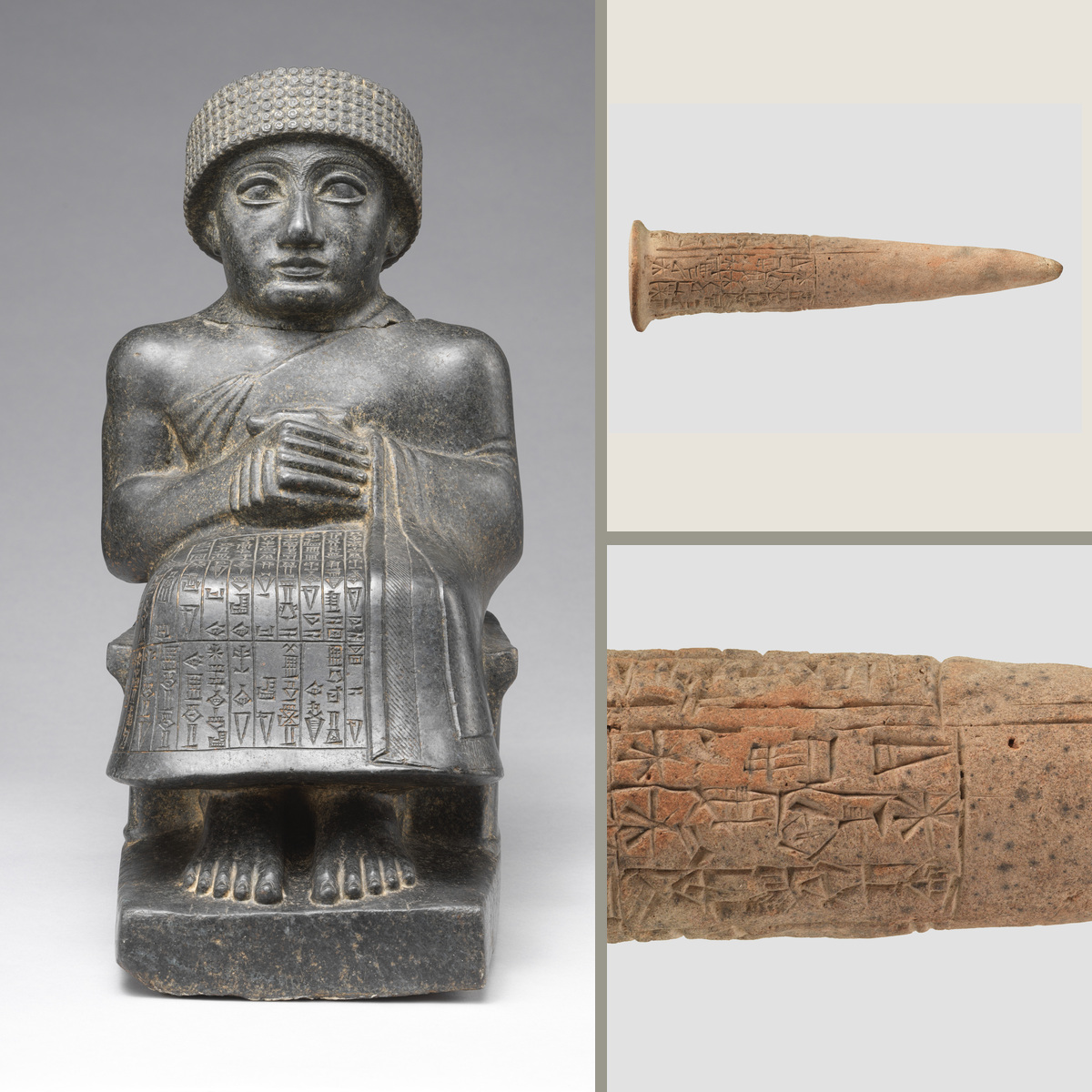
The cylinders of GudeaGudeaRuler of Lagash in the late third millennium BCE, whose inscriptions document temple construction and the name Anunna.Glossary · Click to read the explanation, ruler of LagashLagash, Sumerian city-stateCity-state in present-day southern Iraq; Girsu was one of its centers associated with royal inscriptions.Glossary · Click to read the explanation in the late third millennium BCE, describe the building of NingirsuNingirsuA major god of the Sumerian state of Lagash, invoked in Urukagina’s reform undertaking.Glossary · Click to read the explanation's temple (ETCSL 2.1.7). [3][12] Gudea marks out squares on the temple site, from the first to the seventh, and from the second on each one is given an image. The seventh is "the E-ninnu bathing the country with moonlight at dawn" (lines 562–577). [12] Jagersma, citing Wolfgang Heimpel, notes that here the short numbers two, three, five and six take an extra syllable (the copula -am) while the longer words for four and seven do not: the count itself is shaped by rhythm. [3] The cylinders also say that great stone slabs were set up one a day until all stood "by the seventh day" (lines 617–624), and that when the god entered his new house, a slave woman was allowed for seven days to be equal to her mistress (lines 1211–1223). [12]
In The Return of Ninurta to Nippur (ETCSL 1.6.1), the god's trophies include a "Six-headed wild ram" and a "Seven-headed serpent" (lines 30–40, 55–63). [13]
What these sevens share, and where the evidence stops
Read together, these passages show three uses of seven.
- A named set. "The seven me", "the seven gates", "the seven judges", "these seven" warriors. The grammar marks them as definite groups, the same way administrative and legal texts name real groups of seven. [3][6]
- A series that ends at seven. Gates, mountain ranges, terrors, auras, squares and sons are counted one by one, and the series stops at seven.
- A turning point. What follows the seventh step changes the story: Inanna is judged, Gilgamesh finds the cedars, Huwawa is struck, the messenger reaches Aratta.
Some copies skip from the first to the seventh step while others write out every stage, which suggests that scribes could shorten the count because the audience knew where it would end. [7]
The limits matter as much as the pattern. The poems never say why seven was chosen, and they do not list Inanna's seven me or link them to her garments. The dictionary meaning of imin is simply "seven"; its link with "totality" appears in a much later scholarly word list. [4] These sevens show how Sumerian poetry was composed, copied and taught in the late third and early second millennium BCE, not a single "Sumerian doctrine" of the number. Whether they have any historical link with sevens in later Near Eastern texts is a separate question, and resemblance alone does not answer it.
References and notes
- ETCSL project, "About the project: a brief overview", The Electronic Text Corpus of Sumerian Literature, University of Oxford Overview paragraph: date range of the Sumerian literary corpus (about 2100 to 1650 BCE) Return to the text ↑
- Ashmolean Museum, Oxford, "Clay tablet with inscribed cuneiform script with Sumerian epic of Gilgamesh", AN1932.155, online collection record Record fields: title, place of excavation (Tell Uhaimir), date (about 1900-1600 BCE), credit line (Oxford Field Museum Expedition, 1932) Return to the text ↑
- Bram Jagersma, A Descriptive Grammar of Sumerian, PhD thesis, Leiden University, 2010 (open access) Chapter 9, Numerals, printed pp. 241-243 (numeral system; umin 'seven' as 5+2; Gudea Cylinder A 21:1-12 and Heimpel 1970) and pp. 248-249 (cardinals with the demonstrative =be; 'the seven harps'; 'the seven royal judges', NG 117; 'square seven', Cyl A 21:11); PDF pages 268-276 Return to the text ↑
- Electronic Pennsylvania Sumerian Dictionary, 2nd edition (ePSD2), Oracc, entry imin [SEVEN] (NU) Whole entry: forms, periods, senses (1. seven, 327 instances), lexical equations including CT 18, pl. 29-30, K 2054 obv. ii 19'-24' (imin = kiššatu, MUL, sebet, Uruk, Kiš, Yamutbal) Return to the text ↑
- J.A. Black, G. Cunningham, E. Flückiger-Hawker, E. Robson and G. Zólyomi, The Electronic Text Corpus of Sumerian Literature (ETCSL), Oxford 1998-: "Inana's descent to the nether world" (ETCSL 1.4.1), translation Translation lines 1-175 read in full, especially 6-13, 14-25, 102-113, 114-128, 129-163, 164-172; also 290-358, especially 348-353 Return to the text ↑
- J.A. Black et al., The Electronic Text Corpus of Sumerian Literature (ETCSL), Oxford 1998-: "Inana's descent to the nether world" (c.1.4.1), composite transliteration Lines 14, 102, 119, 125, 129-133 (incl. 129A-B), 159 and 167: me 7-bi; abul kur-ra 7-bi; me kur-ra (line 132); abul 7-kam-ma; a-nun-na di-kud 7-bi Return to the text ↑
- J.A. Black et al., The Electronic Text Corpus of Sumerian Literature (ETCSL), Oxford 1998-: "Gilgamesh and Huwawa, version A" (ETCSL 1.8.1.5), translation Translation lines 1-202 read, especially 34-47, 48-67 with manuscript notes, 140-151 with the note on lines 148A-148AAA, 187-202 with the note on 193-199 Return to the text ↑
- J.A. Black et al., The Electronic Text Corpus of Sumerian Literature (ETCSL), Oxford 1998-: "Gilgamesh and Huwawa, version A" (c.1.8.1.5), composite transliteration Lines 36, 45, 61-62 (61a-d), 148H-148XX, 149 and 193-199: 7-bi-e-ne; hur-saj 7-kam-ma; ni2-te-a-ni 7-kam-ma; me-lem4-a-ni 1-7 Return to the text ↑
- J.A. Black et al., The Electronic Text Corpus of Sumerian Literature (ETCSL), Oxford 1998-: "Enmerkar and the lord of Aratta" (ETCSL 1.8.2.3), translation Translation searched in full for numbers; lines 160-175, 281-293 and 500-514 read in context Return to the text ↑
- J.A. Black et al., The Electronic Text Corpus of Sumerian Literature (ETCSL), Oxford 1998-: "Enmerkar and the lord of Aratta" (c.1.8.2.3), composite transliteration Lines 170, 287 and 509: hur-saj 5 hur-saj 6 hur-saj 7-e; bad3 7-e Return to the text ↑
- J.A. Black et al., The Electronic Text Corpus of Sumerian Literature (ETCSL), Oxford 1998-: "Gilgamesh, Enkidu and the nether world" (ETCSL 1.8.1.4), translation Lines 136-150, 213-285 (especially 254-267); Me-Turan version segment A lines 1-16 and segment B lines 1-28 Return to the text ↑
- J.A. Black et al., The Electronic Text Corpus of Sumerian Literature (ETCSL), Oxford 1998-: "The building of Ningirsu's temple" (Gudea cylinders A and B) (ETCSL 2.1.7), translation Translation searched for numbers; lines 562-577, 617-624, 781-798 and 1211-1223 read in context Return to the text ↑
- J.A. Black et al., The Electronic Text Corpus of Sumerian Literature (ETCSL), Oxford 1998-: "The return of Ninurta to Nibru" (ETCSL 1.6.1), translation Lines 24-69 and 130-145 read, especially 30-40, 55-63 and 135-139 Return to the text ↑
Suggest a correction · Suggest a source for this record
Cite this record
IL Archive, «Seven in Sumerian Poetry: Gates, Terrors, Mountains and Judges», https://ilarchive.com/en/studies/seven-in-sumerian-literature
Continue reading
Related readings