Entity · Person
Gudea
A reference page linking a name, group, or concept to the materials that discuss it.
Ruler of Lagash in the late third millennium BCE, whose inscriptions document temple construction and the name Anunna.
Estimated reading time: 2 min Published Last reviewed:
Share article
Text
Introduction
Gudea was a historical ruler of the city-state of Lagash in southern MesopotamiaMesopotamiaHistorical region associated with the Tigris and Euphrates: Uruk, Ur, Eridu, cuneiform, Sumer, Akkad, Babylon and Assyria, their languages and cults, and the limits of archaeological evidence.Glossary · Click to read the explanation in the late third millennium BCE. His surviving record is especially rich in building inscriptions, statues, and a long composition preserved on two clay cylinders. These sources reveal how the ruler represented his service to the gods, but their claims should not be mistaken for neutral reporting of every event. [1]
Identity and chronology
Gudea bore the Sumerian title ensi (ruler) of Lagash, whose territory included Girsu (modern Tello). Museum catalogues place his monuments in the Neo-Sumerian period while offering approximate object dates: the Louvre assigns several works to around 2120–2110 BCE, whereas the Metropolitan Museum dates statue 59.2 to about 2090 BCE. These are estimates for objects, not exact dates for Gudea's birth, death, or every stage of his rule. [2]
Building and inscription
His name is particularly associated with building the temple of the god Ningirsu at Girsu. The project is narrated in The Building of Ningirsu's Temple, commonly known as Gudea Cylinders A and B. The composition intertwines divine commands, preparation of materials, human labour and ritualsRitualAn organised or distinguished practice meaningful to a community; it may leave traces, but its form alone does not reveal an associated doctrine.Glossary · Click to read the explanation in a royal-religious idiom. Its assertions about the legitimacy of construction must therefore be distinguished from independent archaeological confirmation of particular details. Cylinder B is also a surviving object in the Louvre, inventory MNB 1511, rather than merely a title transmitted by later literature. [1][3]
Gudea and the Anuna
In Cylinder A, lines 353–364 in the University of Oxford's Electronic Text Corpus of Sumerian Literature, the “AnunaAnunna / AnunnakiAnunna/Anunnaki is a collective designation for Mesopotamian gods whose scope varies by text and period; it is not a group with one fixed membership or number.Glossary · Click to read the explanation gods of the land of Lagash” stand beside Gudea in prayer and supplication for the building of Ningirsu's house. The Anuna occur again in lines 551–561, admiring the work. These passages attest the name in this textual setting; they do not make Gudea a god or a member of the divine group, nor establish a single unchanging characterization of the Anuna across Mesopotamian history. [1]
Portrait and evidential limits
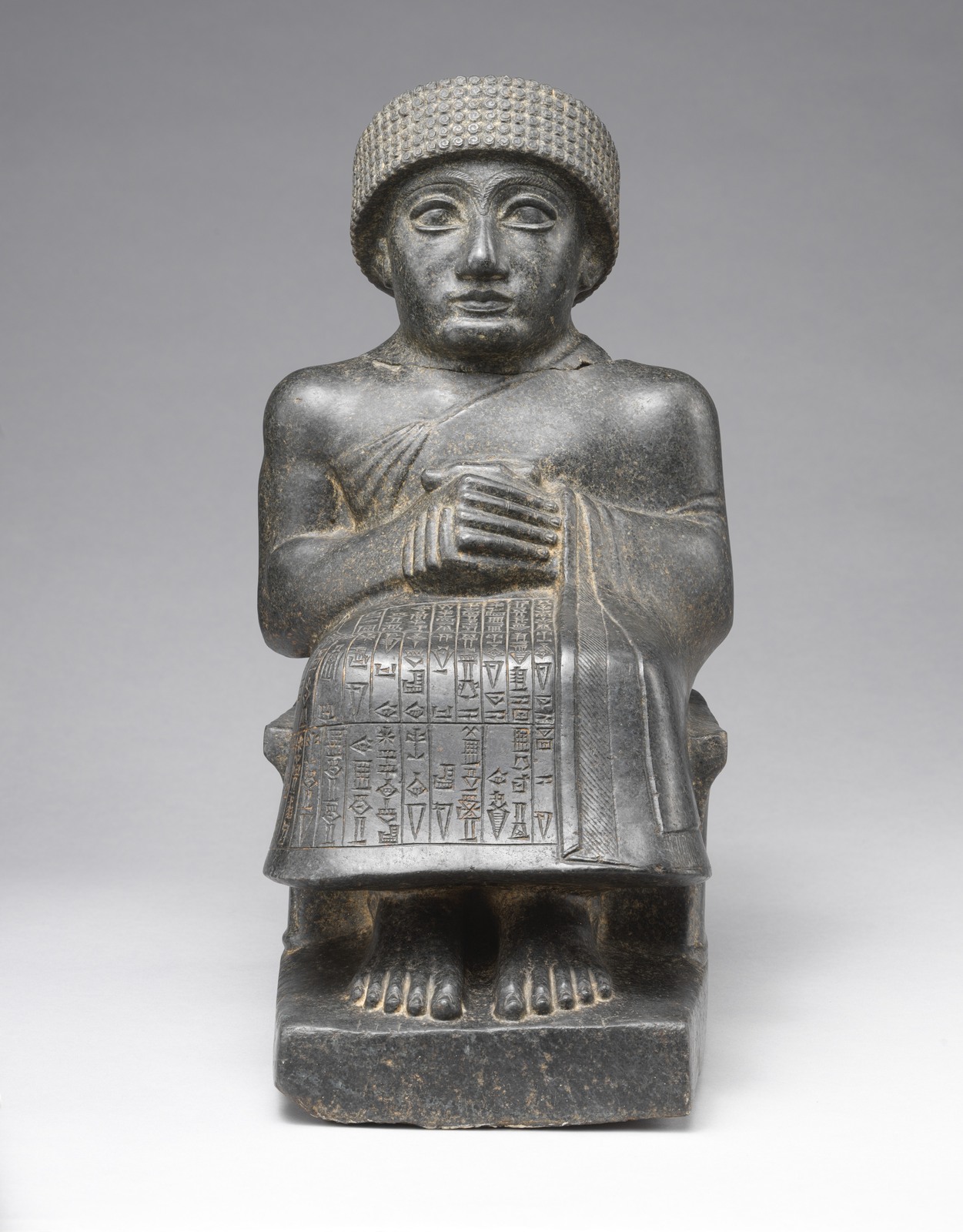
The cover shows a diorite statue of Gudea held by the Metropolitan Museum of Art, accession 59.2, which the museum attributes probably to Girsu. The sculpture and inscriptions document a presentation of the ruler as devout. Artistic representation, however, is not a photographic portrait and cannot establish his actual facial features precisely. Reading statues and inscriptions together reveals both the visual language of authority and piety and the official account of building and worship; both require contextual criticism. [2]
References and notes (3)
- University of Oxford, Electronic Text Corpus of Sumerian Literature (ETCSL), “The building of Ningirsu’s temple (Gudea, cylinders A and B),” 2.1.7. Cylinder A, lines 353–364 and 551–561, with accompanying English translation. Return to the text ↑
- The Metropolitan Museum of Art, “Statue of Gudea,” accession 59.2, collection record 329072. Object record: diorite, approximate date (ca. 2090 BCE), probable provenance (Girsu), image and rights. Return to the text ↑
- Musée du Louvre, “Cylindre B de Gudea,” inventory MNB 1511, collections record. Object record: clay cylinder with 24 columns, discovered at Tello in 1877, approximate museum date. Return to the text ↑
Suggest a correction · Suggest a source for this record
Cite this record
IL Archive, «Gudea», https://ilarchive.com/en/entities/gudea
Continue reading
Related readings