Study
The Sebettu: “the Seven” as Demons and as Protectors in Mesopotamia
An extended study of a topic, with evidence and references.
- Names
- Sebettu · Sebitti · Sibitti
- Timeline
- From 2100 BCE to 600 BCE
- Region
- Mesopotamia
In Mesopotamian texts "the Seven" (Sebettu) are both merciless demons in exorcists' spells and warrior gods who protect kings and households. How one group could play both roles.
Estimated reading time: 9 min Published Last reviewed:
Share article
Video
Why Is Seven Sacred? What the Clay Tablets of Ancient Iraq Reveal
Our fourth documentary follows the number seven through the clay tablets of ancient Iraq and its neighbours, then reads the scriptures in their own words and with respect. Some scenes are AI-generated illustrations.
The YouTube player loads only when you press play. Watch on YouTube
Text
Introduction
MesopotamiaMesopotamiaHistorical region associated with the Tigris and Euphrates: Uruk, Ur, Eridu, cuneiform, Sumer, Akkad, Babylon and Assyria, their languages and cults, and the limits of archaeological evidence.Glossary · Click to read the explanation knew many groups of seven, but one of them had no other name: the gods called “the Seven”. In some tablets they are terrifying demons who spread disease and darkness; in others they are armed gods who march beside the king or stand guard at the door of an ordinary house. How could the same group be feared as a source of evil and trusted as a protection against it?
This study follows that question through the texts and objects that scholars actually use. It separates the ancient wording from modern translations, keeps apart the different tablets in which the Seven appear, and states where the evidence is firm and where it is only probable. It does not treat the Seven as a single fixed doctrine: the sources span some two thousand years and several genres, and they do not always agree.
The name and the scholarly sources
The AkkadianAkkadianAn ancient East Semitic language written in cuneiform from the third millennium BCE; its varieties include Babylonian and Assyrian, and it served in international diplomacy.Glossary · Click to read the explanation name means simply “the Seven”. In the poem of Erra and Ishum, the god AnuAn / AnuAn is the Sumerian sky god, called Anu in Akkadian. The sign AN by itself does not identify him: it also denotes sky or divinity.Glossary · Click to read the explanation “named” his seven sons “the Seven”, so the number itself serves as their name.[1] Tablets often spell it si-bit-ti, and older publications, including the 1957 report on their temple at Khorsabad, write the name Sibitti or Sebitti; recent studies normalise it as Sebettu.[2]
The fullest modern treatment is Gina Konstantopoulos’s monograph The Divine/Demonic Seven and the Place of Demons in Mesopotamia (Brill, 2023). Its table of contents shows the range of the evidence: third-millennium references and Sumerian narratives, Old Babylonian incantations, second-millennium cults, Assyrian royal inscriptions from Ashurnasirpal II to AshurbanipalAshurbanipalAshurbanipal was an Assyrian king of the seventh century BCE, reigning about 668–631 BCEGlossary · Click to read the explanation, household incantations, the Udug-hul series, the iconography of the group and its link with the Pleiades, and an appendix listing the textual attestations.[3] In an earlier article Konstantopoulos describes the Sebettu as “divine-demonic beings” who “navigate an identity both demonic and divine”, a duality she sees as the result of their long history.[4]
Demons in the incantations: “they are the Seven”
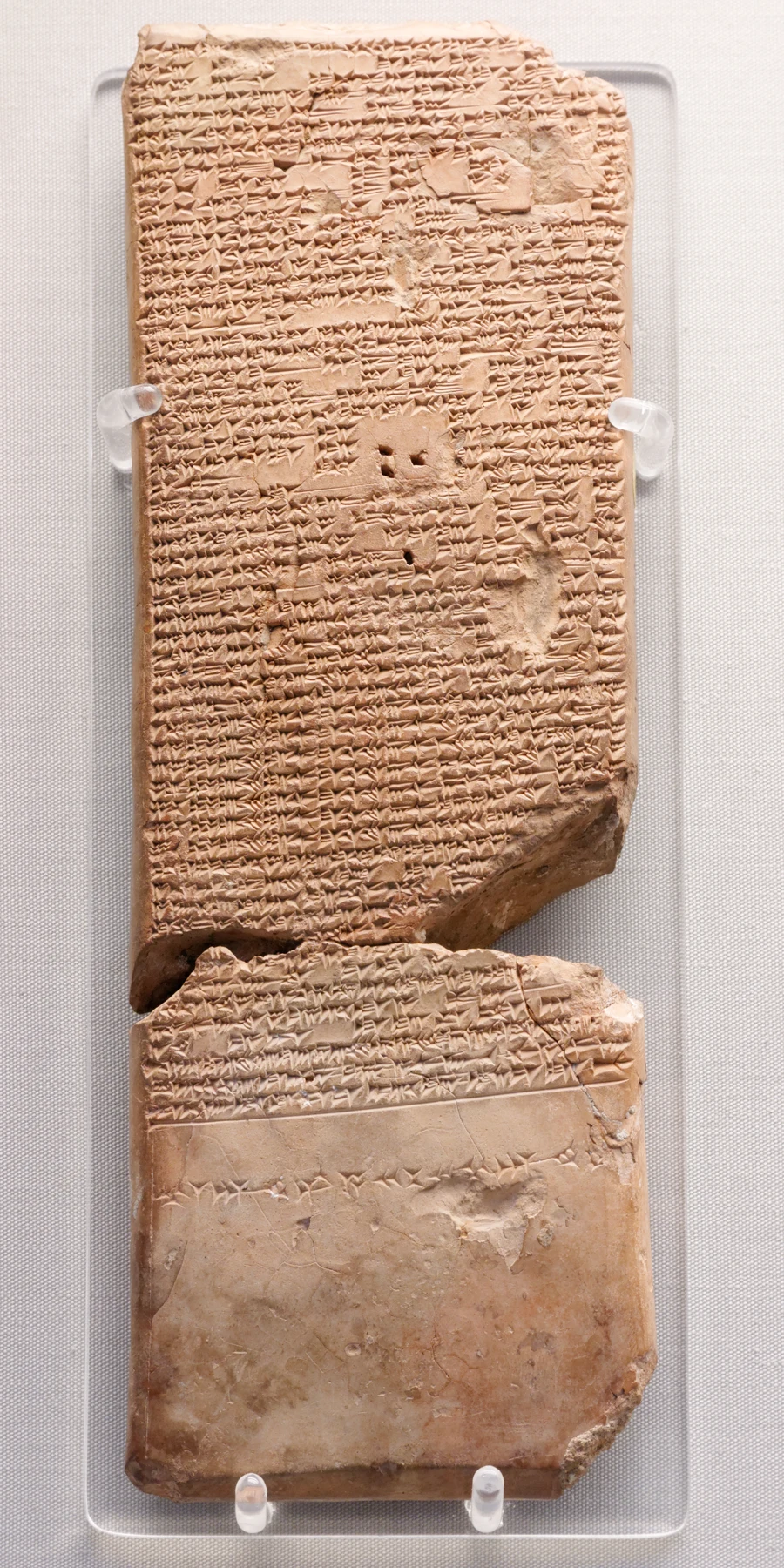
The best-known description of the Seven comes from the Udug-hul incantations (Akkadian Utukkū lemnūtu, “Evil demons”), a bilingual Sumerian-Akkadian series used by exorcists; its editor argues that one main purpose of these spells was to treat illnesses blamed on demons. Its roots go back to Sumerian spells, and the canonical series was known to scholars of the first millennium BCE.[5]
English readers usually meet these lines in R. Campbell Thompson’s The Devils and Evil Spirits of Babylonia (1903–1904), a pioneering work now in the public domain. Its translation of Tablet V reads:
R. Campbell Thompson, The Devils and Evil Spirits of Babylonia, vol. I (1903), Tablet V, pp. 77–79.
Thompson’s work must be used with care. Markham GellerMarkham GellerScholar of Semitic languages, cuneiform and Mesopotamian medicine who discussed Dilmun and paradise.Glossary · Click to read the explanation, who has edited the series anew, notes that Thompson combined the copies of different manuscripts into a single hand copy, so that the features of each tablet were obscured.[6] The famous quotation in Thompson’s own introduction goes further: it runs lines from Tablet V straight into lines from Tablet XVI, as if they were one poem, and only the footnotes reveal that two tablets are involved.[7] Modern scholarship therefore quotes Geller’s editions: a composite text in 2007 (Evil Demons, in the series State Archives of Assyria CuneiformCuneiformWriting with wedge-shaped signs, developed from Mesopotamian recording traditions and used for several languages from the third millennium BCE.Glossary · Click to read the explanation Texts) and a full edition of every manuscript, line by line, in 2016. In the 2016 edition the same passage of Tablet 5 reads:
Udug-hul Tablet 5, lines 167–175 and 179–180, translated by M. J. Geller, Healing Magic and Evil Demons (2016), pp. 211–213.
The ApsûAbzuCosmic subterranean freshwater in Mesopotamian religion, associated with Enki/Ea. The name occurs in E-abzu, “House of the Abzu”, at Eridu. Distinct from the narrative figure Apsû in the Enūma eliš and unnamed excavated structures.Glossary · Click to read the explanation is the subterranean fresh water, the domain of EaEnkiMesopotamian deity also known as Ea, linked with Eridu and the Abzu (deep fresh waters), wisdom, incantations, and narratives of creation and cosmic order. Later written attestations do not identify the deity of Eridu’s earliest layers.Glossary · Click to read the explanation (Enki); the same passage calls the Seven “evil ones of Ea, the throne bearers of gods”. Geller adds that an Old Babylonian forerunner already had the refrain, reading “seven times seven” where the later text has “twice seven”.[8]
Earlier in the same tablet the Seven are “the Seven gods of the broad heavens” and “the Seven gods of the broad Netherworld”, “seven evil gods”, “seven in Heaven and seven in the Netherworld”. Geller comments that this passage shows “the divine Seven or Sibitti-demons, reflecting their roles as both benevolent gods and demons”. He also doubts the proposal that these lines refer to seven levels of heaven and earth.[9]
Tablet 16 describes them one by one: the first is “the furious South Wind”, the third a panther, the fourth a serpent, the fifth a lion, the sixth a rising wave, the seventh a storm, and “the Seven of them (act as) messenger of Lord Anu”. The tablet then tells how they whirled about at the base of heaven and “kept circling furiously in front of the crescent moon”, until the moon god Sîn (NannaNanna / Su’en / SinMesopotamian moon god known as Nanna, Su’en and Sîn/Sin. Worshipped especially at Ur and Harran, he is associated with the crescent and lunar cycle; names and myths have different histories.Glossary · Click to read the explanation) was dimmed in his brightness. Geller restores and compares some of these lines from a late text concerned with an eclipse.[10]
Sons of Anu, weapons of Erra
The poem of Erra and Ishum, a Babylonian work known from first-millennium BCE manuscripts, gives the Seven a birth story.[3] The electronic Babylonian Library translation of Tablet I reads: “Anu, the king of the gods, impregnated Earth, / It bore him seven gods, whom he named ‘the Seven’.” Anu gives each one a destructive task, then hands all seven to the warrior god Erra: “Let these be your wrathful weapons, that they march at your flank!”[1] In the poem it is the Seven who rouse a sleeping Erra to war. The poem itself is the subject of a separate study; here it matters because it calls them gods and sons of Anu, yet makes them instruments of destruction.
Their parentage is not the same everywhere. RitualRitualAn organised or distinguished practice meaningful to a community; it may leave traces, but its form alone does not reveal an associated doctrine.Glossary · Click to read the explanation texts call them sons of Enmešarra, and one commentary calls them sons of Išhara; Wiggermann doubts that all these groups of seven were identical.[11] “Sons of Anu” is therefore the version of Erra and Ishum, not a single fixed genealogy.
Warrior gods of the Assyrian state
According to Konstantopoulos, the Sebettu first appear in Assyrian royal inscriptions under Tukulti-Ninurta I (1243–1207 BCE). Shalmaneser III mentions them on a stone altar dedicated to the Seven found at NinevehNineveh and KuyunjikNineveh is an ancient Assyrian city near Mosul in northern Iraq; Kuyunjik is one of its archaeological moundsGlossary · Click to read the explanation; Sargon IISargon IISargon II was an Assyrian king of the late eighth century BCE; ORACC dates his reign about 721–705 BCEGlossary · Click to read the explanation calls them the ones “who go before the gods” in a text known from stelae found as far apart as Tell Tayinat in TurkeyTurkeyTurkey is a modern country including Anatolia and territory in southeastern EuropeGlossary · Click to read the explanation, Kition in Cyprus and Tang-i Var in western IranIranIran is the modern country containing Shush, ancient SusaGlossary · Click to read the explanation; they close the lists of gods in the inscriptions of SennacheribSennacherib, king of AssyriaAssyrian king, 704–681 BCE; part of Ahiqar’s story is set at his court.Glossary · Click to read the explanation; and in the succession treaty of EsarhaddonEsarhaddon, king of AssyriaSennacherib’s son and successor, Assyrian king in 680–669 BCE, named in Ahiqar and Tobit.Glossary · Click to read the explanation they stand at the boundary between Assyrian and foreign gods among the divine witnesses. Konstantopoulos argues that their demonic, warlike character made them especially useful on the frontiers of the empire.[4] This reading of their political role is her interpretation; the inscriptions themselves are firm evidence.
The group was also identified with the Pleiades, the small star cluster in Taurus, a connection that belongs to a separate study.[4]
Protectors at the house gate
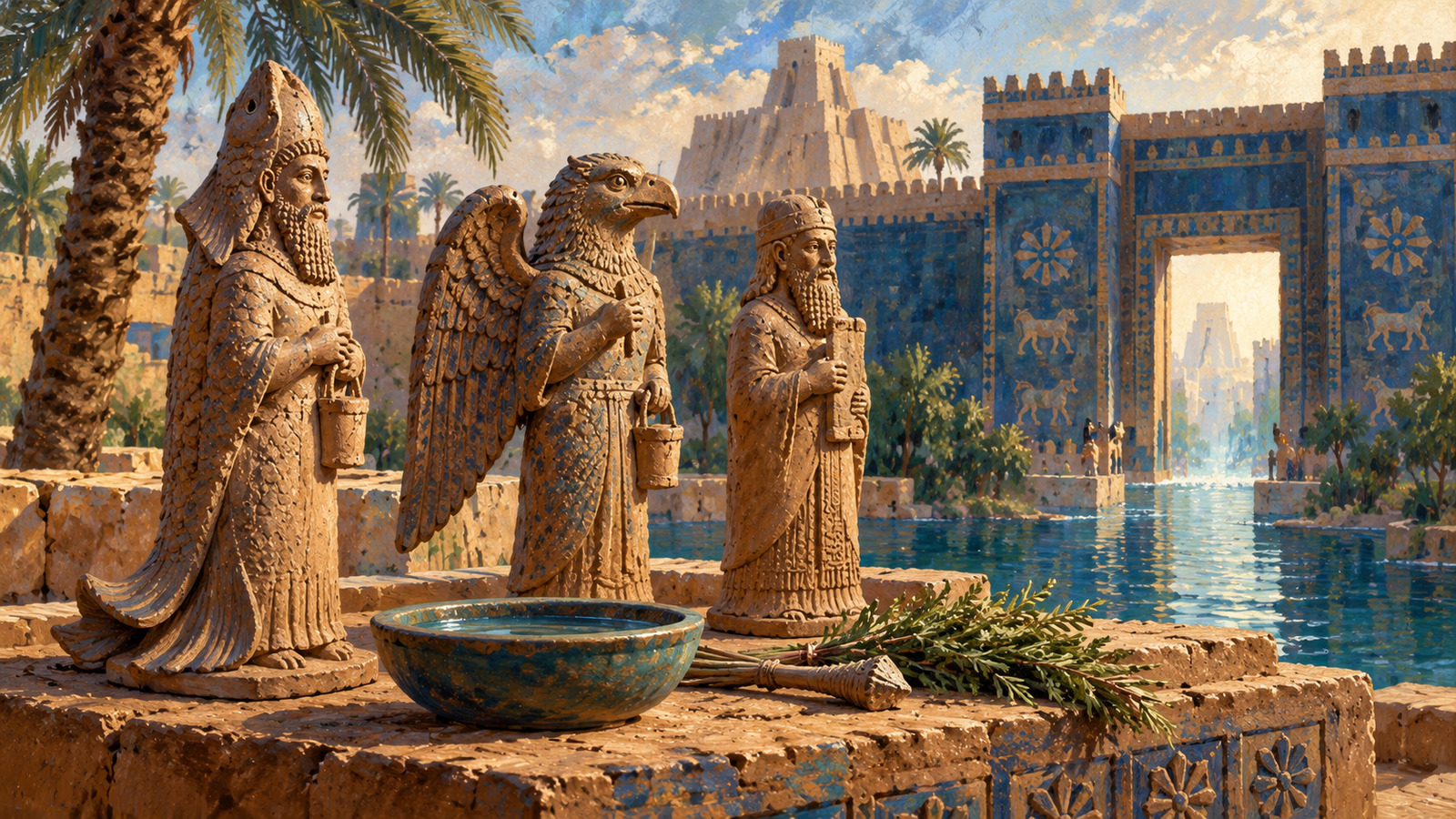
The most concrete evidence for the Seven as protectors comes from household rituals edited by Frans WiggermannFrans A. M. WiggermannFrans A. M. Wiggermann is an Assyriologist, a scholar of ancient Mesopotamian languages and texts.Glossary · Click to read the explanation. One of them is titled “to block the entry of the enemy in someone’s house”; one manuscript of it was written by a junior scribe in 750 BCE, according to its colophon. The exorcist is told to cut tamarisk wood and make seven statues of the Sebettu. They are crowned, set on a tamarisk pedestal in a walking pose, coated with red paste, and hold a bronze hatchet in the right hand and a bronze dagger in the left. They wear a bronze girdle, a bronze headband and bronze horns, the sign of divinity, and bows and quivers hang at their sides.[12]
The incantation recited before them, partly broken, presents them as “fearful warriors”, in Wiggermann’s summary, and shows that they were posted in the gate. A parallel text buries them “in front of the statue of tamarisk”, and their sister Narudda “in the outer gate, together with the statues of Sebettu”. Here the same fierceness that made the Seven dangerous is turned outward, against anything evil approaching the house.[12]
The statues were made of wood, and what we know of their appearance comes from the ritual texts. They should not be confused with another set of seven protective figures, the seven sages (apkalluApkalluAn Akkadian term for a sage or expert. Specific texts describe seven primordial sages; rituals use related protective figures. Neither the titles nor the depicted forms are always identical.Glossary · Click to read the explanation), whose statues the same house rituals also prescribe.[13]
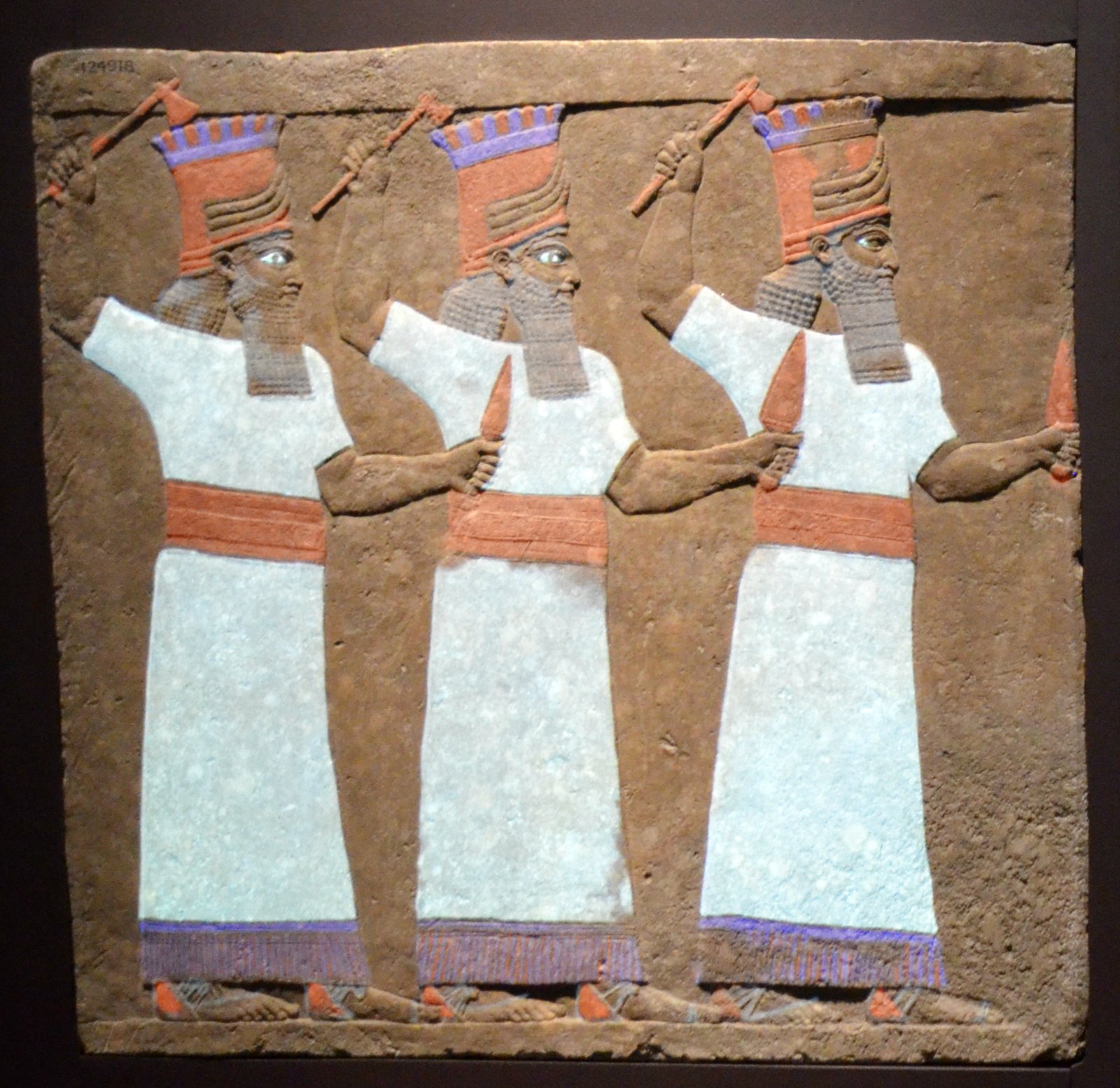
A gypsum relief from AshurbanipalAshurbanipalAshurbanipal was an Assyrian king of the seventh century BCE, reigning about 668–631 BCEGlossary · Click to read the explanation’s North Palace at NinevehNineveh and KuyunjikNineveh is an ancient Assyrian city near Mosul in northern Iraq; Kuyunjik is one of its archaeological moundsGlossary · Click to read the explanation (645–640 BCE), now in the British Museum, shows three armed figures with an axe raised in the right hand, a dagger in the left and tall horned crowns. The museum’s description notes that it “has been suggested” that they are three of the Seven. Traces show that each figure first held a bow in the left hand, later erased. The identification is probable, not confirmed, but the weapons match the ritual descriptions closely.[14]
The temple of the Seven at Khorsabad
The Seven also had temples. At Khorsabad, ancient Dur-Sharrukin, the new capital founded by Sargon II (721–705 BCE) north-east of Mosul, excavations by the Iraqi General Directorate of Antiquities from 1957 explored the lower city, including a temple of the Sibitti not far from the citadel.[15] The temple was published by the Iraqi archaeologist Fuad Safar in the journal Sumer that same year.[2]
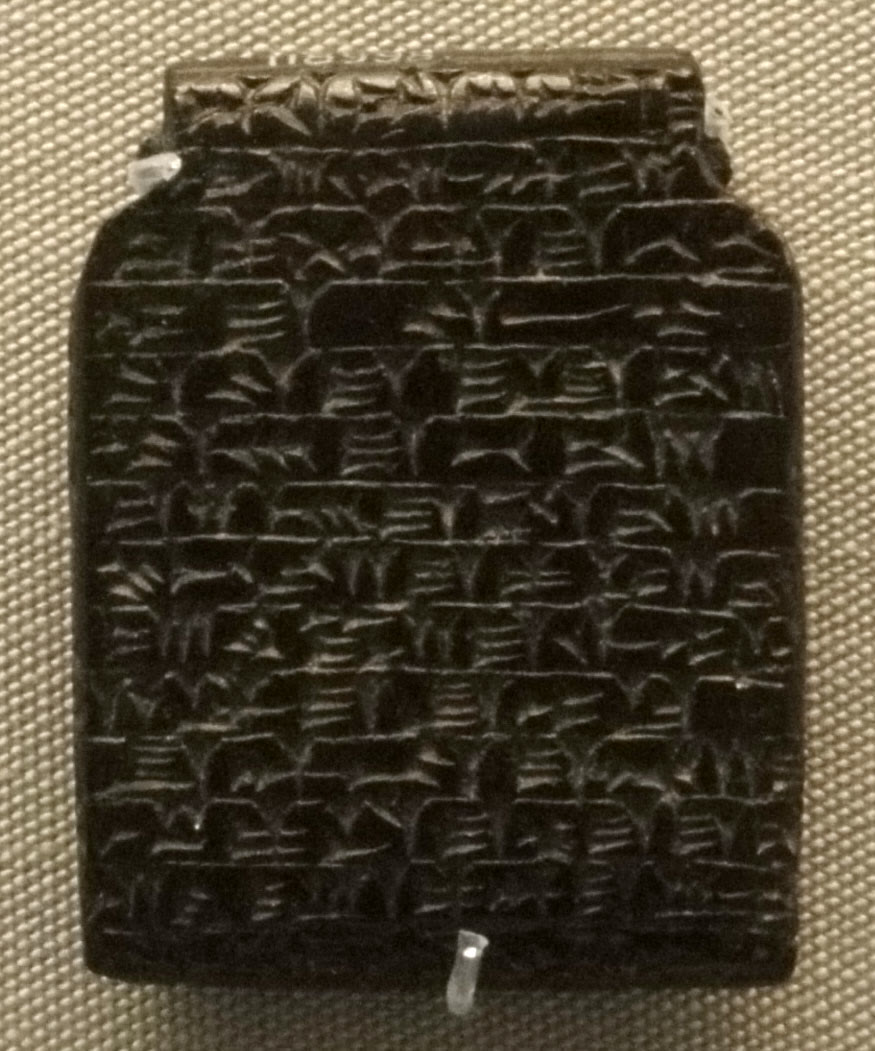
According to the French Ministry of Culture’s documentation of the Mosul Museum, the temple’s altars are blocks of limestone with a circular tray resting on three feet shaped like lion’s paws. A cuneiform inscription in Assyrian on the edge of the tray links the temple to the Sibitti. Eight of these altars stand in the courtyard of the Mosul Cultural Museum, a location that may paradoxically have protected them during the occupation of Mosul by Daesh (2014–2017). A ninth, once displayed in the entrance hall, “remains untraceable”, and an almost complete incense burner from the temple courtyard was partly destroyed, its upper part never found in the rubble.[15]
What the evidence allows us to say
- Confirmed: the Seven appear in incantations as evil gods and demons who cause disease and terror (Udug-hul Tablets 5 and 16).
- Confirmed: in household rituals, statues of the Seven, described as gods with horns of divinity and weapons, were made and buried at the gate to keep evil out.
- Confirmed: Assyrian kings invoked them, and a temple with altars inscribed for them stood at Khorsabad.
- Confirmed, with variation: their parentage differs between texts (Anu and Earth in Erra and Ishum; Enmešarra or Išhara elsewhere).
- Probable: the three armed figures of the North Palace relief represent part of the Seven.
- Scholar’s view: that their double nature made them useful at the edges of empire is Konstantopoulos’s argument.
- Caution: the popular English “Seven are they” comes from Thompson’s 1903 translation, which merged manuscripts and, in its introduction, two different tablets.
For the ancient exorcist the two faces of the Seven were not a contradiction. A force that no one could withstand was the reason to fear them in an incantation and the reason to trust them at the door.
References and notes
- Erra and Išum, Standard Babylonian Tablet I, edited by Enrique Jiménez with English translation (electronic Babylonian Library, LMU Munich, chapter published 1 May 2023; full edition in preparation) Tablet I, lines 1-50, read in the eBL translation (lines 23-46 on the Seven: Anu begets them on Earth, lines 28-29; Anu hands them to Erra as weapons, lines 39-44) Return to the text ↑
- Fuad Safar, The Temple of Sibitti at Khorsabad, Sumer 13 (1957) 219-221 Bibliographic record only (KeiBi, University of Tübingen); the article itself was not read. The spelling si-bit-ti is taken from the manuscripts transliterated in Geller 2016 (e.g. UH 5:180) Return to the text ↑
- Gina Konstantopoulos, The Divine/Demonic Seven and the Place of Demons in Mesopotamia (Ancient Magic and Divination 20; Leiden and Boston: Brill, 2023) Table of contents only (pp. v-vii, chapters 1-5 and appendices A-E); the chapters themselves were not read Return to the text ↑
- Gina Konstantopoulos, Migrating Demons, Liminal Deities, and Ancient Assyria's Western Campaigns, Advances in Ancient, Biblical, and Near Eastern Research 1/1 (2021) 129-148, DOI 10.35068/aabner.v1i1.788 (CC BY-NC-ND 4.0) Full article, read in its open republication (the journal server was unreachable): abstract, sections on Tukulti-Ninurta I, Shalmaneser III, Sargon II, Sennacherib, Esarhaddon's succession treaty, the Pleiades, and the conclusion Return to the text ↑
- Markham J. Geller, Healing Magic and Evil Demons: Canonical Udug-hul Incantations, with the assistance of Luděk Vacín (Die babylonisch-assyrische Medizin in Texten und Untersuchungen 8; Boston and Berlin: De Gruyter, 2016), open access Chapter One, pp. 3-4 (history of the series and of its editions) Return to the text ↑
- Markham J. Geller, Healing Magic and Evil Demons: Canonical Udug-hul Incantations (De Gruyter, 2016) p. 3 (on R. Campbell Thompson's combined copies in CT 16 and his edition) and p. 3 n. 2 (the 2007 composite text) Return to the text ↑
- R. Campbell Thompson, The Devils and Evil Spirits of Babylonia, vol. I (Luzac's Semitic Text and Translation Series 14; London: Luzac, 1903), public domain Introduction, pp. xlii-xliii (the quotation and its footnotes: Tablet V col. v l. 28; Tablet XVI l. 13); translation of Tablet V col. v, pp. 77-79; Tablet XVI, pp. 90-91 Return to the text ↑
- Markham J. Geller, Healing Magic and Evil Demons: Canonical Udug-hul Incantations (De Gruyter, 2016) Udug-hul Tablet 5, lines 167-182 with notes, pp. 211-213 (note to l. 180 on the Old Babylonian 'seven times seven') Return to the text ↑
- Markham J. Geller, Healing Magic and Evil Demons: Canonical Udug-hul Incantations (De Gruyter, 2016) Udug-hul Tablet 5, lines 76-92 ('The demonic Seven') with the note to ll. 83-90, pp. 191-194 Return to the text ↑
- Markham J. Geller, Healing Magic and Evil Demons: Canonical Udug-hul Incantations (De Gruyter, 2016) Udug-hul Tablet 16, lines 1-41 ('The evil Seven') with notes to ll. 34-36, pp. 501-510 Return to the text ↑
- F. A. M. Wiggermann, Mesopotamian Protective Spirits: The Ritual Texts (Cuneiform Monographs 1; Groningen: Styx, 1992), open digital copy in the Ancient World Digital Library p. 115 (sons of Išhara in Sp 1131; the Seven of Elam with their sister Narudda; the sons of Enmešarra) and p. 21 (incantation to the statues, text I 311ff., partly restored) Return to the text ↑
- F. A. M. Wiggermann, Mesopotamian Protective Spirits: The Ritual Texts (Groningen: Styx, 1992) pp. 1-2 (text I, title and manuscripts; colophon of MS A dated 750 BC), pp. 9-11 (text I lines 85-96, making the seven statues of Sebettu), p. 21 (incantation), pp. 46-48 (inventory of figures: Sebettu, Narudda, burial places from text II Obv. 25 and 28) Return to the text ↑
- Markham J. Geller, Healing Magic and Evil Demons (De Gruyter, 2016); F. A. M. Wiggermann, Mesopotamian Protective Spirits (Styx, 1992) Geller, Udug-hul Tablet 12, lines 120-135 and notes ('Seven healing figurines', identified as ūmu-apkallū after Wiggermann), pp. 422-424; Wiggermann, p. 46 (the seven ūmu-apkallū of text I) Return to the text ↑
- British Museum description of the North Palace relief (three protective spirits), as quoted on the Wikimedia Commons file page; Lucia Marchini, Review: I am Ashurbanipal, Current Archaeology 347 (22 January 2019) Commons file description (museum text on weapons, erased bows, and the suggested identification with the Sibitti); Marchini's review, paragraph on the Sebetti panel and the photo caption on the coloured lighting Return to the text ↑
- Ministère de la Culture (France), Mosul Cultural Museum documentation, page "Khorsabad" (English version) Sections on the city of Sargon II and on the Sibitti temple, its altars and the incense burner Return to the text ↑
Suggest a correction · Suggest a source for this record
Cite this record
IL Archive, «The Sebettu: “the Seven” as Demons and as Protectors in Mesopotamia», https://ilarchive.com/en/studies/sebettu-the-seven
Continue reading