Entity
Apkallu
A reference page linking a name, group, or concept to the materials that discuss it.
- Names
- abgal · apkallū
- Region
- Mesopotamia (Babylonia and Assyria)
Apkallu are sages in Mesopotamian tradition: antediluvian lists tell of them, and their figures serve in protective rituals. The entry separates texts, art objects and comparative interpretations with Oannes and Enoch.
Estimated reading time: 8 min Published Last reviewed:
Share article
Text
Introduction
Apkallu names wisdom and protection in Mesopotamian traditions, but it does not designate a single individual or a single visual type. How did accounts of primordial sages in lists of kings become connected with ritualRitualAn organised or distinguished practice meaningful to a community; it may leave traces, but its form alone does not reveal an associated doctrine.Glossary · Click to read the explanation instructions and figurinesFigurineA small shaped object depicting a human, animal or abbreviated form, in clay, stone or another medium. Its form alone does not establish its use; manufacture, handling traces and find context matter.Glossary · Click to read the explanation buried beneath floors, and then with the Greek-language story of Oannes?
This entry distinguishes words, written witnesses, and excavated objects, and then examines proposals that connect the sages with Enoch and the Watchers. The purpose is not to establish that such sages really lived before a historical flood, but to understand what ancient writers and ritual specialists did with these traditions. [1]
Guide to this entry
- The term, its written forms, and accounts of the transmission of wisdom.
- Sages before and after the flood, and what a genealogy of learning achieves.
- Protective rites, small buried figurines, and monumental Assyrian reliefs.
- Oannes, AdapaAdapaAdapa is a sage of Eridu in Mesopotamian tradition, associated with Ea. The South Wind story, audience with Anu, and ritual sources give him distinct roles; they do not establish his identity with Adam or the first human.Glossary · Click to read the explanation, and a critical comparison with Enoch and the Watchers.
What does apkallu mean?
In AkkadianAkkadianAn ancient East Semitic language written in cuneiform from the third millennium BCE; its varieties include Babylonian and Assyrian, and it served in international diplomacy.Glossary · Click to read the explanation, apkallu can mean a “sage” or an “expert.” CuneiformCuneiformWriting with wedge-shaped signs, developed from Mesopotamian recording traditions and used for several languages from the third millennium BCE.Glossary · Click to read the explanation texts also use logographic writings such as ABGAL and NUN.ME. ORACC's indexed entry records several spellings and occurrences. It would be an error to infer that all instances refer to exactly the same mythical being: expertise can be a title or quality, while the “seven sages” occupy a particular literary and religious setting. [1]
The apkallu are not a documented group of historical individuals. Some traditions associate ancient sages with Enki/EaEnkiMesopotamian deity also known as Ea, linked with Eridu and the Abzu (deep fresh waters), wisdom, incantations, and narratives of creation and cosmic order. Later written attestations do not identify the deity of Eridu’s earliest layers.Glossary · Click to read the explanation, the deity of wisdom and subterranean fresh water, and with the AbzuAbzuCosmic subterranean freshwater in Mesopotamian religion, associated with Enki/Ea. The name occurs in E-abzu, “House of the Abzu”, at Eridu. Distinct from the narrative figure Apsû in the Enūma eliš and unnamed excavated structures.Glossary · Click to read the explanation, the realm of those waters. Elsewhere the term appears in lists concerned with scholarly authority or in instructions governing ritual representations. The genre of each source matters more than a familiar image of a winged or fish-cloaked sage.
Were there seven sages before the flood?
Later Babylonian compositions name seven sages linked to kings placed in a time before the flood. The “UrukUrukAncient city at Warka in southern Iraq, a major urban centre around 3200 BCE that preserved early writing and accounting tablets.Glossary · Click to read the explanation List of Kings and Sages,” tablet W 20030,7 from UrukUrukAncient city at Warka in southern Iraq, a major urban centre around 3200 BCE that preserved early writing and accounting tablets.Glossary · Click to read the explanation, pairs rulers and sages, marks the flood as a dividing event, and continues with figures of later eras. Its colophon dates the copied tablet to 165 BCE, under Seleucid rule. That is the date of the extant witness, not archaeological evidence that its mythical pre-flood protagonists lived at a particular time. [3]
The incantation series Bīt mēseri (approximately “House of Confinement”) preserves one sequence: Uanna, Uannedugga, Enmedugga, Enmegalamma, Enmebulugga, An-Enlilda, and Utuabzu. The sages are credited with exceptional understanding and mastery of the arrangements of heaven and earth; in some versions the final figure ascends to heaven. Their names, order, and epithets nevertheless vary among textual witnesses. No single list should silently be made the standard for every tradition. [4]
After the flood: sage and court scholar
The flood does not end the claimed genealogy of wisdom. The Uruk list first names Nungalpirigal after it, then moves toward learned specialists and authors called ummânu, roughly “master scholars” or “experts.” In doing so, its compilers construct a line of scholarly legitimacy running from primeval revelation to their own learned milieu. It is not an uninterrupted, independently verifiable succession of teachers stretching into prehistory, but a later intellectual account of where expertise came from. [3] [14]
A late Assyrian tablet, LKA 76 = VAT 13839, complicates any neat division further. The reverse contains narratives about four sages said to be of human descent, incorporated into Bīt mēseri. The published abstract of Zachary Rubin's edition establishes that distinction between imagined divine beginnings and scholarly practice; the full article is access-restricted and was not read in full for this review. [5]
Sages who guard a house: texts and deposits
Mesopotamian building-protection instructions prescribe making figures from clay, wood, or other materials and depositing them under floors, near thresholds, and at interior locations in order to ward off harmful forces. F. A. M. Wiggermann's Mesopotamian Protective Spirits organizes the relevant rituals, including Bīt mēseri. Protection is what the ritual prescribes and claims; excavation cannot test whether an object actually repelled supernatural harm. [2]
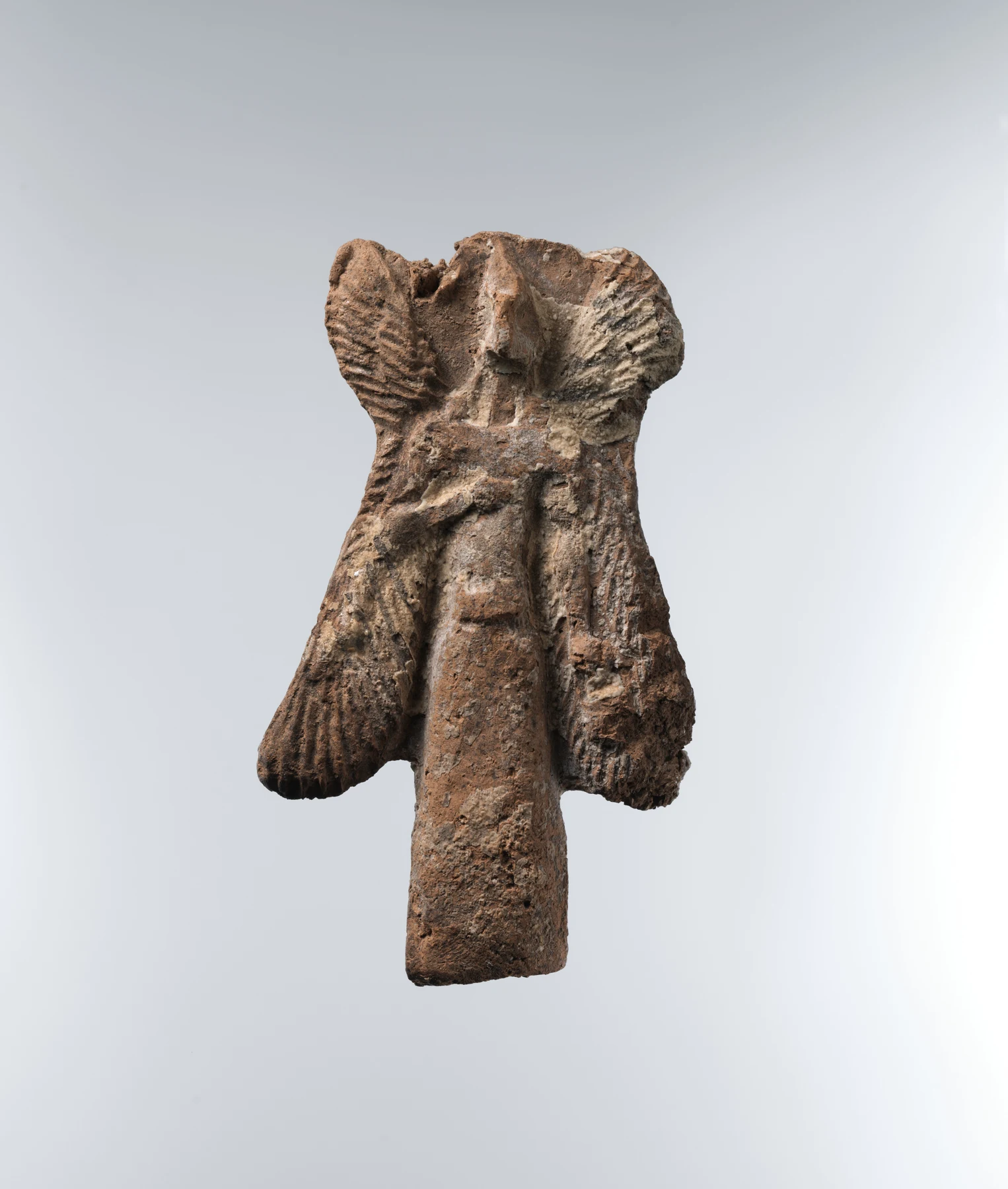
At the so-called exorcist's house in Assur, excavators found bird-headed and fish-cloaked figurines in small brick-built cavities beneath the floors. Carolyn Nakamura compared their distributions with written instructions and found that the combinations and placements did not invariably match the textual prescription. The difference between normative text and physical practice is evidence in its own right. It prevents us from presenting every recovered deposit as the exact execution of a single ritual manual. [6]
A small ceramic figure from Nimrud (Kalhu)Nimrud: ancient KalhuNimrud is the site of the Assyrian city Kalhu in present-day northern Iraq, near Mosul.Glossary · Click to read the explanation is preserved at the Metropolitan Museum of Art as 54.117.26, dated approximately to the ninth–eighth century BCE. The museum identifies its bird-headed, winged shape, bucket, and discovery beneath a room's floor, and regards a protective function as likely from the context. The British Museum holds other related pieces, including 91839, recorded as found in a brick receptacle and probably part of a set originally comprising seven. [7] [9]
Is every winged palace figure an apkallu?
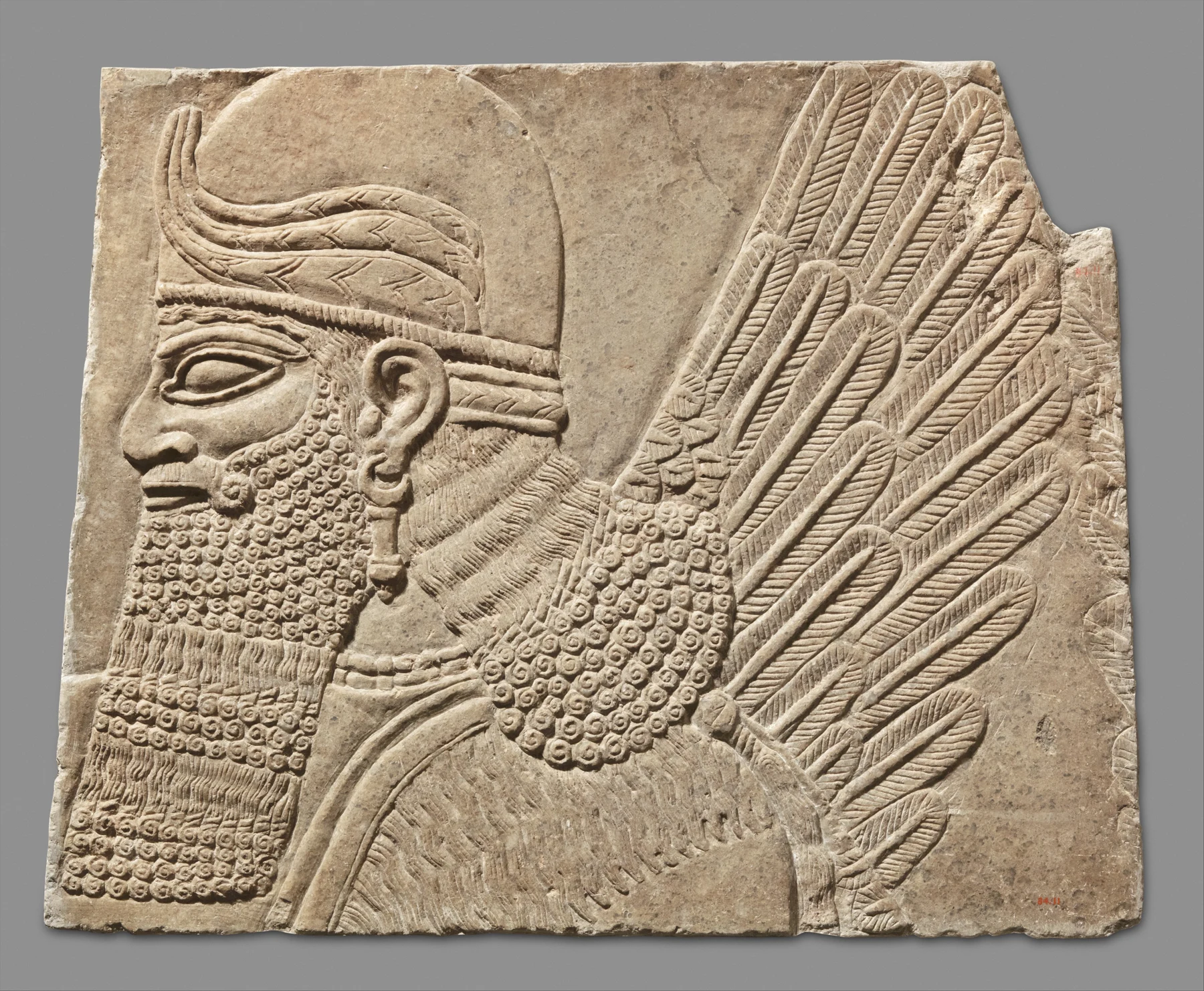
Neo-Assyrian palace reliefs depict supernatural figures with human or raptor heads, wings, buckets, and cone-shaped implements, sometimes beside a stylized tree or the king. A gypsum-alabaster panel from Ashurnasirpal II's Northwest Palace at Nimrud, Metropolitan Museum 31.72.3 (about 883–859 BCE), shows an eagle-headed winged figure with a bucket and cone. The implement is discussed as a purifier in Akkadian, although its precise physical identification and some aspects of the gesture remain debated. [8]
The Met regards an identification with apkallu as plausible rather than certain: related protective figurines can be identified from ritual texts, but monumental images could carry several mythic associations. A resemblance cannot make every wing an “angel” or assign every fish-cloaked figure to one named sage of the Uruk list. We must distinguish a secure description of the object from a proposed identification of the figure. [8]
Oannes: the later Greek-language account
BerossusBerossusBerossus was a Babylonian priest and author of the Hellenistic period who wrote a history of Babylonia in Greek in the third century BCE. His Babyloniaca survives through quotations and fragments preserved by later writers.Glossary · Click to read the explanation, a Babylonian priest writing in the Hellenistic age, was reported by later authors to describe OannesOannesOannes is a teacher in the narrative attributed to Berossus, a Babylonian author writing in Greek in the third century BCE. He emerges from the sea in a combined fish-and-human form, teaches writing, arts, laws and agriculture, and returns to the sea at night.Glossary · Click to read the explanation, an amphibious, fish-associated being that emerged from the sea to teach people writing, crafts, learning, urban life, and laws. His Babyloniaca survives only in fragments transmitted by subsequent writers who excerpted or summarized it. Those literary layers cannot be treated as if they were a complete original Greek manuscript, let alone a direct cuneiform inscription. [10]
Oannes can plausibly be connected, linguistically and traditionally, with Uanna, a name of the first sage. But the detailed Greek narrative need not have precisely the same meaning as every surviving Akkadian incantation. The fish imagery serves a story about the divine origins of civilized knowledge; it is not evidence of a zoological fish-human species inhabiting the ancient rivers. [4]
Adapa and Enmeduranki: related, not interchangeable
AdapaAdapaAdapa is a sage of Eridu in Mesopotamian tradition, associated with Ea. The South Wind story, audience with Anu, and ritual sources give him distinct roles; they do not establish his identity with Adam or the first human.Glossary · Click to read the explanation, the wise figure of EriduEriduEridu (Abu Shahrain), a multi-mound site in southern Iraq occupied since the Ubaid, later home to a religious precinct associated with Enki. Its eighteen sounding levels are not proof that every early building was a temple.Glossary · Click to read the explanation connected with Ea, is known from a narrative in which he ascends to heaven and follows advice to refuse food and drink offered there. In some later scholarly strands his name or epithets converge with those of Uanna. Yet the Adapa of the South Wind narrative is not automatically every apkallu appearing in a ritual or list. The sage Utuabzu appears alongside the seventh primeval king EnmedurankiEnmedurankiAntediluvian king in Mesopotamian traditions, named in a Sumerian king list and depicted by an Akkadian legend as a transmitter of divinatory knowledge; distinct from Utuabzu and Enoch.Glossary · Click to read the explanation; confusing them erases the source's distinction between its king column and its sage column. [11]
These traditions offer several ways to authorize knowledge: receiving it from a deity, placing its beginnings under the name of a primordial sage, and claiming descent from such expertise. Connections between them have to be traced by witness, wording, and date of copying. The number seven or an ascent to heaven, on its own, establishes neither a single person nor direct literary borrowingLiterary borrowingUse of verbal or narrative material from an earlier text or tradition in a later work, distinguishing evidence of transfer from mere resemblance.Glossary · Click to read the explanation.
Enoch and the Watchers: a debated comparison
In 1 EnochFirst EnochA composite Second Temple Jewish apocalyptic collection on the Watchers, parables, celestial cycles, historical visions, and judgment, preserved complete in Geʽez.Glossary · Click to read the explanation, especially its Book of the WatchersBook of the WatchersOpening unit of 1 Enoch (chapters 1–36), concerning the Watchers’ descent, offspring and judgment, Enoch’s mission and cosmic journeys; a composite work with multiple textual witnesses.Glossary · Click to read the explanation, knowledge imparted to humankind by heavenly beings becomes bound up with a story of transgression and corruption. Amar Annus compares the WatchersWatchersDesignation of a heavenly being in ancient Jewish literature: a holy messenger in Daniel, but a rebellious group in First Enoch. It is not automatically equivalent to demons or giants’ spirits.Glossary · Click to read the explanation with Mesopotamian sages and argues that some Enochic narratives critically invert older accounts of primordial wisdom. He also notes that certain Mesopotamian witnesses portray individual sages negatively; these traditions do not uniformly praise all apkallu. [12]
A later study by Annus (2024) develops the proposal in terms of a “counter-narrative,” focusing in part on the different status and heavenly ascent of EnochEnoch son of JaredEnoch son of Jared is a figure in the genealogy of Genesis 5, seventh when counted from Adam.Glossary · Click to read the explanation. This is a scholarly hypothesis about composition and reception, not a source stating that “the apkallu were the Watchers.” Nor were the Watchers of one Enochic text simply the clay figures an Assyrian practitioner buried beneath a floor. For that 2024 study, the present review used the published abstract rather than claiming to have checked its full apparatus of Jewish and cuneiform evidence. [13]
What is secure, and what remains an interpretation?
It is documented that apkallu appears in scholarly lists and ritual writings, that relevant protective figurines were excavated, and that their textual and material witnesses have different dates. It is a well-supported interpretation that some lists legitimize scholarly authority through mythical ancestry. Neither point makes the pre-flood biographies historical records. Equating the sages with the Watchers, or identifying all winged images as apkallu, requires separate argument in each case, and alternative readings remain possible. [6] [8]
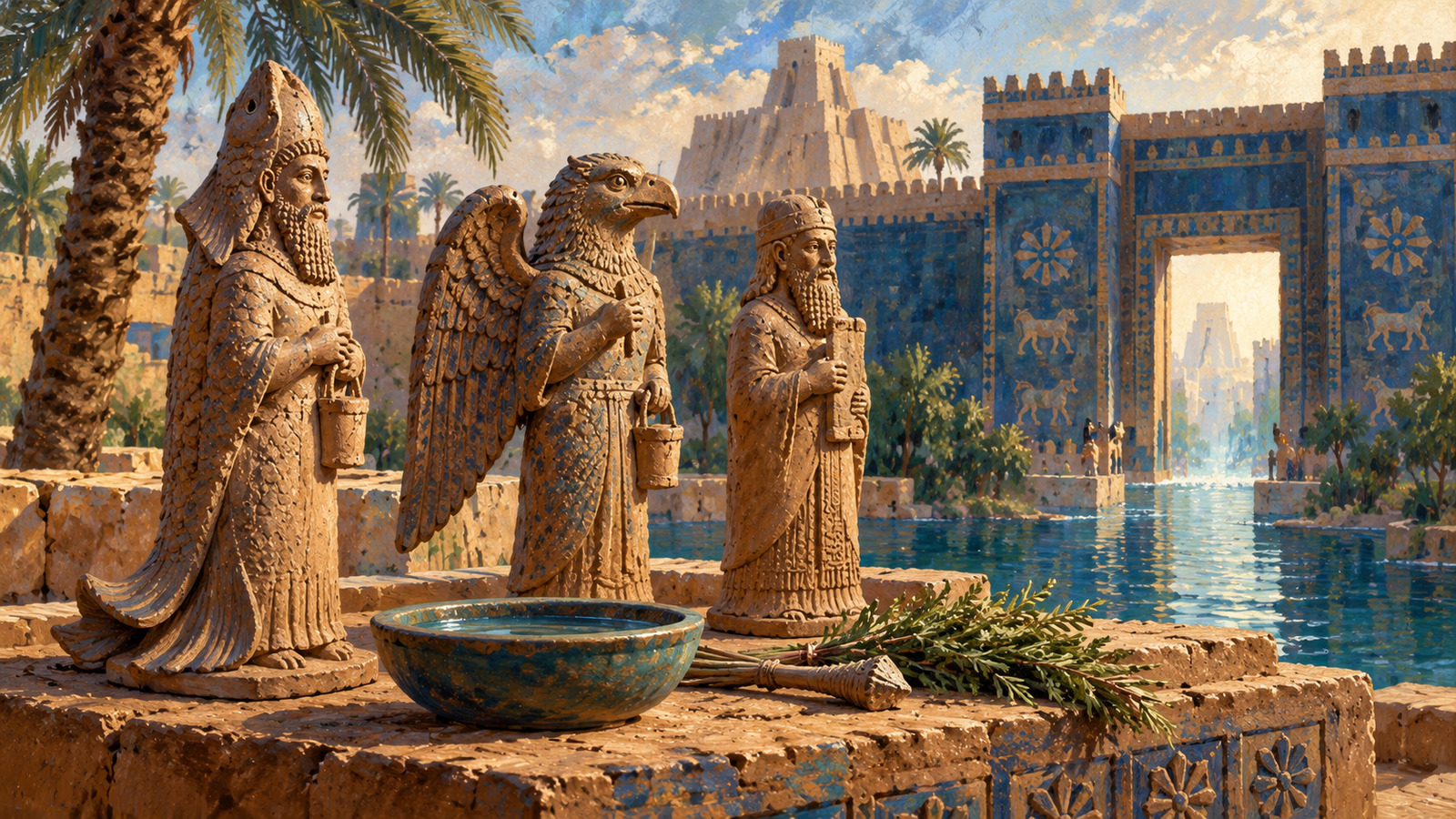
The new cover is a contemporary AI-generated interpretive illustration (2026): it combines motifs that do not form one documented archaeological assemblage. The evidential core of this entry lies in identified objects and critically located texts, not in visual invention.
References and notes (14)
- ORACC, TSAE Akkadian lexical index, apkallu; the indexed excerpt lists ABGAL, NUN.ME and further forms. Direct full-page opening was unsuccessful. Search-index excerpt only: 49 indexed occurrences, not individual attestations Return to the text ↑
- F. A. M. Wiggermann, Mesopotamian Protective Spirits: The Ritual Texts (1992). Digital-library catalogue and contents verified; passages are supported indirectly through Nakamura, not an independent reading of the complete PDF. Digital library catalogue and contents of texts I–V only; full PDF not read Return to the text ↑
- Marie Young, “The Tablets I Spoke about Are Good to Preserve until Far-off Days,” in Canonisation as Innovation (Brill, 2022), table 3.1: search-visible excerpt of the Uruk list and dated colophon; translation credited to A. Lenzi with modifications. p. 119, table 3.1, search-visible excerpt only; PDF inaccessible Return to the text ↑
- Amar Annus, “On the Origin of Watchers,” Journal for the Study of the Pseudepigrapha 19/4 (2010), discussion of Bīt mēseri and the seven names; selected PDF pages read. Journal pp. 284–286 (PDF pp. approx. 7–9) Return to the text ↑
- Zachary Rubin, “The Sages and the Sons of Nippur: An Edition of LKA 76 (VAT 13839) from Assur,” Journal of Cuneiform Studies 74 (2022), publisher abstract only, not the article. Article pp. 63–74, metadata; abstract only Return to the text ↑
- Carolyn Nakamura, “Dedicating Magic: Neo-Assyrian Apotropaic Figurines and the Protection of Assur,” World Archaeology 36/1 (2004), accessible text inspected for material deposits and their divergence from prescription. pp. 18–23, especially 19–22, publicly accessible author text Return to the text ↑
- The Metropolitan Museum of Art, “Apkallu figure: bird-headed, winged figure carrying a bucket,” object 54.117.26; catalogue description, dates, findspot and proposed function. Full museum object page; no direct handling of object Return to the text ↑
- The Metropolitan Museum of Art, “Relief panel,” object 31.72.3, Northwest Palace, Nimrud; curator’s discussion of conditional apkallu identification. Complete museum description and rights; image viewed online, binary not retrieved Return to the text ↑
- British Museum, clay bird-headed figure 91839 (DT.391); catalogue/findspot data in indexed result; direct page not opened. Indexed catalogue record excerpt only Return to the text ↑
- Annus (2010) summarizing Berossus’ Oannes fragments through Stanley Burstein’s English translation (1978); original Greek not independently collated. pp. 283–284, especially n. 5; mediated translation Return to the text ↑
- Annus (2010), selected treatment of Adapa, Utuabzu and Enmeduranki alongside the Adapa ascent; not independent Akkadian collation. pp. 278 and 284–286, selected reading Return to the text ↑
- Amar Annus, “On the Origin of Watchers” (2010), proposal of Enochic inversion and selected negative sage traditions; explicitly an authorial interpretation. pp. 277–285 and 296–299, selected passages of accessible article Return to the text ↑
- Amar Annus, “The Story of the Watchers as a Counter Narrative,” Religions 15/9 (2024), publisher abstract and metadata only; full apparatus not checked. Published abstract only Return to the text ↑
- Alan Lenzi, “The Uruk List of Kings and Sages and Late Mesopotamian Scholarship,” Journal of Ancient Near Eastern Religions 8/2 (2008), University of the Pacific abstract on the list’s agenda; full text unavailable there. Article pp. 137–169; abstract only Return to the text ↑
Suggest a correction · Suggest a source for this record
Cite this record
IL Archive, «Apkallu», https://ilarchive.com/en/entities/apkallu
Continue reading
Related readings