Entity
Enmeduranki
A reference page linking a name, group, or concept to the materials that discuss it.
- Names
- En-me-dur-an-ki · En-men-dur-ana
Antediluvian king of Mesopotamian tradition, linked to Sippar and the transmission of divinatory knowledge. Sources distinguish him from the sage Utuabzu; comparisons with Enoch do not prove identity or direct borrowing.
Estimated reading time: 8 min Published Last reviewed:
Share article

Text
Introduction
Enmeduranki, also written En-men-dur-ana in a Sumerian form, is a king placed before the Flood in Mesopotamian literary memory. He is associated with SipparSippar: Abu HabbahSippar is an ancient Babylonian city in present-day Iraq, identified with Tell Abu Habbah.Glossary · Click to read the explanation and with traditions by which specialist diviners claimed to have inherited authoritative knowledge. There is no contemporary biography demonstrating that he ruled in historical time. Our evidence instead consists of sources with different purposes and histories: a Sumerian king list, an AkkadianAkkadianAn ancient East Semitic language written in cuneiform from the third millennium BCE; its varieties include Babylonian and Assyrian, and it served in international diplomacy.Glossary · Click to read the explanation foundation legend about divine instruction and human transmission, and a later list pairing kings with sages. [1][2][3]
The geographical setting here is Sippar in MesopotamiaMesopotamiaHistorical region associated with the Tigris and Euphrates: Uruk, Ur, Eridu, cuneiform, Sumer, Akkad, Babylon and Assyria, their languages and cults, and the limits of archaeological evidence.Glossary · Click to read the explanation, in ancient southern IraqIraqIraq is a modern country encompassing much of ancient MesopotamiaGlossary · Click to read the explanation.
Confusion arises when these witnesses are combined into a single biography or when similarities with the HebrewHebrewA Northwest Semitic language of the Canaanite group, encompassing Iron Age epigraphy, Biblical, Rabbinic, medieval and Modern Hebrew; its scripts and pronunciations changed over time.Glossary · Click to read the explanation EnochEnoch son of JaredEnoch son of Jared is a figure in the genealogy of Genesis 5, seventh when counted from Adam.Glossary · Click to read the explanation are treated as proof of identity. Each text needs to be read on its own terms before its account of scholarly authority and its surviving manuscripts can be compared with another tradition. [4]
The king of Sippar in the Sumerian King List
The composite Sumerian King List, as edited in the University of Oxford's Electronic Text Corpus of Sumerian Literature, names En-men-dur-ana at Zimbir, another name for Sippar. Kingship has passed there from Larak and next passes to Shuruppak. Lines 26–27 of the edition read as follows, in a simplified transliteration that retains the place-name indicator. [1]
That is, “At Zimbir, En-men-dur-ana became king; he ruled for 21,000 years.” This duration belongs to a mythic chronology that gives antediluvian rulers extraordinarily long reigns; it is not a reign that can be plotted on a historical calendar. Counting from Alulim, En-men-dur-ana is the seventh king named, yet the same list counts eight kings before the Flood, not just seven figures. Names and some details vary between manuscripts. The quotation is a normalized reading from a scholarly composite, not a verbatim transcript of one photographed prism. [1]
The Weld-Blundell Prism, held by the Ashmolean Museum in Oxford under accession number AN1923.444, is among the fullest physical witnesses to the Sumerian King List and dates to approximately 1800 BCE. That is the date of an Old Babylonian clay copy, not the date of Enmeduranki's supposed reign or evidence that all forms of the king list were composed in that particular year. [6]
King and sage in the Uruk List
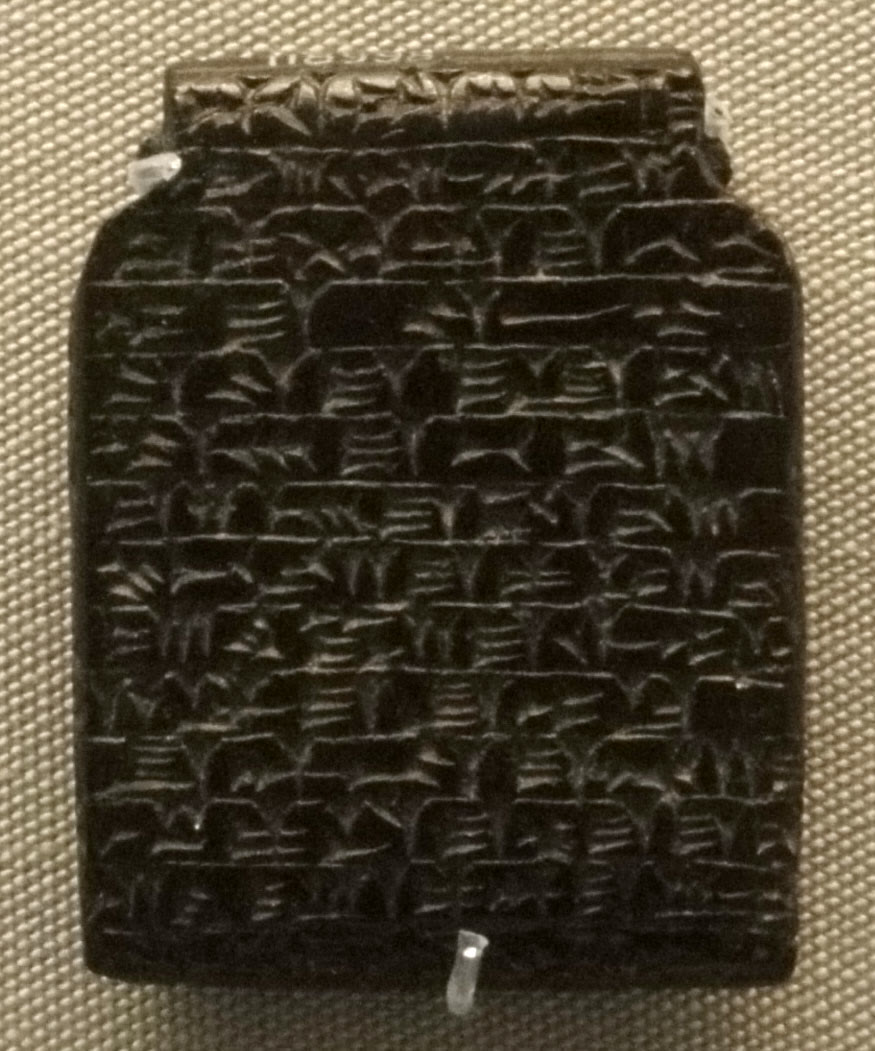
A tablet from UrukUrukAncient city at Warka in southern Iraq, a major urban centre around 3200 BCE that preserved early writing and accounting tablets.Glossary · Click to read the explanation, designated W 20030,7, preserves the “Uruk List of Kings and Sages.” It pairs early kings with the learned sages, or apkallūApkalluAn Akkadian term for a sage or expert. Specific texts describe seven primordial sages; rituals use related protective figures. Neither the titles nor the depicted forms are always identical.Glossary · Click to read the explanation, assigned to their reigns. Obverse line 7 reads in an abbreviated Akkadian transliteration; square brackets indicate editorial restoration, and the surviving traces are marked by ⸢…⸣. Scribal name determinatives have been omitted for legibility. [3][5]
“In [the reign of] King Enmeduranki, the sage was UtuabzuUtuabzuUtuabzu is a sage in the Uruk List of Kings and Sages, preserved on a tablet copied in 165 BCE. The list pairs him with the seventh king, Enmeduranki.Glossary · Click to read the explanation.” The arrangement matters: Enmeduranki is the king and Utuabzu is his associated sage. The tablet does not give two names for one person. “In the reign of” is restored, while ⸢…⸣ marks partially preserved signs; the seventh pairing is part of this list's literary ordering, not an independent dated event in the lives of either figure. [3]
The known manuscript was copied by Anu-bēlšunu at Uruk on 16 May 165 BCE, as its colophon specifies the tenth of Ayyaru, Seleucid year 147. A second manuscript of the list was subsequently identified and discussed by Sophus Helle. Its second-century-BCE witness establishes the continuing circulation of a learned tradition, not that the whole tradition was first created in 165 BCE. [5]
The legend of Enmeduranki and the authority of divination
The Akkadian text commonly called the “Legend of Enmeduranki” differs from either king list. It is an origin narrative for bārûtu, the practice and profession of divination, including the examination of a liver or of oil on water. Its later instructions also regulate ancestry, training, and eligibility within the craft. The first line of the modern composite text begins as follows; the royal title is partly restored in this line. [2]
“Enmeduranki, k[ing of Sippar].” In lines 2–9 the king is linked to Anu, EnlilEnlilEnlil/Ellil: a major Mesopotamian god associated with destinies, kingship, and Ekur at Nippur, already prominent in third-millennium god lists. His name’s origin and cult beginnings remain debated.Glossary · Click to read the explanation and EaEnkiMesopotamian deity also known as Ea, linked with Eridu and the Abzu (deep fresh waters), wisdom, incantations, and narratives of creation and cosmic order. Later written attestations do not identify the deity of Eridu’s earliest layers.Glossary · Click to read the explanation. ShamashShamashMesopotamian god of the sun and justice, shown before Hammurabi on an eighteenth-century BCE stele preserved in the Louvre.Glossary · Click to read the explanation, the sun god associated with Sippar's Ebabbar temple, and AdadAdad: storm godAdad is the storm god in Mesopotamian traditions, associated with rain, thunder and powers of fertility or destruction.Glossary · Click to read the explanation, the storm god, bring him into their divine assembly in passages that require restoration. The narrative describes his honour, his seat upon a golden throne, a revelation concerning oil observed in water, and the gift of the “liver, tablet of the gods,” alongside ritualRitualAn organised or distinguished practice meaningful to a community; it may leave traces, but its form alone does not reveal an associated doctrine.Glossary · Click to read the explanation cedar wood. Neither the throne scene nor any bracketed wording should be described as completely legible on a single surviving tablet. [2]
Lines 10–15 then turn from reception to transmission: Enmeduranki assembles people from Nippur, Sippar and BabylonBabylonBabylon is an ancient city in central present-day Iraq, south of BaghdadGlossary · Click to read the explanation, honours them, and repeats the conferral of divinatory knowledge. They are not necessarily his biological sons, nor are they all described as Sippar residents. Lines 16–18 broaden the inventory to commentaries, the celestial omen series Enūma Anu Enlil, and calculation, alongside the examination of livers and oil. The fact that these disciplines appear in a later catalogue of knowledge does not imply that every title was named in the original scene of divine revelation. [2]
The focus then shifts to the restriction of expertise. Line 19 of Helle's composite Akkadian text calls the scholar: [2]
“The learned scholar who guards the secrets of the great gods.” The text goes on to require the beloved son to swear before Shamash and Adad by tablet and stylus before receiving instruction. It then enumerates conditions attaching to a diviner's son who traces his lineage to Enmeduranki, including ritual, bodily, and professional qualifications. Helle reads the Akkadian grammar of lines 23–29 as a conditional list of eligibility requirements, rather than following an earlier translation whose dependent clause lacks a clear grammatical conclusion. The passage therefore does not describe every child of Enmeduranki or date an actual institution to an antediluvian epoch. It legitimizes restricted access to a learned craft through an exemplary ancestor. [2][4]
Manuscripts, composition and the time of the story
Three timelines must not be collapsed: the antediluvian time inside the narrative, the uncertain development or composition of the traditions, and the date of each surviving manuscript. The following landmarks have different kinds of evidentiary status. [2][5][6][8]
- Before the Flood, in the story: a symbolic frame with no verifiable calendrical date; 21,000 years belongs to this literary setting.
- Approximately the nineteenth to eighteenth centuries BCE: Old Babylonian copies of the Sumerian King List; the Weld-Blundell Prism dates to around 1800 BCE. A copy's date is not the creation date of every part of the list.
- Neo-Assyrian period, first millennium BCE: four NinevehNineveh and KuyunjikNineveh is an ancient Assyrian city near Mosul in northern Iraq; Kuyunjik is one of its archaeological moundsGlossary · Click to read the explanation manuscripts of the Enmeduranki legend as catalogued by Helle. Their survival does not make their scribes the original authors.
- Around the third century BCE: one scholarly estimate for the composition of the Jewish Book of the WatchersBook of the WatchersOpening unit of 1 Enoch (chapters 1–36), concerning the Watchers’ descent, offspring and judgment, Enoch’s mission and cosmic journeys; a composite work with multiple textual witnesses.Glossary · Click to read the explanation. This concerns a section of Enochic literature, not a single composition date for all of 1 EnochFirst EnochA composite Second Temple Jewish apocalyptic collection on the Watchers, parables, celestial cycles, historical visions, and judgment, preserved complete in Geʽez.Glossary · Click to read the explanation.
- 19 April 229 BCE: a Seleucid-period exemplar of the Enmeduranki legend was copied at Uruk, according to its colophon; this is not the legend's initial composition date.
- 16 May 165 BCE: Anu-bēlšunu's extant copy of the Uruk List of Kings and Sages, W 20030,7, evidences a later arrangement of inherited traditions.
These dates do not supply an uninterrupted documented line of transmission from an antediluvian king to any biblical figure. The different purposes of the king list, the divination legend and the list of sages make their separate histories essential. [1][5]
Enmeduranki and Enoch: evidence and limits
The genealogy in Genesis 5:21–24 places Enoch son of JaredEnoch son of JaredEnoch son of Jared is a figure in the genealogy of Genesis 5, seventh when counted from Adam.Glossary · Click to read the explanation seventh when counted from Adam and assigns him a lifespan of 365 years. The number makes a solar comparison possible, not least because Enmeduranki's city was associated with Shamash; numerical suggestiveness, however, is not proof of a particular act of borrowing. The relevant Hebrew words in Genesis 5:24 say: [7]
“He was no more, because God took him.” Genesis does not here describe instruction from Shamash and Adad or the handing over of liver-divination equipment. The later, multi-part First Book of EnochFirst EnochA composite Second Temple Jewish apocalyptic collection on the Watchers, parables, celestial cycles, historical visions, and judgment, preserved complete in Geʽez.Glossary · Click to read the explanation develops visionary journeys, angels and revealed knowledge. Jude 1:14 explicitly calls Enoch in Greek “ἕβδομος ἀπὸ Ἀδὰμ Ἑνὼχ” (“seventh from Adam”); that passage shows the use of this ordinal in a later tradition, rather than dating Genesis or the Uruk tablet. [7][8][9]
The case for comparison is stronger than the number seven alone. Both traditions feature an antediluvian figure, unusual access to a supra-human realm, authoritative knowledge received and then handed down, and an interest in legitimate mediators of that knowledge. Andrei Orlov argues that Enmeduranki's tradition was a significant model for aspects of the Enoch figure. This is an argument about cultural and literary influence, however, not the presentation of a bilingual document or a dated transmission record proving that a particular Enochic sentence was copied from a particular cuneiformCuneiformWriting with wedge-shaped signs, developed from Mesopotamian recording traditions and used for several languages from the third millennium BCE.Glossary · Click to read the explanation line. Against too simple an equation stand the different genealogical structures, the clear distinction between King Enmeduranki and Sage Utuabzu, and the contrast between professional Babylonian divination and the diverse visionary, ethical and astronomical concerns of Enochic writings. [3][4][8]
A relationship through shared cultural environments or developing motifs of the “seventh sage” remains a meaningful hypothesis, not an identity of persons or a demonstrated direct textual borrowing. The linguistic intermediaries, transmitters and relative dates of the individual literary layers remain uncertain. A composite edition and two much later Uruk tablets cannot, by themselves, supply a single origin for every version of these stories. [2][3][4]
References and notes (9)
- Electronic Text Corpus of Sumerian Literature (ETCSL), University of Oxford, “The Sumerian King List,” composite transliteration and corresponding translation. c.2.1.1, lines 25–39, especially 26–29; translation t.2.1.1, paragraph 1–39. Return to the text ↑
- Sophus Helle, The First Authors: Narratives of Authorship in Ancient Iraq, PhD thesis, Aarhus University, 2020; composite Akkadian text and translation based on Lambert (the Lambert edition was not independently consulted). Appendix 1.9, “The Legend of Enmeduranki,” printed pp. 291–295, lines 1–29 and note on line 24; discussion pp. 113–114 and 221. Return to the text ↑
- Sophus Helle, “The Role of Authors in the ‘Uruk List of Kings and Sages’: Canonization and Cultural Contact,” Journal of Near Eastern Studies 77, no. 2 (2018). Original note number 3 retained. Consulted printed pp. 219, 222–223, 225, 229–230, 232–234; appendix W 20030,7, obv. 7. Return to the text ↑
- Andrei A. Orlov, “The Learned Savant Who Guards the Secrets of the Great Gods: Evolution of the Roles and Titles of the Seventh Antediluvian Hero in Mesopotamian and Enochic Traditions,” Part I, Scrinium 1 (2005). First five pages of the PDF: introduction, “King Enmeduranki,” and beginning of the translation taken from Lambert; not the full article. Return to the text ↑
- Helle, The First Authors (2020), edition and commentary on “The Uruk List of Kings and Sages,” including newly recognized manuscripts and colophons. Appendix 5.1, printed pp. 359–364, especially 359 and 361–363; obv. 7 and colophon lines 22–24. Return to the text ↑
- Ashmolean Museum, University of Oxford, “SUMERIAN KING LIST,” collection object description; no image reproduced from this page. Object description: Weld-Blundell Prism AN1923.444, probably from Larsa, c. 1800 BCE. Return to the text ↑
- Hebrew text of Genesis, chapter 5, Mechon Mamre; brief Hebrew primary quotation rather than a reproduced extended modern translation. Genesis 5:18–24, especially 5:21–24, Enoch’s genealogy, age and being taken by God. Return to the text ↑
- Annette Yoshiko Reed, Fallen Angels and the History of Judaism and Christianity: The Reception of Enochic Literature (Cambridge University Press, 2005); official preview excerpt, not the entire book. Printed introduction pp. 1–2 in publisher’s available excerpt; approximate dating of the Book of the Watchers and Enochic plurality. Return to the text ↑
- Jude 1:14 in the Greek of the 1904 Nestle Greek New Testament as displayed by OpenBible; only the specified passage was checked. Jude 1:14, words ἕβδομος ἀπὸ Ἀδὰμ Ἑνὼχ. Return to the text ↑
Suggest a correction · Suggest a source for this record
Cite this record
IL Archive, «Enmeduranki», https://ilarchive.com/en/entities/enmeduranki
Continue reading