Site · City
Sippar: Abu Habbah
Sippar at Tell Abu Habbah was a Babylonian centre of the sun god Shamash. Its temple housed an excavated tablet library. A flood story attributed to Berossus gives the city a separate role as the place where writings survive the flood.
Estimated reading time: 3 min Published Last reviewed:
Share article
Text
Introduction
Tell Abu Habbah is the site of Sippar-Yahrurum, a Babylonian city known for the temple of ShamashShamashMesopotamian god of the sun and justice, shown before Hammurabi on an eighteenth-century BCE stele preserved in the Louvre.Glossary · Click to read the explanation. A carved tablet records a king’s provision for the cult, and tablets recovered in their storage places show how the temple kept written works. A later flood story gives Sippar a literary role as the place where writings are buried and recovered. [1][2][3][7]
Sippar and the temple of Shamash
Tell Abu Habbah and nearby Tell ed-Der are two archaeological sites associated with the name Sippar. Abu Habbah is identified with Sippar-Yahrurum and Tell ed-Der with Sippar-Amnanum. The sites are about six kilometres apart. The temple of ShamashShamashMesopotamian god of the sun and justice, shown before Hammurabi on an eighteenth-century BCE stele preserved in the Louvre.Glossary · Click to read the explanation at Abu Habbah was called Ebabbar. Excavations have exposed courtyards, areas connected with the temple’s economic activity and the remains of the zigguratZigguratZiggurat: a monumental stepped or terraced cult structure of ancient Mesopotamia. Not every raised temple platform was a ziggurat, and the form and specific use of lost upper stages often remain uncertain.Glossary · Click to read the explanation. Excavations at the end of the nineteenth century exposed much of the complex. Subsequent work by the University of Baghdad extended the excavated areas and clarified the building plan. [1][2]
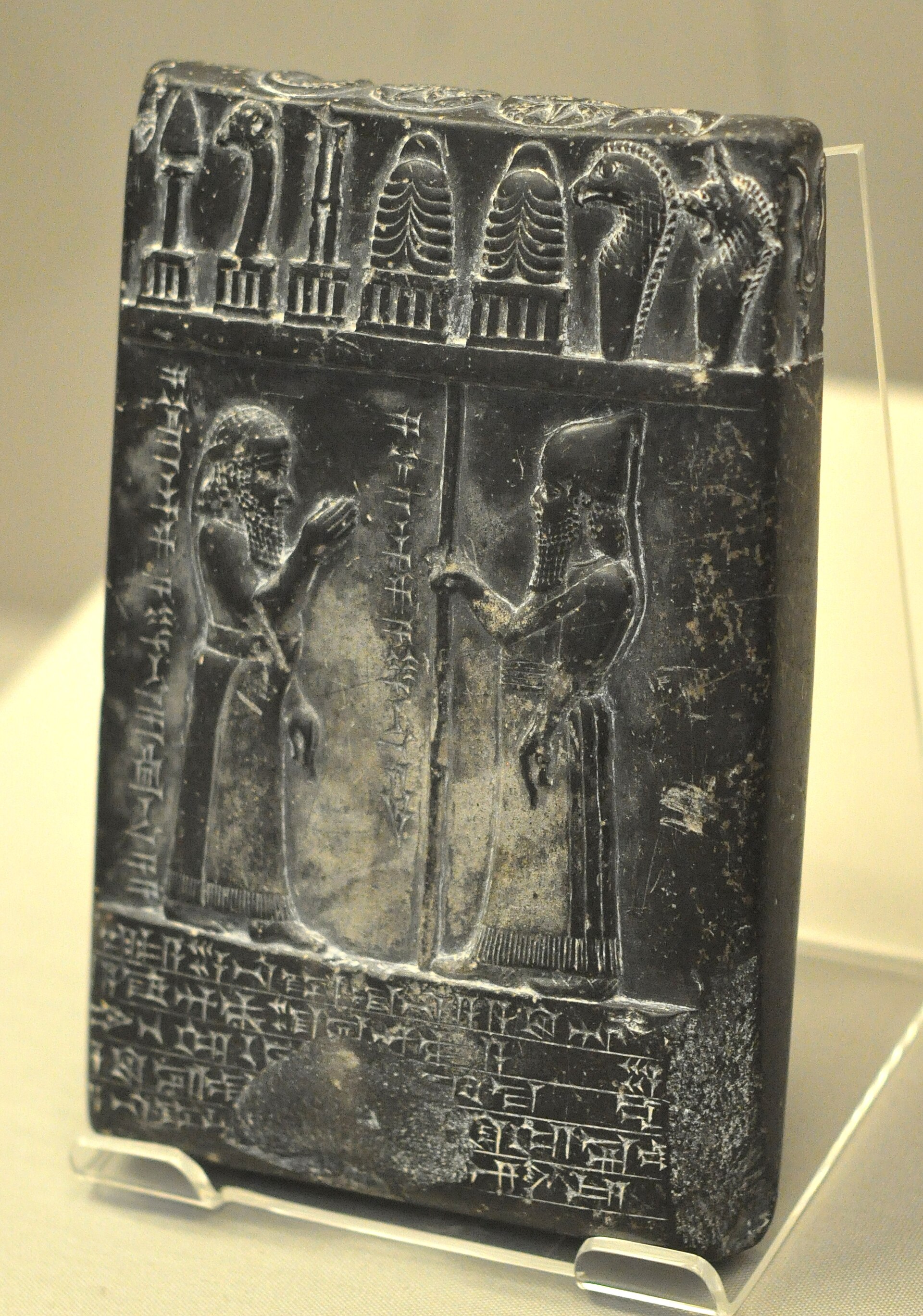
The British Museum’s limestone Tablet of Shamash depicts Nabu-apla-iddina being led into the presence of the seated sun god. A solar disc rests on a stand in front of the god. The text records the king’s renewal of the temple’s endowment. A different royal account survives on a clay cylinder of Nebuchadnezzar II, The Met 85.15. It describes rebuilding Ebabbar. The museum identifies a foundation deposit as the probable purpose of the cylinder and lists Sippar as a possible place of origin. [3][4]
Inside the tablet library
Iraqi archaeologists excavated a library in room 355 of the Shamash temple in the 1985–1986 season. Yale’s CuneiformCuneiformWriting with wedge-shaped signs, developed from Mesopotamian recording traditions and used for several languages from the third millennium BCE.Glossary · Click to read the explanation Commentaries Project reports nearly 800 clay tablets recovered in their storage positions. The German Archaeological Institute describes the installations as shelf-like compartments. Yale dates the tablets to the Neo-Babylonian and early Achaemenid periods. Their positions show how written works were kept together in a particular room. Yale also describes Hormuzd Rassam’s excavations in the 1880s, when tablets were recovered chiefly from rooms 53 and 55. Finds from several rooms inform the history of writing at the temple. [1][5]
The library included multiple tablets of the Epic of Atrahasis. A. R. George and F. N. H. Al-Rawi published these witnesses to the Babylonian composition about human creation and the flood. Their report identifies the excavator as Walid Al-Jadir of the University of Baghdad. These clay tablets document the circulation of a flood narrative in the temple’s library. [6]
The writings in the story of Xisuthrus
In the account attributed to Berossus and transmitted through Alexander Polyhistor in Eusebius’s Chronicle, the god called Cronos tells Xisuthrus to bury writings in the city of the Sippareni before the flood. After the waters subside, a voice directs the survivors back to BabylonBabylonBabylon is an ancient city in central present-day Iraq, south of BaghdadGlossary · Click to read the explanation and tells them to recover the writings. The narrative says they dig them up at Sippar. The episode gives the city a part in the survival and transmission of knowledge after the flood. [7]
Quick answer
How is Sippar named in the flood story? Andrew Smith’s translation calls it “HeliopolisHeliopolis, ancient IunuHeliopolis is the Greek name of Egyptian Iunu, at Matariya in northern present-day CairoGlossary · Click to read the explanation, the city of the Sippareni.” Heliopolis means “City of the Sun” in Greek. [7]
References and notes
- German Archaeological Institute, “Sippar (Tell Abu Habbah)” Project description. Ebabbar excavations, courtyards and ziggurat, work of the University of Baghdad and tablets found in shelf-like compartments. Return to the text ↑
- Lina Mahmood, Two Cities of Sippar: Tell Abu-Habbah and Tell ed-Der, Stony Brook University (2006) Institutional abstract. Identifications as Sippar-Yahrurum and Sippar-Amnanum, and roughly six kilometres between the sites. Return to the text ↑
- British Museum, “Tablet of Shamash,” collection record reproduced on Google Arts & Culture Object description and details. Limestone, relief with Nabu-apla-iddina and the enthroned sun god, temple endowment and Sippar findspot. Return to the text ↑
- The Metropolitan Museum of Art, “Cuneiform cylinder with inscription of Nebuchadnezzar II, describing the rebuilding of Ebabbar, the temple of the sun-god Shamash at Sippar,” 85.15 Object description and details. Rebuilding inscription, probable function as foundation deposit and geography catalogued as Sippar with a question mark. Return to the text ↑
- Yale University, Cuneiform Commentaries Project, “Cities and Libraries” Section “Sippar.” Room 355, the 1985/1986 season and nearly 800 tablets found in place on their shelves. Return to the text ↑
- A. R. George and F. N. H. Al-Rawi, “Tablets from the Sippar Library VI. Atra-ḫasīs,” Iraq 58 (1996), 147–190 Publisher’s extract. Walid Al-Jadir’s excavation of the library and the copies of Atrahasis recovered there. Return to the text ↑
- Eusebius of Caesarea, Chronicle, book 1, translated by Andrew Smith (2008), Christian Classics Ethereal Library Alexander Polyhistor’s account of Xisuthrus, pp. 21–23 in the displayed pagination. Burial of writings before the flood, instruction to recover them and return to Sippar. Return to the text ↑
Suggest a correction · Suggest a source for this record
Cite this record
IL Archive, «Sippar: Abu Habbah», https://ilarchive.com/en/sites/sippar-abu-habbah
Continue reading