Artifact · Inscription
The Cylinder Seal of Adda (British Museum 89115)
An object record bringing together its image, metadata, rights, and context.
- Timeline
- From 2340 BCE to 2200 BCE
- Region
- Mesopotamia
A greenstone seal from the Akkadian period names Adda the scribe in Sumerian. Its impression shows the sun god emerging between mountains, water flowing from Enki’s shoulders and an armed figure whose identity is still debated.
Estimated reading time: 4 min Published Last reviewed:
Share article
Photograph
Photograph by Nic McPhee, via Wikimedia Commons, CC BY-SA 2.0. Cropped on Commons.
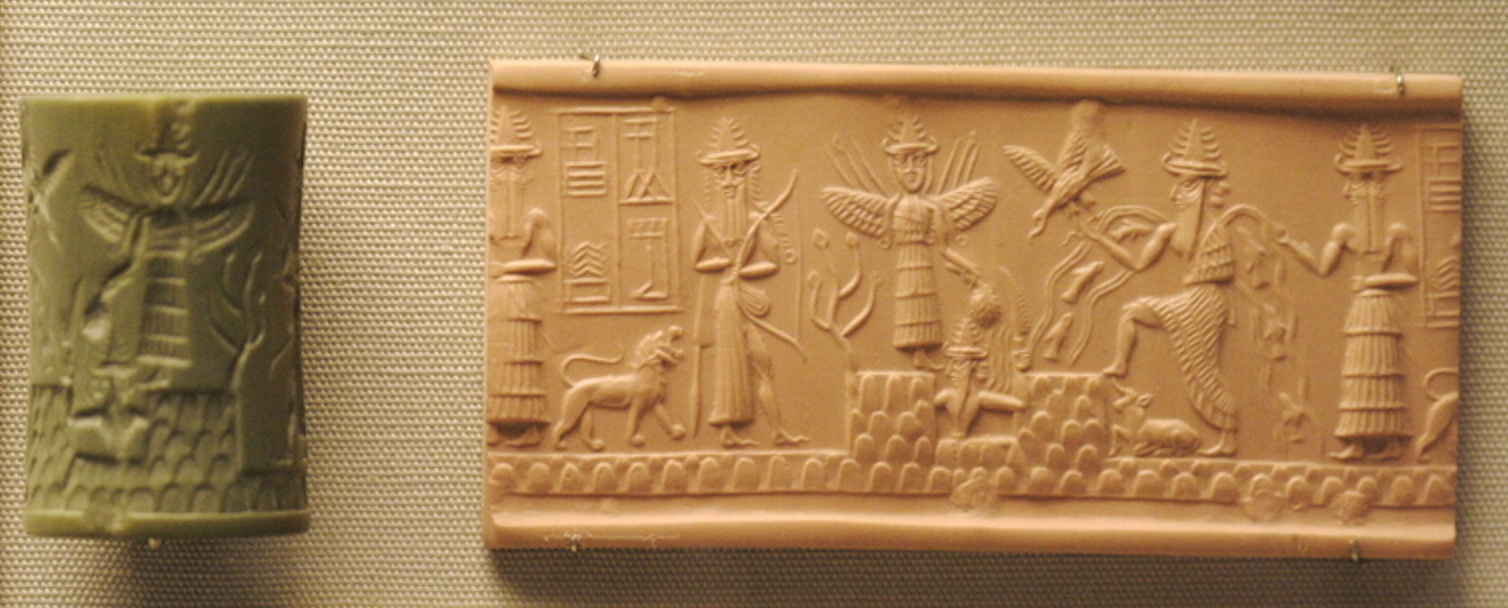
The original greenstone cylinder seal of Adda (British Museum 89115), left, and a modern impression of its design, right. The scene includes Shamash between the mountains and streams flowing from Enki’s shoulders
License · Image sourceObject details
- Title
- The Cylinder Seal of Adda (British Museum 89115)
- Timeline
- From 2340 BCE to 2200 BCE
- Region
- Mesopotamia
- Rights
- CC BY-SA
Text
Introduction
Adda’s cylinder sealCylinder sealSmall engraved cylinder rolled over soft clay to leave an extended image. Used to secure, document and identify administrative actions; its pictures do not automatically constitute writing.Glossary · Click to read the explanation is a greenstone object from the AkkadianAkkadianAn ancient East Semitic language written in cuneiform from the third millennium BCE; its varieties include Babylonian and Assyrian, and it served in international diplomacy.Glossary · Click to read the explanation period, now in the British Museum as 89115. Its two-line inscription names a scribe. Rolled across clay, the carved stone produces a band of figures that includes the sun god rising between mountains. The pattern can be read on the modern impression beside the stone in the photograph. [1][2][3][4]
Adda the scribe
The cylinder is 39 millimetres high and 25.5 millimetres in diameter. Christina Tsouparopoulou describes its sides as slightly concave. The CuneiformCuneiformWriting with wedge-shaped signs, developed from Mesopotamian recording traditions and used for several languages from the third millennium BCE.Glossary · Click to read the explanation Digital Library Initiative lists it as CDLI Seals 005353, object P458063, and records SipparSippar: Abu HabbahSippar is an ancient Babylonian city in present-day Iraq, identified with Tell Abu Habbah.Glossary · Click to read the explanation (Tell Abu Habbah) as a possible provenance in its detailed entry. The British Museum’s published entry lists Sippar in a combined findspot and acquisition field. No excavated layer or findspot is specified there. Renate Marian van Dijk-Coombes lists the provenance as unknown. The British Museum dates the seal to about 2300 BCE. CDLI uses an Old Akkadian period range of about 2340–2200 BCE. Van Dijk-Coombes assigns the seal to Akkadian II in the stylistic sequence used in her study. [1][2][3][6]
In a frame above the lion are two lines of SumerianSumerian languageAncient language of southern Mesopotamia, clearly attested in third-millennium BCE texts and maintained in learning and ritual after its spoken use declined.Glossary · Click to read the explanation. The CDLI edition reads them ad-da and dub-sar, “Adda, scribe.” The first line gives the name and the second the profession. The museum identifies the horned headdresses as marks of divinity. The names of the carved figures depend on their attributes and comparisons with related seals. Adda’s place of work remains unknown. [1][2][3][6]
How the scene unfolds
A carved cylinder carries its design around a curved surface. Rolling it over soft clay brings the figures into a continuous band, with the design repeating if the seal keeps turning. In MesopotamiaMesopotamiaHistorical region associated with the Tigris and Euphrates: Uruk, Ur, Eridu, cuneiform, Sumer, Akkad, Babylon and Assyria, their languages and cults, and the limits of archaeological evidence.Glossary · Click to read the explanation, impressions could mark clay tablets and the clay used to close containers or doors. Such impressions can sometimes tie a particular seal to an ancient administrative act. The CDLI record lists no surviving ancient impressions for Adda’s seal. The modern impression next to it in the photograph shows the design. [1][3][4]
In the middle of the scene, the sun god ShamashShamashMesopotamian god of the sun and justice, shown before Hammurabi on an eighteenth-century BCE stele preserved in the Louvre.Glossary · Click to read the explanation emerges between two mountains represented by rows of rounded forms. Rays project from his shoulders and he holds a serrated blade. To his left stands winged IshtarInanna / IshtarA prominent Mesopotamian goddess whose Sumerian name Inanna became associated with Akkadian Ishtar across diverse traditions. She was associated with desire, war, royal authority and Venus, while local forms and genealogies varied among texts.Glossary · Click to read the explanation, facing outward. Weapons rise from her shoulders. Van Dijk-Coombes reads what she holds as a cluster of dates and interprets the combination as bringing together aspects of war and fertility. [2][3]
On the right, EnkiEnkiMesopotamian deity also known as Ea, linked with Eridu and the Abzu (deep fresh waters), wisdom, incantations, and narratives of creation and cosmic order. Later written attestations do not identify the deity of Eridu’s earliest layers.Glossary · Click to read the explanation, also called Ea, sets a foot on the mountain. Streams with fish emerge from his shoulders. A bull lies beneath his raised leg. Behind him stands his attendant Isimud, or Usmu, with two faces looking in opposite directions. On another Akkadian seal in the Yale Babylonian Collection, Isimud introduces a worshipper to a seated Ea. That comparison preserves the partnership between the gods in a different scene. [2][3][5]
The armed figure and the bird
The figure beside the lion faces the viewer and carries a bow and a quiver. Tsouparopoulou describes him as a hunting god. The British Museum suggests a hunting god such as Nusku. Van Dijk-Coombes compares the figure’s loose hair, tasselled quiver and distinctive garment with those of a martial deity on other Akkadian seals. She proposes Ilaba, a god associated with the Akkadian kings, while discussing the earlier identification as Ninurta. The name remains uncertain. [2][3][6]
A bird spreads its wings between Ishtar and Enki. Tsouparopoulou tentatively identifies it as the Zu bird and reads Enki’s gesture as possibly directed toward it. Van Dijk-Coombes records the bird without assigning it a name in her description of this seal. The visual details support comparison with other objects. The link to a particular named bird or story remains a proposal. [2][3][5]
Quick answers
What does the inscription say?
It names “Adda, scribe” in two lines of Sumerian. [1]
Which figures appear beside the mountains?
Shamash rises between the mountains. Ishtar stands to his left, while Enki and his two-faced attendant Isimud are to the right. [2][3]
Was the seal found at Sippar?
The British Museum lists Sippar under findspot or acquisition. The detailed CDLI record marks it as uncertain, and Van Dijk-Coombes records the provenance as unknown. [1][2][6]
What does the photograph show?
It shows the original stone cylinder next to a modern impression. The impression spreads the design into a band so the whole scene can be seen. [1][3][4]
References and notes
- Cuneiform Digital Library Initiative, “CDLI Seals 005353 (physical) (P458063),” British Museum 89115 Physical information and provenance, Old Akkadian period range, Text, lines 1–2, and the list of seal impressions. Return to the text ↑
- Renate Marian van Dijk-Coombes, “Revisiting the ‘kriegerischer Gott’ of the Akkadian Period,” Religions 14, no. 9 (2023), article 1215 P. 4, catalogue no. 3, the date in the stylistic sequence, provenance and detail of each figure. Pp. 9–11, attributes of the armed deity. Pp. 13–14, Ninurta and the proposal of Ilaba. Return to the text ↑
- Christina Tsouparopoulou, “Progress Report: An Online Database for the Documentation of Seals, Sealings and Seal Impressions in the Ancient Near East,” Studia Orientalia Electronica 2 (2014), pp. 37–68 P. 41, fig. 4b, dimensions, greenstone, concave profile, inscription and figure identifications, including the tentative reading of the bird. Return to the text ↑
- Holly Pittman, with Joan Aruz, Ancient Art in Miniature: Ancient Near Eastern Seals from the Collection of Martin and Sarah Cherkasky, Metropolitan Museum of Art, 1987 Pp. 11–12, how a seal made a repeating band in clay, clay sealings for jars and doors, and the relationship of sealings to administration. Return to the text ↑
- Agnete W. Lassen and Klaus Wagensonner, eds., Women at the Dawn of History, Yale Babylonian Collection, 2020 P. 68, no. 7, YPM BC 03756, Isimud with Ea in a separate scene. No. 8, limits on identifying the figures and narratives shown on seals. Return to the text ↑
- British Museum, “Greenstone seal of Adda,” Google Arts & Culture, object registration 1891,0509.2553 Museum object description and details. Approximate date, dimensions, the combined Find/Acquired field, horned headdresses, the identification of the deities and the proposal of Nusku. Return to the text ↑
Archive records may be reviewed and refined as better evidence or sources become available. Suggest a correction
Suggest a correction · Suggest a source for this record
Cite this record
IL Archive, «The Cylinder Seal of Adda (British Museum 89115)», https://ilarchive.com/en/artifacts/adda-cylinder-seal-bm89115
Continue reading