Artifact · Inscription
The Stele of the Vultures (Louvre AO 50)
An object record bringing together its image, metadata, rights, and context.
- Timeline
- From 2450 BCE to 2425 BCE
- Region
- Mesopotamia
Seven limestone fragments preserve Eannatum’s account of victory over Umma. Soldiers, vultures and a net full of prisoners share the stone with Sumerian oaths about a boundary, its irrigation channels and its markers.
Estimated reading time: 4 min Published Last reviewed:
Share article
Photograph
Photo composite by Pataliputra, with background by Kikuyu3 and photographs by Eric Gaba (Sting), via Wikimedia Commons, CC BY-SA 4.0.
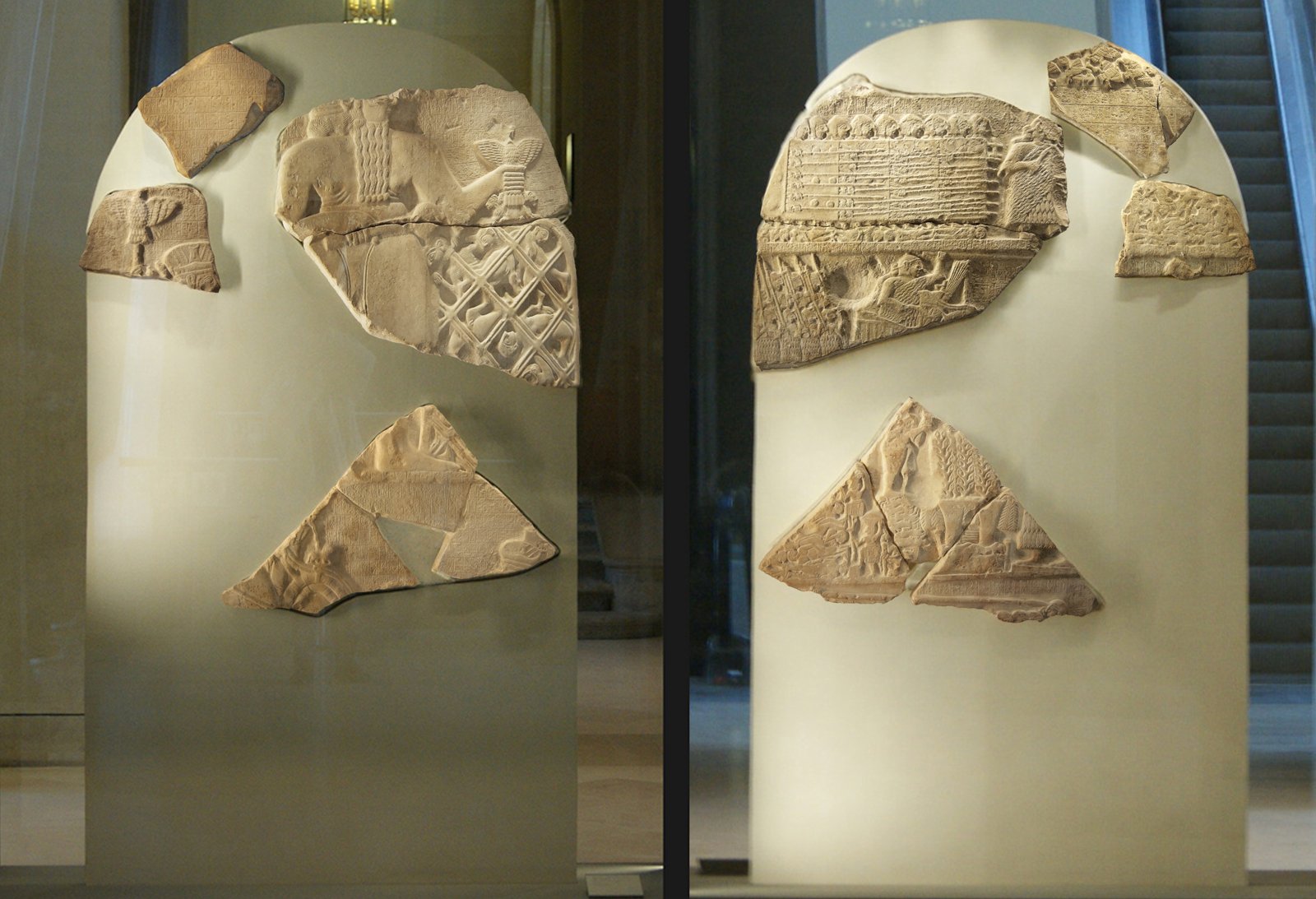
Both faces of the Stele of the Vultures, Louvre AO 50 and associated fragments. The surviving pieces are shown against the reconstructed outline
License · Image sourceObject details
- Title
- The Stele of the Vultures (Louvre AO 50)
- Timeline
- From 2450 BCE to 2425 BCE
- Region
- Mesopotamia
- Rights
- CC BY-SA
Text
Introduction
The Stele of the Vultures is a limestone victory monument commissioned by Eannatum of LagashLagash, Sumerian city-stateCity-state in present-day southern Iraq; Girsu was one of its centers associated with royal inscriptions.Glossary · Click to read the explanation. Its surviving scenes show soldiers on the march, rites over the dead and prisoners caught in a net. Its SumerianSumerian languageAncient language of southern Mesopotamia, clearly attested in third-millennium BCE texts and maintained in learning and ritual after its spoken use declined.Glossary · Click to read the explanation inscription puts Eannatum’s victory over neighbouring Umma in the context of a dispute over land and water. The Louvre dates the stele to about 2450–2425 BCE. Seven fragments are known, from a monument found in pieces at Girsu, modern Tello in southern IraqIraqIraq is a modern country encompassing much of ancient MesopotamiaGlossary · Click to read the explanation. [1][2][4]
Seven pieces of one stone
The Louvre gives the stele’s dimensions as 180 cm high, 130 cm wide and 11 cm thick. The top was rounded, and sculptors carved scenes on both faces. The principal inventory number AO 50 covers three fragments. AO 2346, AO 2347, AO 2348 and AO 16109 identify the four others. Each fragment preserves a different portion of the relief or writing. The museum describes AO 16109 as joining two other fragments. The British Museum transferred that piece to the Louvre in 1933. [1]
The Louvre records different findspots for the excavated pieces. According to the Louvre, two fragments were found near the foot of the mound known as Tell K. Another had been reused in a palace. Girsu was an important city of the state of Lagash and a centre for the worship of its patron god, NingirsuNingirsuA major god of the Sumerian state of Lagash, invoked in Urukagina’s reform undertaking.Glossary · Click to read the explanation. The find locations record where pieces survived, after the monument itself had been broken. [1][4]
Soldiers, vultures and offerings
The face with the battle scenes is divided into horizontal bands. One fragment shows Eannatum on foot ahead of tightly packed soldiers. Shields and spears make their advance look coordinated. Another fragment shows him leading his troops from a chariot. The modern name of the stele comes from a small piece that shows vultures carrying away the heads of the dead. On a lower band, the Louvre identifies a scene of sacrifice and offerings, with a bull, a vessel and a cluster of dates. This combination of scenes puts what happened after the fighting on the same stone as the royal advance. [1][3]
Barbara Couturaud notes how early Mesopotamian reliefs repeat figures in rows. On the stele, the ranks of similarly equipped soldiers make the army legible as a group. The king can be recognized by his position and distinctive headgear. His two appearances belong to separate bands, and much of the stone between the scenes has been lost. [1][3]
The net in relief and in the oath
On the other face, a large figure stands beside a net full of captives. Above the net is the lion-headed eagle Imdugud, grasping two lions. The trapped figures occupy a compact space beside the much larger figure. The inscription also gives the net a role in the settlement with Umma, as an object by which its ruler is made to swear. [1][2]
In one surviving oath, Eannatum presents the ruler of Umma with the great net of EnkiEnkiMesopotamian deity also known as Ea, linked with Eridu and the Abzu (deep fresh waters), wisdom, incantations, and narratives of creation and cosmic order. Later written attestations do not identify the deity of Eridu’s earliest layers.Glossary · Click to read the explanation. The ruler promises to respect the boundary of Ningirsu’s land, to leave its levees and irrigation channels intact and to leave its steles standing. He calls on the net of Enki to fall upon Umma if he crosses the boundary. Other passages repeat the oath with other gods, including Ninhursag. In the relief the net contains defeated people. In the oath it stands for a punishment that may follow a future breach. [1][2]
The inscription represents the settlement from Lagash’s viewpoint. A later royal inscription of Enmetena of Lagash also describes the border dispute. It credits an earlier king of Kish, Mesilim, with measuring the land and setting up a stele. It then describes Eannatum and Enakale of Umma as marking out the boundary again. The comparison helps explain why removing a marker or altering a channel mattered enough to forbid in the oath. [2][5]
Quick answers
Who made the Stele of the Vultures?
Eannatum of Lagash commissioned it to commemorate his victory over Umma. The Louvre dates it to about 2450–2425 BCE. [1][2]
Why is it called the Stele of the Vultures?
A fragment shows vultures carrying away the heads of the dead after the fighting. [1][3]
What does the inscription say about the boundary?
The ruler of Umma is made to swear that he will respect the boundary of Ningirsu’s land and leave its irrigation works and boundary steles intact. [2]
Where can the fragments be seen?
The seven known fragments are held in the Louvre under AO 50 and associated inventory numbers. The fragments are from Girsu, modern Tello. [1][4]
References and notes
- Musée du Louvre, “Stèle des vautours,” AO 50, AO 2346, AO 2347, AO 2348 and AO 16109 Description, Inscriptions, Physical characteristics, Places and dates, and History. Seven fragments, the reliefs, dimensions, Early Dynastic IIIB date, findspots and the transfer of AO 16109 in 1933. Return to the text ↑
- Cuneiform Digital Library Initiative, witness P222399 and composite P431075, based on Douglas Frayne, Presargonic Period (2700–2350 BC), RIME 1, University of Toronto Press, 2008, E1.9.3.1 Composite Q001056, obverse on the land of Gu’edena and conflict with Umma. Composite lines 293′–309′ (oath invoking Ninhursag) and 333′–362′ (net of Enki, boundary, channels and steles). Return to the text ↑
- Barbara Couturaud, “Soldiers and Prisoners in Motion in Mesopotamian Iconography during the Early Bronze Age,” Arts 13, no. 4 (2024), article 132 Sections 3–5, especially figure 8. The headgear, repeated soldiers, the ruler’s chariot and vultures on the Stele of the Vultures. Return to the text ↑
- Ariane Thomas, “Tello, formerly Girsu,” Archéologie, French Ministry of Culture The First Dynasty of Lagash, the sanctuary of Ningirsu, Eannatum’s victory monument and Ernest de Sarzec’s excavations. Return to the text ↑
- Cuneiform Digital Library Initiative, Enmetena inscription composite P431117, RIME 1.09.05.01 Columns i–ii, including Mesilim’s demarcation and stele, followed by Eannatum and Enakale’s re-demarcation of the boundary. Return to the text ↑
Archive records may be reviewed and refined as better evidence or sources become available. Suggest a correction
Suggest a correction · Suggest a source for this record
Cite this record
IL Archive, «The Stele of the Vultures (Louvre AO 50)», https://ilarchive.com/en/artifacts/stele-of-the-vultures-ao50
Continue reading