Artifact · Inscription
The Relief of Ur-Nanshe (Louvre AO 2344)
An object record bringing together its image, metadata, rights, and context.
- Timeline
- From 2500 BCE to 2340 BCE
- Region
- Mesopotamia
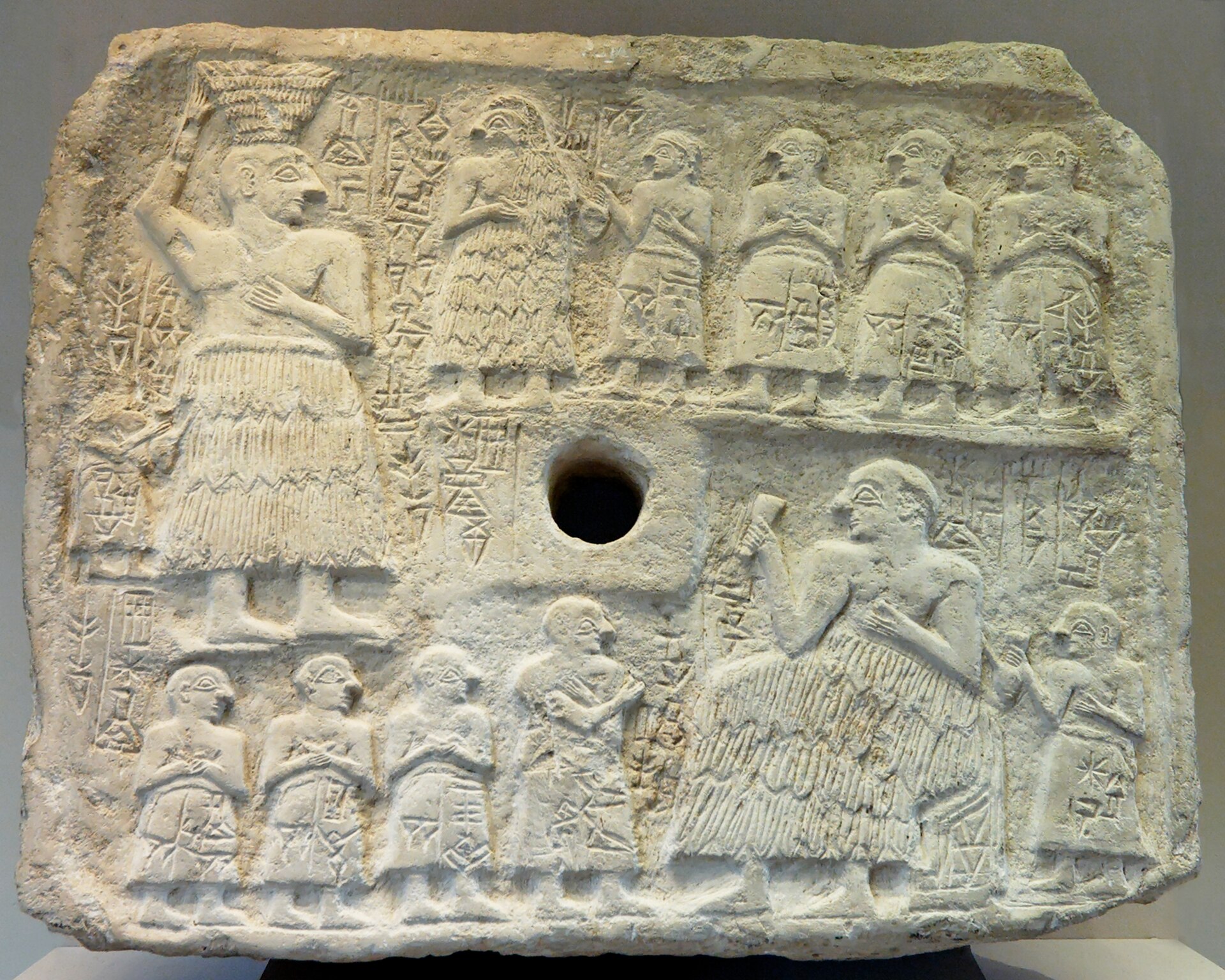
A pierced limestone relief from Girsu shows the king of Lagash carrying a building basket and presiding at a banquet. Its Sumerian inscriptions name temples, people in the scenes and boats of Dilmun associated with timber.
Estimated reading time: 4 min Published Last reviewed:
Share article
Photograph
Marie-Lan Nguyen (Jastrow) / Wikimedia Commons, CC BY 2.5.
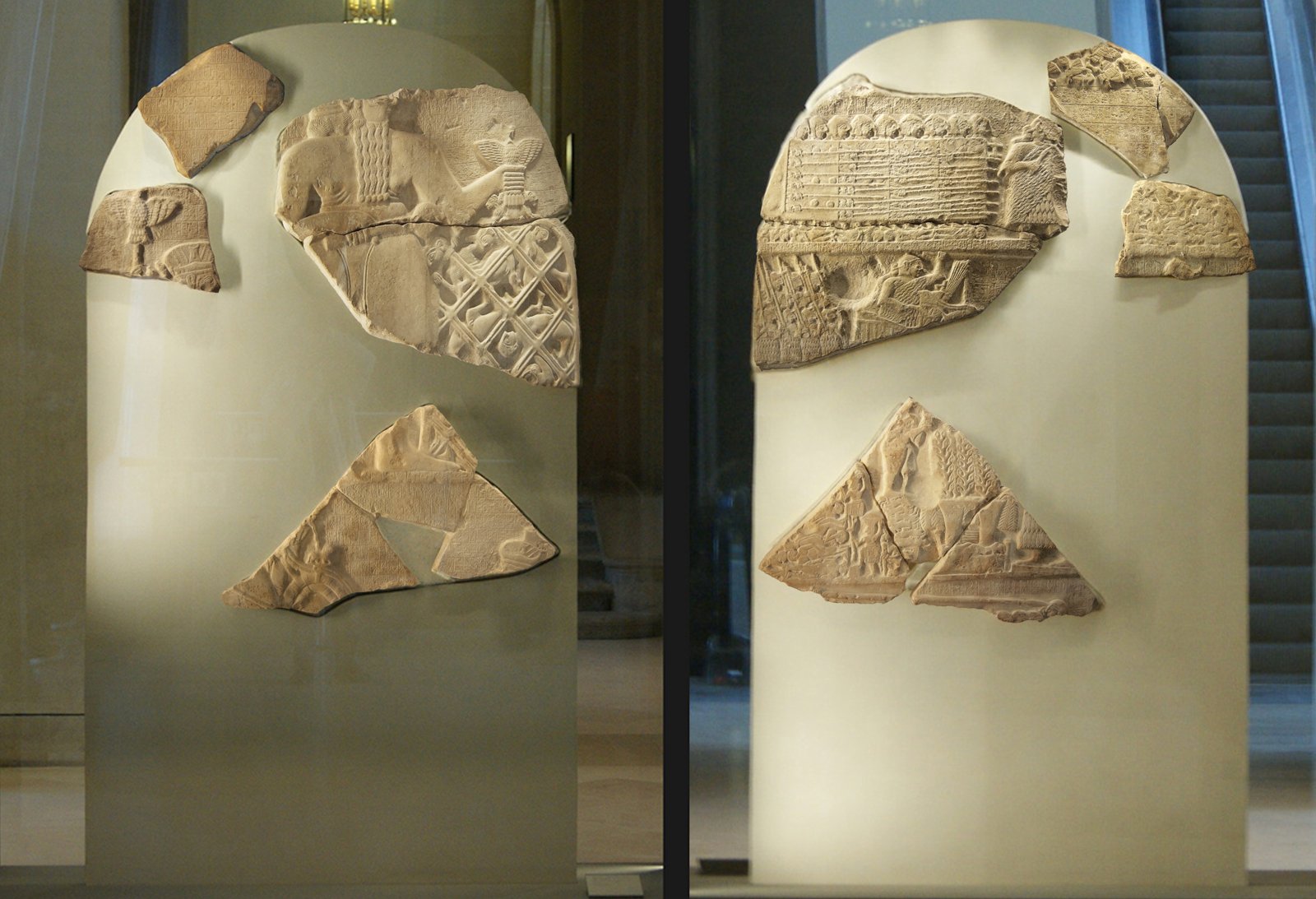
Limestone relief of Ur-Nanshe from Girsu, showing the king with a basket above and seated at a banquet below (Musée du Louvre, AO 2344)
License · Image sourceObject details
- Title
- The Relief of Ur-Nanshe (Louvre AO 2344)
- Timeline
- From 2500 BCE to 2340 BCE
- Region
- Mesopotamia
- Rights
- CC BY
Text
Introduction
Ur-Nanshe appears twice on this limestone plaque. In the upper scene the king of LagashLagash, Sumerian city-stateCity-state in present-day southern Iraq; Girsu was one of its centers associated with royal inscriptions.Glossary · Click to read the explanation stands with a basket on his head. Below, he sits and raises a cup. A circular hole separates the two scenes near the middle of the stone. The Sumerian inscriptions name buildings the king had made, identify people beside him and record timber associated with boats of DilmunDilmun: Ancient Gulf Land and Literary SettingDilmun was an ancient Gulf trading land with a major archaeological centre in Bahrain and connections to eastern Arabia and Failaka. This entry separates boats, burials and kings from the literary purity and fresh water of Enki and Ninhursaga, and tests the limits of comparison with Eden.Glossary · Click to read the explanation. The Louvre holds the relief under inventory number AO 2344. [1][2][3][5]
A plaque from Girsu
Ernest de Sarzec found the relief in 1888 at Tell K in Tello, ancient Girsu, near a building associated with Ur-Nanshe. The Louvre records its acquisition in 1890 as a gift from the Ottoman government after the excavations. It describes a limestone low relief, 39 cm high, 46.5 cm wide and 6.5 cm thick. The CuneiformCuneiformWriting with wedge-shaped signs, developed from Mesopotamian recording traditions and used for several languages from the third millennium BCE.Glossary · Click to read the explanation Digital Library Initiative (CDLI) identifies the same object by its Louvre number and by P222359. The museum’s physical description supplies the measurements given here. [1][2][4]
Both catalogues assign the relief to the Early Dynastic IIIb period. CDLI gives about 2500–2340 BCE for that period. The Louvre’s date field includes an approximate range of 2550–2500 BCE in the description and a second range of 2495–2465 BCE. The king’s name on the stone ties the plaque to his reign. The ranges are modern estimates. [1][2][3]
The builder and the banquet
The upper scene places the king at the left, facing a row of smaller figures. He steadies his basket with one hand. The Louvre reads the basket as a container of bricks for construction. In the lower scene the king sits at the right, facing a group of standing figures. A figure approaching him holds a vessel. The Louvre interprets the lower scene as a ritualRitualAn organised or distinguished practice meaningful to a community; it may leave traces, but its form alone does not reveal an associated doctrine.Glossary · Click to read the explanation banquet celebrating the building work. The inscriptions put names on garments and place longer statements in the space around the figures. [1][3][4][5]
The first figure facing the king in the upper scene is larger than the people behind it. The Louvre tentatively identifies the group as his wife and sons, while CDLI’s translation gives Abda as a daughter. Önhan Tunca argues that the first figure is one of the king’s sons. He compares the costume and long hair with depictions of men and points out that the captions in this row follow the same pattern of a name followed by the sign for child. The next figure is identified as Akurgal, who succeeded Ur-Nanshe. Tunca treats the larger figure’s position ahead of Akurgal as evidence of higher standing at the time. The figure’s identification remains disputed. [1][3][4][6]
The building inscription
The main inscription calls Ur-Nanshe king of Lagash and son of Gunidu. The next phrase also uses the Sumerian word for child, this time with the name Gursar. CDLI renders it as “son” of Gursar, with quotation marks around the kinship term. On a separate stone fragment from Lagash, Vaughn Crawford gives both son and citizen as possible meanings of the same expression, citing Edmond Sollberger for the latter. The phrase on the Louvre relief therefore leaves room for a civic affiliation as well as a family relationship. [2][3][7]
The upper text credits the king with building the temples of NingirsuNingirsuA major god of the Sumerian state of Lagash, invoked in Urukagina’s reform undertaking.Glossary · Click to read the explanation and Nanshe and the structure called the Smaller Abzu. A separate passage beside the seated king repeats his name and title and mentions boats of Dilmun bringing loads of timber from the mountains. It gives no specific mountain source or itinerary. The texts therefore record both the buildings and the procurement of a material used in construction. [2][3][5][8]
Where the relief stood
Léon Heuzey reported that three pierced plaques were found a short distance from the western corner and the southwest side of the building. He proposed that the plaques could have been laid flat, with the holes holding upright votive objects. Christina Tsouparopoulou considers another possibility. Comparing the recorded positions with the lines of the pillars, she suggests that the plaques could have fallen from walls in the courtyard or portico. The find positions give a basis for both proposals, and the original mounting of AO 2344 remains uncertain. [4][8]
The building is known by the excavators’ name Maison des Fruits. Tsouparopoulou connects it with the shrine of Girsu named on other inscribed objects and argues that fish-shaped foundation deposits and evidence of water installations point to a sacred use connected with water. She considers EnkiEnkiMesopotamian deity also known as Ea, linked with Eridu and the Abzu (deep fresh waters), wisdom, incantations, and narratives of creation and cosmic order. Later written attestations do not identify the deity of Eridu’s earliest layers.Glossary · Click to read the explanation or Nanshe possible recipients of its cult while leaving the dedication open. The names on AO 2344 establish what the ruler claimed to have built. Identifying which of those buildings stood beside the plaque requires evidence from the excavation as well. [3][8]
References and notes
- Musée du Louvre, ‘Relief d’Ur-Nanshe’, AO 2344 Identification and description, physical characteristics, places and dates, and object history. Return to the text ↑
- Cuneiform Digital Library Initiative, ‘RIME 1.09.01.02, ex. 01’, P222359 Catalogue record and transliteration, surfaces a–c. Return to the text ↑
- Cuneiform Digital Library Initiative, ‘RIME 1.09.01.02 composite’, P431035 (Q001021) Edition and translation, surface a, lines 1–10, surface b, lines 1–6, and the figure labels on surface c. Return to the text ↑
- Léon Heuzey, Une villa royale chaldéenne vers l’an 4000 avant notre ère, d’après les levés et les notes de M. de Sarzec (Paris, Ernest Leroux, 1900) § VI, pp. 17–19 and fig. 8, for the findspots of the plaques, the figures and an early proposal for the function of the holes. Return to the text ↑
- Musée du Louvre-Lens, L’histoire commence en Mésopotamie, dossier pédagogique (2016) Theme 1, section II, ‘Les premiers rois’, pp. 5–6, and the photograph and caption for AO 2344 on p. 6. Return to the text ↑
- Önhan Tunca, ‘À propos d’une figure de la plaque perforée d’Ur-Nanše (Urn. 20) : fille/femme, fils ou devin ?’, Nouvelles Assyriologiques Brèves et Utilitaires 2004, no. 1 Note 22, pp. 22–23, on the dress, hair, labels and relative positions of the figures facing the king. Return to the text ↑
- Vaughn E. Crawford, ‘Inscriptions from Lagash, Season Four, 1975–76’, Journal of Cuneiform Studies 29, no. 4 (1977), pp. 189–222 p. 193, 4H-T1, obverse, col. ii′ and n. 16, on the expression ‘son/citizen of Gursar’ on a separate stone fragment. Return to the text ↑
- Christina Tsouparopoulou, ‘The Early Dynastic “Maison des Fruits” at Tell K in Tello (Ĝirsu)’, Bulletin of the American Society of Overseas Research 391 (2024), pp. 191–225 Manuscript pp. 15–16, n. 19 and figs. 4 and 17 for the plaques’ recorded positions, and pp. 25–26 and 29–33 for the water installations, fish deposits and possible cult. Return to the text ↑
Archive records may be reviewed and refined as better evidence or sources become available. Suggest a correction
Suggest a correction · Suggest a source for this record
Cite this record
IL Archive, «The Relief of Ur-Nanshe (Louvre AO 2344)», https://ilarchive.com/en/artifacts/ur-nanshe-relief-ao2344
Continue reading