Artifact
The Gezer Calendar (Istanbul 2089 T)
An object record bringing together its image, metadata, rights, and context.
- Timeline
- From 1000 BCE to 901 BCE
- Region
- The Levant
A limestone tablet from Gezer divides the farming year into periods of sowing, harvest and other work. Its seven lines preserve an early example of alphabetic writing.
Estimated reading time: 4 min Published Last reviewed:
Share article
Photograph
Osama Shukir Muhammed Amin FRCP(Glasg) / Wikimedia Commons, CC BY-SA 4.0.
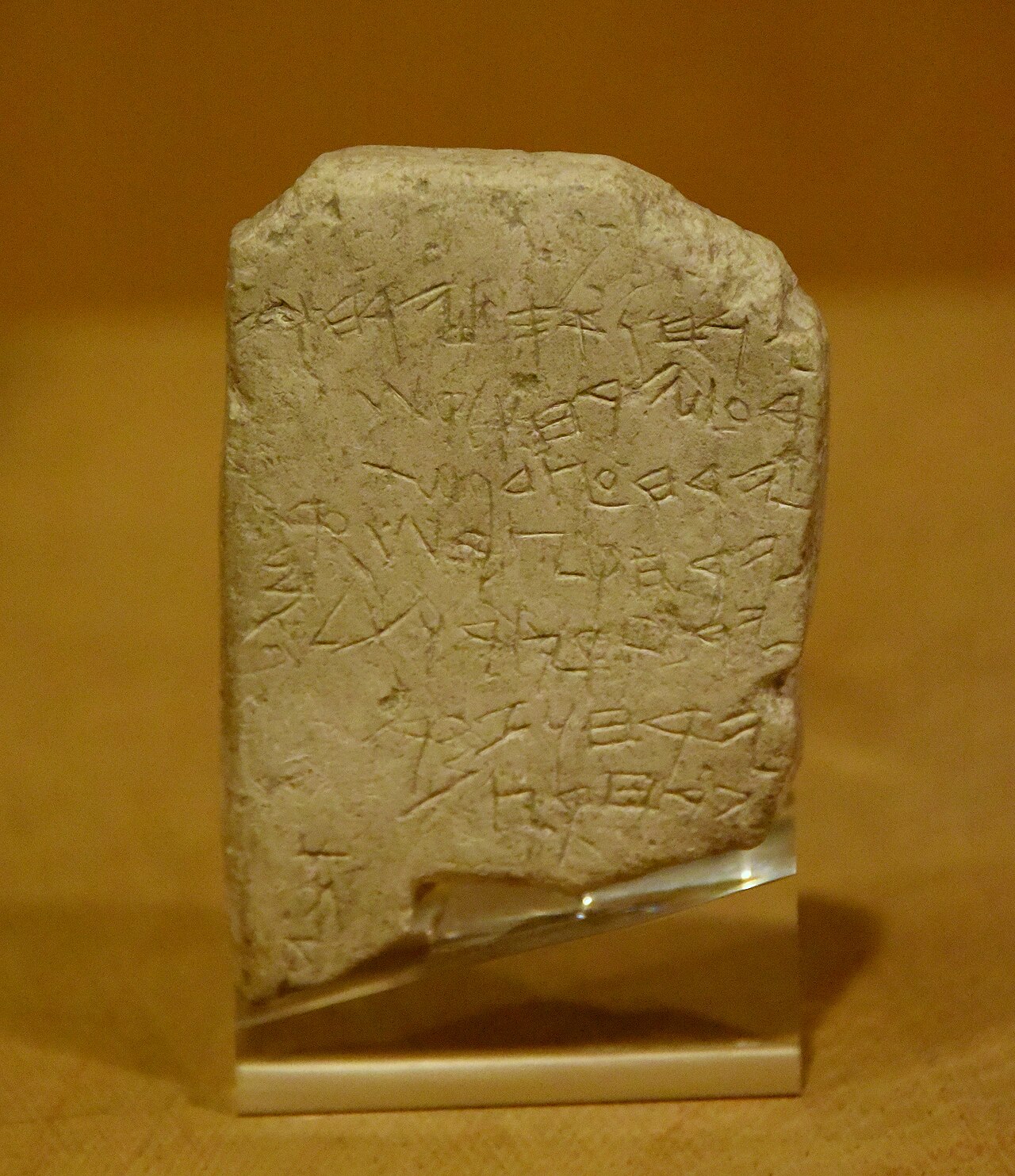
The inscribed face of the Gezer Calendar, Istanbul Archaeological Museums 2089 T
License · Image sourceObject details
- Title
- The Gezer Calendar (Istanbul 2089 T)
- Timeline
- From 1000 BCE to 901 BCE
- Region
- The Levant
- Rights
- CC BY-SA
Text
Introduction
Seven lines on this limestone tablet name agricultural tasks and assign them periods of time. The stone came to light in 1908 in R. A. Stewart Macalister’s excavations for the Palestine Exploration Fund at Gezer. The original is held by the Istanbul Archaeological Museums under inventory number 2089 T. The display label dates it to the tenth century BCE. Cambridge’s Museum of Archaeology and Anthropology holds a plaster cast, registered as 2008.78. [1][2][3]
The stone and its findspot
Macalister records the find at the northern end of trench 8, in debris that he called Fourth Semitic. The lower part of the stone had broken away on a slant, through a square hole. Macalister proposed that the hole took a peg for fixing the stone to a wall. He describes a second hole on the back that meets the first and a border of diagonal lines on the left edge. The last surviving traces of writing run vertically near the break, beside the seven lines of the main inscription. [1]
Macalister assigned the tablet to the sixth century BCE on the basis of the few associated finds. He also reported that other readers placed it two centuries earlier. The tenth-century date is the convention used in the Istanbul label and the Cambridge catalogue. Lyndelle Webster and her colleagues note that Macalister’s methods limit how his finds can be fitted into the site’s stratigraphy. Their radiocarbon chronology is based on samples from a later excavation along the southern edge of the mound. It gives a chronology for those deposits. The date of the tablet remains an estimate. [1][2][3][8]
Eight periods of work
The repeated forms for one or two months yield a cycle of twelve months divided among eight tasks. A. M. Honeyman notes that each of the two written forms occurs four times. In Jacqueline Vayntrub’s arrangement, the first three double periods cover gathering produce, sowing and late sowing. The next periods include harvesting barley and another grain harvest. Two months are assigned to work on the vines, read by Vayntrub as pruning, and the cycle ends with summer fruit. The activities serve as the labels for the periods. [4][5]
The third line illustrates how much can turn on a few letters. Vayntrub understands it as a month for hoeing weeds. Aaron Koller interprets the plant as flax and takes the disputed word before it to refer to harvesting. He points to ancient depictions of flax being pulled up by hand and relates the wording to a verb for reaping attested in Aramaic. His proposal depends in part on how the writer may have pronounced two consonants. The difference changes both the crop and the kind of work described. [4][6]
Script, language and the name in the margin
Christopher Rollston assigns the letter forms to Phoenician script. The use of that script leaves room for more than one language. Koller notes that the form of the word for flax and certain contracted vowel sounds can fit either Phoenician or a northern variety of HebrewHebrewA Northwest Semitic language of the Canaanite group, encompassing Iron Age epigraphy, Biblical, Rabbinic, medieval and Modern Hebrew; its scripts and pronunciations changed over time.Glossary · Click to read the explanation. The short vertical text at the lower left is commonly understood as part or all of a personal name, read as Abi. Koller notes that the form also occurs independently on an Iron Age papyrus. The identification of the writer and the completion of the name therefore remain open. [1][6][7]
What the list was for
The two parts of each entry do different work. Vayntrub notes that the word for month belongs to the same family as the word for moon. It gives the list a repeatable unit of time. The other part names an activity that people could recognize by its place in the farming year, even when the timing shifted. She compares this pairing of times and activities to the series in Ecclesiastes 3:2–8. [4]
Macalister imagined the tablet as a display of its writer’s skill. William F. Albright suggested that it was a school exercise intended to teach the sequence of agricultural work. Vayntrub sees the inscription as an intellectual exercise in finding order in nature and places it within the wider tradition of wisdom literature. Where the stone was first used, and by whom, remain open questions. [1][4]
References and notes
- R. A. Stewart Macalister, The Excavation of Gezer, 1902–1905 and 1907–1909, vol. II (John Murray, 1912) § 26, ‘Cereals and Fruits: The Agricultural Year’, pp. 24–28. Findspot, material, holes, break, marginal text, date and proposed use. Return to the text ↑
- Museum of Archaeology and Anthropology, University of Cambridge, collection record 2008.78 Description, period and context entry of 20 October 2010. Plaster cast, 1908 discovery, original in Istanbul and tenth-century date. Return to the text ↑
- Istanbul Archaeological Museums, exhibition label ‘Tablet, Limestone, Gezer’, photographed by oncenawhile Bilingual label in the photograph showing inventory number 2089 T, limestone, Gezer and the tenth century BCE. Return to the text ↑
- Jacqueline Vayntrub, ‘“Observe Due Measure”: The Gezer Inscription and Dividing a Trip around the Sun’, in Jeremy M. Hutton and Aaron D. Rubin (eds.), Epigraphy, Philology, and the Hebrew Bible: Methodological Perspectives on Philological and Comparative Study of the Hebrew Bible in Honor of Jo Ann Hackett (SBL Press, 2015) pp. 191–193, 196–200 and 204–206. Proposed uses, sequence of eight items, hoeing weeds and the analysis of measured time. Return to the text ↑
- A. M. Honeyman, ‘The Syntax of the Gezer Calendar’, Journal of the Royal Asiatic Society 85, nos. 1–2 (1953), pp. 53–58 Open extract on eight periods and the four occurrences of each written form. Return to the text ↑
- Aaron Koller, ‘Ancient Hebrew מעצד and עצד in the Gezer Calendar’, Journal of Near Eastern Studies 72, no. 2 (2013), pp. 179–193 Sections on the Gezer Calendar and conclusions, especially line 3, harvesting flax, consonants and dialect, and the notes on the name Abi. Return to the text ↑
- Christopher A. Rollston, ‘Rollston Responds to Shanks’, Biblical Archaeology Society, 1 May 2008 Point 4 on the script of the inscription and on letter forms within the Phoenician tradition. Return to the text ↑
- Lyndelle C. Webster et al., ‘The chronology of Gezer from the end of the late bronze age to iron age II: A meeting point for radiocarbon, archaeology egyptology and the Bible’, PLOS ONE 18, no. 11 (2023), e0293119 Abstract, ‘Archaeological excavation at Gezer’ and fig. 2. Sample locations and limits of Macalister’s stratigraphy. Return to the text ↑
Archive records may be reviewed and refined as better evidence or sources become available. Suggest a correction
Suggest a correction · Suggest a source for this record
Cite this record
IL Archive, «The Gezer Calendar (Istanbul 2089 T)», https://ilarchive.com/en/artifacts/gezer-calendar-2089t
Continue reading